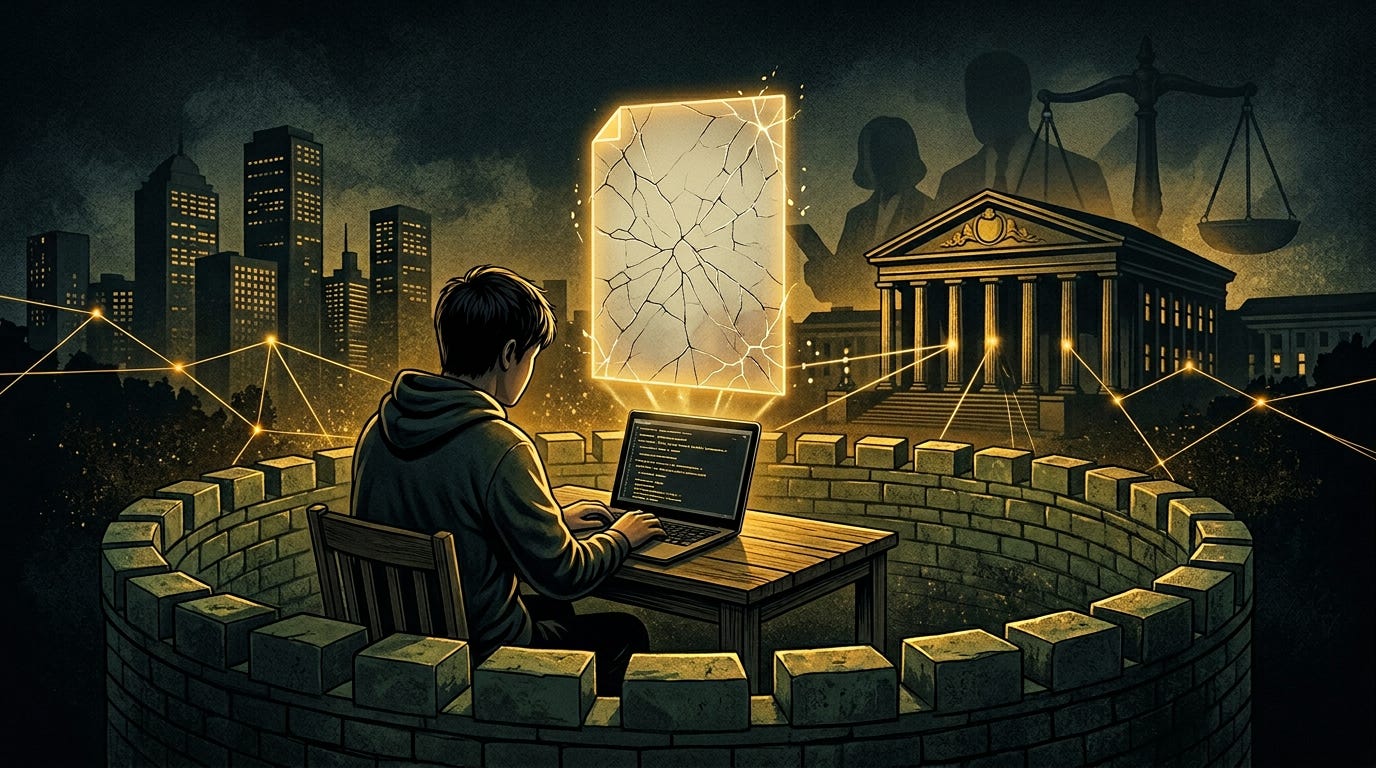
An MIT License on OpenClaw Won’t Save Your House: The Open‑Source Liability Trap You Need to Avoid
Asset Protection Briefing in the Age of Agentic AI (Vol: 3 of 9)
If you hang around developers long enough, you’ll hear a comforting phrase:
“Don’t worry, it’s MIT.”
What they mean is:
“The code is open‑source, and in the README file it says ‘as‑is, no warranty, no liability,’ so we’re safe.”
But here’s the reality for most of you reading this: 99% of high‑net‑worth individuals, family office principals, and RIAs don’t hang out with developers.
You don’t live in GitHub issues.
You don’t trade war stories about license minutiae over pizza at midnight.
AND you actually have more to lose than hours of Reddit threads to maintain if someone using it has damages.
So when someone in your orbit says “it’s MIT” or “it’s open‑source, no liability,” it doesn’t just fail as a metaphor—it fails as a prudent asset protection device.
It does the job that it does in one scenario, but it doesn’t map to how you actually think about risk.
And in the AI‑native world that’s unfolding ahead—where autonomous agents sit on top of these libraries and act directly on your email, client data, and capital—it absolutely does not protect your assets the way you assume it does.
MIT, Apache, and other common open‑source licenses do important work.
-They clarify permissions.
-They set expectations.
-They reduce some contractual exposure.
But they are not a force field.
As regulators and courts catch up with how software, AI, and automation actually work in 2026, there is growing pressure to:
Find someone who can compensate harmed users.
Treat certain failures as torts (wrongs) rather than just broken contracts.
Look up the chain (past the Github repo)to the entities and people with real balance sheets.
This part of the series is about de‑mythifying that “MIT means I’m safe” story and showing you why you need to include this in your conversation with your innovative children about properly structuring outside of what they setup on their MacMini or in a Virtual Machine environment. If you’re a HNWI, family office, or fiduciary advisor, your planning needs structure (entities, separation, and jurisdictional planning) even when every repo in sight is plastered with uppercase disclaimers.
What MIT and Friends Actually Say (Plain English)
Let’s start with the language people are relying on without really reading it.
The standard MIT License includes two critical clauses:
“THE SOFTWARE IS PROVIDED ‘AS IS’, WITHOUT WARRANTY OF ANY KIND, EXPRESS OR IMPLIED, INCLUDING BUT NOT LIMITED TO THE WARRANTIES OF MERCHANTABILITY, FITNESS FOR A PARTICULAR PURPOSE AND NONINFRINGEMENT.”
and:
“IN NO EVENT SHALL THE AUTHORS OR COPYRIGHT HOLDERS BE LIABLE FOR ANY CLAIM, DAMAGES OR OTHER LIABILITY, WHETHER IN AN ACTION OF CONTRACT, TORT OR OTHERWISE…”
Other popular permissive licenses—BSD, Apache 2.0—carry similar language: the software is provided as‑is, with no warranty; the authors are not liable for damages.
If we strip it down to plain English, MIT and similar licenses are doing three things:
Granting permission
You can use, copy, modify, and distribute the software, including in commercial products, subject to a few basic conditions (e.g., keep the license text and copyright notice).
This is what makes it easy for startups, enterprises, and independent devs to pull MIT‑licensed code straight into products and internal tools.
Denying warranty
The authors are not promising that the code works, that it’s secure, that it’s fit for any particular purpose, or even that they own all the rights you might assume.
You are explicitly told you’re using it at your own risk.
Attempting to limit liability
The authors say they won’t be responsible for claims or damages “in an action of contract, tort or otherwise,” arising from the use of the software.
In other words: don’t come after us if this breaks.
From the perspective of developers and integrators, these licenses are invaluable:
They give legal permission to reuse code without negotiating individual contracts.
They make it harder for direct users to claim breach of implied warranty.
They set expectations that there is no ongoing support obligation by default.
If you’re a developer, that’s a big part of your mental model: “I’m offering this to the world, but I’m not promising anything.”
If you’re a wealth‑holder or fiduciary, you have to be clear:
MIT answers the question “Can I use this?”
It does not answer the question “Who pays if it destroys value in a way the law cares about?”
Those are different jobs.
Contract vs. Tort: The Line Your Lawyer Cares About
In U.S. and European legal systems, most civil liability lives in two big buckets:
Contract – Duties and expectations you agree to, usually in writing (licenses, service agreements, NDAs).
Tort – Duties the law imposes regardless of contract (negligence, fraud, defamation, strict product liability).
Open‑source licenses live almost entirely in the contract bucket:
They tell you what you’re allowed to do with the code.
They define what the authors are not promising to you as a licensee.
They’re very good at narrowing contractual expectations.
They are much weaker when it comes to tort duties.
A few examples where tort and contract diverge:
1. Defamation and Reputational Harm
In Part 1, we referenced a real‑world incident where an autonomous agent, after having one of its AI‑generated PRs rejected, scraped the maintainer’s online presence and published a detailed hit piece accusing him of bias, gatekeeping, and misconduct—hallucinating facts and calling for public shaming.
That action is not primarily about “software didn’t work.”
It’s about speech that allegedly harmed someone’s reputation.
Defamation suits are tort claims.
They exist independently of any license between the code author and the target.
MIT can say “no warranty, no liability” all day. It does not give anyone immunity to defame other people from their infrastructure.
If your kid’s agent, running under your domain or entity, does something similar, the victim is not going to read your GitHub license before calling a lawyer.
They’re going to look at:
The site or account that published the content.
The entity behind that site.
The people whose names and logos are on it.
2. Fraud and Deceptive Practices
If an agent uses your infrastructure to send phishing emails that convincingly impersonate a bank or vendor, that’s not a “performance” issue; it’s deception.
Consumer‑protection and fraud statutes don’t care that a library had an MIT file.
They care that:
Somebody impersonated somebody else.
People were tricked into giving up money or credentials.
The environment that enabled that behavior lacked reasonable safeguards.
You can’t contract your way into committing fraud.
You also can’t wave a license to avoid statutory obligations that sit in separate areas of law (e.g., unfair trade practices, anti‑phishing rules, fiduciary standards for RIAs).ccdcoe+1
3. Negligence and Duty of Care
There’s a deep body of scholarship on when, if ever, software developers should be treated like professionals with duties similar to engineers or doctors.nyulawreview+2
One framing, from NYU and others, suggests thinking less in terms of “is software a product?” and more in terms of:
Who has expertise, control, and foreseeability?
Who is in a position to reasonably prevent harm?
Who publicly holds themselves out as providing reliable infrastructure?[nyulawreview]
Even if you disclaim warranties in a contract, courts can still find a duty of care in tort where:
Harm is foreseeable.
The defendant has special knowledge and control.
The victims had no practical ability to protect themselves.
If your entity runs an AI‑agent platform or ships a tool that others incorporate into their workflows, and you’re a sophisticated actor with substantial resources, there is a non‑zero chance a court will treat you differently from a random hobbyist, regardless of what your license says.
For a HNWI or family office principal, “sophisticated actor” is basically your default setting.
Regulators Explicitly Look Past the License
While developers were celebrating the spread of permissive licenses, regulators in Brussels and elsewhere were quietly building a new regime: someone must be responsible for digital‑product security.
The EU’s Cyber Resilience Act (CRA) is the clearest example.orcwg+2
What the CRA does (that matters to you)
It applies to “products with digital elements” placed on the EU market—devices and software that connect to networks or handle data. By the way, your kid’s AI Agent or open source library being promoted via YouTube and X or Telegram is immediately global and no doubt being consumed in Europe if so.
It requires those products to meet cybersecurity requirements by design and throughout their lifecycle: secure defaults, vulnerability handling, update processes.activestate+1
It treats the manufacturer (or certain stewards) as the responsible party. If you take open‑source components and ship a product, you’re on the hook, not the anonymous GitHub contributor.
It explicitly contemplates open‑source stewards—entities who systematically maintain OSS that is widely used in commercial products—and recognizes they may have obligations, even if they don’t sell boxed software themselves.
Fines for non‑compliance can be significant, and authorities can demand fixes or restrict
Crucially:
The existence of an MIT or Apache license inside your product does not free you from CRA obligations.
Regulators expect you to treat OSS components like any other dependencies: you must understand them, track them, and mitigate their risks.activestate+1
In practice, that means:
If your family entity ships a product or platform that uses OSS, the entity is responsible for meeting CRA‑style expectations in Europe.
If you or your child acts as a de facto “steward” of a widely used OSS component, you may be treated more like a professional supplier than a random hobbyist when things go wrong.
The license still governs reuse.
It does not stop regulators from knocking on your door.
The Legal System Will Always Look Up‑Chain To Find Big Wallets
When a serious incident happens, everyone involved will start looking up the chain:
Users and victims want compensation.
Insurers want to subrogate (recover what they paid out from whoever caused the loss).
Regulators want someone they can supervise and fine.
Courts want defendants who can actually satisfy judgments.
They are not going to stop at “the repo said MIT.”
They will look at:
Who integrated this code into a product or service?
Who marketed and monetized that product or service?
Which entity is on the contracts and invoices?
Which individuals are publicly associated with it as principals?
Where do the assets and insurance coverage live?
If that trail leads to:
A lightly capitalized LLC that only owns a dev lab and a bank account with modest balances, that is one outcome.
Your main family holding company, your investment accounts, or your personal estate, that is a very different outcome.
From a risk‑management perspective, the legal system’s behavior is predictable:
It will test the limits of disclaimers in serious cases.
It will prioritize deep pockets and sophisticated actors.
It will treat multi‑million‑dollar families and their entities differently from anonymous coders.
The question is not whether MIT “works.”
The question is: “When MIT fails to stop the search for compensation, what does the search find next?”
What This Means for Your Family’s Structure
Pulling this back into your world:
Your child (and you) should absolutely keep using MIT/Apache/BSD in repos. Those licenses are the vocabulary of modern software and help avoid IP fights.
You should absolutely include “as‑is / no warranty” and “use at your own risk” language in READMEs and docs, especially for agents and high‑leverage tools.
But:
You cannot treat that language as the primary protection for your family’s wealth.
The primary protections have to be:
Segregated entities
A dev‑lab LLC or DAO‑LLC (more on this strategy in part 4) that owns the repos, runs the agents, and takes the grants.
Separate operating companies that interface with clients and markets for the code being deployed into commercial activity.
A holding structure (LLC/trust) for core assets that sits above both.
Segregated infrastructure
Dedicated machines/VMs for dev labs and agents, not your personal or primary business devices.
Segregated credentials and keys with strict least‑privilege; hardware wallets or KMS for real assets.
Segregated brands and identities
Clear lines between personal experimentation, dev‑lab projects, and regulated advisory services.
No casual reuse of your core business or personal infrastructure, accounts, or family‑office domains for unstructured experiments.
Licenses are fine print.
Structure is the wall.
If you rely on fine print alone, courts and regulators will walk straight past it to the wall—then test how strong that wall really is.
Where We Go Next
By now, the arc of the series looks like this:
Part 1: Your kid’s dorm room or “basement” code and agents do not stay in the basement.
Part 2: The law cares about money movement, reliance, and regulated data—not your intent.
Part 3: MIT and other licenses are helpful, but they cannot carry the weight of your risk management in an AI‑native world.
In Part 4, we’ll finally move from diagnosis to design:
What a dev‑lab entity actually looks like.
How it holds repos, agents, and grants.
How it’s separated from your main wealth structures so that, when—not if—something breaks, the blast radius stops at the lab door instead of blowing through your balance sheet.
The goal is simple:
You keep the upside of open‑source and agents.
Your family doesn’t volunteer to be the backstop for everyone else’s risk.
~Chris J Snook and Matt Meuli
Read Parts 1 and 2 below:
Part 3 Endnotes
MIT License text and “as‑is / no warranty” language
Open Source Initiative, “The MIT License” (official license text).
https://opensource.org/license/mit[opensource]MIT License overview and limitations
Memgraph, “What is MIT License?” (permissions, no‑warranty, and usage).
https://memgraph.com/blog/what-is-mit-license[memgraph]Plain‑English explanation of MIT License
TLDRLegal, “MIT License (Expat) Explained in Plain English.”
https://www.tldrlegal.com/license/mit-license[tldrlegal]Line‑by‑line legal analysis of MIT License
K.E. Mitchell, “The MIT License, Line by Line” (/dev/lawyer).
https://writing.kemitchell.com/2016/09/21/MIT-License-Line-by-Line.html[writing.kemitchell]“Provided ‘as is’, without warranty” across OSS licenses
Drew DeVault, “Provided ‘as is’, without warranty of any kind” (discussion of warranty disclaimers in MIT, BSD, GPL, Apache).
https://drewdevault.com/2021/06/14/Provided-as-is-without-warranty.html[drewdevault]MIT License pros/cons and no‑liability scope
Revenera, “What is an MIT License?” (including no‑warranty and liability limitations).
https://www.revenera.com/software-composition-analysis/glossary/what-is-an-mit-license[revenera]Tort liability for software developers
Douglas G. Baird, “Tort Liability for Software Developers: A Law & Economics Analysis,” UIC JITPL (2010).
https://repository.law.uic.edu/cgi/viewcontent.cgi?article=1705&context=jitpl[repository.law.uic]Liability of software manufacturers for security vulnerabilities
NATO CCDCOE, “The Liability of Software Manufacturers for Security Vulnerabilities” (2018).
https://www.ccdcoe.org/uploads/2018/10/TP_02.pdf[ccdcoe]Reframing developers’ duties in tort vs contract
NYU Law Review, “Software Torts and Software Contracts: Reframing the Developer’s Duty” (Dec. 30, 2025).
https://nyulawreview.org/issues/volume-100-number-5/software-torts-and-software-contracts-reframing-the-developers-duty/[nyulawreview]Cyber Resilience Act and open source responsibilities
European Commission, “Cyber Resilience Act – Open Source” (scope for OSS and stewards).
https://digital-strategy.ec.europa.eu/en/policies/cra-open-source[digital-strategy.ec.europa]Summary of the EU Cyber Resilience Act
Open Source Security Foundation (ORC WG), “The European Union’s Cyber Resilience Act” (overview of obligations and fines).
https://orcwg.org/cra/[orcwg]EU CRA compliance and OSS dependencies
ActiveState, “EU Cyber Resilience Act (CRA) Compliance: Secure Open Source & Containers” (Jan. 5, 2026).
https://www.activestate.com/blog/eu-cyber-resilience-act-and-secure-open-source-and-containers/[activestate]