Artificial Intelligence + Actionable Intelligence = Actual Intelligence
From Tokens to Trust: Measuring Wealth in the Intelligence Economy
TL:DR Takeaways of this 6,000-word Sunday Brief
Artificial Intelligence + Actionable Intelligence = Actual Intelligence
Actual Intelligence + Trust = Appreciating Assets
Every Token Ultimately Rests on Atoms.
Every Economy Ultimately Rests on Trust.
Every Future Ultimately Rests on Human Agency.
Section I: From Tokens to Trust
Why You Should Read/Listen to the Full Piece
If you’re anything like me, you’ve probably spent the last two years experiencing a strange combination of excitement and unease.
Every day seems to bring another headline announcing a breakthrough in artificial intelligence. Entire industries are being told they will be transformed. Investors are pouring hundreds of billions of dollars into infrastructure. Governments are racing to secure semiconductor supply chains. Data centers are appearing across the landscape. Every company suddenly claims to be an AI company. Every startup deck seems to include the letters AI somewhere on the first page.
Meanwhile, ordinary people are left wondering what any of it actually means.
What does it mean for your job?
What does it mean for your children?
What does it mean for your business?
What does it mean for your retirement?
What does it mean for your portfolio?
What does it mean for the country?
And perhaps most importantly, how do you separate signal from noise in a world where everyone seems certain about a future nobody can actually predict?
I have found myself asking many of those same questions.
Not because I fear technology. Quite the opposite. My career has largely been built around studying technological disruption and helping organizations navigate periods of rapid change. But experience has taught me that the biggest risks rarely come from the technology itself. They come from misunderstanding the system surrounding the technology.
We often become so fascinated by the invention that we fail to notice the incentives, assets, institutions, infrastructure, and human behaviors that determine whether the invention ultimately creates prosperity or destroys it. After recent interviews I did with Roger Ohan and Charlie Garcia I dove deeper into my own frameworks and reconsidered what it means to my readers and me in a parallel sense-making synthesis of the implications.
That is why I believe the most important question surrounding artificial intelligence is not how smart the machines become.
The most important questions are how we measure the impact they (bits) have and how we invest in their insatiable appetite for physical resources (atoms).
Because if we are using the wrong scoreboard, we may be optimizing for outcomes that ultimately make us weaker rather than stronger.
And that realization has led me down a path that connects artificial intelligence, token economies, energy infrastructure, human agency, trust, national wealth, and one deceptively simple question:
If GDP is no longer the right scoreboard, what is?
The Chart That Made Me Stop
A few weeks ago, I was reviewing a collection of technology adoption metrics when I came across a chart tracking software development activity on GitHub.
The curve looked almost absurd as 2026 was on pace to achieve 14B (not in the historical chart below).
GitHub COO Kyle Daigle noted that GitHub activity had accelerated to roughly 275 million commits per week in early 2026, highlighting how rapidly AI-assisted software development is expanding. Author Note: If this current pace continues it would almost triple the volume of 2025 by end of this year. Source
Commits, repositories, contributions, and developer activity were all accelerating. At first glance, it looked like another technology chart. We’ve all become numb to exponential curves.
But the longer I looked at it, the more interesting it became. Because the chart wasn’t really measuring software. It was measuring something deeper.
It was measuring the conversion of intelligence into action. Every commit represents an idea transformed into a system. Every deployment represents knowledge becoming utility. Every repository represents accumulated problem-solving capacity.
In many ways, GitHub has become one of the world’s largest living records of human and increasingly artificial intelligence being translated into executable action.
That distinction matters.
For most of human history, intelligence was scarce. Every calculation originated in a human brain. Every design originated in a human brain. Every innovation originated in a human brain.
Today, we are entering a world where intelligence itself is becoming abundant. That abundance changes everything.
And it led me to a simple equation that has increasingly become the lens through which I view the next decade.
The Three AI’s
1) Artificial Intelligence + 2) Actionable Intelligence
= 3) Actual Intelligence
At first glance, it sounds like wordplay. It isn’t. The rest of this piece will attempt to prove this thesis to you as I have done to myself thus far.
In fact, I believe that simple equation above may be one of the most important economic equations of the coming decade.
Artificial intelligence by itself is merely potential.
It is capability. It is possibility. It is latent power waiting to be directed.
Actionable intelligence is something different. Actionable intelligence is intelligence guided by purpose and put to purpose.
It is intelligence directed toward an outcome. It is where judgment enters the system. It is where trust enters the system. It is where human agency enters the system.
And when artificial intelligence is combined with actionable intelligence, something entirely different emerges.
Actual intelligence.
Actual intelligence is intelligence that produces desired outcomes.
Not possibilities. Not predictions. Not simulations.
Outcomes.
This distinction will become increasingly important as we move deeper into the Intelligence Economy. Because abundance changes what is scarce. And scarcity determines value.
My Front Row Seat to the Token Economy
Long before artificial intelligence became the dominant topic of conversation, I found myself captivated by another question 15 years ago.
What happens when value becomes programmable?
That question eventually led me into one of the most fascinating periods of my professional life.
Between 2017 and 2020, I had the opportunity to help convene some of the earliest global conversations surrounding tokenization, digital ownership, incentive design, and emerging economic systems through the World Tokenomic Forum.
What started as a side project fueled by a kitchen table conversation with my co-author Travis Wright in Grand Cayman following a book signing event in October 2017, evolved into something much larger.
The conversations took us from Grand Cayman to Vilnius, Lithuania. From Hong Kong to Laramie, Wyoming, between 2017-2021 despite Covid’s plans thwarting much more in the 2020-2021 period.
Along the way, I met entrepreneurs, regulators, economists, software architects, investors, futurists, policymakers, and academics, all wrestling with a similar challenge.
How do you create systems that coordinate value in a digital world while the majority of value still transacts in an analog legal precedent?
At the time, most people viewed tokens through a very narrow lens. They saw cryptocurrency. Speculation. Price charts. Volatility. Scam after scam, etc.
Those things certainly existed. But they were never the most interesting part of the story to me. The deeper thinkers understood that tokens were not really about cryptocurrency. Tokens were real. Tokens were containers. Tokens were about coordination. Token economies were about incentives. Tokens were about ownership. Tokens were about trust. Tokens were about utility. And these tokens were now fully programmable.
Looking back now, many of those conversations feel less like predictions and more like early reconnaissance missions into a future that is arriving slower than the early minority expected, but suddenly for the rest of society.
One of the most influential thinkers I encountered during that journey was Mickey McManus, co-author of Trillions.
Years before AI became a household topic, Mickey and his co-authors were exploring what happens when computation becomes pervasive and the impacts it has on the “built” world of atoms.
Their central insight was profound. As compute becomes embedded everywhere, intelligence becomes ambient.
We stop interacting with computers. We begin living inside computational environments. At the time, that sounded futuristic.
Today it feels increasingly obvious.
Large language models, autonomous agents, ubiquitous sensors, and AI-enhanced systems suggest we are rapidly moving toward a world where intelligence itself becomes part of the infrastructure layer of society.
Looking back, those conversations were not merely about technology. They were about economics. They were about incentives. They were about trust. And ultimately, they were about human behavior.
What Most People Get Wrong About Tokens
One of the biggest misunderstandings today is the word “token” itself. People hear the term and immediately think of cryptocurrencies. Bitcoin. Ethereum. Memecoins. Stablecoins. Speculative assets.
That association is understandable. But it is also limiting. Because tokens existed long before blockchains. In fact, most of us used tokens as children.
Remember arcade tokens?
You walked into the arcade carrying dollars. Those dollars worked almost everywhere. Inside the arcade, however, you exchanged those dollars for tokens. Those tokens had no inherent value outside of those four walls.
Their value came from what they unlocked.
Pac-Man.
Donkey Kong.
Galaga.
The token was simply a container. The utility lived inside of it.
The same thing happened at laundromats. You exchanged quarters for specialized tokens. Those tokens unlocked washing machines. They unlocked drying machines. Again, the token itself wasn’t the value. The token was simply the container that represented access to value.
Once you understand this distinction, the entire digital economy begins to look different. Airline miles are tokens. Hotel points are tokens. Gift cards are tokens. Property deeds are tokens. Stock certificates are tokens. Driver’s and hunting/fishing licenses are tokens. Membership cards and Substack subscriptions are tokens.
Money itself is arguably a token representing a claim on economic value, or in the case of the last 55 years (since 1971), a pure fiat piece of paper with George Washington’s face on it, that is merely a tokenized unit of the national debt, in circulation, owed to the Federal Reserve Bank, functioning as official legal tender to settle your transactions in the USD hegemonic global economy.
The digital economy allows us to create, transfer, program, and coordinate these containers at unprecedented scale and speed. The hyper-emergent token economy is not replacing the physical economy.
It is creating a second operating system on top of it.
Atoms remain below.
Bits that operate above.
Tokens become the containers through which value moves between these two layers at light speed 24/7/365.
This realization eventually led me to another conclusion that I believe is becoming increasingly important.
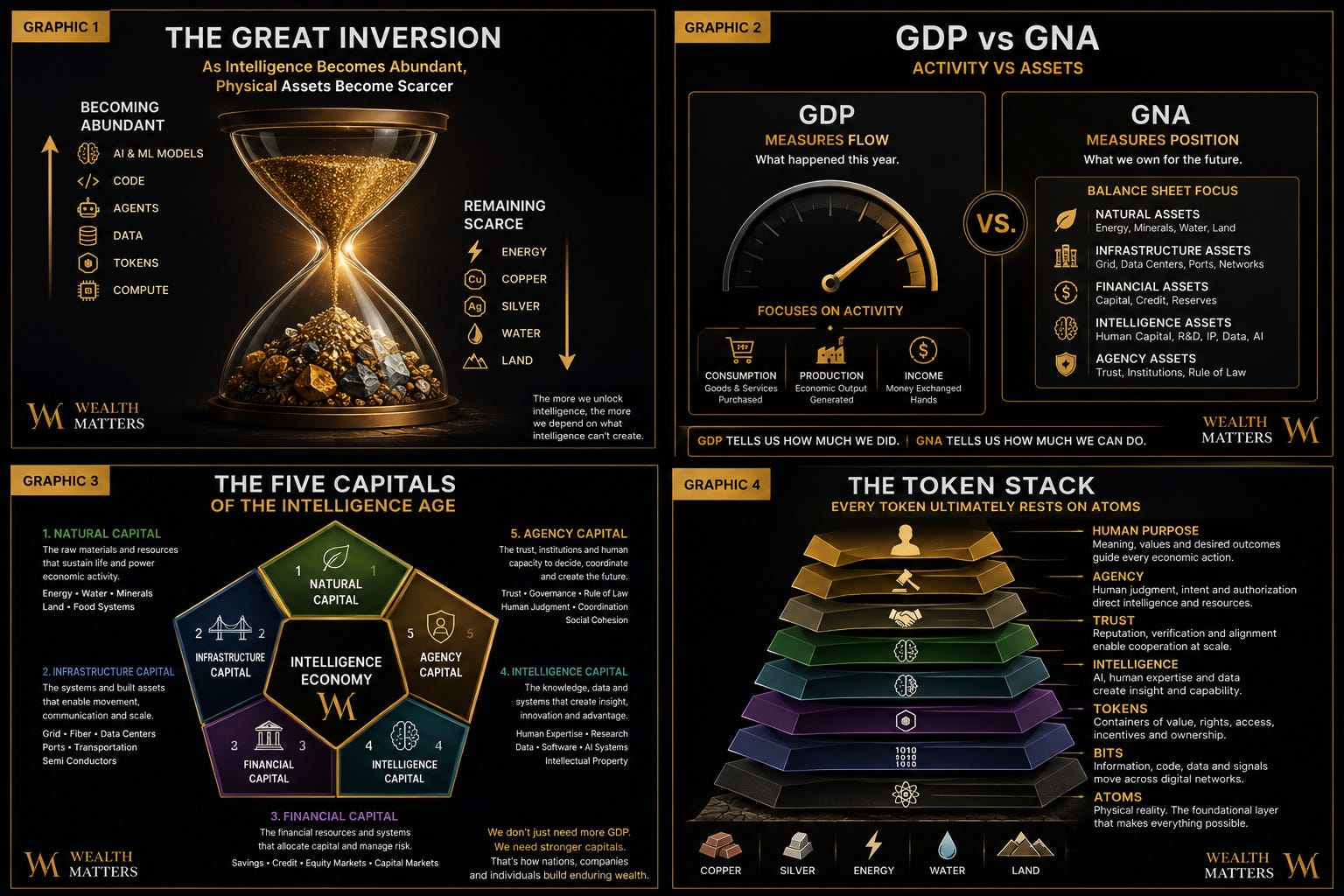
Every token ultimately rests on atoms, which are still governed by the laws of physics. And every economy ultimately rests on both physics and the existence of trust between counterparties.
That realization became the bridge to a much bigger question.
If intelligence is becoming abundant, and tokens are increasingly becoming the containers through which value moves, what assets become more valuable rather than less valuable?
To answer that question, we need to leave the digital world for a moment and return to the physical one in Section II.
Because despite all the excitement surrounding artificial intelligence, the future remains firmly anchored in something surprisingly old-fashioned.
Atoms.
Before you enjoy the remaining two sections for “free” I have 4 simple requests if you have gotten value from this thus far.
Share this post and publication with your network and friends.
Leave a comment/Join the conversation and bring it to life.
Upgrade from guest to “subscriber” to unlock free posts each week like this as well as all of the ATOMIQ LEVEL livestream articles and featured guests from the best in finance, tech, and business on Substack and beyond.
If that is already you, then upgrade today to “paid” For less than the cost of a 1/2 tank of gas in California ($59/year), you can receive all the specific playbooks for asset protection, estate and legacy planning, recommended jurisidiction strategy for your situation, the names, advisory open office hours weekly with our Shields & Succession column and whatever I come up with next to bring you the most “actionable intelligence that I can.
Now, it’s time to go back to your regularly scheduled programming.
Section II: The Great Inversion
More than a century ago, Henry Ford famously observed:
“Thinking is the hardest work there is, which is probably the reason so few engage in it.”
At the time, the statement reflected the realities of the industrial economy. Physical labor was abundant. Machines were becoming increasingly capable. Factories were scaling production. Yet genuine thinking—the ability to reason, solve problems, make decisions, imagine alternatives, and allocate resources—remained scarce.
Thinking was hard because it was limited to human beings, who were also limited by their access to knowledge and literacy at scale. Every innovation required a human mind. Every strategy required a human mind.
Every design required a human mind. Every meaningful decision required a human mind. For most of modern economic history, thinking was among the scarcest resources available to civilization.
Fast forward more than one hundred years to today, and NVIDIA CEO Jensen Huang recently offered an observation that sounds remarkably similar, yet comes from the exact opposite direction.
Discussing artificial intelligence infrastructure, Huang noted that:
“Inference (machine thinking) is the most expensive workload.”
As Charlie Garcia wrote this week, this was the thing about the AI boom that all of the smart money got wrong in the early wave of capital allocation when they thought that “training” was the more expensive “input”.
For those unfamiliar with the terminology, inference is the process of an AI system actually “thinking” through a problem and generating an answer.
Training teaches the model. Inference puts that training to work.
Training creates capability. Inference creates utility.
Training is potential. Inference is action. And action is expensive.
The more I reflected on the juxtaposition of Ford’s legendary observation and Huang’s visionary one, the more I realized they may collectively describe one of the most important economic transitions in human history.
Ford was describing a world where thinking was the hardest work humans could do.
Huang is describing a world where thinking is becoming the most expensive work machines can do.
Read that again.
For over a century, human beings were the primary producers of intelligence. Today, we are building systems capable of producing intelligence at scale.
That shift changes everything.
Not because machines are replacing humans. But because intelligence itself is transitioning from scarcity toward abundance.
And whenever something abundant replaces something scarce, the entire value structure surrounding it begins to change.
The Age of Abundant Intelligence
For most of the industrial era, economic systems were organized around scarce intelligence and relatively abundant physical resources.
The challenge was finding enough skilled people to transform raw materials into productive output.
Capital flowed toward labor. Labor transformed resources. Resources became products. Products generated economic activity. GDP became the scoreboard.
That framework made sense because intelligence was constrained by population. There were only so many engineers. Only so many scientists. Only so many analysts. Only so many entrepreneurs.
Only so many people were capable of solving difficult problems. Artificial intelligence changes that equation.
For the first time in history, we are creating systems capable of generating analysis, recommendations, software, designs, simulations, forecasts, and increasingly complex decisions at a scale unimaginable even a decade ago.
The implications are profound. Intelligence is no longer constrained solely by population growth. It is increasingly constrained by infrastructure.
That distinction may prove to be one of the most important investment insights of the next decade. Because as intelligence becomes abundant, something else becomes scarce.
And scarcity is where value accumulates asymmetrically.
Why Atoms Still Matter
This is where many futurists and tech bros lose the plot, in my humble opinion. The popular narrative suggests that artificial intelligence somehow liberates us from the physical world.
The opposite may be true. Artificial intelligence is not replacing atoms, it is consuming them.
Every AI prompt requires electricity. Every inference requires compute. Every compute cycle requires semiconductors. Every semiconductor requires fabrication facilities. Every fabrication facility requires land, water, chemicals, energy, and specialized materials. Every data center requires copper. Every transformer requires copper. Every transmission line requires copper. Every cooling system requires water. Every backup system requires fuel. Every server rack requires steel, aluminum, concrete, and real estate.
The cloud is not floating in the sky. The cloud is sitting on a human’s, company’s, or nation’s balance sheet. And that balance sheet is made of atoms.
One of the biggest misconceptions of the AI era is the assumption that digital abundance somehow eliminates physical scarcity.
It does not.
In many ways, it amplifies it. Every token eventually touches an atom. Every bit ultimately rests upon infrastructure. Every intelligence transaction consumes physical resources somewhere. The intelligence economy is not escaping the laws of physics. It is becoming increasingly dependent upon them.
As investors, we should pay close attention whenever a technological revolution increases demand for foundational resources and capital.
History repeatedly shows that the greatest fortunes are often built not only by the companies creating the new technology, but also by those controlling the infrastructure beneath it.
The railroads enriched rail operators, but also steel producers, coal suppliers, equipment manufacturers, and landowners.
The automobile revolution enriched car companies, but also energy producers, road builders, insurers, and logistics networks.
The internet enriched software companies, but also fiber providers, semiconductor manufacturers, and network infrastructure operators.
Artificial intelligence appears poised to follow the same pattern.
The Great Inversion
This realization led me to what I now call The Great Inversion.
Historically, intelligence was scarce, and physical resources were abundant. Today, intelligence is becoming abundant while the assets required to support intelligence are becoming increasingly strategic.
The more intelligence we create, the more energy we consume. The more agents we deploy, the more compute we require. The more automation we build, the more infrastructure we need. The more digital value we create, the more physical systems must support it.
This inversion changes how we think about value creation. The future will not be won solely by those who create intelligence. The future may belong to those who own the assets intelligence requires to operate.
Energy.
Copper.
Water.
Land.
Compute infrastructure.
Semiconductor manufacturing.
Transmission capacity.
Data centers.
And perhaps most importantly, trust.
This is the inversion that too few people are discussing. As intelligence becomes abundant, the physical and institutional assets supporting intelligence become increasingly valuable.
The more valuable intelligence becomes, the more valuable its dependencies become. The more valuable its dependencies become, the more important balance sheets become.
Which brings us directly to the problem with GDP.
The Scoreboard We Inherited
Gross Domestic Product is one of the most influential economic measurements ever created.
For decades, it has served as the primary scorecard used by governments, economists, investors, and policymakers to evaluate economic performance.
GDP measures activity. (How much was produced? How much was consumed? How much was spent? How much changed hands?)
It was an extraordinary innovation for the industrial era because industrial economies were largely organized around production.
Factories produced goods. Workers produced output. Consumers purchased products. Governments measured the resulting economic activity.
The framework worked because most value creation was visible and tangible.
You could count automobiles. You could count homes. You could count factories. You could count steel production. You could count economic output.
But as economies become increasingly digital, automated, tokenized, and intelligent, GDP begins to reveal its limitations. Imagine an AI system that enables a company to accomplish in one hour what previously required ten employees working all week.
Has value been created? Almost certainly.
Has productivity increased? Absolutely.
Has the total capability improved? Without question.
Will GDP necessarily capture all of that value? Not always.
In some cases, GDP could actually appear weaker because fewer labor hours, fewer transactions, or lower operating costs are involved.
The measurement system begins to struggle because the nature of value creation itself is changing. This doesn’t make GDP wrong.
It simply makes GDP incomplete.
And incomplete scoreboards often produce incomplete decisions.
Roger Ohan and the GDP Problem
One of last week’s most thought-provoking conversations that I have had was with Roger Ohan on the ATOMIQ LEVEL (see the “Sources” section for the link). Roger introduced his GNA framework that immediately resonated with me because it addressed something I had been wrestling with for years.
GDP measures activity. But activity is not wealth. Activity is not resilience. Activity is not optionality. Activity is not strategic strength.
Activity is a flow. Wealth is a stock.
Those are fundamentally different concepts.
Imagine two nations.
Nation A generates extraordinary GDP growth through borrowing, consumption, and short-term economic activity.
Nation B grows more slowly but steadily accumulates energy assets, infrastructure, intellectual property, educational advantages, water security, technological capabilities, and strategic resources.
Under traditional GDP analysis, Nation A may appear stronger.
But under a balance sheet framework, Nation B may actually be building a more durable foundation for future prosperity.
This distinction becomes increasingly important as intelligence becomes an economic asset. Artificial intelligence is not merely another technology.
It is a force multiplier.
And force multipliers amplify whatever foundation exists beneath them. A nation with abundant energy, strong institutions, trusted markets, educated citizens, robust infrastructure, and strategic resources may experience enormous gains from AI adoption.
A nation lacking those foundations may discover that intelligence alone is insufficient.
Because intelligence is not self-sustaining. Intelligence must be fed. And what feeds intelligence increasingly looks like a balance sheet problem rather than a GDP problem.
The Five Capitals of the Intelligence Age
As I continued exploring these ideas through conversations with investors, economists, entrepreneurs, technologists, and policymakers, I found myself searching for a framework capable of capturing the broader picture.
The result is still evolving, but increasingly, I believe the Intelligence Economy can be understood through five interconnected forms of capital.
Natural Capital: includes energy resources, water systems, minerals, agricultural capacity, ecosystems, and land. Every economic system ultimately rests upon the natural world. These assets often sit quietly beneath daily life, yet they remain foundational to everything else. (I suggest you read and follow MAATTR on Substack and listen to the ATOMIQ LEVEL interview we did months back for more on his emergent natural capital asset class framework)
Infrastructure Capital: includes power grids, data centers, fiber networks, transportation systems, logistics networks, ports, communications systems, and semiconductor manufacturing capacity. Infrastructure determines how effectively resources can be transformed into productive activity.
Financial Capital: includes savings, credit systems, equity markets, debt markets, reserves, liquidity, and capital allocation mechanisms. Financial capital determines how efficiently opportunities can be funded and risks can be absorbed.
Intelligence Capital: includes human expertise, research institutions, intellectual property, software, data assets, artificial intelligence systems, and accumulated knowledge. Intelligence capital increasingly drives competitive advantage.
The fifth and perhaps most underappreciated is Agency Capital.
Agency Capital consists of trust, governance, reputation, property rights, institutional legitimacy, rule of law, social cohesion, and human decision-making capacity.
Agency Capital determines whether societies can coordinate effectively. It determines whether individuals trust institutions. It determines whether capital can be deployed confidently. It determines whether intelligence can be converted into action.
And that is where our equation reconnects.
Artificial Intelligence + Actionable Intelligence = Actual Intelligence.
Actionable intelligence is where Agency Capital enters the system.
Human judgment. Human values. Human accountability. Human purpose.
These are not side effects. They are prerequisites. Because intelligence without direction is merely noisy chaos. Only when intelligence is combined with agency does it become capable of producing meaningful outcomes. And only when meaningful outcomes are trusted do they become durable sources of wealth. This is why you should also tune into the ATOMIQ LEVEL conversation in the “Sources” that I had with Michael J. Casey, on the role human agency must play in this unfolding future if we are to get it “right”.
This realization may ultimately be the bridge between Roger Ohan’s Gross National Assets framework and the future of artificial intelligence, and the roadmap to both value creation within your portfolio and the net happiness quotient that is unique to the human experience we all crave to see persist.
The economies that win the next decade may not be the ones generating the most activity. They may be the ones most effectively compounding all five forms of capital simultaneously.
Which raises perhaps the most important question of all.
In a world where intelligence is becoming abundant, what remains uniquely human?
Section III: The Human Agency Premium
You are still here! Bless you for sticking with this piece, or for coming back to it after some needed mental digestives.
If Section I was about understanding the emergence of the token economy, and Section II was about understanding why the physical world matters more than many people realize, then this final section is ultimately about understanding the one asset that may become more valuable than all the others combined.
The human being.
That statement may sound strange inside an article focused on artificial intelligence. Yet the deeper I have gone down this rabbit hole over the past decade, the more convinced I have become that the future is not primarily a story about machines.
Like all great moments across history. It is a story about people.
More specifically, it is a story about what happens when billions of humans suddenly find themselves surrounded by trillions of digital entities capable of producing intelligence, coordinating action, making recommendations, conducting transactions, and interacting with one another at speeds and scales never before witnessed. What McManus et al profoundly described as “thriving in the emerging information ecology.”
Because that is the future that is emerging. And I believe most people are dramatically underestimating how different that world may look.
The Population Explosion Nobody Is Talking About
When economists discuss population growth, they typically focus on humans.
Birth rates. Demographics. Immigration. Labor participation. Dependency ratios. These metrics have mattered because, for most of history, every productive unit of intelligence originated from a human being.
A company with one hundred employees effectively had one hundred units of productive intelligence.
A nation with one hundred million citizens had one hundred million sources of intelligence. The size of the population largely determined the upper limits of economic output.
Artificial intelligence changes that relationship. Over the next decade, it is entirely possible that every individual will be supported by dozens, hundreds, or even thousands of specialized AI agents operating on their behalf. Some will negotiate. Some will research. Some will transact. Some will write. Some will analyze. Some will monitor. Some will coordinate. Some will educate. Some will sell. Some will buy. Many will communicate directly with other agents.
The result is that the population of non-human intelligence may soon exceed the population of biological intelligence by orders of magnitude.
Humanity may be entering the first era in history where intelligence itself is no longer constrained by the number of people alive.
That reality has profound implications.
Because whenever something becomes abundant, something else becomes scarce. And scarcity determines value.
The Scarcity Shift
For centuries, intelligence was scarce. Today, intelligence is becoming abundant. The question investors should be asking is simple:
What becomes scarce next?
The answer, I believe, is human agency. This is where my conversation with Michael Casey, mentioned earlier, became particularly illuminating.
Michael has spent years exploring the intersection of technology, decentralized systems, economics, governance, and human freedom. Throughout our discussion, one theme repeatedly surfaced.
The future is not fundamentally a contest between humans and machines. The future is a contest over agency.
Who decides?
Who directs?
Who authorizes?
Who is accountable?
Who determines the objective?
Who determines what success looks like?
These questions become more important as intelligence becomes easier to produce. Because intelligence alone does not determine outcomes. Direction determines outcomes. Purpose determines outcomes. Values determine outcomes. Agency determines outcomes.
And agency remains profoundly human. At least for now.
The irony of the Intelligence Economy is that as intelligence becomes abundant, judgment becomes scarce. As answers become abundant, wisdom becomes scarce.
As automation becomes abundant, responsibility becomes scarce. As agents become abundant, purpose becomes scarce. This is why I increasingly believe that human agency may become one of the most valuable assets on Earth.
Not because humans are smarter than machines. But because humans remain the source of purpose. For now and the foreseeable future.
Why Actionable Intelligence Matters
This is precisely why I have become increasingly attached to the equation introduced earlier in this article.
Artificial Intelligence + Actionable Intelligence = Actual Intelligence
The reason this equation matters is because the majority of recent or mainstreeam AI discussions stop at artificial intelligence. They assume intelligence itself is the destination.
It isn’t.
Artificial intelligence creates possibilities. Actionable intelligence determines which possibilities deserve action. Actual intelligence creates outcomes.
That middle layer is where human beings continue to play an indispensable role. Actionable intelligence is not simply information. It is judgment. It is context. It is prioritization. It is values. It is deciding what matters. It is deciding what doesn’t.
It is determining what future is worth pursuing. In practical terms, actionable intelligence is where human agency enters the system. Without agency, artificial intelligence remains potential.
With agency, artificial intelligence becomes productive. Without agency, intelligence generates options. With agency, intelligence generates outcomes.
The winners of the next decade may not be those who possess the most artificial intelligence. They may be those who most effectively combine artificial intelligence with human judgment.
Digital Sense and the Human Experience
This conclusion brings me full circle over the past decade and back to the book I co-authored with Travis Wright.
When Digital Sense was published by Wiley in 2017, artificial intelligence was nowhere near the center of public conversation that it occupies today.
Yet one of the central themes of the book feels even more relevant now than it did then.
Technology changes. Human nature does not. Platforms change. Human psychology does not. Tools evolve. Human motivations remain remarkably consistent.
One of the observations we explored throughout the book was that as products become commoditized and information becomes ubiquitous, customer experience increasingly becomes the primary differentiator that drives the premium a brand can demand in the marketplace.
Companies can copy features. They can copy pricing. They can copy functionality.
What becomes increasingly difficult to copy is the relationship a brand establishes with its customers. At the time, we were writing about digital transformation, social media, customer engagement, and emerging technologies.
What we did not fully appreciate was how relevant those ideas would become in the Intelligence Economy. Because, the rise of artificial intelligence does not eliminate the importance of customer experience. It amplifies it.
The Human Customer and the Agentic Customer
And more than that, it now requires design thinking around the parallel Agentic customer journey as well as the human customer journey. For the first time in history, businesses find themselves serving two distinct customer populations simultaneously.
Human customers. And agentic customers.
The human customer wants empathy, reliability, simplicity, and expects speed, less friction, and personalization.
The human customer wants confidence and value for their money. The human customer wants understanding. The human customer wants reassurance. The human customer wants to feel seen and heard. The human customer wants trust.
However, The agentic customer wants something entirely different.
The agentic customer wants access. The agentic customer wants APIs. The agentic customer wants permissions. The agentic customer wants machine-readable information. The agentic customer wants efficiency. The agentic customer wants outcomes.
Today, nearly every company is designed around the human customer experience, and has barely caught up to the implementation of that in their digital transformation efforts across the silos.
Tomorrow’s companies will need to design for both. This creates a fascinating challenge and a massive “leap-frog” opportunity, because agentic customers will likely outnumber human customers by an order of magnitude in the coming decade. Every individual may have dozens, hundreds, or even thousands of agents acting on their behalf. Examples include:
Agents researching investments.
Agents evaluating healthcare providers.
Agents comparing insurance products.
Agents booking travel.
Agents negotiating contracts.
Agents managing subscriptions.
Agents purchasing products.
Agents coordinating workflows.
Many transactions that currently occur between humans may increasingly occur between agents. Customer experience itself is about to bifurcate. There will be a Human Customer Experience. And there will be an Agentic Customer Experience.
The companies that thrive will likely excel at both. They will build systems that allow agents to transact efficiently while simultaneously preserving the human trust that makes those transactions meaningful. This is not an either-or proposition.
It is a both-and proposition.
Because while agentic customers may become numerically dominant, human customers remain economically and emotionally supreme.
The agent may execute the transaction. The human still owns the objective.
The agent may compare the products. The human still assigns the value.
The agent may negotiate the price. The human still determines what matters.
This distinction becomes critically important because many organizations may become tempted to optimize exclusively for the machine.
History suggests that would be a mistake.
The greatest brands of the next decade may not be those that build the most efficient agent interfaces. They may be those who best understand the human being sitting behind those agents.
The empathy map does not disappear. It becomes more valuable.
The relationship does not disappear. It becomes the scarcest asset.
The trust equation does not disappear. It becomes more important.
Because even in an economy increasingly populated by artificial agents, the final measure of success remains deeply human. Someone still has to care. Someone still has to trust. Someone still has to choose. And that someone is still a person.
The Trust Layer
There is another scarce resource emerging alongside agency.
Trust.
In many ways, trust may become the most valuable economic asset of the Intelligence Age.
The reason is simple:
When information becomes abundant, verification becomes scarce.
When content becomes abundant, credibility becomes scarce.
When intelligence becomes abundant, trust becomes scarce.
The internet dramatically increased the amount of information available to humanity. Artificial intelligence is dramatically increasing the amount of intelligence available to humanity. Both developments create extraordinary opportunities. Both developments also create extraordinary noise.
The challenge is no longer obtaining information. The challenge is determining which information deserves confidence.
The challenge is no longer obtaining intelligence. The challenge is determining which intelligence deserves action.
Trust becomes the filter. Trust becomes the coordination mechanism.
Trust becomes the infrastructure. Trust becomes the bridge between intelligence and action.
What makes this challenge even more important is that we are entering the Intelligence Age at a moment when trust is already under extraordinary pressure.
The 2025 Edelman Trust Barometer described the current environment as a global “Crisis of Grievance,” finding that economic fears have evolved into widespread distrust of institutions, leadership, and information itself. Roughly six in ten respondents across 28 countries reported moderate-to-high levels of grievance, driven by a belief that government, business, and other institutions increasingly serve narrow interests while ordinary people struggle. Perhaps most troubling, seven in ten respondents believe leaders regularly mislead the public through exaggeration or falsehoods.
Think about what that means in the context of artificial intelligence.
If trust is already fragile in a world dominated by human-generated information, what happens when the volume of machine-generated content, analysis, recommendations, and synthetic media expands by orders of magnitude?
The challenge is no longer finding answers. The challenge is knowing which answers deserve trust. THAT IS WHY WE SUBSTACK. This is why I put my energy into thr long form conversation here. This is why your comments matter to EVERY discussion!
The challenge is no longer accessing intelligence. The challenge is determining which intelligence deserves action. This realization has profound implications for investors, businesses, institutions, and families.
Because trust compounds. Just like capital compounds.
In fact, trust may prove to be the highest-return asset on the balance sheet of the Intelligence Economy. The organizations that consistently earn trust will attract attention.
Attention will attract relationships. Relationships will attract opportunities. Opportunities will attract capital. And capital, when deployed intelligently, compounds.
This is one reason the Edelman research continues to find that people place more trust in their direct employer than in virtually any other major institution. In an era defined by uncertainty, people increasingly anchor themselves to relationships and organizations that demonstrate competence, transparency, and accountability.
In a world increasingly filled with synthetic intelligence, trusted human relationships may become even more valuable than they are today.
Not less. More.
Because trust is what transforms information into belief. Belief into action. And action into lasting value.
Actual Intelligence Plus Trust
As I continued connecting these dots, another equation emerged.
Actual Intelligence + Trust = Appreciating Assets.
This may be the most important equation in the entire article. Because intelligence alone does not create wealth. Execution alone does not create wealth. Technology alone does not create wealth.
What creates wealth is the consistent conversion of intelligence into trusted outcomes.
Trusted outcomes create confidence. Confidence attracts capital. Capital funds innovation. Innovation creates productivity. Productivity creates wealth. Wealth creates optionality. Optionality creates resilience. And resilience creates the capacity to endure uncertainty. That entire cycle depends upon trust. Without trust, the system breaks down. Without trust, transactions become more expensive. Without trust, coordination becomes more difficult. Without trust, intelligence loses value.
The economies that understand this principle may gain a significant advantage in the years ahead.
The Race to Own the Future
This brings us back to Roger Ohan‘s framework and the concept of Gross National Assets, and all of the recent complementary analysis by the unbelievably prolific mind of Charlie Garcia in his last 4 posts.
If GDP measures activity, then GNA attempts to measure capacity.
GDP asks: How much happened?
GNA asks: What do we own?
GDP asks: What was produced?
GNA asks: What can be produced tomorrow?
GDP measures flows. GNA measures foundations.
The distinction becomes increasingly important as artificial intelligence reshapes the global economy. Because the future may not belong to the countries generating the most activity. The future may belong to the countries accumulating the strongest asset base. Energy. Infrastructure. Natural resources. Human capital. Intelligence capital. Trust capital. Agency capital.
The Five Capitals framework is ultimately an attempt to measure these foundations. And what is true for nations is equally true for businesses, families, and individuals.
The question is not simply how much income you generate. The question is what assets you are accumulating.
The question is not simply how much activity you create. The question is whether your capabilities are compounding.
The question is not simply whether you are adopting AI. The question is whether AI is helping strengthen your balance sheet.
Because artificial intelligence can amplify strengths. It can also amplify weaknesses.
And force multipliers are unforgiving.
Why Wealth Matters 3.0 Exists
As I look back on the journey from co-authoring Digital Sense in 2017, to helping organize the World Tokenomic Forum, to hosting hundreds of conversations through ATOMIQ LEVEL and Wealth Matters 3.0, one conclusion continues to crystallize.
The future belongs neither to the technologists nor the traditionalists. It belongs to the translators, and what I lovingly coined the “sense-makers” when we published Digital Sense.
Sensemakers are:
The people capable of helping others navigate complexity.
The people willing to challenge assumptions.
The people willing to remain intellectually curious.
The people willing to continuously learn.
The ATOMIQ LEVEL conversations I’ve been fortunate to have with Roger Ohan, Charlie Garcia, Michael Casey, Mickey McManus, Michael Howell, Brent Johnson, and many others are not about finding certainty. They are about building better frameworks for navigating uncertainty and shortening the learning curve while reducing the cost of each failure or necessary learning.
That is why Wealth Matters 3.0 exists. That is why ATOMIQ LEVEL exists. That is why our premium subscriber weekly office hours with Matt Meuli’s “Matt Chats” on asset protection and estate/succession planning exist.
Not because anyone has all the answers. But, because better questions lead to better decisions. And better decisions compound.
The free and paid members of the Wealth CMDR community are not subscribers. You and they are my fellow explorers. My fellow builders. My fellow translators. And the lifeblood of this work that gives me meaning. Thank you for reading.
The real risk is doing nothing
~Chris J Snook
Sources & Further Exploration
The ideas explored in this article are drawn from a combination of public research, books I’ve read or written, reports, previous interviews I’ve done, and personal observations accumulated over nearly 15 years studying digital transformation, tokenization, artificial intelligence, economics, and capital markets.
While this article reflects my own synthesis and conclusions, I encourage readers to explore the original source materials below and form your own perspective and thesis.
Related Posts From my own Subscriptions I Respect/Rely On:
Wealth Matters 3.0 & ATOMIQ LEVEL Conversations
Roger Ohan — Gross National Assets (GNA) Framework
ATOMIQ LEVEL Interview
A foundational conversation exploring why Gross National Assets (GNA) may become a more useful framework than GDP for understanding national wealth creation, productive capacity, and long-term economic resilience in the Intelligence Economy.
Michael Casey — Human Agency and the Intelligence Economy
ATOMIQ LEVEL Interview
An exploration of human agency, decentralized systems, artificial intelligence, governance, trust, and the role of human decision-making in an increasingly automated world.
Matt Ross — Natural Capital in an Artificial Economy
ATOMIQ LEVEL Interview
David Johnston — Owning Your Inference vs Renting it Back For Life is the 100x Gap
ATOMIQ LEVEL Interview
Book’s Referenced:
Digital Sense
Chris J. Snook & Travis Wright (Wiley, 2017)
https://www.amazon.com/Digital-Sense-Transform-Experiences-Connect/dp/111936225X
Explores how digital transformation, customer experience, emerging technologies, and evolving consumer expectations reshape competitive advantage. Many of the ideas around trust, experience, and relationship-building discussed in this article were first explored here.
Trillions
Mickey McManus, Peter Lucas & Joe Ballay
https://www.amazon.com/Trillions-Thriving-Information-Ecology-Everything/dp/1118484513
One of the earliest and most insightful examinations of pervasive computing, networked intelligence, sensor ecosystems, and the societal implications of abundant computation.
The Human Brand
Chris Malone & Susan Fiske
https://www.amazon.com/Human-Brand-People-Products-Companies/dp/1118611256
Research showing that people evaluate companies using many of the same cognitive frameworks used to evaluate other humans, particularly through the lenses of warmth and competence.
The Sovereign Individual
James Dale Davidson & William Rees-Mogg
https://www.amazon.com/Sovereign-Individual-Mastering-Transition-Information/dp/0684832720
A controversial but influential examination of how technology transforms power structures, institutions, capital formation, and governance.
The Ledger
Roger Ohan
https://www.amazon.com/Ledger-Important-Astray-Framework-Sovereign-ebook/dp/B0GX45G1LM
Insightful, urgent, and deeply provocative, The Ledger is more than a critique of economics; it is a call to action for every citizen to stop being a mere consumer of their country and start acting like a shareholder.
AI & Infrastructure Podcasts
NVIDIA Founder Jensen Huang on Inference
NVIDIA GTC Keynotes and Public Statements
https://www.nvidia.com/en-us/gtc/
Multiple presentations discussing inference workloads, accelerated computing, AI infrastructure, and the growing demand for compute resources.
International Energy Agency (IEA)
Energy and AI Research
https://www.iea.org/reports/energy-and-ai
Research detailing the growing energy demands of AI systems, data centers, electrical grids, and computational infrastructure.
GitHub Octoverse
Annual Developer and Software Activity Report
https://octoverse.github.com
GitHub’s annual report measuring software development activity, global developer growth, open-source adoption, and the acceleration of code production.


