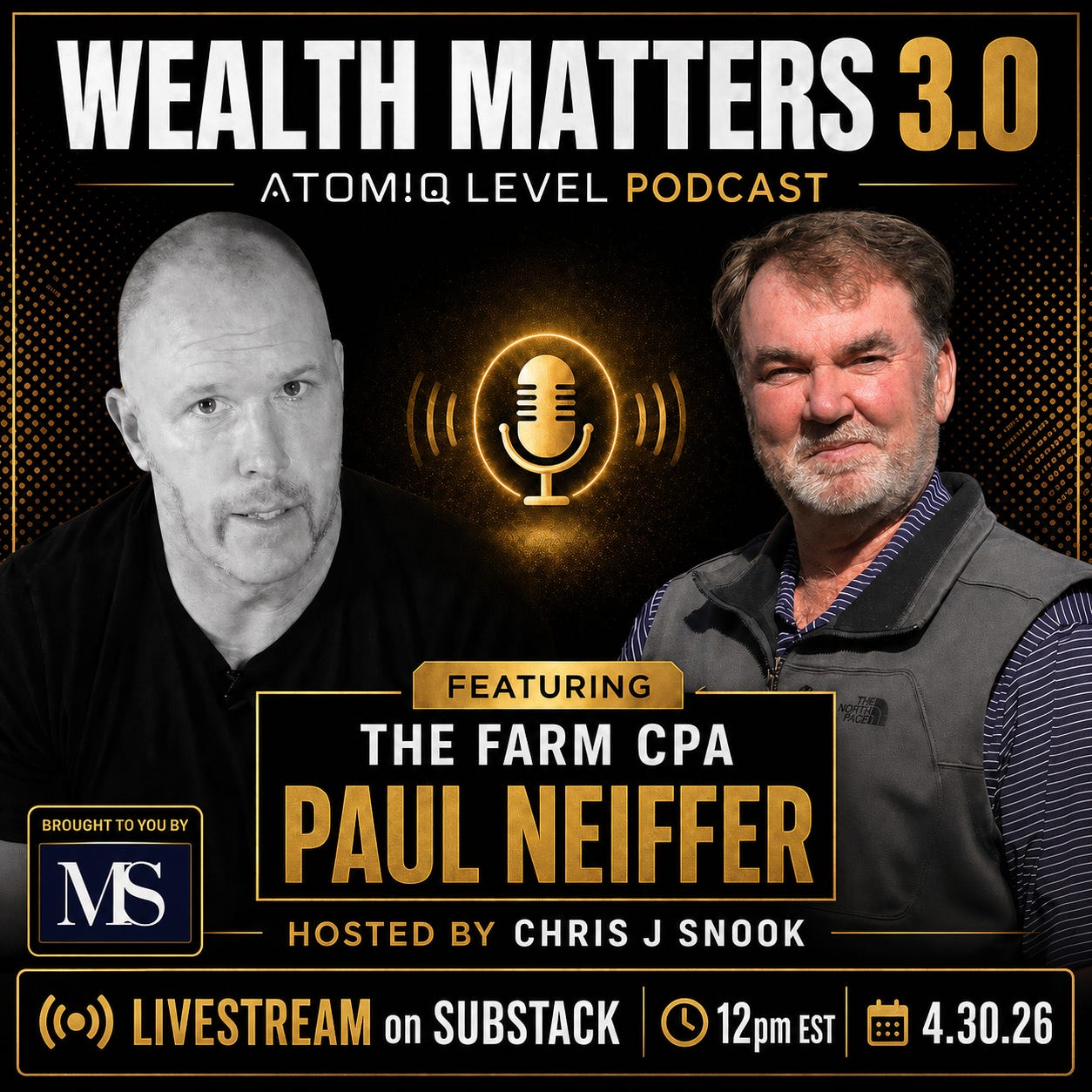
Some people chase complexity because it makes them sound smart.
And then there are people like Paul Neiffer.
Paul has spent a lifetime doing something far more valuable: making complexity useful.
In a world where tax law, farm policy, estate planning, artificial intelligence, land values, succession structures, and generational wealth are all colliding at once, Paul Neiffer has become one of the rare voices who can stand in the middle of that storm and explain what actually matters.
Not with Wall Street theatrics. Not with Silicon Valley jargon.
Not with the over-polished language of someone trying to build a personal brand out of borrowed conviction.
But with the dry humor, practical wisdom, and field-tested credibility of a man who grew up close enough to the land to understand that wealth is never just numbers on a spreadsheet. It is soil. It is family. It is a risk. It is timing. It is patience. It is the difference between what you can control and what you must learn to endure.
That is why this conversation with Paul Neiffer, known widely as The Farm CPA, is not simply a discussion about taxes.
It is a conversation about the American operating system beneath the American balance sheet.
It is about the family farm as a business, a legacy, an asset class, a tax planning puzzle, a succession crisis, and in many ways, one of the last living symbols of economic sovereignty.
And it begins, fittingly, with a boy on a farm.
The Kid Who Read 500 Books Before the World Called Him a Writer
Paul did not begin by telling a story about credentials.
He began with family.
He was born into a farming lineage shaped by older parents, Depression-era grit, homesteading, and the long arc of American agricultural expansion. His father was born in 1912, grew up during the Depression, hopped a freight train from the Dakotas, made his way to Washington State, and eventually homesteaded in southern Idaho and central Washington.
His mother came from farm families as well.
So before Paul ever became a CPA, before he built a niche audience, before he became a trusted interpreter of farm tax policy, he inherited an older and more durable education.
The education of watching land get worked.
The education of seeing people live without debt.
The education of knowing that a harvest does not care about your feelings, that markets do not care about your intentions, and that timing is never fully in your control.
His parents owned their land free and clear. When Paul came of age in the 1980s, he faced the obvious fork in the road: become a farmer or become a CPA.
His father wanted him to become a CPA. His wife wanted him to become a CPA. So Paul became a CPA.
But he never really left farming.
Today, he still owns farmland in Iowa, Missouri, and Washington State, along with a small place in Parker, Colorado. That combination matters because Paul is not merely advising from a distance. He understands the farmer from both sides of the ledger: as owner and advisor, as reader and writer, as technician and storyteller.
And if you want to understand why his writing works, you have to understand the small rural classroom that helped shape him.
Paul went to a school where first and second grade shared a room. There were only thirty-six kids from first through sixth grade. By third grade, his teacher realized he was going to be bored in fourth grade because he was already absorbing the material.
So she sent him to the library. He started reading.
And in sixth grade, he read around 500 books. Since fourth grade, he says he has never dropped below 100 books a year.
That detail could sound like trivia, but it may be the hidden key to the entire Paul Neiffer story. He does not describe himself as someone who has always had a burning passion to write. Yet long before he became a writer, he became a reader. And after decades of absorbing stories, biographies, thrillers, financial books, tax policy, farm programs, legal updates, and the lived complexity of client problems, he developed something more powerful than style.
He developed pattern recognition.
The Man Who Found a Niche Before Niches Were Cool
Around 2008 or 2009, Paul noticed something that now seems obvious only because he saw it first.
There were professional blogs for attorneys.
There were professional blogs for CPAs.
But there was not really a professional blog focused on farming from the lens of a CPA.
So he started one.
In March of 2009, he launched Farm CPA Today.
That small decision became the beginning of a long compounding curve. About a year later, Top Producer Magazine reached out and asked him to write a few articles. That turned into a column called The Farm CPA, which he has now been writing for roughly fifteen years.
But like many real stories, this one did not evolve in a straight line.
In 2010, tragedy hit Paul’s CPA firm when one of his partners died by suicide. The firm eventually merged into what became CliftonLarsonAllen, one of the largest CPA firms in the country. Through that transition, Paul’s audience continued to grow, and his blog became part of a larger professional ecosystem.
Then came retirement from CLA at the end of 2022.
For many people, retirement means slowing down.
For Paul, it meant starting over in public.
He launched The Farm CPA Report on Substack in 2023. He had an audience from his prior work, but he still had to rebuild the connection, redirect readers, and establish a new home.
And he did it the way farmers do most things.
By showing up. By posting. By staying useful. By not waiting for perfect conditions. Like a good farmer, he just faithfully sowed, and now he is reaping!
Paul still calls it blogging. He does not dress it up much more than that. But his mission is deceptively powerful: take complicated information and make it readable for the person with a fifth-grade education and the person with a PhD.
That is not dumbing down. That is translation.
And translation is one of the most valuable forms of intelligence in a world drowning in information.
The Millionaire Next Door Meets the Man in the Field
At one point in the conversation, Paul mentions The Millionaire Next Door as one of the books that has stayed with him.
It makes perfect sense.
The book’s core idea is not glamour. It is discipline. Time. Consistency. Living below your means. Putting money to work. Letting compounding do what compounding does.
That worldview fits the farm mind.
Paul’s early life trained him in long horizons. As he explains, farming is risky by nature. Weather, markets, prices, policy, inputs, yields, land values, interest rates, equipment costs, and family dynamics all move around the farmer.
The farmer is often a price taker, not a price maker.
So the discipline becomes simple but difficult: control what you can control.
That line could apply to farming. It could apply to investing.
It could apply to entrepreneurship. It could apply to life.
Paul is honest that he has made mistakes. He has taken entrepreneurial swings and struck out. But that, too, is part of the farmer’s operating system. You do not get to opt out of uncertainty. You learn to make decisions inside of it.
And that is where Paul’s wisdom becomes valuable far beyond the farming community.
Whether you own 5,000 acres or a service business, whether you are a CPA, founder, investor, advisor, or family steward, the same question eventually finds you:
What are you building that can survive weather you cannot control?
Why the Farm CPA Is Really a Trusted Advisor Story
One of the most revealing parts of this conversation is when Paul describes the relationship between farmers and CPAs.
For many farmers, the CPA is not just a tax preparer.
The CPA is a trusted advisor.
Sometimes, Paul says, the CPA knows more about the operation than the spouse does. He remembers specific land purchases, acreage, costs, and deal details years later. A client might call and vaguely reference a property, and Paul can recall the 160 acres and the price paid.
That is not just memory.
That is intimacy with the balance sheet.
And in farming, the balance sheet is never merely financial. It is emotional. It is generational. It is the story of what a family built, what they borrowed, what they survived, and what they hope someone else will carry forward.
This is why the profession cannot be reduced to software.
Yes, AI will change accounting.
Yes, Claude can help Paul produce and organize hundreds of pages of farm tax update material faster than he could manually format it in Word.
Yes, tax research tools are becoming more accessible because AI can surface buried content more quickly than old search systems.
But the human CPA’s role does not disappear.
It gets rewired.
The future trusted advisor will not be paid merely to find the rule. The machine can help find the rule. The advisor will be paid to understand the client, the context, the risk, the family dynamics, the timing, and the tradeoffs.
That distinction matters.
Because farmers do not just need compliance.
They need judgment.
The Coming Succession Crisis in American Farmland
Then the conversation turns toward one of the most important and under-discussed wealth transfer issues in America: the aging farmer.
Paul notes that the average age of the American farmer is around 58. Many children of farmers do not want to take over the operation. Some families have no clear farm successor. Others have heirs divided between those who want to keep the land and those who want to sell.
This is where the conversation becomes more than personal biography.
It becomes a window into a national transition.
Imagine a family inherits 500 or 1,000 acres in Iowa.
Two siblings want to keep the land.
Two siblings want to cash out.
The siblings who want to keep it cannot afford to buy out the others, or they do not feel comfortable concentrating that much personal capital into the purchase.
Historically, that kind of tension could force a sale.
But Paul explains that new structures are emerging, including Section 721-type agricultural funds, which may allow families to contribute land into a fund structure, receive units, and create optionality for different heirs. Those who want ongoing exposure can keep units. Those who want liquidity may be able to sell over time.
For readers who care about estate planning, this is one of the most important reasons to listen to the episode.
Because this is where tax law, family psychology, land stewardship, liquidity needs, and legacy collide.
And it is not theoretical.
This is happening now.
Across America, farmland that took generations to assemble is moving toward transfer. The next chapter will depend on whether families plan before emotion and urgency force decisions.
The Tax Code as a Map of Hidden Incentives
This episode also becomes a masterclass in how the tax code quietly shapes behavior.
Paul and Chris discuss hobby loss rules, the definition of a farmer, Section 179, depreciation, charitable remainder trusts, cash balance plans, estate tax exemptions, stepped-up basis, and how farmers are treated differently in certain estimated tax payment rules.
But what makes the conversation compelling is not simply the technical content.
It is the way Paul frames the tax code as something practical people need to understand before they make irreversible decisions.
A small acreage owner selling eggs or hay may wonder whether they are a farmer or merely engaged in a hobby. That distinction can determine whether expenses can offset broader income or whether deductions are limited to revenue. Courts look at multiple factors, including professionalism, record keeping, time invested, outside income, and the seriousness of the profit motive.
This is where Paul’s value shines.
He understands that the real world is messy.
A family might have a barn, fencing, a well, irrigation, hay revenue, chickens, goats, a ranch, or a side operation. Somewhere between lifestyle, hobby, and business, tax consequences begin to change.
That is not something most people should guess at.
And it is exactly the kind of thing Paul has spent a career explaining.
Farming, AI, and the Future of Work
One of the subtle surprises of the interview is how naturally farming and AI fit together.
At first glance, they seem like opposite worlds.
One is soil, machinery, weather, and harvest.
The other is models, prompts, compute, and automation.
But in practice, both are about leverage.
Paul is already using tools like Claude to help with his farm tax update work. He uses AI not to replace his expertise, but to accelerate the packaging, formatting, and organization of material he already understands.
That is the key.
AI is not the brain.
AI is the tool.
The trusted expert still needs to know what is right, what is wrong, what is missing, and what matters.
This is especially important in tax and law-adjacent domains, where hallucinated confidence can be expensive. Paul is not trying to build the AI box. As he puts it, he wants a good box and he wants to use it.
That practical attitude may be the best AI adoption strategy for many professionals.
Do not worship the tool.
Do not ignore it.
Use it where it saves time, but keep human judgment where consequences matter.
The Hidden Wealth Lesson: Food Still Matters
As the conversation widens, Chris and Paul arrive at one of the most important points of the entire episode:
AI will not eliminate the need for food.
The world may be racing toward more automation, more agents, more bots, more digital economies, and more abstract forms of capital. But human beings still need water, calories, land, infrastructure, and energy.
The physical world remains undefeated.
That is why farmland is not merely nostalgic. It is strategic.
It is productive. It is finite.
It sits at the intersection of cash flow, food security, tax planning, family legacy, and sovereignty. For investors and families thinking beyond the next market cycle, that matters. For children inheriting land they do not understand, it matters. For CPAs and advisors serving agricultural clients, it matters. For entrepreneurs trying to understand what durable wealth looks like in an age of digital acceleration, it matters.
The farm may look old-fashioned from the outside. But underneath it sits one of the most sophisticated wealth, risk, and legacy problems in America.
Why You Should Listen
This episode is not a surface-level interview with a niche tax expert. It is a conversation with a man who has lived at the intersection of land, law, family, policy, and practical wealth for decades.
You will hear how Paul went from a farm kid and voracious reader to one of the most trusted voices in agricultural tax strategy. You will hear why farmers are risk takers by necessity, why CPAs still matter in the age of AI, why farmland succession may become one of the defining wealth transfer challenges of the next decade, and why the best tax planning often starts long before anyone files a return.
You will also hear something rarer. You will hear humility.
Paul does not posture as a guru. He jokes that he is “just a guy.” But that is exactly what makes the conversation work. He is the kind of guy who has read the books, worked the fields, studied the rules, advised the families, written the updates, watched the industry change, and still wakes up curious about what the next farm bill, tax provision, or AI workflow might mean for the people who keep America fed.
That is the kind of conversation worth slowing down for. Because behind every acre is a balance sheet. Behind every balance sheet is a family.
Behind every family is a story. And behind this episode is one of the clearest reminders yet that the future of wealth will not belong only to those who understand technology.
It will belong to those who understand what technology cannot replace.
Land.
Food.
Legacy.
Judgment.
And the rare trusted advisors who can help families protect all four.
Listen to the Full Episode
Press play on this ATOMIQ LEVEL conversation with Paul Neiffer, The Farm CPA, and you will never look at farmland, farm taxes, estate planning, or the future of professional advice quite the same way again.
Thank you to everyone who tuned into my live video! Join me for my next live video in the app.
The Real Risk Is Doing Nothing!
~Chris J Snook