TL:DR
Chris J Snook and Danny DeMichele explain how financial advisors, fiduciaries, and family offices can build secure private AI infrastructure, automate workflows responsibly, and turn proprietary knowledge into a local small language model.
Why Advisors and HNWI Should Care
Most conversations about artificial intelligence begin with a tool. This one begins with a more important question:
What happens when everything around you is changing—and you are not?
In this week’s Generative Advisor Weekly Office Hours AMA, Danny DeMichele and I moved beyond prompts, copilots, and generic productivity tricks to examine what it actually means to rewire an advisory firm for the age of intelligence.
We talked about why firms are starting in the wrong place, why disconnected AI agents create a dangerous “Franken-stack,” how regulated businesses can use frontier models without surrendering sensitive data, and why a privately owned small language model may eventually become more valuable than the book of business it was trained to serve.
This is not a conversation about adding another subscription. It is a conversation about deciding who will own the intelligence inside your firm.
“If nothing changes, nothing changes” is one of those phrases that sounds useful until you reverse it.
What happens when everything around you changes, and you do not?
That was the frame I brought into my conversation with Danny this week after your questions came in from our 3-part series on “The Future of Advice” this past week.
It has been on my mind because every advisor, attorney, accountant, fiduciary, and family office leader is now being asked to make decisions about a technology they may not yet have a common picture of.
For those of us over 40, the words artificial intelligence can still summon a flash of the Terminator. For someone younger, AI may simply look like an empty ChatGPT or Claude window waiting for a prompt.
Those are radically different pictures. And when the people inside a firm are carrying different pictures, they will make different decisions, move in different directions, and assign different levels of risk to the same technology.
A modern advisory firm cannot afford that kind of strategic ambiguity.
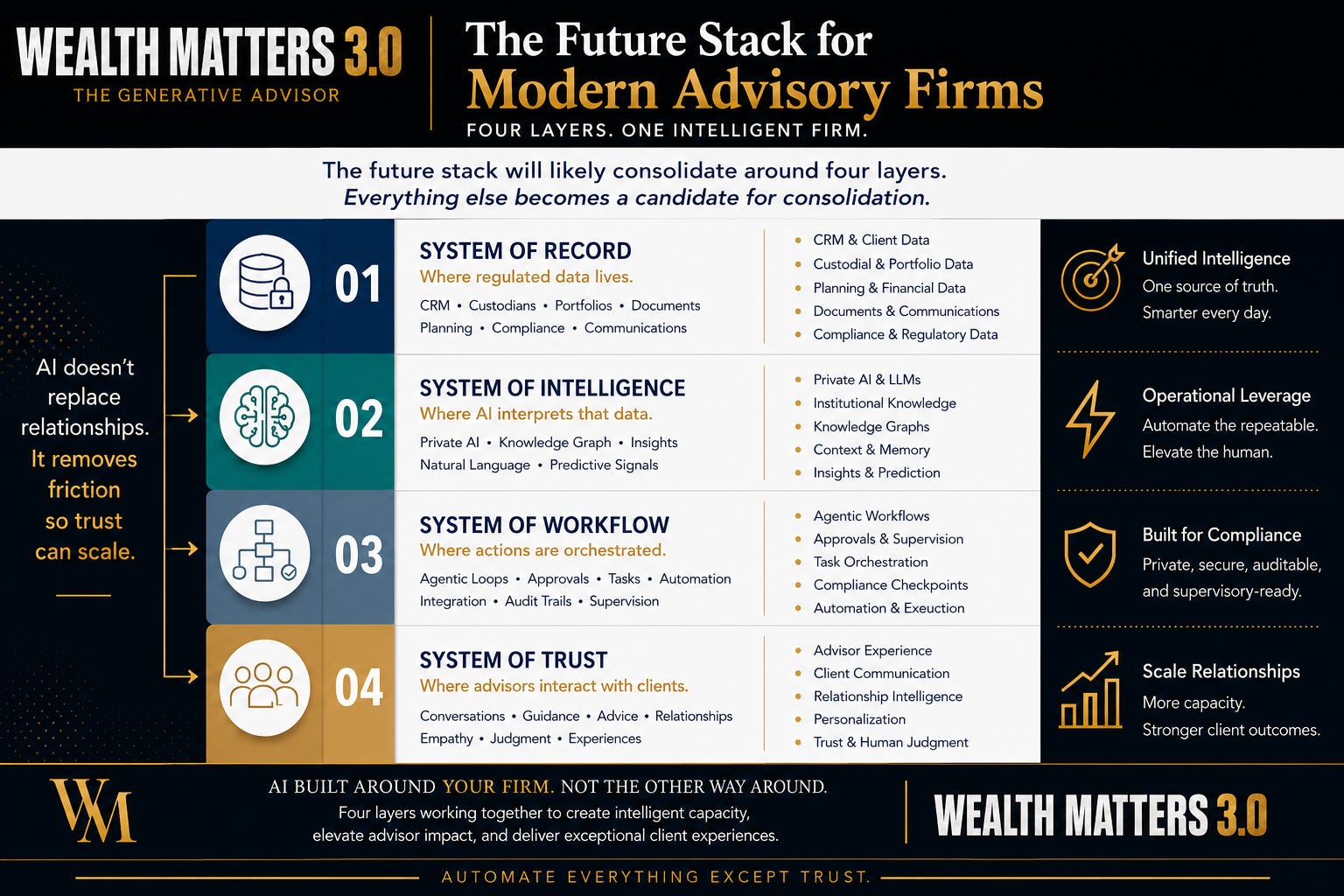
The framework Danny and I have been using to create a common picture contains four layers:
the system of record,
the system of intelligence,
the system of workflow, and
the system of trust.
The first three can be improved, connected, and increasingly automated. The fourth is what makes the entire enterprise worth protecting.
Human-to-human trust is the one layer we should never automate.
Subscribe to The Generative Advisor to stay alerted to each Friday’s live Office Hours, new implementation case studies, and the first deployment openings for ATOMIQ’s Private AI Lockbox Advisor solutions and system.
Three favors before you continue reading.
Hit the ❤️. The algorithm understands dopamine better than most firms understand their own information flows.
Hit the 🔄 restack. Somebody in your network is duct-taping six AI agents to five SaaS platforms and calling it transformation. Save them before the Franken-stack gets a budget.
Hit 📤 share. Send this to the advisor whose CRM currently knows more about the client relationship than the firm does.
Drop a comment. Tell me the workflow your team would never trust AI to touch—and the one they would gladly hand over tomorrow. I read every one, and I reply to the ones that make me laugh, make me think, or prevent a compliance meeting. Preferably all three. Now, lets get back to your article and programming :)
Do Not Begin With “Just” an Agent
Danny’s first answer surprised me because it was not about where a firm should begin. It was about where it should not begin.
The mistake he sees repeatedly is a company choosing one visible tactical problem—proposal generation, meeting follow-up, research summaries, or CRM updates—and building an autonomous agent around it. That agent then reaches into a transcription platform, an email account, a calendar, a document system, and perhaps a frontier model.
The demo looks impressive.
Then another department buys a different agent. Someone connects a third tool through Zapier. Compliance adds a manual checkpoint. Marketing builds its own version. Each tool has separate permissions, instructions, data, and operating assumptions.
Soon, the firm has created a collection of artificial employees that do not share a manager, a memory, or a rulebook.
Danny called it a Franken-build.
The problem is not that the individual agents are useless. The problem is that the firm has built the outer limbs before establishing the nervous system.
A durable AI system must first become contextually aware of the company. Uploading a folder of policies and procedures is not enough. Documents tell the machine what the organization claims to do. Communications reveal what the organization actually does.
The true character of a firm lives in its emails, meeting transcripts, client conversations, internal decisions, exceptions, and explanations. It lives in the language people use when the standard operating procedure stops being standard.
That is where the soul of the company is hiding.
Before choosing an agent, map how information currently moves. Who creates it? Who receives it? Where is it stored? What remains trapped in the founder’s head? Which conversations disappear after the call ends? Which systems contain duplicate or conflicting records?
The first phase of AI implementation may therefore contain very little AI.
You may need to standardize transcription, repair permissions, unify communication practices, and decide which systems of record will be kept, replaced, connected, or retired. As Danny explained, AI cannot perform reliably when the underlying communication and data processes remain fragmented.
Calm down so you can speed up.
The AI Is Not the Center. Your Data Is.
Many AI architecture diagrams place an agent in the middle of the organization. Danny believes that picture is upside down. Your data belongs in the middle.
Around that data sits an orchestration layer—the coach that interprets the request, understands the rules, checks the user’s permissions, and assigns the correct task to the correct sub-agent.
The marketing employee should not necessarily see what the chief compliance officer sees. An assistant preparing a meeting brief should not receive unrestricted access to every estate document, tax return, or private family communication. A planning agent may need information from the CRM, calendar, and prior meeting transcripts without receiving authority to send an irreversible recommendation directly to the client.
The orchestrator determines who can ask, what they can access, which model should be used, and what must be approved before anything happens.
Without that layer, an AI agent becomes little more than a smarter automation chain. It jumps from system to system, depending on outside APIs, carrying incomplete context and creating new openings for errors, prompt injections, and permission failures.
That is not an intelligence system. It is a demo operating in production.
Intelligence Will Become as Ordinary as Electricity
A century ago, electricity was a differentiator. A hotel could advertise that it had electric lights. A city could illuminate a fairground and attract crowds simply by showing people what the technology could do. Over time, electricity stopped being the feature and became the infrastructure underneath every feature.
Nobody checks into a modern hotel and congratulates management for installing outlets. Danny and I believe the same transition is happening with organizational intelligence.
Today, an advisory firm may advertise that it uses artificial intelligence. Soon, that claim will sound like a building owner announcing that the property has wiring.
A system of intelligence will not be something a firm receives extra credit for having. It will be something the firm is allowed to continue existing because it has.
The competitive question will therefore move from Do you use AI? to What intelligence do you own, and what can your firm do because of it?
This is where the distinction between rented intelligence and owned intelligence becomes existential.
What a Defense Contractor Taught Us About Regulated AI Design and Implementation
Danny described one of the most revealing implementation projects his team has completed: an AI infrastructure engagement for a defense-related manufacturer operating under ITAR restrictions.
This was not a marketing agency experimenting with blog automation. The company’s systems were involved in producing components that could be used in military aircraft and rockets. Mishandling regulated information could produce consequences far beyond a failed software deployment.
At first glance, it appeared that the available compliant models would be too limited to perform the sophisticated analysis the company needed.
Instead of assuming that every piece of company information required the same level of restriction, the team centralized the data and asked an approved model to classify it.
The result changed the architecture of the entire project.
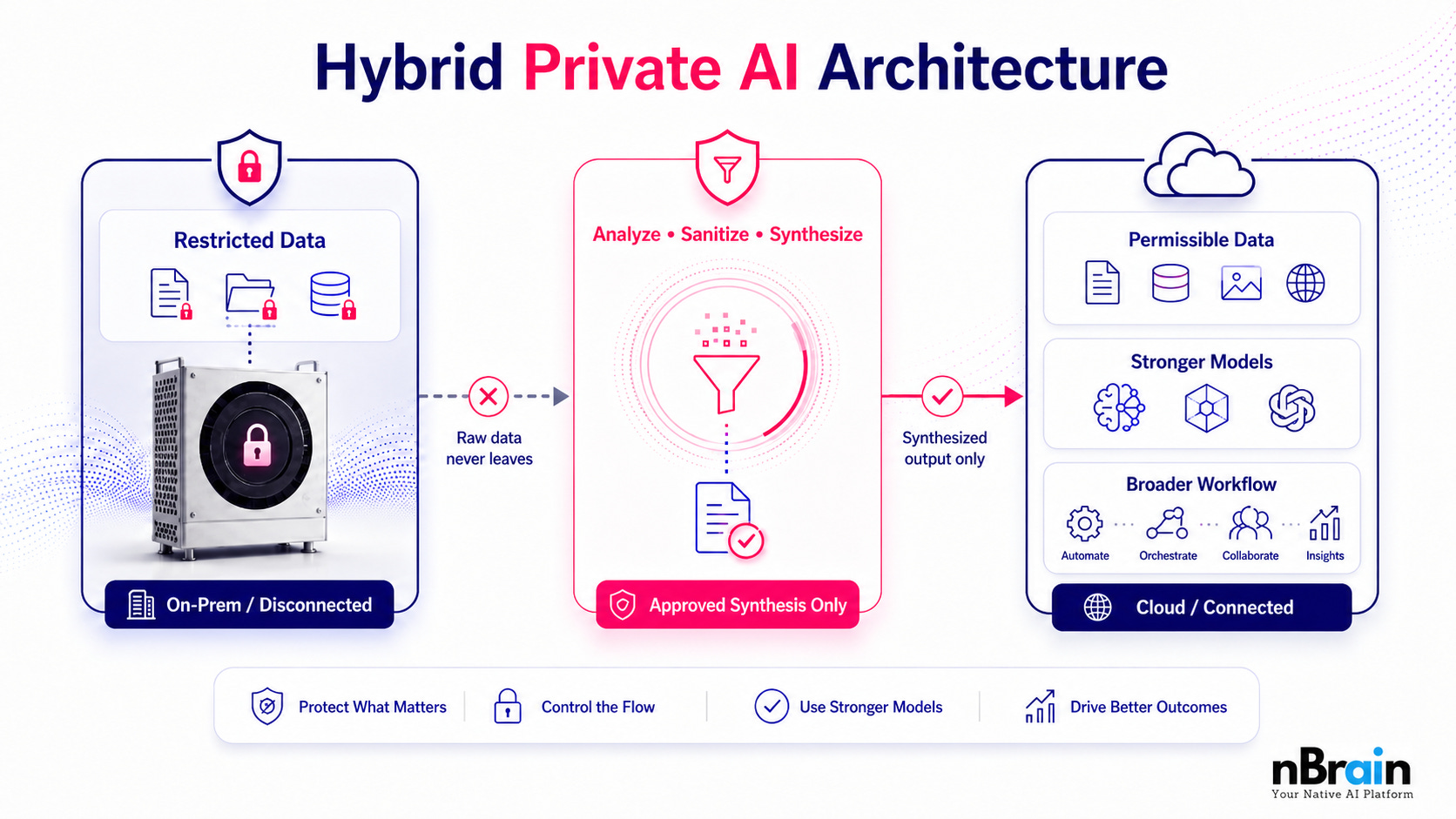
Only about 3% of the information required the most restrictive environment. Approximately 97% could be safely processed through more capable models under the appropriate private configuration.
That allowed the team to create a hybrid system: highly restricted data remained inside an on-premises, disconnected environment, while the larger body of permissible information could benefit from stronger models. The protected system could analyze or sanitize the restricted portion and pass only an appropriate synthesis into the broader workflow.
A human trying to micromanage the project from the beginning might have rejected the entire opportunity. The machine helped identify a compliant path through it.
AI often performs better when you give it a clearly defined goal rather than a rigid sequence of inherited instructions.
That insight applies directly to financial services. Not every email, document, or workflow requires the same model, security boundary, or degree of isolation. The architecture should classify information and route it intelligently rather than treating every task as identical.
SLM May Become More Valuable Than AUM
The most important part of an on-premises or privately controlled architecture is not merely that the machine sits inside your office.
It is that the system can gradually distill the firm’s proprietary knowledge into its own localized small language model (SLM).
A frontier model knows an extraordinary amount about what the world knows. It does not inherently know what only your firm knows (yet).
It does not know why your best advisor asks one additional question before recommending a trust strategy.
It does not understand the language your clients use before a liquidity event.
It does not recognize the subtle life changes that historically precede a new planning need or rebalancing of the portfolio.
It does not possess the accumulated judgment hidden across years of correspondence, meeting notes, and decisions.
That missing knowledge is the firm’s real intellectual property.
For decades, the value of a financial advisory business has been calculated largely from recurring fees and assets under management. A book producing a predictable amount of annual revenue can command a multiple because an acquirer expects those clients and fees to remain.
But imagine that the firm also owns a secure, private model containing its institutional understanding of portfolio management, tax strategy, estate coordination, asset protection, client communication, and multigenerational service.
That model does not merely contain client records. It contains the organization’s accumulated way of thinking.
A properly governed SLM could become a licensable asset, an internal succession mechanism, a quality-control system, and the continuity layer that allows the firm’s best judgment to survive the retirement or departure of key people.
In the coming intelligence economy, the most valuable asset may no longer be the money you manage. It may be the proprietary intelligence that explains how you manage it.
Danny’s point was even more practical: most day-to-day workflows do not require the newest and most expensive frontier model. Frontier systems may remain valuable for development, coding, and unusually complex reasoning, but routine firm operations can often be handled by a smaller model trained around the organization’s actual domain.
That matters because rented intelligence can be repriced, rationed, or removed.
Token costs can rise. Access can be limited. Models can disappear. Providers can change their policies. Capacity will increasingly flow toward governments, defense, hyperscalers, and the largest corporate buyers before it reaches a boutique advisory firm.
You should not have to wait for somebody else’s token allocation to access your own institutional memory.
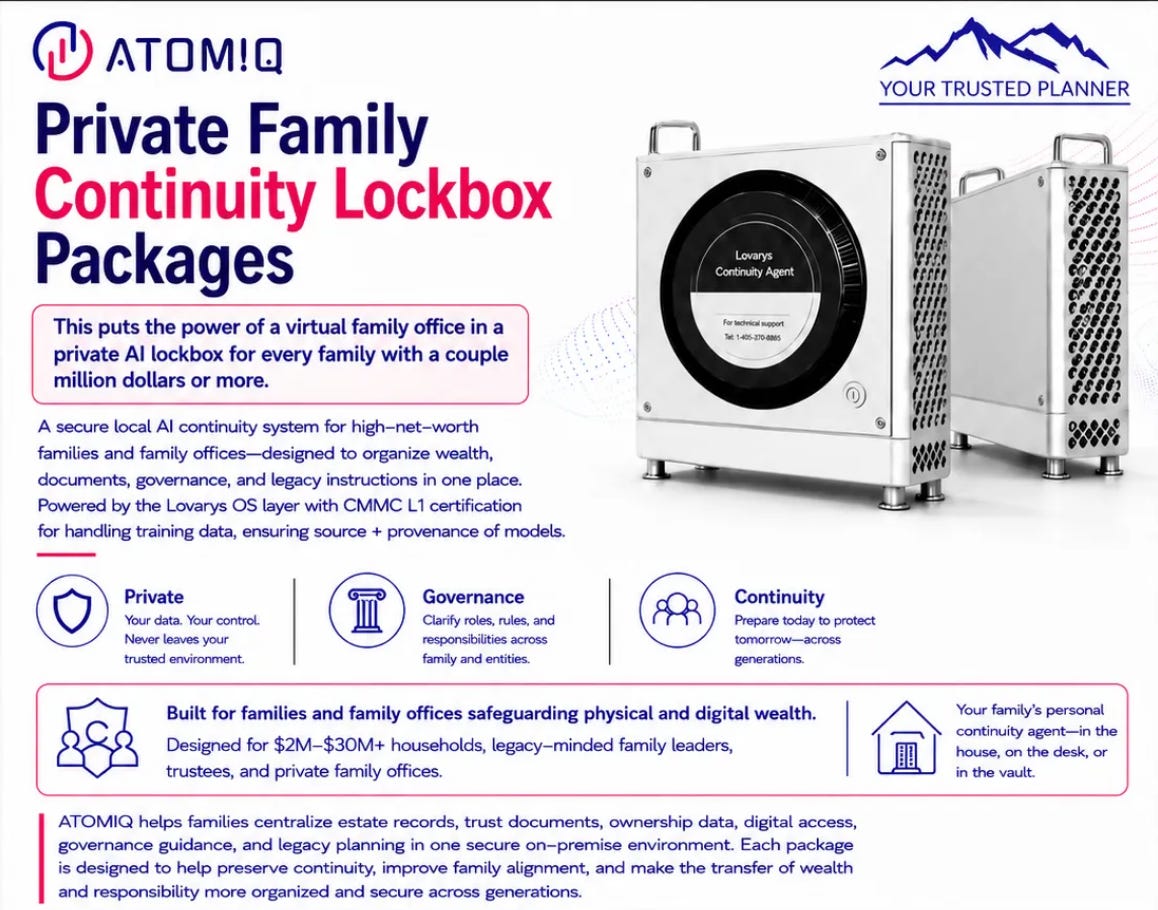
From Private Firm “Brain” to Family Continuity Lockbox
This is the practical need behind the product ATOMIQ has now begun soft-launching.
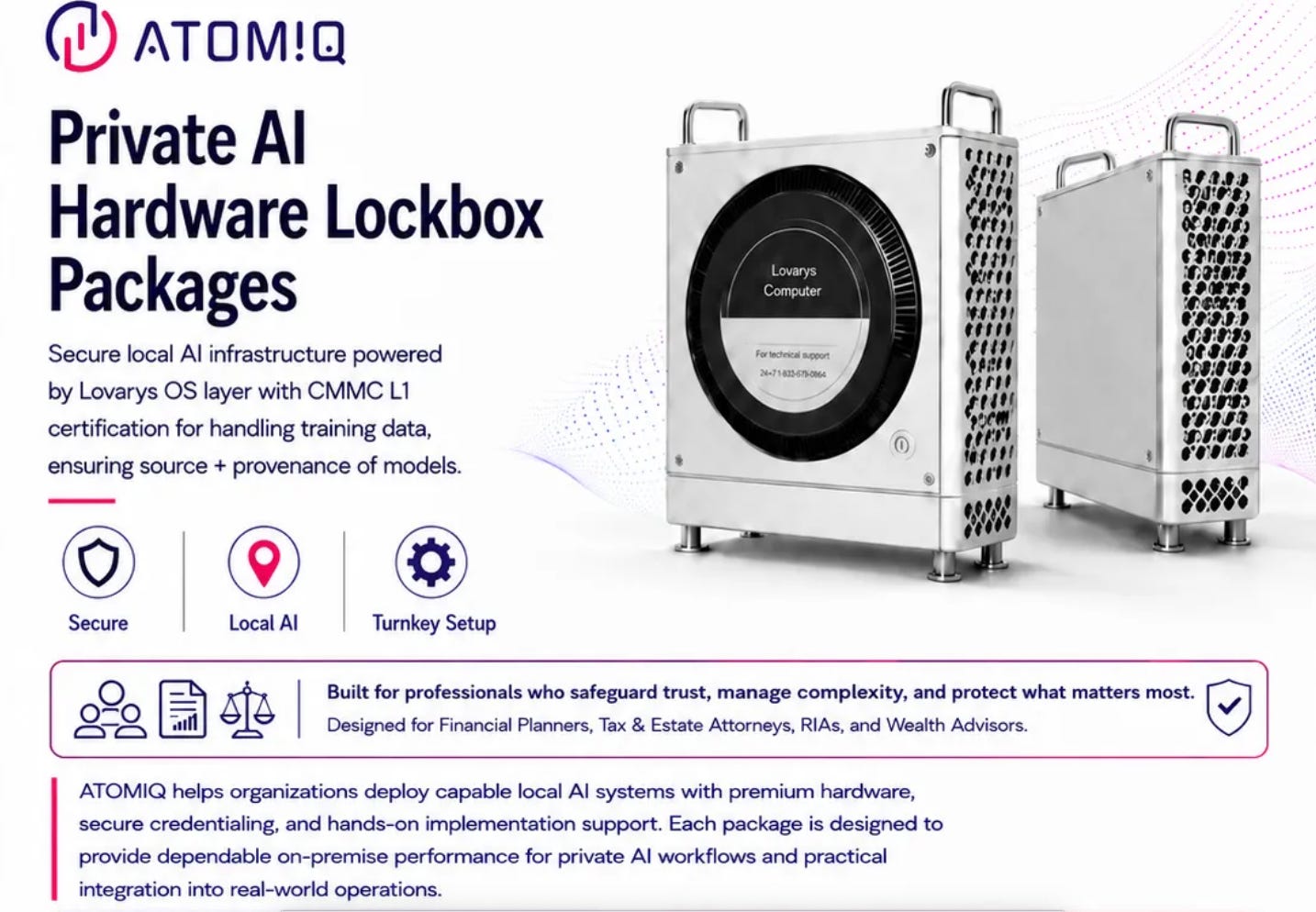
For regulated professional firms, the Private AI Hardware Lockbox is designed to become the secure home for a firm’s brain: a local system that can support private workflows, credentialed access, communications intelligence, and the gradual development of a proprietary SLM.
For high-net-worth families and family offices, the Family Continuity Lockbox addresses a related but more personal problem.
A family may have an estate attorney, investment advisor, accountant, insurance professional, trustee, operating-company manager, and cybersecurity provider. Each controls part of the picture. No one necessarily sees the whole.
The family’s system of record is fragmented across institutions, inboxes, portals, filing cabinets, vaults, and individual memories.
The Continuity Lockbox is intended to give the family a controlled place to organize estate records, trust documents, entity information, ownership data, digital access instructions, governance rules, and continuity responsibilities. It can sit in the home, on a desk, inside an office, or in a vault as the physical home of the family’s private intelligence environment.
It is not merely document storage.
The larger vision is a virtual family office in a private AI lockbox for families with a couple million dollars or more—an intelligent continuity agent designed to help the right people understand what exists, who controls it, and what must happen next.
The family still needs attorneys, accountants, trustees, and advisors. The purpose of the system is to help those humans operate from the same picture.
One-Way Doors and Two-Way Doors
The question every responsible leader eventually asks is how much freedom to give the machine.
Danny’s framework is refreshingly simple: separate reversible decisions from irreversible ones.
An internal draft report that can be corrected is a reversible task. Let the AI run. Observe it, improve it, and accept that early versions may contain mistakes.
A strategy delivered directly to a client is different. Once the client receives it, the action cannot be fully reversed. Those workflows should include human approval until the system has demonstrated sufficient reliability.
The complete process can still be designed for end-to-end automation. Human checkpoints are then inserted at the stages where errors would carry the greatest consequence.
Over time, the team may discover that a checkpoint can be handled by a deterministic rule, a second validation agent, or a comparison against prior outputs. Human involvement can decrease as evidence and confidence increase.
The objective is not blind autonomy. It is earned autonomy.
You can take more risk on the two-way doors (reversible). Keep a person at the one-way doors (irreversible) until the system has proven that it can walk through them safely.
Nobody Resists Change That They Want
The final question of the hour was not technical. It was human.
How do you introduce new workflows without overwhelming the employees who are already busy serving clients?
Most people do not resist change. They resist being changed by someone else.
The common failure pattern is an executive team deciding what an employee needs, building a system without that person, and then unveiling the finished automation shortly before launch.
The employee sees an existential threat disguised as a productivity tool.
Even when the system works 99% of the time, that employee will become the world’s greatest expert on the remaining 1%. Every flaw becomes evidence that the project should be stopped.
The answer is to bring the people doing the work into the process early. Ask them where the friction is. Let them help define success. Show them how the technology can remove work they dislike and create space for work that requires judgment, creativity and relationships.
One of my favorite moments in Hidden Figures comes when Dorothy Vaughan recognizes that the arrival of IBM mainframes will change the future of her entire department. She does not wait for someone to protect her existing job. She learns FORTRAN and teaches the other women around her.
She does not preserve the old role. She becomes essential to the new system. That is the invitation leaders should make to their teams now.
We cannot promise that every job will remain exactly as it is. We can promise that none of us has much of a future if we refuse to learn how intelligence will rewire the firm.
The employee who becomes the internal process engineer, AI translator, workflow architect, or reversible-versus-irreversible decision maker may leap from a replaceable role into one of the most important positions in the company.
You are not necessarily replacing the person. You may be replacing the job they never wanted to keep doing.
The Firm of the Future Owns What Only It Knows
The world’s models already contain much of what everyone knows. Your opportunity is in the knowledge that only your organization, your people, and your clients have created together.
That knowledge currently sits in disconnected systems, private conversations, and individual memories. It is being captured by software vendors that may understand more about your activity than your own organization does.
The next generation of durable firms will reverse that relationship.
They will own their information layer.
They will control the orchestration.
They will decide which models receive which data.
They will automate reversible processes aggressively and protect irreversible decisions carefully.
They will use intelligence to deepen the human relationship rather than remove it.
And they will build systems capable of preserving the firm’s judgment, the client’s context, and the family’s continuity long after any one tool, subscription, or individual is gone.
The future of advice is not artificial. It is proprietary intelligence wrapped in human trust.
Press play on the full conversation with Danny DeMichele to hear the implementation stories, architectural distinctions, and practical answers we could not fit into this article.
Then subscribe, bring us your questions, and join us live next Friday for another edition of The Generative Advisor Weekly Office Hours and AMA. Danny and I will continue taking the questions that regulated advisors, fiduciaries, and family office leaders cannot afford to answer with another generic AI demo.
The real risk is doing nothing!
~Chris J Snook with Danny DeMichele
Substack exclusive launch (Order/Inquire Today)
ATOMIQ has now soft-launched a limited initial run of Private AI Hardware and Family Continuity Lockbox packages developed with nBrain and Your Trusted Planner, powered by LovarysOS and deployed on configurations using Apple- and NVIDIA-based infrastructure.
We currently have a handful of units available for an initial group of approximately six fiduciary firms, high-net-worth families, or family offices.
Advisory firms can explore a private firm brain or localized SLM trained around their communications, workflows, planning knowledge, and client experience.
Families and family offices can explore a Continuity Lockbox designed to organize physical and digital wealth, estate records, governance instructions, ownership data, and multigenerational responsibilities in one controlled environment.
Book a one-on-one Private AI Lockbox discovery and pre-consult with Chris and Danny.
or email support@atomiqstudio.com to begin the conversation.
Thank you to everyone who tuned into my ATOMIQ LEVEL LIVE Weekly AMA today! Join me for my next live video in the app.