If it can be frozen, it isn’t money
Venezuela’s USDT shock was the unpaid Bitcoin ad no one saw coming.
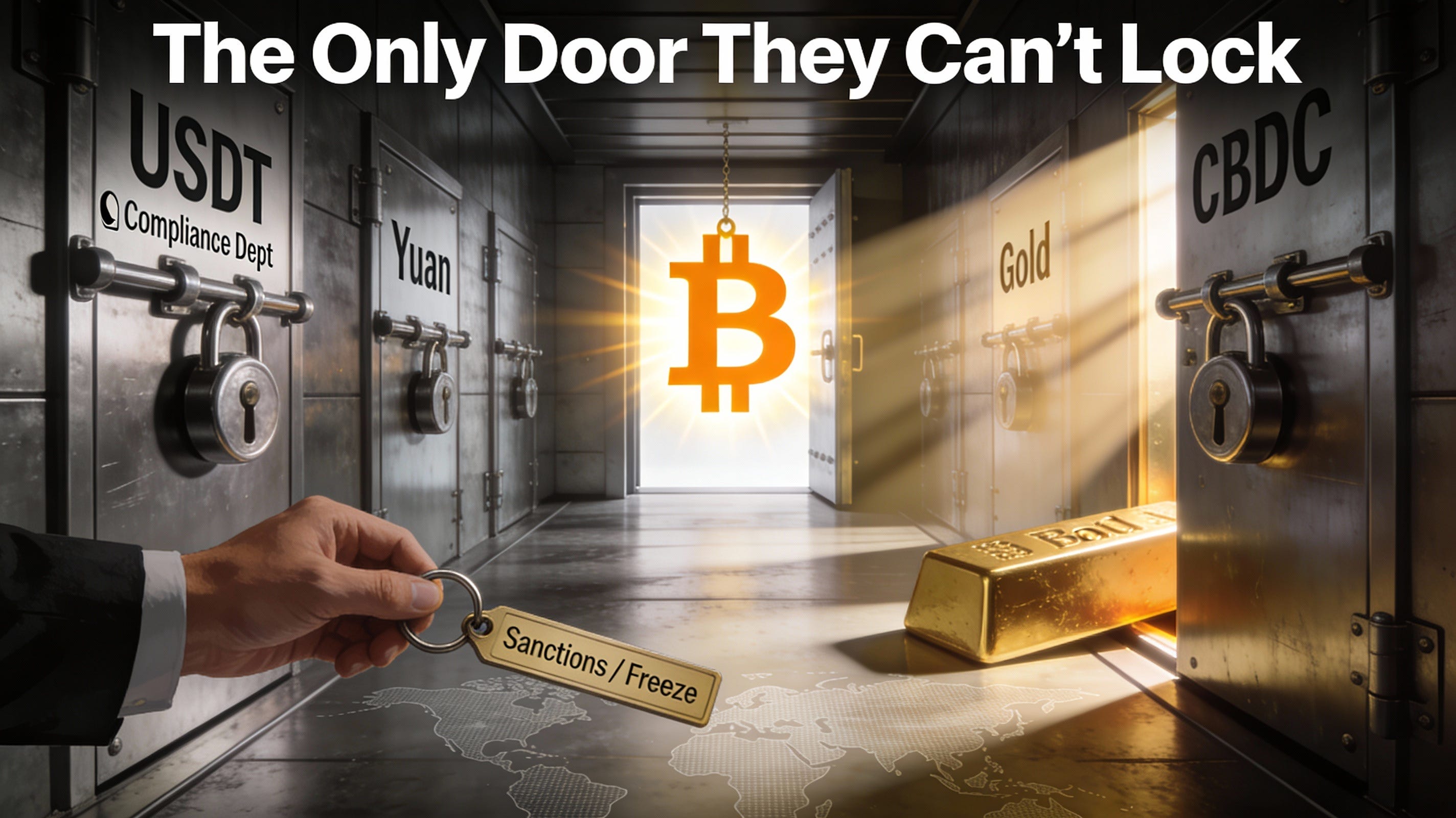
Imagine global finance as a hallway full of doors. Most of them only open if someone on the other side turns a key — a bank, a government, a compliance officer. Bitcoin is the one (and only) door that doesn’t need anyone else’s permission to open. Anyone with a wallet can walk through and freely transact 24/7/365 on a global scale, with a micro-payment or a multi-billion-dollar transaction.
That difference between permissioned and permissionless money sounds theoretical until a government suddenly loses access to its own funds. That is exactly what just played out in Venezuela, and the implications go far beyond Caracas.
The Night the Money Stopped
For years, Nicolás Maduro’s regime routed roughly 80% of Venezuela’s oil revenue through Tether (USDT) on the Tron blockchain, using stablecoins as a workaround to move billions outside the traditional banking system and around U.S. sanctions.
Then the United States made a phone call. Tether froze the wallets. Overnight, the flow of funds stopped. The workaround wasn’t a new system; it was just a different interface to the old one.
While headlines fixated on arrests and corruption, every finance minister and central banker watching understood the deeper message: stablecoins are not a way out of the dollar’s reach — they are an upgraded rail for it.
Stablecoins: Useful, Not Sovereign
Stablecoins like USDT promise the speed of crypto with the familiarity of the dollar. In practice, they are still fully permissioned instruments. There is a company, a CEO, a legal jurisdiction, and a compliance department that can be leaned on when regulators want something done.
That structure is why USDT has exploded in everyday use across emerging markets. In cities like Caracas, even elderly homeowners now pay HOA dues and basic expenses in Tether because it is faster and more stable than the local currency. But useful does not mean sovereign. If a single phone call can freeze it, it is not independent money; it is conditional access to someone else’s balance sheet.
The idea that stablecoins offered a reliable path to evade sanctions just failed a real-world stress test, in public, on-chain, for everyone to see.
From Caracas to Moscow: The Game Theory
Now put yourself in another capital: Tehran, Moscow, Beijing, or any government trying to hedge against the weaponization of the dollar system. You just watched Venezuela’s “crypto solution” shut off like a light switch.
Where do you put reserves now?
- USDT? Clearly controlled. One call, and it can disappear.
- Yuan? Comes with its own geopolitical strings and dependencies.
- Gold? A proven store of value, but try moving 500 million across borders in 10 minutes without intermediaries.
- CBDCs? Digital fiat with the same or stronger control functions, just with a different logo.
Once those options are stripped down, there is only one asset left that settles globally, finally, and without asking permission from any government, company, or platform: Bitcoin.
Bitcoin: The Only Permissionless Rail
Bitcoin has no CEO, no help desk, and no compliance line for Washington or anyone else to call. There are only 21 million units secured by a decentralized network of nodes and miners who validate transactions according to open rules that no single actor can change unilaterally.
That makes Bitcoin the only asset of scale that allows any holder — whether an individual, an institution, or a nation-state — to move value without needing approval. It is not a better version of the existing system; it is a different category of system altogether.
The same mechanism that can freeze a government’s oil revenue can also lock an individual out of an account or block a transaction. The difference is scale, not principle. Bitcoin’s core promise is not “number go up,” but that ownership and settlement cannot be turned off.
What This Means for Investors
For investors and advisors, the Venezuela episode forces a sharp distinction that markets often blur: not all “crypto” is the same.
Stablecoins are permissioned digital dollars — excellent tools for payments, liquidity, and short-term cash management, but always subject to external control.
Bitcoin is a permissionless monetary infrastructure — slower and more volatile, but uniquely free from the freeze, reverse, or deny functions that define the rest of the system.
As more of the world’s wealth migrates onto digital rails, the core risk is not just price volatility; it is counterparty control risk. If your ability to use an asset depends on someone else continuing to say “yes,” you do not fully own it. Bitcoin removes that layer.
When Tether froze Venezuela’s wallets, it exposed this hierarchy in a single, brutal lesson. One type of digital asset obeys. One does not. That contrast is the unpaid Bitcoin advertisement no one planned, but everyone in global finance just watched.
The market has not fully priced in that difference yet, but it will. The smart money and institutions are piling in, and you don’t need their position to end-run their allocation with your own.
You are still early, but not too early.
Yours in health and wealth,
~Chris J Snook
Sources:
Venezuela’s USDT use, stablecoins as permissioned instruments, and Bitcoin as a distinct, permissionless monetary system:
https://www.coindesk.com/policy/2025/01/06/venezuela-tether-freeze-stablecoins-bitcoin-sanctionsU.S. action against Venezuela’s USDT flows, Tether wallet freezes, and implications for sanctions, reserves, and global game theory:
https://www.reuters.com/world/venezuela-usdt-oil-revenue-tether-freeze-sanctions-2025-01-04


