


Why Every Advisor Must Read and Act Now
Unless you are selling your book of business or practice before the end of the year and retiring forever into the sunset without a care in the world, then you MUST read and understand this. If you are the former, then congrats and enjoy the golf course and beaches. For the rest of you, please “listen to me with both eyes” (winks).
Kimi K3 is not merely another artificial-intelligence model for advisers to place on a technology watchlist.
Its release is a signal that near-frontier intelligence is becoming downloadable, comparatively inexpensive and increasingly difficult for any government, laboratory or incumbent vendor to contain once it enters the open ecosystem.
That development creates an extraordinary opportunity for independent registered investment advisers. It also changes the threat environment around them.
And today, is the worst and least powerful this technology will ever be.
The strategic question is no longer simply whether an RIA, CPA, Attorney, CFP, CFA, etc., should use Kimi K3, Claude, GPT, Gemini, DeepSeek, Qwen, or another model.
The most important question is whether the firm is building an institutional architecture capable of evaluating, preserving, governing, replacing, and defending itself against all of them and the ones we haven’t heard of yet.
An independent fiduciary that answers that question correctly can accumulate proprietary intelligence while maintaining control of client data, professional judgment, and operational continuity. A firm that answers it poorly may become dependent on a closed vendor, exposed to an ungoverned open model, or vulnerable to adversaries using the same capabilities against it.
The model is not the strategy. The architecture surrounding the model is the strategy.
The Market Is Still Watching the Wrong Layer
The release of Moonshot AI’s Kimi K3 has understandably attracted attention because of its scale and capability. The Kimi team describes it as a 2.8-trillion-parameter mixture-of-experts model with 104 billion parameters activated during inference, native visual capabilities, and a one-million-token context window. Its technical paper reports an approximately 2.5-times improvement in overall scaling efficiency over Kimi K2 and describes frontier-level performance across coding, knowledge, reasoning, visual and long-horizon agentic tasks, while acknowledging that it still trails the strongest proprietary models in the developers’ evaluation suite. The complete model weights were released publicly on July 27, 2026. (arXiv)
Those details matter, but they are not the most important part of the story.
Ben Goertzel‘s initial response to K3 focused on the larger architectural implications. And that is the actual point that we need to understand and unpack. Ben remarks that as near-frontier intelligence becomes more powerful, open and widely available, economic value does not reside only in the laboratories training the models or the data centers running them. It also migrates into the systems above the models—the architectures that provide memory, coordination, governance, evaluation, permissions, reasoning and persistent institutional purpose.
In plain speak, if the previous generation of open models was the fastest production jet available, K3 is that aircraft upgraded with greater range, a larger payload, more sophisticated sensors and a substantially more capable flight computer.
At that point, the scarce value is no longer merely the engine. It is the air-traffic control, mission planning, security clearance and command system that determines where the aircraft may fly, what it may carry and what it is authorized to do.
That is the emerging System of Intelligence I have written about in prior posts that you and I need to not only understand, but design for, and properly own within our businesses.
The market has already understood the opportunity beneath the models. More artificial intelligence requires more inference. More inference requires more processors, memory, networking, electricity, cooling, real estate, and data-center capacity.
Those investments are real and consequential.
But the infrastructure thesis may stop one layer too low.
I believe that the more important question is what happens above the models when models themselves become increasingly capable, plural, and substitutable.
What happens when an enterprise no longer needs to build its entire artificial-intelligence strategy around one foundation-model company?
What happens when Kimi, DeepSeek, Qwen, Llama, Claude, Gemini, GPT and the next wave of models can be evaluated, routed, restricted, promoted, demoted or replaced inside the same governed environment?
What happens when the model becomes an ingredient rather than the whole system?
That is where the next advisory moat begins.
The Model Is Becoming an Ingredient
During the first phase of generative-AI adoption, the foundation model was treated as the center of the technology universe.
The model was the product. The model was the moat. The model was the strategy.
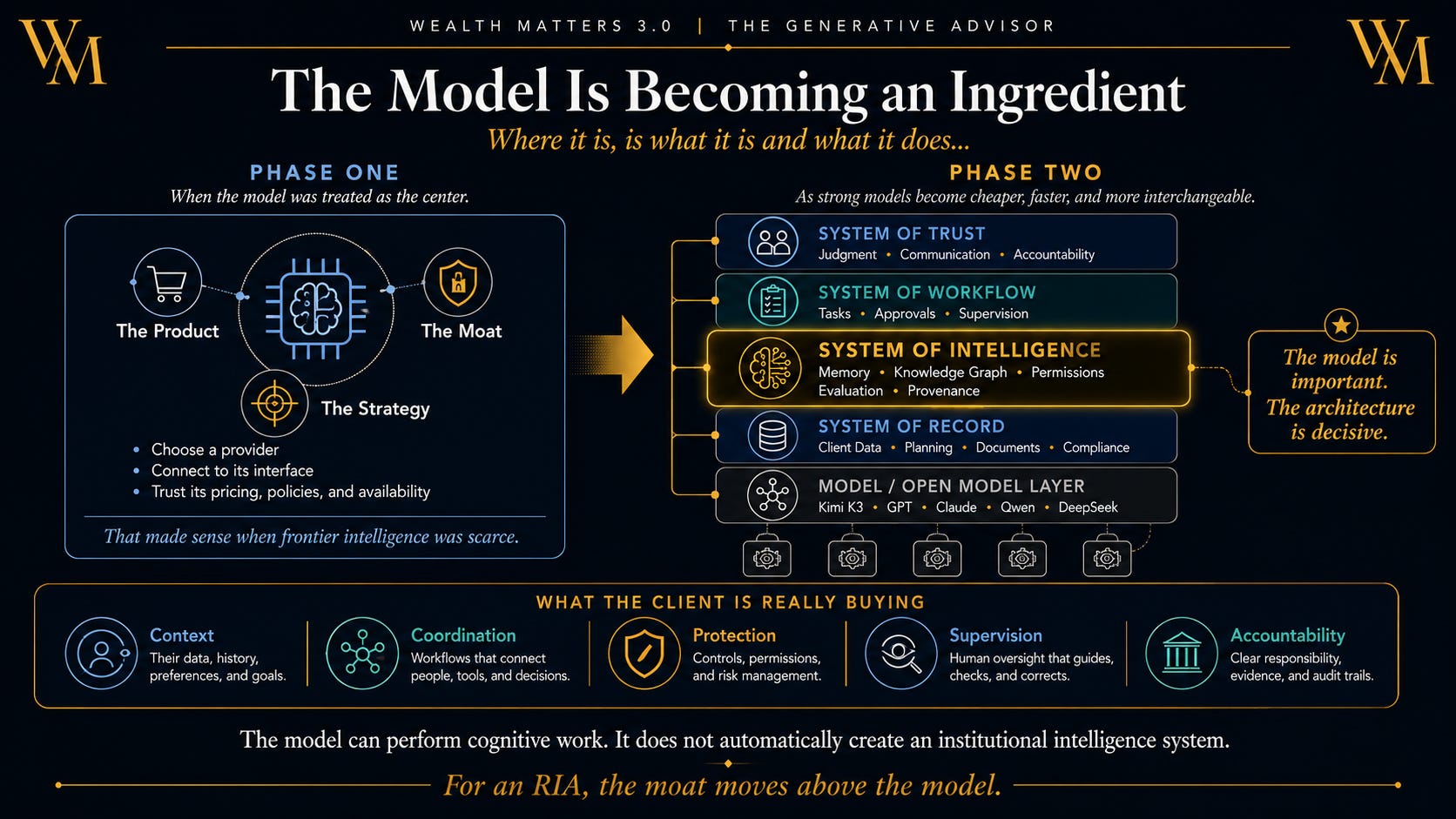
Enterprises were encouraged to choose a provider, connect their applications to its interface, and trust that the provider’s pricing, performance, availability, policies, data practices and commercial incentives would remain aligned with their own.
That was understandable while advanced intelligence appeared scarce and was controlled by a limited number of laboratories.
Scarcity is changing.
The acceptable performance floor continues to rise. Open-weight systems are becoming more capable. Specialized models can outperform larger general-purpose systems inside defined domains. Inference costs continue to compress, while new releases arrive faster than most regulated firms can procure, test, and integrate them.
This does not make foundation models unimportant. It makes them components.
A model can be exceptionally capable and still possess no durable understanding of the institution using it. It can summarize a client meeting without understanding what the conversation changed. It can analyze a trust document without knowing how that document relates to the operating company, the family balance sheet, a pending liquidity event, or the client’s previous decisions.
It can produce a recommendation without knowing whether the user requesting it is authorized to see the underlying information. It can generate an action plan without understanding which steps require legal review, compliance approval or informed client consent. It can produce a persuasive explanation without preserving the evidence necessary to reconstruct that answer later.
The model can perform cognitive work. It does not automatically create an institutional intelligence system.
That distinction matters enormously to any fiduciary advisor. The client is not purchasing text generation, better decks, or stock picks. The client is relying on the firm to maintain context, recognize obligations, coordinate professionals, protect information, supervise decisions and remain accountable for the outcome.
The Four-Layer Enterprise Stack
The emerging architecture can be understood through four distinct layers: the System of Record, the System of Intelligence, the System of Workflow and the System of Trust.
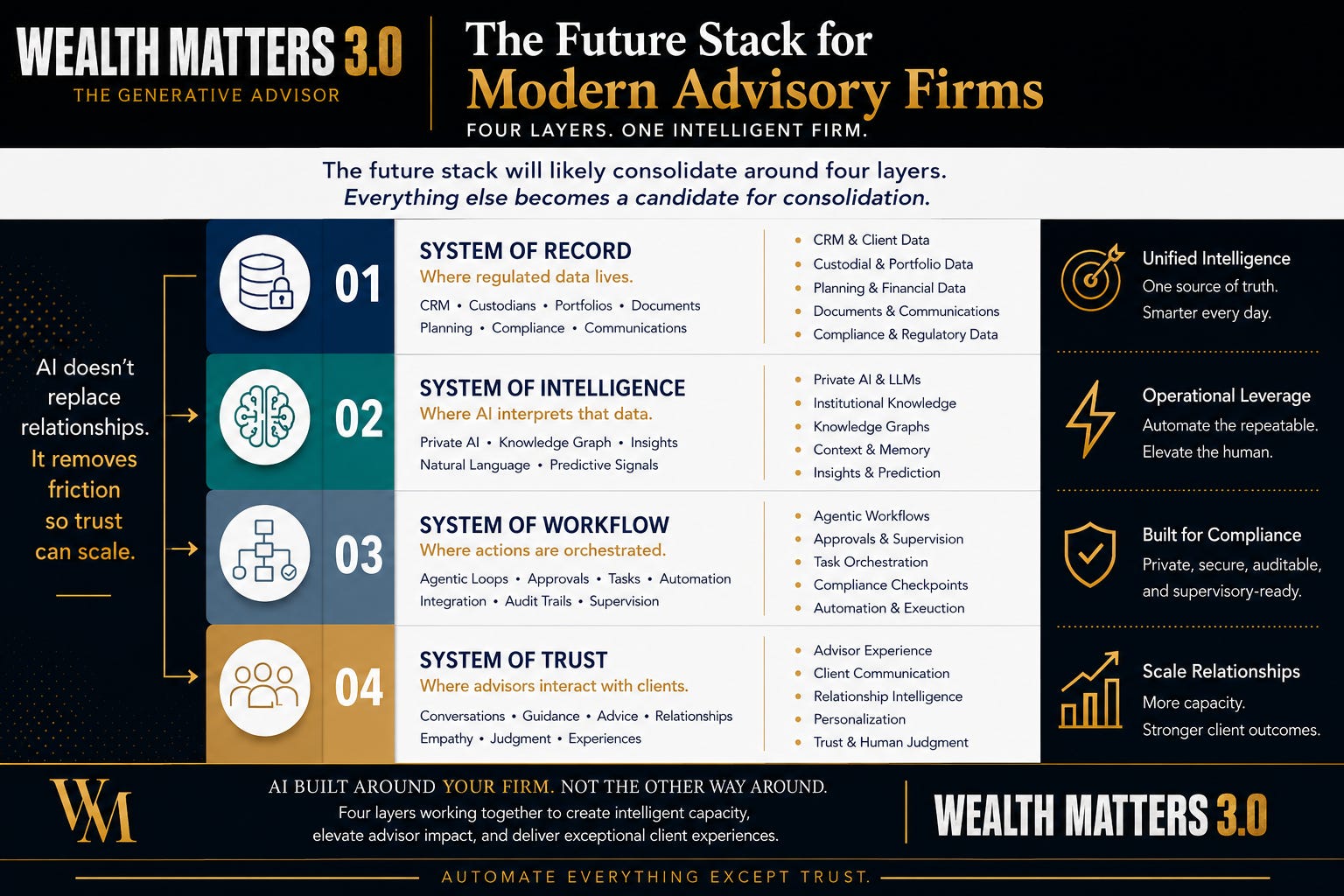
Each layer performs a different function. Each has a different responsibility. And as the architecture matures, many of today’s disconnected applications are likely to consolidate into one of these four categories.
The System of Record
The System of Record is where the institution’s authoritative information lives.
It includes client data, custodial records, portfolio information, financial plans, tax records, entity documents, ownership structures, communications, agreements, compliance files, historical decisions, and internal policies.
The System of Record tells the firm what has been stored and what is officially known. But storage is not the same as understanding.
A customer relationship management (CRM) system may record that a client owns several businesses.
A document repository may contain the operating agreements.
A planning system may contain retirement assumptions.
An estate file may contain trust documents.
An email archive may contain a conversation about selling one of the companies.
None of those systems (most of which you don’t own) was necessarily built to understand the relationship among those facts or to each other.
That understanding must be created elsewhere.
The System of Intelligence
The System of Intelligence is where artificial intelligence interprets the institution.
It is the connective layer through which private models, commercial models, and open-weight models interact with institutional knowledge, persistent memory, knowledge graphs, retrieval systems, reasoning tools, permissions, policy controls, evaluations, provenance, and predictive signals.
The System of Intelligence does not merely retrieve information. It relates information.
It recognizes that a revised operating agreement may create an estate-planning issue. It understands that a discussion about selling a family business may require coordination among the financial adviser, attorney, tax professional, insurance adviser, and investment team.
It distinguishes between something that was discussed and something that was decided.
It identifies an unresolved issue that has appeared in several client meetings without being completed. It detects conflicts among records, determines which source is authoritative and preserves the reasoning behind a recommendation.
Most importantly, it determines which model may be used for which task, against which category of information and under which permissions.
The System of Workflow
The System of Workflow is where intelligence becomes coordinated action.
Tasks are created. Responsibilities are assigned. Documents are assembled. Approvals are requested. Compliance checkpoints are inserted. Exceptions are escalated. Work is supervised, and audit trails are preserved.
Without an effective workflow layer, artificial intelligence produces answers.
With it, artificial intelligence contributes to outcomes.
That distinction matters because many firms are experimenting with systems that can suggest an action without possessing the operational controls required to complete it safely.
A useful enterprise architecture must connect interpretation to execution without allowing the model to grant itself authority.
The System of Trust
The System of Trust is where the professional interacts with the human being.
It is where advice is delivered, trade-offs are explained, emotions are acknowledged, judgment is applied, and accountability remains visible. It is where a client decides whether to sell a business, transfer control, change a beneficiary, restructure an estate or assume a risk that cannot be reduced to an optimization problem.
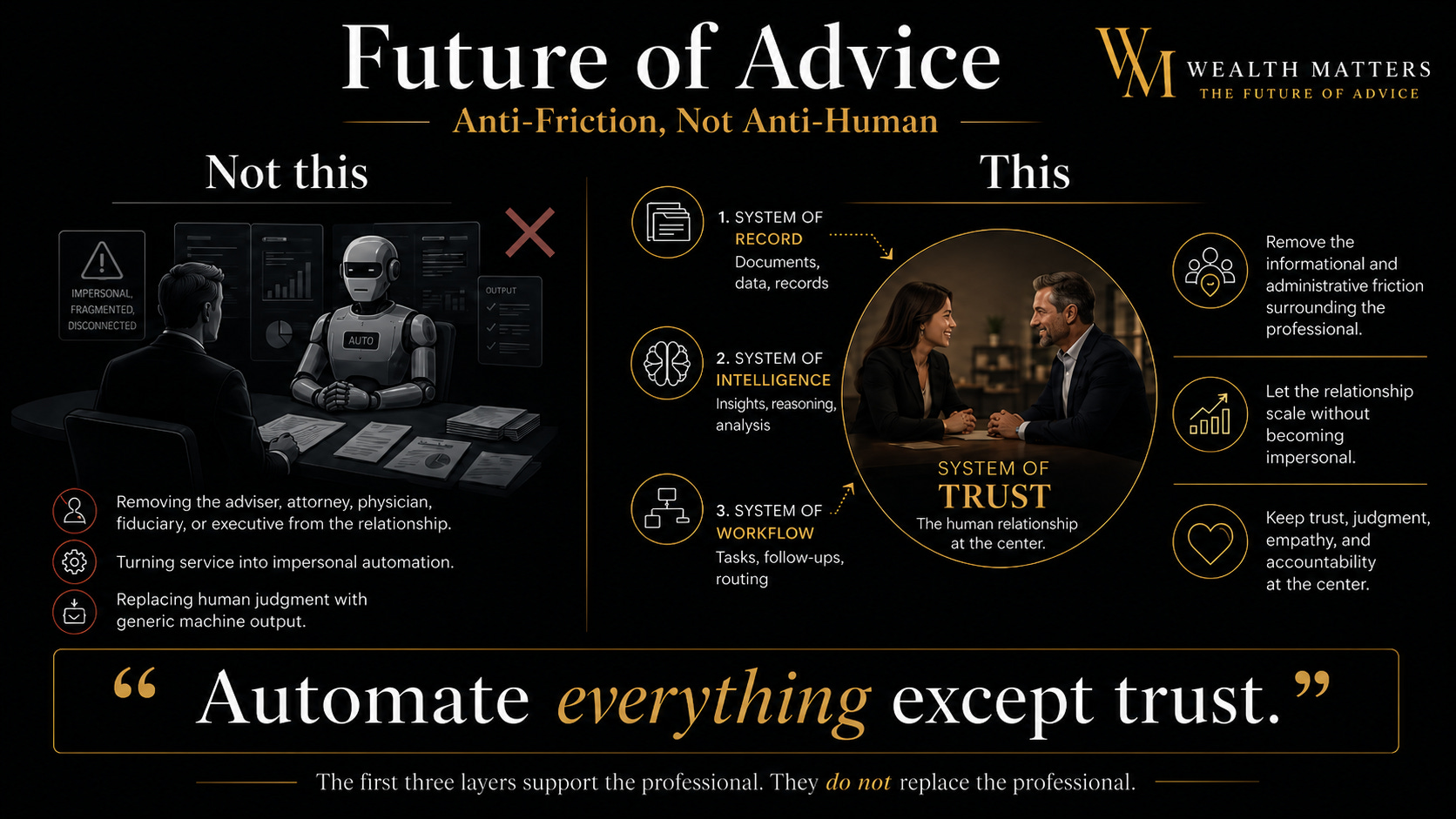
The purpose of the first three layers is not to remove the adviser, attorney, physician, fiduciary or executive from the relationship.
It is to remove the informational and administrative friction surrounding that professional so the relationship can scale without becoming impersonal.
Automate everything except trust. AI does not replace the relationship. It removes friction so trust can scale.
Why Kimi K3 Increases the Value of the Intelligence Layer (and Why You Must Own It)
A stronger and less expensive model lowers the cost of raw intelligence. Lowering the cost of intelligence does not destroy value. It relocates it.
When capable intelligence is scarce, much of the economic value belongs to the organization producing the model. When capable intelligence becomes widely available, value begins moving toward institutions that can place it into proprietary context.
That is the role of the System of Intelligence.
The model may be able to analyze a document, but the intelligence layer knows why the document matters. The model may propose an answer, but the intelligence layer determines whether the model was eligible to receive the question. The model may identify a pattern, but the intelligence layer decides whether that pattern should update institutional memory or initiate a supervised workflow.
The System of Intelligence answers questions a foundation model cannot answer on its own.
What does this institution already know? Which source is authoritative? What was previously decided? Which policies apply? Which user is authorized to make the request? Which model may process this class of information? What must remain inside the firm? Which actions require human approval? How should the output be evaluated? What happens when the model is wrong? What evidence must be retained? When should the model be suspended or replaced?
The model performs cognitive work.
The intelligence layer determines whether that work becomes a durable institutional asset or disappears as another temporary chat session.
That is the difference between renting intelligence and accumulating it.
