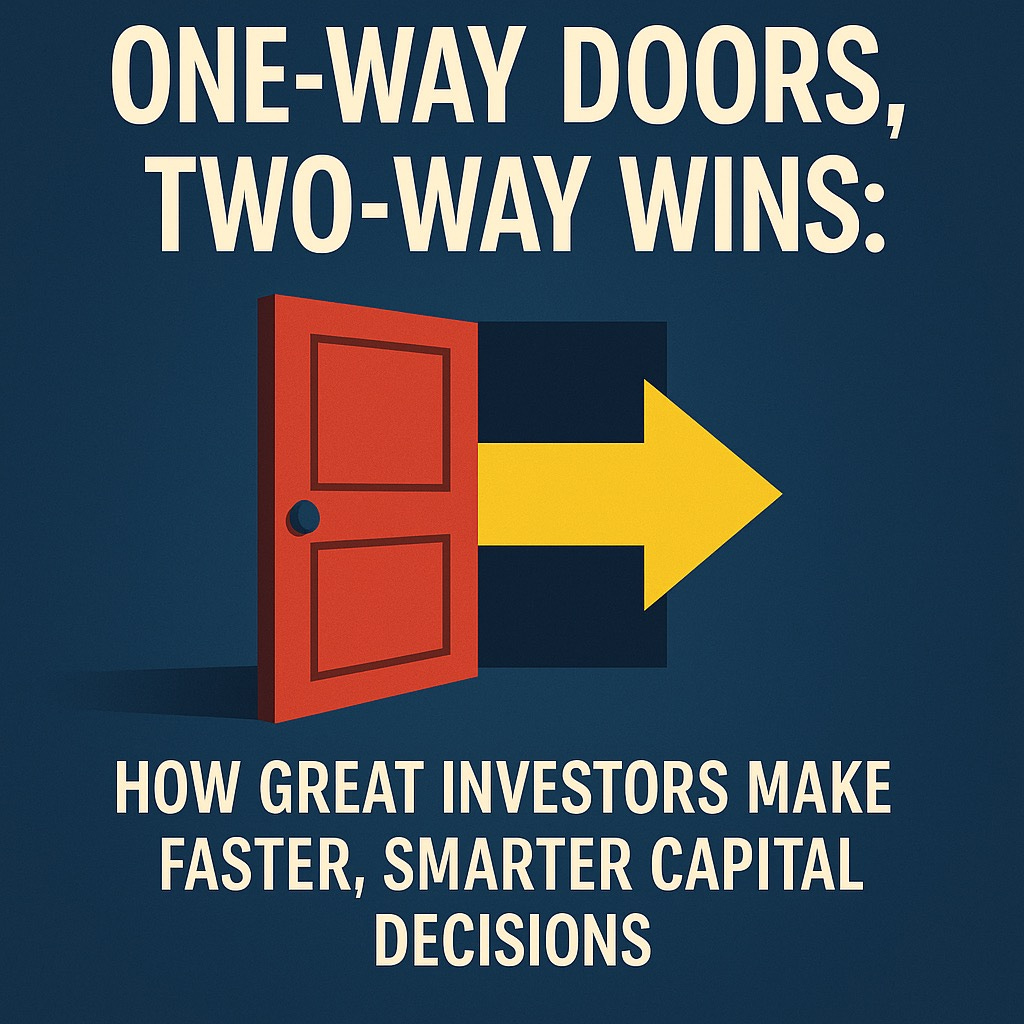
One-Way Doors, Two-Way Wins: How Great Investors Make Faster, Smarter Capital Decisions.
In venture-backed startups, Patrick Collison (Stripe) and Jeff Bezos (Amazon) mastered decision-making frameworks that unlocked staggering velocity and long-term alpha. Their method? Understanding which decisions are Type 1 (one-way, irreversible, high-stakes) versus Type 2 (two-way, reversible, lower-stakes)—and only treating the former with maximum scrutiny.
Most investors? They flip that equation. They overanalyze everything, treat every asset allocation like a bet-the-farm moment, and lose out on compounding speed and asymmetric upside.
In today’s high-volatility, high-opportunity market, that’s a recipe for missed returns.
So here’s the Investor’s Rewired Decision Framework, inspired by the best operators on the planet—adapted for those allocating capital in 2025’s macro chaos:
1. Ask First: Is This Decision Reversible?
“Can we reverse this?” – Patrick Collison
If yes: Move fast. Test. Allocate small. Iterate.
If no: Treat it like a Type 1 door. Deep due diligence. Personal sign-off. Risk mitigation strategy.
Example:
Buying a distressed asset in an Opportunity Zone? Probably reversible with tax benefits and liquidity tailwinds.
Locking up 10 years of capital in a GP fund with no liquidity windows? Type 1. Deep dive required.
2. Speed Is a Strategy
Bezos and Collison both recognized that speed compounds returns.
Stripe shipped features in days. PayPal took months.
Stripe onboarded merchants in minutes. Banks took years.
You don’t need to be reckless—but you can’t afford to be slow.
In today’s world of inflation arbitrage, tokenized asset adoption, and commercial real estate repricing, capital that sits idle loses purchasing power.
Don’t treat every opportunity like it’s your last. Run lean experiments. Place small, reversible bets fast. Then scale the winners.
3. Reserve Full Treatment for True One-Way Doors
Just like Stripe only required CEO sign-off for infrastructure changes like database architecture or payment encryption, you should:
Apply full diligence only to moves that can’t be undone.
Examples: major real estate developments, anchor LP commitments, portfolio reallocations across hard money and equity blends.
Everything else? Trust your system. Act with confidence and iterate.
4. Most Decisions Are Actually Type 2—But We Act Like They’re Type 1
“It turns out, 90% of decisions are actually Type 2.” – Jeff Bezos
Let that sink in.
You’re probably overthinking 90% of your investment calls.
That kills momentum, optionality, and deal flow velocity.
If you’re operating a fund, advising clients, or building your family office playbook—create a system to rapidly greenlight reversible moves and isolate your “bet-the-empire” decisions.
5. Final Checklist from Patrick Collison
Direct from the founder of Stripe, apply these to every major investment or capital move:
✅ Place more value on decision speed
✅ Consider the degree of reversibility and magnitude
✅ Try to make fewer decisions (focus on the high-leverage ones)
✅ Ensure there’s foundational agreement before execution
Bottom Line:
In a world of infinite noise and compressed windows of opportunity, the investors who master velocity, not just accuracy, will win.
Use one-way doors wisely.
Everything else? Step through quickly. You’ll learn more on the other side.
Yours in wealth and health,
~Chris J Snook
🧠 Subscribe for more frameworks like this and never miss a post
🟧 Bonus for all paid subscribers this week: Get the weekly early release chapter drops of my forthcoming book The Rockefeller Method Rewired plus a signed paperback copy upon its release in late Fall!


