


Executive Summary
We’re in Cambrian 2.0
Digital life is exploding.
Cloud apps, APIs, and AI agents.
New “species” every quarter.
More power, more attack surface.
Your perimeter is already gone.
Identity is the new perimeter.
IAM is the rulebook.
Who is this right now?
What exactly can they touch?
What can they change or move?
That’s identity and access management.
It’s the bouncer and the ledger.
It decides who enters which room.
It logs every move they make.
In Cambrian 1.0 (541m years ago), adapt or die.
Armor, senses, coordination, or extinction.
In Cambrian 2.0, the same story.
No IAM? No real AI.
No IAM? Regulators punish you.
No IAM? Insurers reprice you.
No IAM? Breach headlines find you.
Every new agent is new risk.
It must be tracked against its reward.
Each integration multiplies attack paths.
That’s why IAM compounds, not cycles.
It’s structural, not a feature.
AI infra spend is exploding.
Datacenters, chips, cloud, edge.
All of it pays an identity tax.
Every serious stack needs IAM baked in.
So where does capital go?
Own the control layers.
Pure-play IAM security platforms.
Cloud ecosystems where IAM is native.
AI infra that scales identity workloads.
This is the digital immune system.
This is the nervous system.
You’re not picking one shiny “creature.”
You’re owning the whole ecosystem.
You’re betting on Cambrian 2.0 continuing.
More agents, more connections,
More value at the governance layer.
If you allocate for the long game,
You need an IAM / AI-security sleeve.
Single to low double-digit sleeve.
Identity, security, and AI infrastructure core.
That’s how you own the rails.
Not just ride the hype.
If you steward family or client capital,
You can’t afford to be pre-Cambrian 2.0.
You need a map and playbook.
That’s what I’m building in public.
Wealth Matters 3.0 is for you.
HNWI, family offices, RIAs, builders.
Real frameworks, Real Conversations
Not clickbait charts.
AI, asset protection, IAM, hard assets.
How to allocate through Cambrian 2.0.
What to build through Cambrian 2.0
Want that edge before it’s priced in?
We’re living through a Cambrian 2.0 moment—an explosion of digital “life forms” in the form of cloud apps, APIs, and AI agents—and IAM is the rulebook that decides which ones survive inside your ecosystem.
In the original Cambrian explosion, once the right environmental and genetic conditions snapped into place, life didn’t just grow—it diversified violently, creating new body plans, predator–prey dynamics, and ways to move, sense, and survive in a geological blink.
Once those new forms emerged, the environment itself became more dangerous and more opportunity‑rich at the same time, favoring organisms that could adapt their sensing, armor, and coordination.
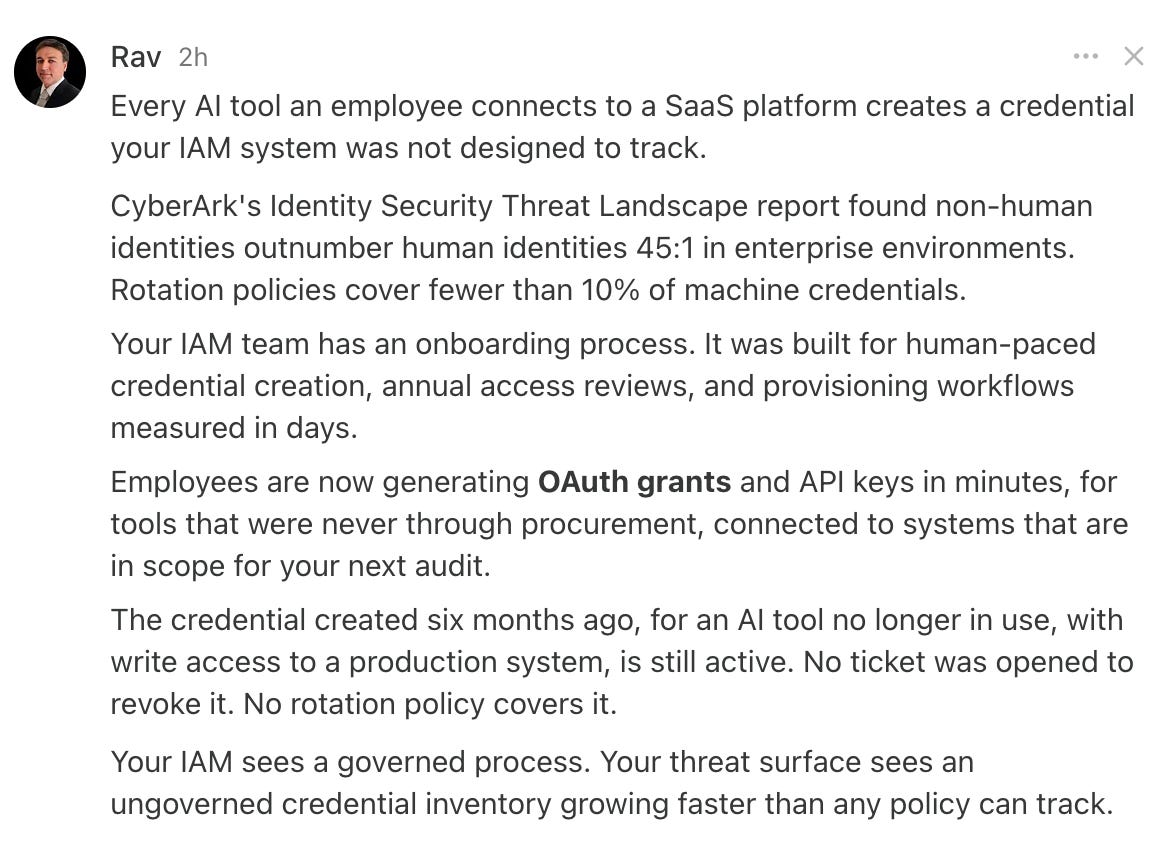
Today’s digital environment is going through the same pattern: organizations are unleashing swarms of new “species” (agents, apps, services), and the real differentiator is not any single creature, but the nervous and immune systems that keep the whole ecosystem from eating itself alive. The example below says the average enterprise IAM system is dealing with 45 non-human identifiers for every human and has no way to track their activity.
For the last few decades, most organizations have lived in a “pre‑Cambrian” digital environment: a finite set of apps, a manageable number of humans, and perimeter defenses that were crude but workable. Identity was important, but it was often treated as plumbing. Now, with cloud everything, thousands of SaaS endpoints, non‑human identities (APIs, services, bots), and fleets of AI agents making decisions and taking actions autonomously, we’re moving from a world of a few “single‑cell organisms” to a dense ecosystem of digital species interacting in real time.
In this kind of environment, the question is no longer “Is the network safe?” but “Who is this, really, and what should they be allowed to do, right now, in this context?”
That’s IAM’s role—like the genetic and developmental rules that determine which body plans can exist, how they develop, and how they interact.
In Cambrian 2.0, organizations without robust IAM can’t safely unleash AI agents on meaningful workflows, suffer more frequent and severe breaches, and get punished by regulators, insurers, and markets.
IAM becomes the rulebook and skeleton of this new ecosystem: it defines which “organisms” (humans, apps, agents) are allowed to exist in your environment, governs how they interact—who can talk to what, touch which data, or trigger which transactions—and lets you evolve safely by adding new agents and services without collapsing under emergent risk.
That’s why IAM demand compounds: each new “species” you introduce—each agent, each SaaS app—forces an upgrade in the rulebook. The richer the ecosystem, the more valuable the control plane.
For capital allocators, the Cambrian framing matters because it is structural, not cyclical; once AI agents and non‑human identities become standard, there’s no going back to simple, perimeter‑only security.
Control layers—the digital immune and nervous systems—capture persistent value, and the opportunity sits in the ecosystem:
The pure‑play IAM “organs,”
The platforms where IAM is native, and
The infrastructure that lets the immune system scale.
Your IAM / AI‑security / infra sleeve is effectively a bet that Cambrian 2.0 continues:
More species of agents,
More complex interactions, and
More value is created at the coordination and governance layers.
The Invisible Gatekeeper Powering the Next Decade of Returns
Identity and Access Management (IAM) is the invisible gatekeeper of the digital world, acting like a bouncer for all of a company’s systems, apps, and data. It checks who you are (like verifying an ID), decides what you’re allowed to access (like granting keys to specific rooms only), and records what happens to keep bad actors—and misbehaving AI agents—from slipping through.
As organizations plug in thousands of cloud apps, devices, and now AI agents, the number of “identities” explodes, and each must be authenticated, authorized, and monitored. Every human, bot, API, and model that can touch sensitive data needs rules and protections around it, and IAM is the control plane that enforces those rules. It issues digital keys, revokes them when needed, and ensures that only the right identities get into the right “rooms” at the right time across hybrid and multi‑cloud environments.
This creates a powerful compounding trend. IAM demand compounds because every new AI agent, cloud app, or connected device multiplies identity risks, requiring scalable controls to govern access safely. As organizations deploy thousands of autonomous AI systems, IAM becomes the “control plane” enforcing least‑privilege rules, just‑in‑time permissions, and AI‑specific guardrails, turning potential chaos into secure operations and resilience. The trend accelerates with the AI infrastructure boom—where poor IAM is a root cause of major breaches costing millions—driving relentless adoption as boards and regulators push toward zero‑trust architectures.
For capital allocators, this is where the opportunity lies:
