


The Core Thesis of the Series
Technology compresses routine expertise. Technology increases the value of trusted judgment.
As intelligence becomes abundant, the winning advisors will not be those who simply manage assets. They will be those who help families coordinate complexity, preserve stewardship, and build a durable operating system for wealth across generations.The Future of Advice
When I began writing this series, I thought I was writing about advisors.
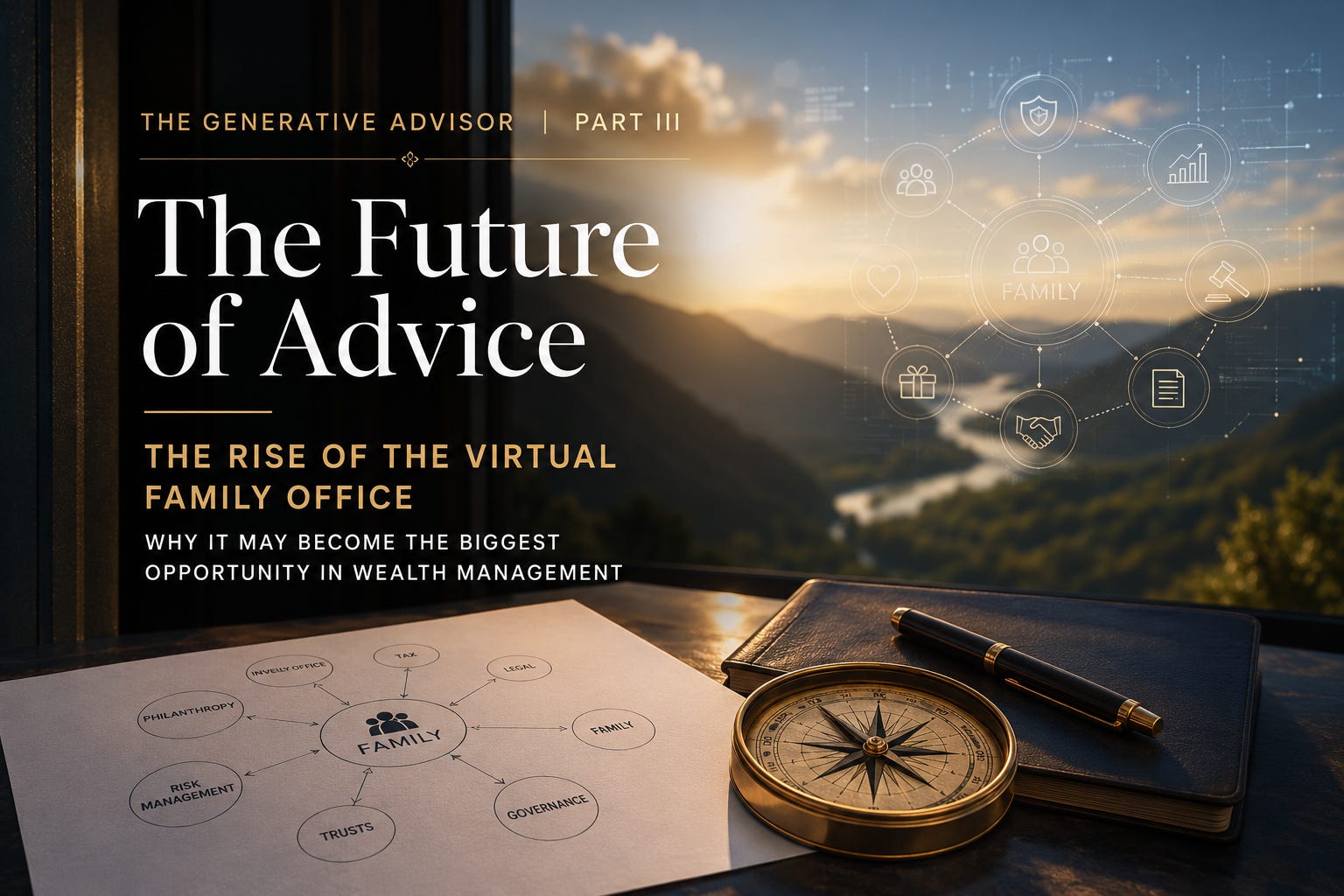
Part I argued that the most valuable asset in wealth management may no longer be Assets Under Management. It may be owning the client relationship when intelligence becomes free.
Part II explored why the firms that thrive in the coming decade may be those that automate everything except trust.
What Evolved As It Was Written
At the time, both ideas felt connected. What I didn’t fully appreciate was what connected them until I sat down to do a final edit on this third installment, this morning.
The more conversations I had with advisors, CPAs, attorneys, trustees, family office executives, and technology founders, the more I realized I was still looking at the problem from the wrong side of the table.
I was looking at the future through the eyes of the advisor, primarily. The more interesting question was what the future looked like through the eyes of the family.
That distinction changed everything.
Because families don’t wake up in the morning thinking about artificial intelligence, and actually don’t even wake up in the morning thinking about macro-economics, geopolitical chess games, or software stacks. They don’t think about CRM systems, planning software, portfolio accounting platforms, prompt engineering, or large language models.
They think about aging parents. They think about children who may or may not be prepared to inherit responsibility. They think about the pending diagnosis and uncertainty, or the list of decisions that sit six inches in front of their face that morning to make it through the day, week, or next holiday with some sanity.
They think about businesses they spent thirty years building. They think about taxes, cost of living increases. They think about if they have their house in order. Maybe then they think about:
Trusts.
Philanthropy.
Healthcare decisions.
Family dynamics.
And increasingly, they think about whether they have access to the right people and professionals (whom they can trust), and how to make sure those professionals are actually talking to one another with the same understanding of their total situation.
The longer I sat with that realization, the more convinced I became that the future of wealth management may not be about managing more assets.
It may be about coordinating more complexity, more accurately and efficiently, as the time to do all this coordination compresses and the demands on that family member’s time increase.
Because that compounding of complexity and time compression means more wrong choices than right ones in the daily decision tree and makes truth out of what Biggie Smalls famously said, “Mo-money…Mo Problems.”
That sounds like a subtle distinction. I don’t think it is. In fact, I think it may become the defining distinction of the next generation of advice.
One of the mistakes we often make when discussing the future is assuming it hasn’t arrived yet. Sometimes the future already exists. It is simply distributed unevenly.
The wealthiest families in the world solved this problem decades ago. Not with technology. Not with AI. With people. They created family offices because complexity eventually overwhelms specialization.
At some point, it no longer matters how talented your attorney is if your attorney isn’t communicating with your CPA. It no longer matters how talented your CPA is if your CPA isn’t coordinating with your trustee. It no longer matters how sophisticated your investment strategy is if no one is looking across the entire ecosystem. The family office emerged because someone needed to own the whole picture.
Someone needed to become the connective tissue. Someone needed to coordinate outcomes rather than individual tasks. Historically, that level of coordination was available only to the ultra-wealthy.
The economics simply didn’t work for everyone else. A dedicated family office required significant staffing, significant infrastructure, and significant cost. Until the AI explosion.
For most families, even affluent ones, the model was inaccessible. And yet the need was often the same.
The business owner worth five million dollars still faces succession planning challenges.
The retired executive worth ten million dollars still faces trust and estate planning challenges.
The physician worth fifteen million dollars still faces family governance challenges.
The entrepreneur worth twenty million dollars still faces cybersecurity, tax planning, insurance, legacy, and wealth transfer challenges.
Complexity Is the Enemy of Execution
The complexity exists long before the traditional family office arrives. What has changed is the economics of coordination.
This is where I believe many conversations about AI are missing the bigger picture. The most important impact of artificial intelligence may not be generating content, writing emails, or summarizing meetings.
The most important impact may be reducing the cost of coordination itself.
That is a very different proposition. And it is one that deserves careful scrutiny. Because we’ve heard versions of this story before.
The internet was going to change everything.
ETFs were going to change everything.
Robo-advisors were going to change everything.
Fintech or Blockchain was going to change everything.
Some of those innovations mattered enormously. Others mattered less than their advocates predicted.
The skeptic is right to be skeptical.
