


The Generative Advisor Series — Part I of III
For decades, the wealth management industry has measured success using a simple scorecard. Assets Under Management (AUM). AUM became the proxy for trust. The proxy for scale. The proxy for enterprise value. The proxy for influence. The proxy for success. The seed ingredient for fee generation.
Entire firms were built around gathering assets. Entire compensation systems were designed around gathering assets. Entire acquisitions roll-up strategies were valued around gathering assets.
But every industry eventually reaches a moment when the metric it optimized for stops telling the whole story.
I believe wealth management is approaching that moment now. Don’t get me wrong, AUM still matters, and the data shows that total AUM will continue to grow at a CAGR of 10.9% through 2032, but the continued fragmentation of the industry and confusion over how to best implement a compliant AI strategy, workflow improvements, and retain the downstream generational relationships that will direct that AUM beyond 2032, is the bigger and more important story.
Because for the first time in modern history, intelligence itself is becoming abundant. And when something becomes abundant, something else becomes scarce.
The firms that understand what is becoming scarce will define the next era of advice, hold off fee compression forces, and build the premium value firm with a strong moat optionality in the years to come.
Three favors before you continue
Hit the ❤️. The algorithm is a slot machine, and hearts are its quarters.
Hit the 🔄 restack. Somebody in your network is two weeks into the beach, watching stocks wiggle, wondering what they were created to do. Get them up or their advisor up to speed.
Hit 📤 share. You know exactly one person who needs to start the daily phone call before it’s too late. Send them the Interlude.
Drop a comment. Tell me your “aha” moment, or the lesson somebody taught you about the future when you were ten. I read every one, and I reply to the ones that make me laugh, make me think, or make me money. Preferably all three. Now, let’s get you back to your regularly scheduled program.
The Last Time This Happened
When the internet arrived, information became abundant. Before the internet, advisors possessed a genuine information advantage.
Research reports.
Market data.
Economic analysis.
Industry intelligence.
Access itself created value. Then the information became free. The advisors who survived weren’t the ones who possessed information. They were the ones who provided interpretation (The sensemakers).
Then the mobile web arrived. It was at this point that access became free. Again, value shifted.
Then cloud computing arrived. Infrastructure became abundant and cheap, unlocking scale. Again, value shifted.
Now, AI is creating another shift. This time, the scarce resource isn’t information, access, or infrastructure…It’s intelligence. The ability to summarize. Analyze. Compare. Draft. Research. Model. Reason. And recommend.
Tasks that once required highly trained knowledge workers are becoming increasingly accessible. Not because humans became smarter. Because intelligence became cheaper.
That changes everything.
The Wrong Question
Most advisors are asking:
Will AI replace advisors?
That is the wrong question. The better questions are:
When intelligence becomes commoditized, what remains valuable?
How do we rewire our workflows, operational stack, and team members to deliver uniquely against that new value shift?
What need states will our human customers still have, and what frees us up to spend the majority of our time filling those needs better than any alternative?
Who ultimately “owns” the client experience in our business? Us or our vendor stack? What parts must we “own” and what do we happily “rent”, and how do we stay nimble and tool agnostic?
Because history suggests the answer is never the thing being commoditized. It is the layer above it. For instance:
When information became abundant, interpretation became valuable.
When access became abundant, experience became valuable.
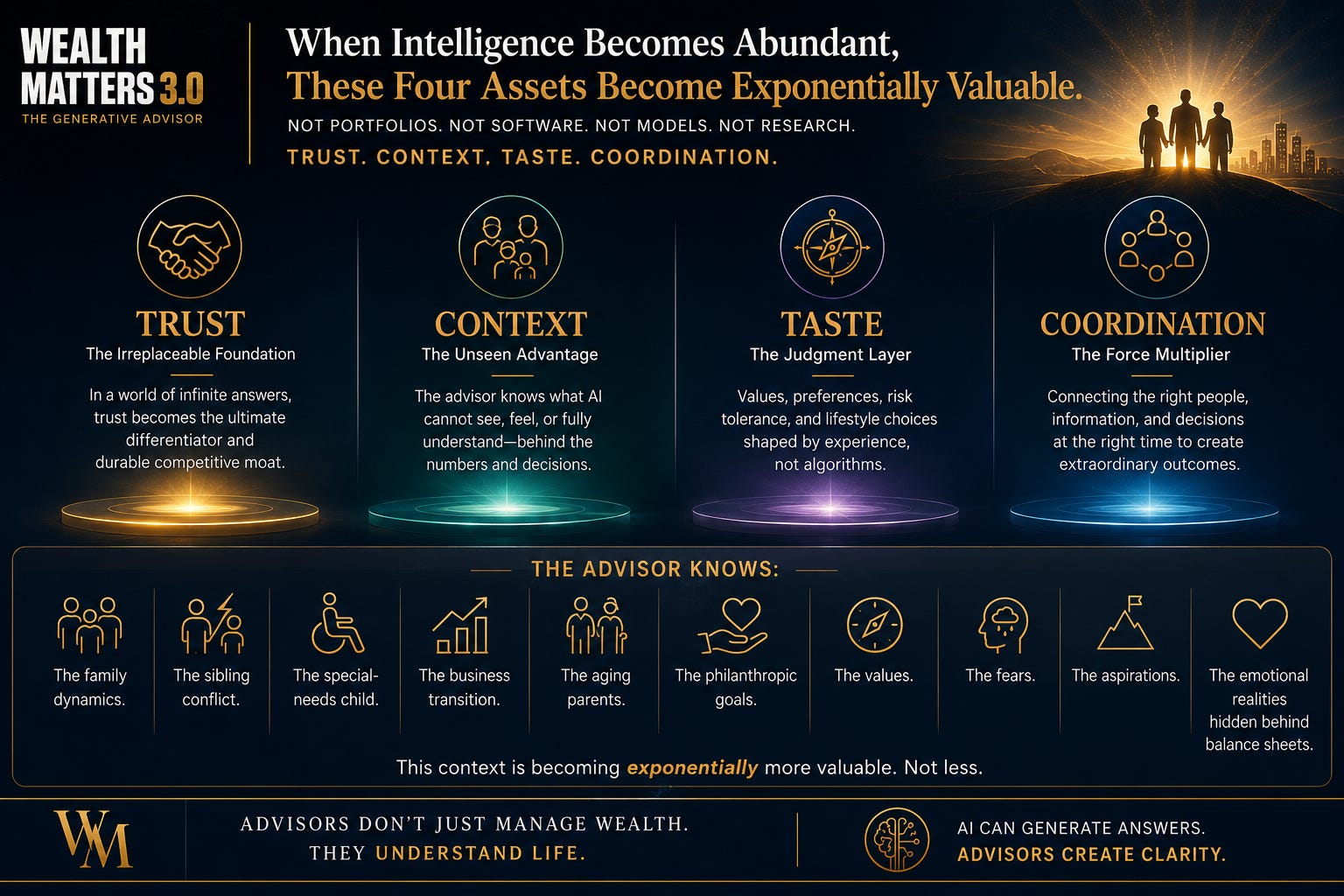
When intelligence becomes abundant, trust becomes valuable. So does context. So does Taste. So does coordination.
Those four assets (trust, context, taste, and coordination) may become the most valuable assets in wealth management.
Not portfolios. Not planning software. Not investment models. Not research.
Trust. Context. Taste. Coordination.
Why the Industry Is Looking the Wrong Way
Most AI conversations today focus on tools. ChatGPT. Claude. Copilot. Agents. Automation. Prompting. Productivity. Those conversations matter.
But they miss the bigger story.
AI is not primarily a software revolution. It is a labor and workflow revolution.
For the last few decades, The $7-rule has applied. Businesses spent one dollar on software and roughly six dollars on people, implementation, administration, consulting, operations, compliance, support, coordination, and execution.
The software market was (and always has been) smaller than the services market. Much smaller.
The reason investors are so excited about AI, isn’t because AI creates better software. It’s because AI may begin absorbing portions of the service layer.
That means every advisory firm should be asking:
Who owns the service layer once intelligence becomes abundant?
Because whoever owns that layer may own the client relationship and the lion’s share of the fees that come along with it.
