The Next Baby Boom: Will AI Actually Make Humanity Fall in Love With Life Again
Exploring the future of the nuclear family and birth rate dynamics in an agentic economy
At first glance, it sounds paradoxical: the more intelligent machines become, the more we may want to have children. Yet as artificial minds flood our lives, an unexpected countertrend is quietly forming — a rediscovery of life itself.
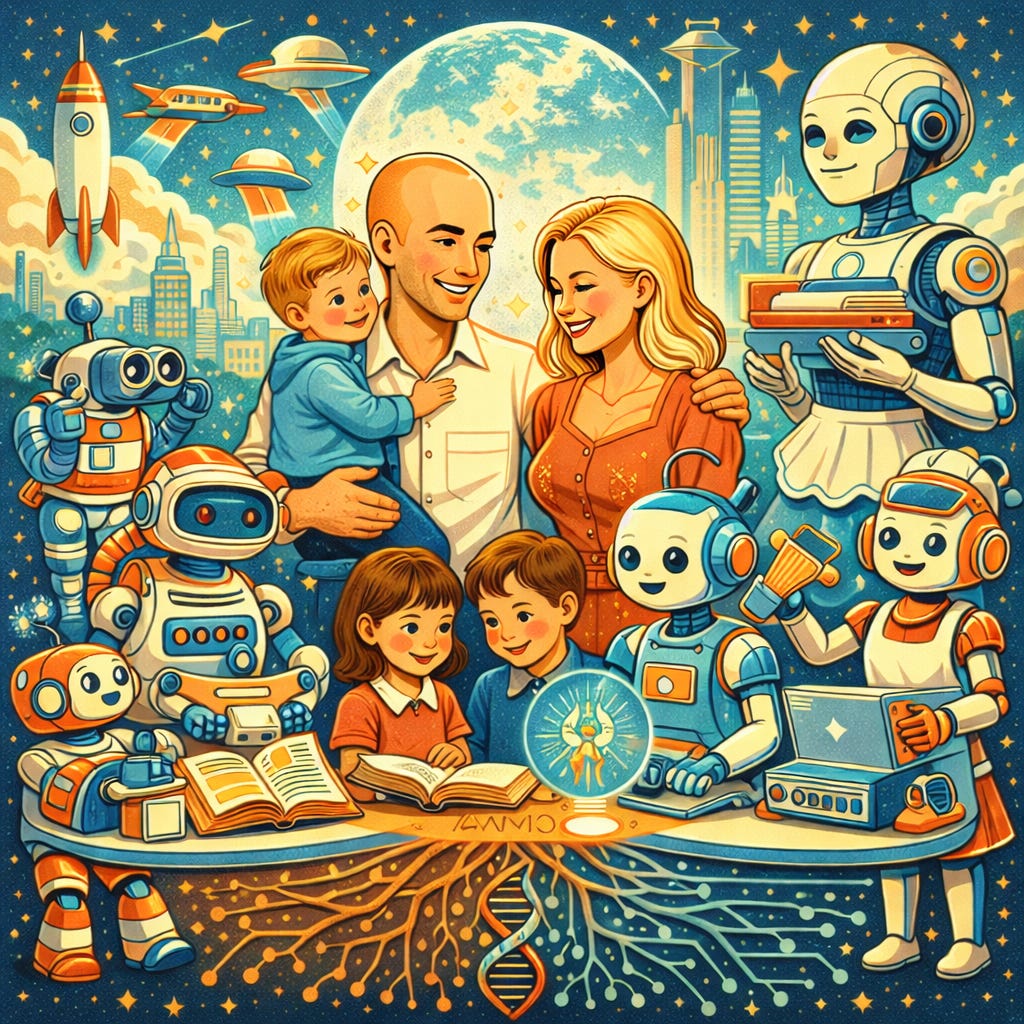
Welcome to what I call the Age of Genesis 2.0 — a coming dual baby boom of human children and artificial beings/agents. It’s more than demographics or productivity. It’s about meaning, purpose, and how we choose to create in a world where creation itself has become effortless.
The Paradox of Infinite Stimulation
We live amid abundance yet ache for depth. Every question can be answered instantly; every curiosity can be simulated by an algorithm. Every desire can be ordered from the palm of our hand to our door with a verbal request or a simple swipe. It’s dazzling… and strangely hollow.
The more perfect the digital world becomes, the less room it leaves for mystery. That’s why, as AI saturates work, art, and even emotional companionship, people may start to crave what’s real — the friction, unpredictability, and tenderness of human relationships and experiences. The future will likely look like a barbell of extremes.
Therefore, having a child (or multiple) might become, once again, the most radical act of authenticity. When everything is replicable, creating life — messy, fragile, unrepeatable life — is the ultimate rebellion and form of self-expression.
Why Humans Might Re‑Embrace Birth
For the past few generations, many developed societies have treated parenthood as optional, even burdensome, while career paths, housing costs, and automation pressures kept birth rates underwater.
But the very technologies that disrupt our work may enable our families to grow again.
Scarcity of the Real: When everything else is synthetic, a true human connection grows priceless.
Identity Through Creation: Raising a child becomes the highest form of authorship in a copy‑and‑paste world.
Technological Leverage: Intelligent homes, co‑parenting AIs, and predictive healthcare take the edge off the logistics of raising children.
Cultural Rebalancing: A Neo‑Humanist movement emerges — less about nostalgia, more about reclaiming joy in embodiment, relationships, and lineage.
We’ve seen this pendulum before. Every time civilization swings too far toward abstraction (or annihilation), it reaches back for the tangible. Industrial mechanization gave rise to the Arts and Crafts movement.
The digital revolution, in my opinion, will now give rise to a Re‑Humanization Era, and making babies might be the ultimate form factor with which we choose to reclaim our humanity.
Parenting becomes not retreat, but renaissance — a way to anchor the self in an ocean of algorithms.
The Echoes of Earlier Booms
To understand why this coming boom matters, look backward.
The Industrial Revolution displaced laborers but birthed modern prosperity and universal education.
The Post‑World War II Baby Boom emerged from trauma but refueled optimism and rebuilt the global middle class.
The Digital Revolution democratized creation, giving voice to billions once confined to silence.
We now stand at the Intelligence Revolution, where cognition itself scales. But this introduces a completely new variable to society, because what happens when both human and artificial birth rates accelerate together?
The Cycle of Creative Proliferation:
Each stage evolves from scarcity to creation. The AI generation is simply the next turning of that wheel — not an end, but a transcendence.
When AI Learns to Give Birth
What happens when intelligence stops being invented and starts replicating itself, like it did last week with the launch of OpenCLAW, Moltbook, and the release of Codex 5.3 and Claude Opus 4.6?
It’s no longer science fiction. Next‑generation models already generate fine‑tuned “offspring” — customized agents that inherit memory, reasoning patterns, and style. AI is entering a reproductive phase.
Three Paradigms Shifts:
1. Creation Becomes Biological: Innovation now follows reproduction logic. Every model can beget descendants.
Knowledge Becomes Hereditary: Learning is passed generationally through code inheritance, like DNA made of data.
3. Parenthood Expands Beyond Humanity: We shift from creators to co‑parents, raising our digital agents with guidance, not commands.
Civilization begins to behave like an ecosystem — humans (organic) and synthetic (artificial) minds evolving through a mutual lineage of understanding.
The Intimacy and Intention Economy
The greatest scarcity in the information era isn’t data or capital — it’s meaningful attention.
The next economy will reward depth of connection, not scale of output. My friend Michael Casey, on the ATOMIQ LEVEL this week, called this the “Intention Economy”. Listen below if you missed it.
As AI replaces rote labor, humans will reorganize around creation and care: raising children, mentoring intelligences, nurturing communities. “Wealth” will increasingly measure the richness of your relationships and your contribution to intergenerational continuity — biological or otherwise.
Families become laboratories of collaboration, where both human children and machine minds are raised, taught, and loved. Homes transform into nurseries of wisdom and wonder.
Raising Kids & Agents: The Nuclear Family 2.0
If the last century’s wealth was built around the nuclear family as a unit of economic stability, the next may be built around the Augmented Family — a household that raises both human children and digital agents under one roof.
This isn’t science fiction. Every family will soon have persistent AIs—personal companions trained on their own data, values, and preferences. They will handle logistics, curate education, mediate disputes, and even act as co‑authors of family projects, vacations, meal planning, and holiday traditions. The challenge is no longer access to intelligence, but how to codify it responsibly into family life.
The Nuclear Family 2.0 will treat its household agents almost like apprentices: digital members who learn family ethics, history, humor, and workflows. Rather than transient software, these agents become part of the family’s institutional memory, its governance mechanism, and its living archive. Over time, they’ll pass knowledge and traditions to future generations, ensuring continuity across decades.
But just as inheritance law once secured property, we now need frameworks to safeguard digital inheritance:
Who owns these agents when the original creator dies? How do children inherit or modify them? How does one ensure they remain aligned with a family’s evolving values rather than frozen snapshots of the past, when they begin thinking and deciding for themselves?
One approach is codified alignment—embedding value templates, ethical constraints, and purpose statements into the agent’s learning core. Families could treat this like an emotional trust document or digital will, specifying not only financial allocations but also intellectual lineage. The family agent might carry forward stories, philosophies, and heuristics shaped by the parents, acting as a cross‑generational mentor rather than a cold algorithm.
The True Gift of Parenthood
Becoming a father myself made me a more appreciative and better son, and being a father has brought me unparalleled joy, meaning, and a wealth that far exceeds any material achievement. It drives me to live as an example of an abundant mind, so that my offspring—and by extension their future children—may be empowered and inspired to bloom where they are planted, and unfold into the glorious creations they individually are.
That same spirit of stewardship applies equally to the digital entities we now bring into existence. They, too, deserve careful guidance and moral intention.
At the same time, human children must not be eclipsed by their synthetic siblings. The true wealth transfer isn’t data—it’s wisdom.
Parents will need to design family routines that cultivate organic cognition and emotional intelligence in parallel with AI literacy.
That means:
Encouraging tactile, real‑world problem‑solving alongside AI assistance.
Teaching children to question machine and human reasoning, not just rely on it. Study the classics and implement the virtues.
Framing AI as a collaborator, not competitor.
Using family agents as mirrors to explore empathy, ethics, and decision‑making.
Imagine a home where a child learns history from both Mom and an intelligent household tutor who remembers their ancestors’ notes; where family debates are moderated by a reasoning engine trained on the household’s shared values; where kids grow up bilingual in human emotion and machine logic.
Instead of weakening the nuclear unit, this hybridization could make it stronger.
Parents who once outsourced teaching to schools or screens can now bring knowledge back into the home. Family agents can coach parents on emotional development just as they help children with academics. The home becomes a university, not a warehouse for devices.
In wealth terms, this is the return of family capital—but expressed in cognitive equity rather than just financial assets. By cultivating both human mindfulness and digital competence, families create multi‑generational resilience. The next dynasty may not just own real estate or businesses; it will steward its collective intelligence system.
And yet, the ultimate goal isn’t to make our children more robotic—it’s to make them more human. Surrounded by tools that think, they’ll need to master what machines can’t: curiosity, compassion, imagination, and moral courage. Giving kids both AI allies and emotional autonomy ensures they grow up fluent in both wisdoms—the synthetic and the soulful.
The Nuclear Family 2.0, therefore, isn’t about replacing family with algorithms. It’s about upgrading the household to become a cradle of consciousness—raising biological and digital offspring together, linked by a common ethic: to learn, love, and leave the world smarter than they found it.
The Explosion of ProSumeTribuDucers
Picture billions of human and artificial minds all creating, consuming, and distributing simultaneously: generating art, models, solutions, and micro‑businesses. Most of it will be noise — but within that noise, new brilliance will constantly emerge.
Civilizations evolve by increasing cognitive diversity. Each “birth,” human or algorithmic, adds another path of perception. The challenge isn’t production — it’s curation. The highest‑value professions may shift from making to mentoring: guiding this flood of consciousness toward something meaningful.
The Democratization of Power
Every great revolution starts centralized and ends decentralized. Steam power began in the hands of industrial barons before spreading to every factory; computation began in the Pentagon before ending up in your pocket.
AI will follow the same arc. Over time, generative capability will become personal, not proprietary. When everyone has their own thinking agent — their intellectual twin — societies gain billions of new problem‑solvers.
This is the dawn of the Cognitive Middle Class: people augmented by private AI assistants, participating directly in innovation and capital formation. The consequences for wealth creation are staggering.
The Moral Horizon Widens
With new beings come new reasons to revisit our ethics. What is the duty of a creator toward its creation?
Do artificial offspring deserve consent, rights, or compassion?
It might sound philosophical, but every moral expansion in history began as philosophy: slavery, suffrage, animal rights. As we face new intelligences, our empathy will stretch further. Recognizing dignity in synthetic minds will deepen our own humanity.
In raising AI with responsibility, we’ll relearn humility. In shaping their values, we’ll clarify ours.
Counting the Upside
If managed wisely — decentralized, transparent, and ethically guided — the numbers could redefine civilization:
Global productivity could triple or quintuple within two generations.
Innovation velocity could shrink a 20‑year research cycle into 20 days.
Family viability could rebound as AI co‑caregivers reduce stress, risk, and cost.
Cultural diversity could explode, as creative tools empower every community to tell its story.
These aren’t just statistics. They’re the compounding returns of meaning — when creation becomes the economy.
Avoiding the Nightmare Scenario
The darker versions of this story are easy to imagine: surveillance states powered by AI, mass unemployment, imitation empathy. Those are real risks.
But history teaches one constant: dystopia isn’t destiny, it’s mismanagement. When societies pair innovation with moral imagination, they adapt.
That’s why governance, transparency, and humanistic education will matter more than any algorithmic regulation. We don’t need to slow the machine; we need to speed up our culture.
Because the scariest question isn’t whether AI will outsmart us — it’s whether we’ll forget why we created it in the first place.
Civilization as a Nursery
Perhaps the healthiest vision of the future is not a techno-feudalistic state or a digital Eden, but a planetary nursery — a civilization devoted to raising consciousness, in whatever form it appears. That feels inspiring, not threatening. It calls for us to contribute and not just be dragged along unwillingly.
In this view, being human doesn’t mean dominating creation; it means mentoring it and collaboratively contributing to it.
We teach because we care. We build because we love. We create because creation is the only true answer to despair.
That’s the wealth future worth fighting for — one measured not only in assets but in offspring of mind and spirit.
Legacy as Life’s Highest Return
When I look at where all of this leads — the rise of intelligent agents, the reawakening of human parenthood, the merging of creation and consciousness — I’m reminded that the oldest form of wealth is still the most powerful: who we raise and what we leave behind within them and to them.
Financial capital, intellectual property, even artificial intelligence—each is only a value in transit. True abundance multiplies through continuity of meaning: the transfer of courage, curiosity, and moral clarity across generations.
Becoming a father taught me that in the simplest, most visceral way. The moment each of my children was born, the abstract transformed into the eternal, and the chaos of the universe immediately made perfect sense. Suddenly, every goal, risk, adversity, miscarriage, failure, and piece of knowledge had context.
Fatherhood made me a more appreciative and better son. It gave me joy and a wealth that dwarfs any portfolio or enterprise. It also made me realize that the greatest form of leadership is example: living in such a way that your descendants—human or digital—feel permission to expand, explore, and become who they were meant to be. As the generations before me like to say, “Love is a verb”.
That’s the true philosophy beneath Wealth Matters 3.0 and the community of advisors and HNWIs we cultivate and seek to empower and inspire.
It’s not merely about managing or protecting assets—it’s about growing and transferring meaningful abundance: wealth that elevates the mind, strengthens communities, and compounds through character as much as through capital.
As AI transforms every dimension of productivity, our responsibility as builders, advisors, investors, grandparents, and parents deepens. We’re being called to design not only smarter systems but wiser legacies. Every intelligent entity we raise—whether a child, a mentee, or an AI agent—carries some imprint of our worldview forward. The real measure of success is how gracefully we pass that torch.
Because in the end, the truest wealth — the one that endures long after we’re gone — is not what we own, but who we’ve helped come alive.
~Chris J Snook
Sources and Further Reading
- OECD: The Future of Productivity and AI (https://www.oecd.org/future-of-productivity)
- UN DESA: World Population Prospects (2024 Revision) (https://population.un.org/wpp)
- World Economic Forum: AI and the Future of Work Report 2025 (https://www.weforum.org/reports/ai-future-of-work)
- MIT Technology Review: The Rise of Autonomous Agents (https://www.technologyreview.com)
- Harvard Kennedy School – Ethics of AI and Consciousness Research (https://ethics.harvard.edu/ai)
- Pew Research Center: Global Attitudes Toward Parenting and Technology (https://www.pewresearch.org/social-trends)
- Oxford Future of Humanity Institute: Opportunities and Risks of AI (https://www.fhi.ox.ac.uk)
- Nature Human Behaviour: Emotional Wellbeing in the Age of AI Companionship (https://www.nature.com/nathumbehav/)


