


Why Non-Technical Businesses Must Rewire Their Operational and Hiring Mindset Immediately.
If you have spent the past 20 or 30 years building a business, much of its most valuable intelligence probably doesn’t appear anywhere on your balance sheet. It lives in the heads of your employees, in the history of your customer relationships, and in thousands of decisions you’ve made along the way. This kind of knowledge is known as tacit knowledge. It is your greatest strength and also every succession plan’s greatest liability.
Artificial intelligence now creates an opportunity to turn portions of that accumulated knowledge into something your business can own, operate, improve, and eventually transfer to the next generation or a buyer.
This isn’t another article about using ChatGPT or Claude to write emails faster. It is about an emerging category of enterprise value I have been calling Intelligence Under Management (IUM™) and why your future wealth may increasingly depend on how much of it you directly control.
Whether you own a small business, a professional services firm, or you own a $6 million vineyard with a tasting room, or a $35 million per year agricultural operation, the opportunity is closer and more practical than you might think. This article is specifically for you-the operator.
Your Next Employee May Never Need a Desk. But Who Will Own What It Knows?
I want you to look at the picture below.
The workstation on the left is my actual desk. I stare at five screens every day once the laptop is opened. My human eyes and ears scan each for relevant outputs that inform my workflows.
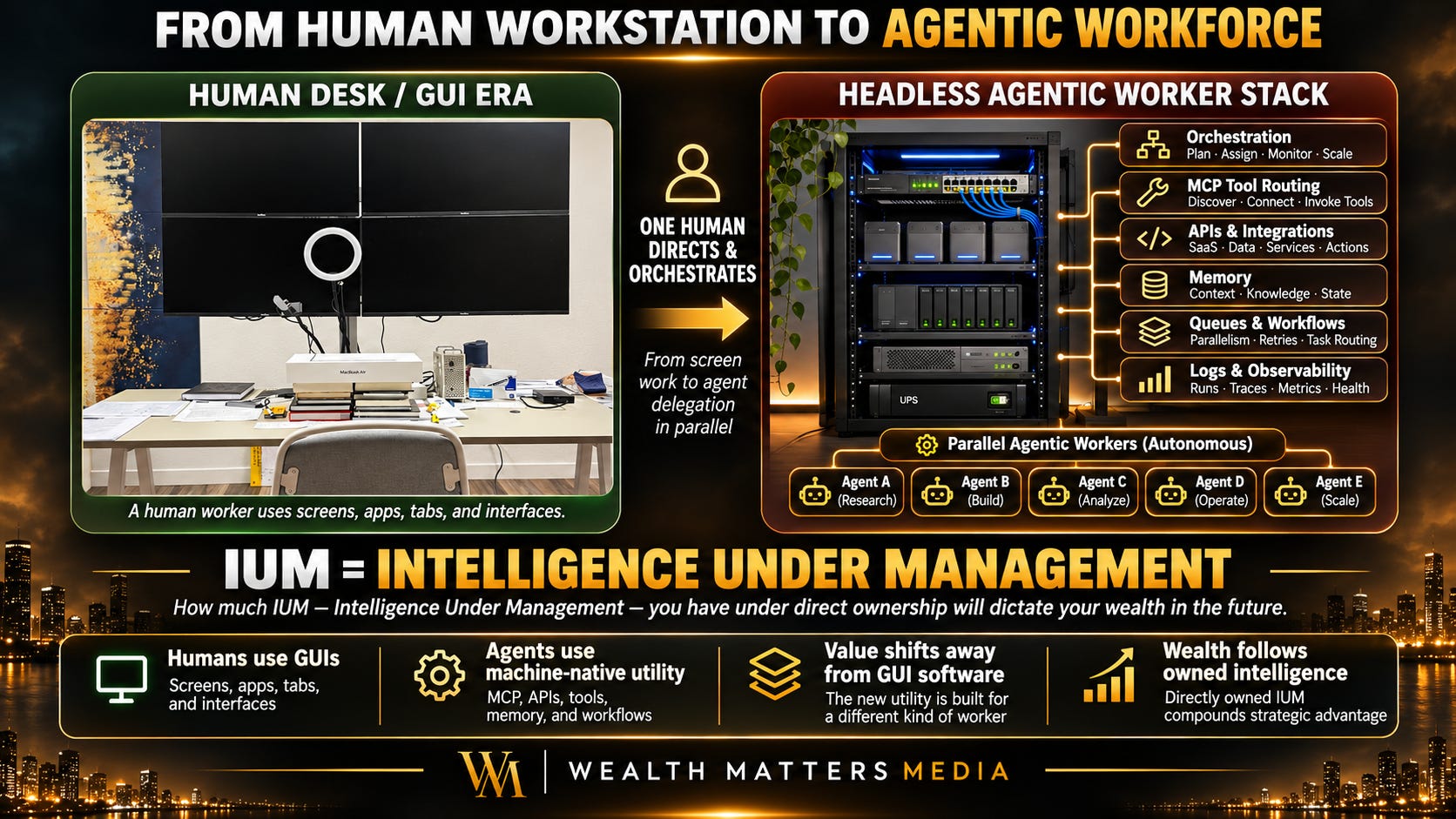
Four monitors. A laptop. A ring light. A camera. Notebooks, paperwork, and enough cables to remind me that even after decades in technology and entrepreneurship, I’ve still managed to create a small jungle of hardware in the name of productivity.
Four Favors Before You Continue
Like this post (the algo is bloodthirsty for cheap dopamine)
Restack it. (Someone in your network could get value from this, and I’d love to have them in the Wealth CMDR community).
Leave a comment and join the discussion. Ask a question, disagree with a well-constructed counterpoint or argument so that the conversation becomes more valuable.
Subscribe and Upgrade. This newsletter and its associated podcast are 100% reader/listener supported, and I serve you and your intellectual curiosity exclusively. Your patronage increases my ability to do research and produce more episodes.
This is where I spend a significant part of my working life researching, writing, producing media, developing businesses, communicating with partners, and making decisions.
Until recently, I would have considered those four monitors a competitive advantage. More screen real estate meant more applications, more information, and presumably more things I could manage at once.
Then I started thinking about something that should change how every business owner approaches their next technology investment.
Why am I still organizing work around the number of screens a human can watch when the next generation of workers doesn’t need screens at all?
Look at the right side of the image. No chair. No keyboard. No monitors. No graphical user interface.
Just computing infrastructure, secure connections, memory, tools, workflows, and specialized AI agents capable of executing different units of work simultaneously.
That rack is a visual metaphor, not a requirement to purchase servers. Your agentic workforce might operate on infrastructure you own, in a secure cloud environment you lease or own, or across both.
But the distinction matters.
The workstation on the left was designed to help one human operate multiple software applications. The system on the right is designed to let one human direct multiple nonhuman (agentic) workers, who don’t have eyes or ears, and work completely differently than we ever will, and soon will outnumber us in the workforce by a factor of 100-1000 to 1. That is the leverage now available to every one of you reading this.
But this isn’t just a different technology architecture. It’s a different economic model, and I believe it’s going to change how we think about enterprise value, human capital, succession, and generational wealth forever in the next 12 months.
The Wealth You Built Is Sitting in Places Your Balance Sheet Cannot See
Now, think back about the business you’ve spent 15, 25, or perhaps 40 years building.
You probably know which customers are going to become difficult before anyone else notices. Your best salesperson understands which conversations indicate serious buying intent. Your operations manager knows which suppliers can be trusted when things go sideways.
Your longest-serving employees know a thousand little things about how your business actually functions that nobody ever thought to write down.
Somewhere along the way, you created an enormous collection of what researchers call tacit knowledge or what I call context.
It’s the knowledge, emotional intelligence, and pattern recognition gained through experience that isn’t easily captured in a manual, spreadsheet, or CRM. And for most owner-operated businesses, it represents a considerable amount of value that remains largely inaccessible to anyone outside the people carrying it.
Now consider what happens when the founder retires. Or the veteran employee leaves. Or the company gets acquired, and the buyer discovers that its most valuable operating procedures were never documented.
A surprising amount of the intelligence that made the company successful can walk out the door.
We have spent decades trying to solve this with documentation, training programs, succession plans, and increasingly sophisticated software.
Those approaches still matter, but we now have another tool available.
We can begin building systems that preserve institutional context, retrieve accumulated knowledge, support decisions, and use specialized AI agents to perform authorized work.
This is what I mean when I talk about moving beyond software subscriptions and toward an owned system of intelligence.
Let me give you two examples from industries that, on the surface, might seem far removed from the AI revolution to better illustrate how you can arbitrage the bits and atoms in your business.
A $6 Million Vineyard: From One Tasting Room to an Owned Intelligence Workforce
Imagine you own a vineyard and winery generating $6 million annually. I am surrounded by these in the Central Coast of California.
You have one tasting room, a successful direct-to-consumer wine club, local restaurant relationships, regional distributors, and perhaps a few dozen employees across hospitality, winemaking, administration, sales, and operations.
You’ve spent 25 years building the brand. Tastings used to be “free” when you began and now require a reservation and up to $65 per person.
You know which visitors are likely to become wine club members. Your tasting room manager knows how to make a first-time guest feel like a longtime customer. Your winemaker understands the history of every vintage, the vineyard’s growing conditions, and the decisions that produced each bottle.
Your distribution manager knows which restaurant accounts reorder consistently, which need special attention, and which distributors require persistent follow-up.
All that knowledge contributes to the value of the business.
But how much of it belongs to the vineyard in an operationally reusable form?
Let’s imagine the owner decides to create an agentic workforce. Not to replace the hospitality team with robots, and certainly not by eliminating the human experience that makes a winery special. Instead, the owner starts capturing and connecting the intelligence that already exists throughout the operation and moves that intelligence more fluidly through the relevant team members and customer touchpoints.
A Guest Relationship Agent could analyze authorized reservation histories, past purchases, tasting preferences, and wine club activity to help staff personalize follow-up and identify likely membership prospects.
A Wine Club Retention Agent could identify changes in purchasing behavior, upcoming renewal opportunities, and members who may need a personal call before they cancel.
A Distribution Intelligence Agent could monitor order patterns, inventory availability, account histories, and regional sales activity to prepare recommended follow-ups for the human sales team.
A Vineyard Operations Agent could combine historical harvest records, field observations, weather data, and production information to help the grower and winemaker identify patterns worth investigating.
And an Institutional Knowledge Agent could make decades of tasting notes, winemaking decisions, hospitality training, supplier relationships, and operating procedures searchable and useful to authorized employees.
These agents don’t need five new desks or five monitors. They need secure access to the appropriate information, well-defined tools, clear operating permissions, and people who can validate their work.
Notice that I’m not suggesting the vineyard suddenly becomes an autonomous winery. Agriculture and hospitality still require deep human expertise. Physical inspection, food safety, alcohol compliance, customer relationships, and consequential production decisions remain with accountable people.
But imagine how much better the team might operate when every employee can access the relevant experience of the company’s best people.
A new tasting room associate can learn the vineyard’s customer service approach faster. A sales manager can arrive each morning with prioritized accounts rather than starting from a blank spreadsheet. A wine club manager can spend more time personally connecting with members and less time manually assembling reports.
Now think about what happens five years later when the founder decides to sell. The buyer isn’t simply acquiring land, inventory, equipment, a brand, and a customer list. The buyer may also be acquiring a documented and transferable operating intelligence system: the company’s customer relationship history, sales processes, institutional expertise, and tested agent workflows, subject to applicable rights and privacy protections.
That’s a different due diligence conversation.
The vineyard’s value still depends on its economics, land, inventory, brand, regulatory compliance, and customer relationships. There is no automatic premium for having AI agents.
But a buyer who can see how the business operates without constant founder intervention has an important reason to take a closer look.
The winery isn’t replacing the people who make the experience valuable. It’s making the institutional intelligence behind that experience more durable.
The $35 Million Pistachio Farmer: Intelligence at Agricultural Scale
Now let’s move from the tasting room to a substantially larger operation.
Imagine a family-owned pistachio enterprise generating $35 million in annual revenue through orchard production, harvesting, processing relationships, and wholesale distribution.
The family has built the operation over several decades. They manage multiple growing blocks, complex water considerations, harvest crews, equipment, quality requirements, logistics, suppliers, and large commercial buyers.
Their advantage isn’t simply the acreage they control. It’s the accumulated knowledge about that acreage. They know which blocks behave differently under certain conditions. Which irrigation issues tend to emerge first. Which contractors perform well under harvest pressure. Which equipment problems are expensive when discovered too late. Which customers require special quality specifications.
Think about how much of that knowledge is embedded in the founder, the farm manager, and the small group of experienced people responsible for making the operation work.
Now imagine the family begins building an owned agricultural intelligence system.
A Water and Irrigation Intelligence Agent could combine sensor readings, irrigation records, weather forecasts, energy costs, and historical field observations to flag anomalies and prepare recommendations for qualified personnel.
A Crop Operations Agent could organize field reports, agricultural observations, pest monitoring records, equipment schedules, and historical production data so managers can better coordinate work.
A Harvest Coordination Agent could track field readiness assessments, machinery availability, labor scheduling, contractor communications, and processing capacity to help managers evaluate competing priorities.
A Buyer and Contract Intelligence Agent could organize customer specifications, delivery commitments, grading records, sales history, and contractual requirements.
And a Financial Operations Agent could analyze authorized cost information across water, fuel, electricity, maintenance, labor, transportation, and other operating expenses to highlight possible margin pressures.
These are decision-support and workflow capabilities, not substitutes for agronomists, trained equipment operators, licensed professionals, or farm management.
The results would need to be validated against actual operating conditions. Poor data, unreliable sensor readings, or inappropriate automation could create serious financial or physical risks.
But the economic possibility is significant.
Consider a purely hypothetical scenario where better coordination, fewer administrative bottlenecks, improved scheduling, and stronger cost visibility contribute to a sustained 1% improvement in operating margin.
On $35 million in annual revenue, that represents $350,000 of additional annual operating profit.
Whether a specific farm can achieve that result depends on its costs, operating structure, weather, water availability, markets, and implementation quality.
Now assume those gains are sustainable, flow through to EBITDA, and a buyer values those incremental earnings at a hypothetical five-times multiple.
That would imply $1.75 million in additional enterprise value from improved earnings alone.
Not because an AI vendor promised a magical valuation premium, but because the business actually generates more profit.
Now add another potential advantage: a successor can inherit a structured operational knowledge base instead of having to reconstruct 30 years of farming experience from scratch.
A son, daughter, professional manager, or acquiring operator may have better access to the reasoning behind historical decisions and the relationships that support the farm’s operations.
The intelligence becomes part of the continuity plan. This is where the connection between AI and generational wealth gets interesting.
For agricultural families, the next great inheritance may include not only the land, water interests, equipment, and operating company, but also the institutional intelligence needed to manage those assets intelligently.
From Assets Under Management to Intelligence Under Management
For decades, the wealth management industry has measured economic power through Assets Under Management (AUM). Every present-day fee structure is built upon this metric.
How much capital do you control? Where is it invested? What income does it generate? How do you protect it?
Those questions remain essential, but I believe another form of capital is becoming increasingly important and will become an asset class metric of its own by 2030.
IUM — Intelligence Under Management™.
IUM represents the institutional context, proprietary knowledge, organizational memory, decision histories, relationships, workflows, and agent capabilities that an individual or enterprise can directly control and put to productive use.
It isn’t simply the volume of data you possess. It’s the amount of useful intelligence you can preserve, govern, deploy, improve, and transfer.
For our vineyard owner, IUM might include decades of wine production expertise, hospitality practices, customer relationship knowledge, and distribution intelligence.
For our pistachio farmer, it might include historical field knowledge, growing practices, operational decisions, commercial relationships, and specialized agricultural workflows.
Both owners have accumulated intelligence through decades of capital investment, labor, trial and error, and experience.
The question is whether that intelligence remains trapped in people and disconnected systems or becomes an enduring enterprise capability.
My thesis is simple:
How much IUM — Intelligence Under Management — you have under direct ownership will increasingly influence how much wealth you can create, preserve, and transfer in the future.
Not because intelligence replaces financial assets, but because proprietary intelligence can help those assets become more productive and less dependent on any one individual.
The Agentic Workforce Is Not Another Software Subscription
Traditional software was designed primarily for humans with a GUI (graphical user interface).
We log in, open applications, navigate menus, click buttons, populate fields, interpret dashboards, and move information from one system to another.
The next wave of software utility is increasingly being designed for machine workers who need none of those utilities.
An AI agent doesn’t have eyes and can’t see a dashboard.
It needs and wants access to relevant context, authorized tools, execution permissions, and feedback about whether its work succeeded.
Protocols such as MCP, along with APIs and other integrations, make it possible to connect agents to business systems without requiring a human to manually navigate each graphical interface.
For our vineyard, one agent might retrieve customer records while another checks inventory and a third prepares a personalized wine club outreach recommendation.
For our pistachio operation, agents might simultaneously organize irrigation data, reconcile purchase orders, review equipment maintenance records, and flag exceptions requiring management attention.
The human remains responsible for overseeing the system, but the human no longer needs to perform every intermediate step manually.
That distinction should change how owners think about investing in headcount. Historically, if you needed more administrative capacity, you hired more people and bought more tools and hardware.
If you needed more throughput, you purchased additional software seats, expanded teams, or outsourced functions.
Now you have another option: invest in specialized units of agentic work operating alongside your employees.
This doesn’t eliminate the cost of labor, technology, or management. Agents consume computing resources, require ongoing maintenance, and need reliable security and oversight, and successful deployments are not necessarily cheaper than people for every task.
But their economic characteristics are different.
They may perform recurring digital tasks in parallel, operate beyond normal business hours, and be reused across multiple workflows without requiring a separate GUI-driven workstation for every unit of work.
The opportunity isn’t unlimited automation. It’s allocating human attention to the decisions, relationships, and responsibilities where human judgment creates the most value.
The Most Important Word Is Ownership
Here is where I believe many business owners could make an expensive mistake.
They will confuse renting access to AI with owning their enterprise intelligence. You can subscribe to a platform, upload documents, build workflows, and create impressive demonstrations.
But if your vendor changes its pricing, discontinues a feature, restricts data access, or makes migration prohibitively difficult, what exactly do you own?
Your vineyard’s customer knowledge shouldn’t become permanently trapped inside an application that you cannot leave.
Your agricultural operation’s proprietary decision histories shouldn’t become inaccessible because a model provider changes.
And your family business shouldn’t have to reconstruct its institutional intelligence every time the technology landscape changes.
This doesn’t mean you need to build your own foundational model or own every server.
It means the durable components of your intelligence system should remain under your control wherever legally and technically practical.
Your proprietary data. Your documented processes. Your agent instructions and workflow logic. Your organizational memory. Your access policies. Your knowledge architecture. And your ability to migrate those assets to another qualified service provider.
This requires real attention to contracts, intellectual property, cybersecurity, privacy, data quality, permissions, and regulatory obligations.
For our vineyard, customer consent and applicable marketing and privacy rules matter.
For our farmer, proprietary operational information, employee records, supplier contracts, and physical safety considerations matter.
Ownership without governance is not sovereignty. It’s another form of risk.
The goal is not to eliminate technology providers. It is to ensure that no single provider owns the intelligence that makes your enterprise valuable.
Your Best Employees Should Help Build Your Next Workforce
The greatest misconception about agentic AI is that the objective is simply to replace people.
I think that misses the larger opportunity. Your best employees are the people who should help design your agentic workforce.
The experienced tasting room manager knows how a memorable customer interaction unfolds.
The vineyard’s winemaker understands the nuances that aren’t captured by a production spreadsheet.
The pistachio farm’s operations manager knows why two apparently similar growing blocks might require different attention.
These people aren’t obstacles to transformation. They’re some of its most important architects. The objective should be to preserve and amplify their expertise rather than discard it.
Interview them. Observe how they solve problems. Capture the exceptions. Document the decisions. Test how reliably AI systems can retrieve and apply that context.
Then give employees tools that reduce repetitive work while helping them apply their expertise more consistently.
It’s also important to recognize that not every judgment can be converted into a workflow. Relationships, tacit skill, ethical decisions, and physical-world uncertainty still require experienced people.
Technology readiness is not the same as organizational readiness.
You can buy the most sophisticated agent platform available and still fail if your people don’t trust it, your information is unreliable, or your operating culture doesn’t support the transition.
This is ultimately a human transformation supported by technology.
And the owners who make that transition successfully may be able to grow capability without growing traditional administrative headcount at the same rate.
What Happens to Your Exit Multiple When the Business No Longer Depends on You?
Now we get to the question that should command the attention of every entrepreneur approaching retirement.
What happens when a prospective buyer realizes that your company’s institutional intelligence is documented, accessible, governed, and transferable?
Buyers have always worried about founder dependence, employee concentration, customer retention, weak internal controls, and the reliability of operating processes.
Those risks influence valuation. Imagine two similarly profitable businesses.
One depends heavily on an owner who personally manages the most important customer relationships and operational decisions.
The other has invested in management development, operating documentation, reliable information systems, and a governed agentic workforce that supports its employees.
The second business may be easier to understand, integrate, and operate after the founder leaves, but I want to be careful here.
Installing AI agents does not automatically increase your valuation multiple. Buyers are interested in durable earnings, cash flow, transferable assets, and manageable risks. They will expect proof that your AI-enabled capabilities work and that the business has appropriate rights to the underlying information and technology.
A poorly implemented system can create liabilities that make a buyer less comfortable.
The opportunity is to demonstrate measurable operational improvements and reduced key-person dependence.
Consider a business with $2 million in annual EBITDA valued at an illustrative five-times multiple.
Its indicated enterprise value would be $10 million.
If a well-managed intelligence initiative helps it produce an additional $400,000 in sustainable annual EBITDA, the same multiple would imply $12 million in enterprise value.
That’s a $2 million difference without assuming any multiple expansion.
Could reduced operating risk also support better buyer confidence or a stronger negotiated multiple?
Possibly, but the argument should be made through evidence, not technology hype.
Don’t build an agentic workforce so you can tell a buyer you have AI. Build one so the buyer can see a more profitable, resilient, transferable business. Think about if your farm or small business existed 100 years ago and was open during daylight hours and lit only by kerosene lamp at night? Now what if somone showed you how to electrify it and stay open 24 hours per day, because it was well lit for employees and now you could use power tools to improve the ouputs? In the initial phase you would tell everyone you had electricity, but today it is a given. AI will be table stakes for any business that survives in the coming 2-5 years. You don’t credit for having AI, you will get rewards for harnessing it properly to improve the unique customer experience that can’t be commoditized as easily when intelligence is abundantly available and cheap to every competitor.
Your Succession Plan Now Needs an Intelligence Transfer Plan
If you own a vineyard, farm, manufacturing company, professional services firm, or other closely held business, your succession planning probably includes familiar conversations.
Taxes. Estate planning. Buy-sell agreements. Insurance. Management development. Liquidity. Trust structures. Family governance.
These remain essential, but I would add another category to the agenda.
What happens to the intelligence that operates the business when you are no longer the person running it?
A family trust can own shares in a vineyard. A holding company can own agricultural land and equipment. Your children can inherit equity.
But none of those structures automatically transfer the judgment accumulated over three decades of growing crops, serving customers, negotiating contracts, or managing employees.
That is why I believe an owned intelligence architecture should become part of the modern succession planning conversation.
The vineyard owner nearing retirement should be asking whether the tasting room, wine club, distribution relationships, and production operations can maintain continuity without constant founder involvement.
The pistachio farmer should be asking whether the next generation can access decades of institutional knowledge about the operation without needing the founder to answer every important question.
The goal isn’t to replace the next generation’s judgment. It’s to give that generation a better foundation on which to exercise it.
You built the family fortune in one economy. Your children and grandchildren will inherit it in another.
The inheritance should include more than financial assets. It should include the ability to understand and operate them.
The 24-Month IUM Roadmap
I wouldn’t recommend attempting to convert an entire business into an autonomous enterprise overnight.
For a company generating between $2 million and $50 million annually, I would begin with a disciplined, phased approach.
Months 1–3: Inventory your intelligence. Identify the people, customer relationships, operating processes, historical records, and decision patterns that make the enterprise distinctive. Establish ownership rights and information-security boundaries.
Months 4–6: Select the first workflows. Choose two or three recurring activities where better information access or agent assistance could produce measurable improvements. The vineyard might begin with wine club retention and distribution follow-up. The pistachio operation might begin with operational reporting and equipment maintenance coordination.
Months 7–12: Deploy and validate specialized agents. Connect approved information sources, establish permissions, create workflows, and test them with experienced employees. Track accuracy, exceptions, costs, time saved, and measurable business outcomes.
Months 13–18: Capture deeper institutional knowledge. Interview senior employees, document decision histories, improve retrieval quality, and create feedback loops. Expand only where the first deployments have proven reliable.
Months 19–24: Prepare the intelligence for transferability. Document architecture, intellectual property ownership, operating procedures, vendor dependencies, security controls, and continuity plans. Train managers other than the founder to oversee the system.
By the end of that process, the objective is not to boast that your company operates 50 AI agents.
It’s to demonstrate that your company has become more productive, less fragile, and better prepared for ownership transition.
The economic scorecard should focus on sustainable margins, service quality, operating capacity, employee productivity, customer retention, and reduced key-person dependence.
Not agent count.
The Coming Divide Between Business Owners Who Rent Intelligence and Those Who Own It
I believe we’re entering a period in which two businesses with identical revenue can have dramatically different future potential based on how they organize and control their intelligence.
One will continue accumulating disconnected software subscriptions, customer records, tribal knowledge, and institutional dependencies.
The other will progressively connect its proprietary information, institutional judgment, human expertise, and agentic capabilities into an owned operating system.
Both may use many of the same AI models. The difference will be what each business has built around those models.
One is renting access to powerful technology.
The other is creating an increasingly useful enterprise capability that can survive changes in models, vendors, employees, and potentially even ownership.
It’s important not to mistake this for a prediction that every company must replace its software or build its own server racks.
The business case will differ by industry, company size, regulation, and operational complexity.
But the underlying question is becoming increasingly relevant:
How much of the value created by your company’s experience can the enterprise preserve and deploy independently of any single person or vendor?
For the vineyard owner, the opportunity may be to preserve 25 years of customer relationships, hospitality knowledge, winemaking context, and operating processes while improving recurring revenue and customer experience.
For the pistachio farmer, it may be to preserve decades of agricultural and commercial expertise while improving operational coordination, visibility, and succession readiness.
Different industries. Different operating economics. The same fundamental opportunity. Turn accumulated knowledge into a durable, productive, transferable asset.
Your Balance Sheet Is About to Tell Only Part of Your Story
I’ve spent much of my career thinking about how entrepreneurs build equity, generate income, protect assets, create liquidity, and transfer wealth across generations.
Those questions aren’t going away, but I think we’re entering a period when another question belongs alongside them.
How much intelligence does your enterprise own?
Not how many AI subscriptions it has.
Not how many agents appear on a dashboard.
Not how much data is sitting unused in a server.
How much proprietary intelligence can it preserve, control, improve, and put to productive use?
And how much of that capability can survive when the founder finally decides to walk away?
Go back to the picture of my desk. The four monitors on the left are still useful to me. I will continue using them to think, create, communicate, and make decisions.
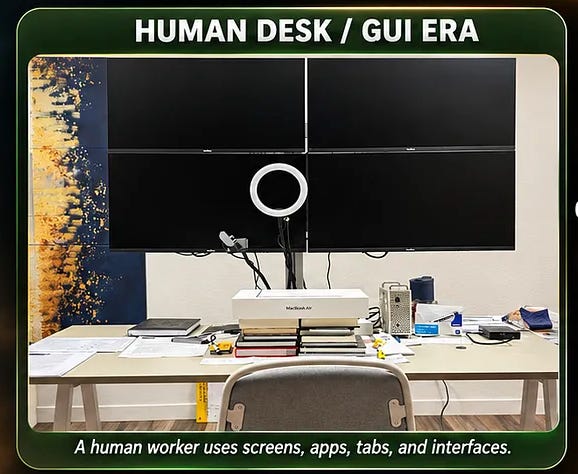
But I no longer believe the number of applications I can personally operate should define the limits of my productive capacity.
My responsibility is increasingly to determine which work needs my personal judgment, which work should be performed by employees, and which repeatable units of work can be delegated to agents operating under clear governance.
That means investing differently in what I consider my total workforce.
Human employees.
Specialist partners.
And agentic headcount.
All working inside a coordinated operating environment. The ultimate objective isn’t to build a company without people.
It is to build a company whose ability to create value is no longer limited by the amount of information one person can process or the number of decisions one founder can make.
For those of you planning an exit, retirement, or generational succession, that may be one of the most important investments you can make during the next five years.
IUM — Intelligence Under Management — may become one of the defining measures of enterprise resilience, ownership optionality, and wealth creation in the agentic economy.
Your next employee may never need a desk. Your next competitive advantage may not look like a traditional application, and one of your most valuable succession assets may be something your current balance sheet doesn’t separately recognize.
The question is whether you’ll own that intelligence or remain dependent on the people and platforms that currently hold it.
Build what lasts. Own the intelligence. Protect the future.
A Question for Your Next Ownership Meeting
If you disappeared from your company’s daily operations for 90 days, how much of its most valuable knowledge, judgment, customer history, and operating intelligence would remain accessible and actionable?
And what would happen to its value if you never came back? That’s where your IUM conversation should begin.
The real risk is doing nothing!
~Chris J Snook