


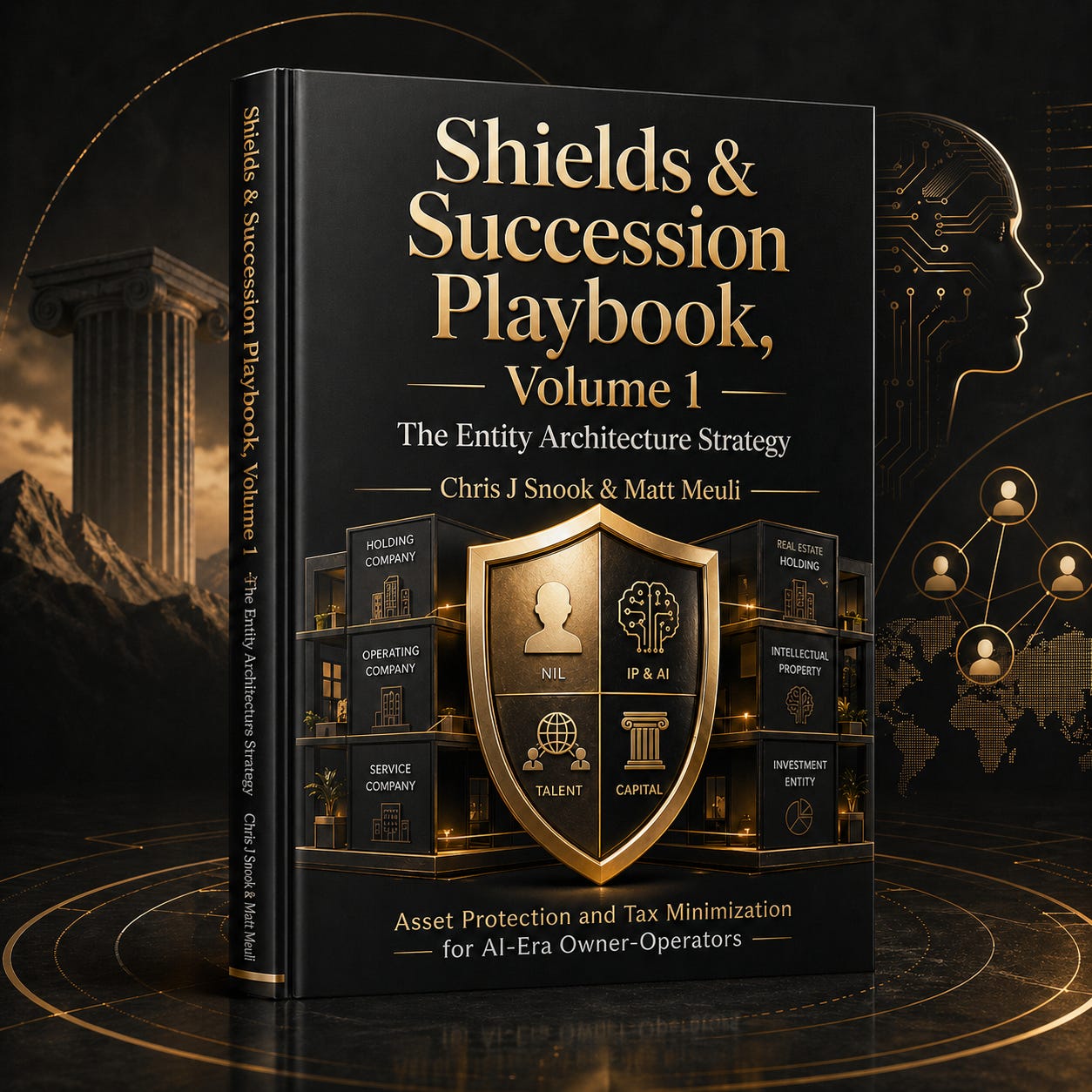
The Entity Architecture Strategy Playbook
Welcome to the Wealth Matters 3.0 Shields and Succession Owner/Operator Playbook Series. In volume one, over the next several weeks, we will break down the questions you should ask and document to give you and your family a clear and common picture and strategy that will align all relevant parties on:
How to separate identity, NIL, IP, AI agents, remote human talent, capital, media distribution, employer of record (EOR or PEO), and operating risk into defensible structures that create durable enterprise value instead of undocumented exposure.
Provide you with a roadmap that you can then take to your advisors in each domain to get their blessing and sign-off for executing your structure to build your ATOMIQ Wealth Dynasty Plan and
The Authors’ Note and Important Disclaimer
This playbook is written as an educational planning framework for owner-operators, founders, creators, advisors, AI builders, investors, and professional service entrepreneurs who are building value through personal brand, intellectual property, AI-enabled workflows, remote talent, media distribution, and operating companies.
It is not legal, tax, employment, securities, or asset protection advice.
The purpose is to help a business owner walk into a coordinated advisory conversation with a clear map of the issues, the likely structures, the documents needed, the risks to avoid, and the right questions to ask.
The execution of this strategy requires coordination among:
In-state business counsel (We can help you/refer you)
Wyoming counsel (We can help you)
Tax counsel or CPA (We can refer you)
IP counsel (We can help you)
Employment counsel (We can refer you)
Estate planning counsel (We can help you)
Securities counsel, if capital management or investment activity is involved (We can refer you)
Insurance advisor (We can refer you)
EOR, PEO, or payroll compliance provider (We can refer you)
The central idea is not to “hide” income, pretend activity happens somewhere it does not, or use Wyoming, an EOR, or a HoldCo as a shortcut around economic reality.
The central idea is this:
The EOR is not the strategy. Wyoming is not the strategy. The HoldCo is not the strategy. The strategy is separating identity, IP, development, distribution, labor, agents, capital, and risk into the right legal and tax containers, then connecting them with written, arm’s-length agreements that reflect economic reality.
That is how the modern owner-operator turns personal brand, AI leverage, remote talent, and proprietary systems into durable enterprise value instead of a pile of undocumented risk.
Part One: Why This Playbook Exists
The modern owner-operator is not just running a small business or a single commercial enterprise any longer.
They most likely are building a personal media brand (like here on Substack), publishing thought leadership, hosting a podcast, licensing frameworks, creating software for internal or external use, using AI agents in their business and personal life, hiring remote talent, advising clients, launching a fund, investing in private deals, building internal tools, and turning their reputation into economic value.
That means the old single-LLC or Corp or sole-proprieter model is breaking down and a gaping hole of unwanted potential vulnerability.
In the old world, a business owner might form one company in the state where they lived, run all revenue through that company, hire local employees, pay local taxes, and keep everything under one roof.
That may still work for some local businesses. But it is not enough for an AI-era owner-operator whose value comes from a combination of:
Name, image, likeness, and personal reputation
Small business operations
Software code
Prompt libraries
AI workflows
Agent systems
Proprietary frameworks
Digital products
Media distribution
Affiliate relationships
Sponsorships
Speaking fees
Advisory work
Remote human contributors
Non-human AI operators
Data assets
Research systems
Deal flow
Capital allocation strategies
Licensing rights
Brand equity
The more valuable these assets become, the more dangerous it is to leave them sitting in one undifferentiated operating company or in your personal name as a sole proprietor.
A single operating company can become a legal junk drawer. It may hold the IP, sign the customer contracts, hire the employees, employ the developers, publish the media, receive the sponsorship revenue, own the software, pay the founder, sign the affiliate agreements, manage AI tools, and absorb every lawsuit, wage claim, customer dispute, creditor claim, data issue, and platform risk.
That is not a structure.
That is exposure with a bank account.
The better approach is to build an entity architecture that separates the different types of value and risk before a problem appears.
This is where the planning mindset from YourTrustedPlanner.com is useful. In one of its estate planning and asset protection pieces, Meuli Law Office explains that estate planning, asset protection, and legacy planning are not the same thing. Estate planning provides control and clarity, asset protection creates risk reduction and smart structure, and legacy design determines what happens next and what it means. When those circles work together, the result is peace of mind and family security. (Meuli Law Office)
That same idea applies to the AI-era owner-operator.
You need more than an LLC.
You need more than a trust.
You need more than a Wyoming entity.
You need more than payroll compliance.
You need more than clever tax planning.
You need a living system and a customized entity architecture.
A structure that can answer:
Who owns the personal brand?
Who owns the NIL rights?
Who owns the trademarks?
Who owns the source code?
Who owns AI-generated work product?
Who owns prompts, agent workflows, and reusable automation systems?
Who operates the media platform?
Who signs sponsorship agreements?
Who hires remote workers?
Who supervises AI agents?
Who owns the customer relationships?
Who manages capital?
Who receives royalties?
Who bears operating liability?
What happens if the founder dies or becomes incapacitated?
What happens if the founder gets sued personally?
What happens if a remote employee creates nexus in another state?
What happens if an AI agent creates legal exposure?
What happens if a buyer or investor asks for the IP chain of title?
The answer cannot be, “It is all in my LLC.”
That may be convenient.
It is rarely optimal.
Part Two: The Core Philosophy of the Entity Architecture Strategy
The goal of entity architecture is not complexity for complexity’s sake.
