


Get Joel’s Resources:
Before you read or listen to the show
Subscribe to Joel on Substack
Get Joel’s new book, AI Made Simple: Artificial Intelligence for Everyday Life, here:
Download his 100% free (no opt-in) deep dive report on the five-part Disruption Confidence Cycle here:
Now push play while you read the rest or just enjoy!
Joel’s work has always lived at the intersection of curiosity, creativity, faith, technology, play, reinvention, and making complicated things feel simple enough for normal humans to actually use. That is why this conversation matters now.
Because AI is not just another tool.
It is the latest disruption in a career built by a man who has survived, studied, and reinvented himself through the web, online gaming, Google AdSense, social media, podcasting, crypto, NFTs, and now artificial intelligence.
TL;DR Key Takeaways
Joel Comm describes himself as independent, strong-willed, curious, playful, and deeply shaped by a spiritual awakening in his mid-twenties that gave him a moral foundation for the rest of his life.
His entrepreneurial path began in the early 1990s as a mobile DJ, radio voice, nightclub DJ, and technology enthusiast. He bought his first computer, a TRS-80 Model 1, in 1980 at age sixteen and was already dialing into bulletin board systems decades before most people understood the internet.
Joel built his first website in 1995 and eventually created ClassicGames.com, a multiplayer JavaScript game room that grew to thousands of players and was acquired by Yahoo in 1998.
He has written 16 books, with his 17th, AI Made Simple, coming out in December. His work has been read around the world, and he has spoken globally by making complex technology accessible, practical, and fun.
Joel’s career has been shaped by repeated disruptions: the web, online gaming, Google AdSense, social media, mobile, live video, blockchain, crypto, NFTs, and AI.
He co-created The Bad Crypto Podcast with Travis Wright in 2017 after a season of uncertainty and serendipity. The show became one of the longest-running crypto podcasts in the world, with more than 10 million downloads.
Joel’s operating philosophy comes from his book The Fun Formula: be curious, take risks, and trust the process.
In this episode, Joel introduces his Disruption Confidence Cycle, a five-stage framework for navigating technological change: disruption, doubt, clarity, confidence, and momentum. You can download his free deep dive report on that framework here:

Joel openly shares that even after decades of reinvention, he has had seasons where he wondered whether his best work was behind him.
The AI wave created that same doubt again. At first, Joel used AI but did not feel fully claimed by it. Then, in early 2026, he began building with AI tools like Claude, OpenClaw, and Claude Code, and everything changed.
By asking AI to guide him “like a fifth grader,” Joel set up tools, built websites, created games, launched experimental projects, and became a practitioner rather than just a commentator.
That practitioner shift became the source of his new clarity, confidence, and momentum.
Joel now hosts AI for Everyone, a show designed especially for people around age 55 and older who feel intimidated, confused, skeptical, or frightened by AI.
His message is not that everyone needs to become technical. It is that everyone needs enough reps to see what AI can help them create, understand, simplify, or improve.
The deeper message: Joel Comm’s story is not about chasing every shiny object. It is about staying curious enough to find your next chapter before the world writes you out of it.
Why You Should Listen
This ATOMIQ LEVEL conversation with Joel Comm is not just an AI interview. It is a story about a man who has spent more than four decades riding the edge of technological change, not because he had a perfect plan, but because he refused to stop being curious.
It is about a kid who bought a TRS-80 in 1980, became a mobile DJ, built websites before most people knew what a website was, sold an online game platform to Yahoo, wrote books that taught the world how to monetize the early web, helped millions of people understand crypto through The Bad Crypto Podcast, rode the NFT wave, lived through the winters, and then found himself asking the question every creative leader eventually asks:
Is my best work behind me?
It is about why the answer was no.
It is about how AI reawakened Joel’s builder instinct once he stopped merely watching the tools and started using them to make things. Websites. Games. Calculators. Speaker platforms. Educational tools. Experiments. Proof that the cost of trying has collapsed.
It is about why older leaders, founders, creators, business owners, advisors, and professionals may have more advantage in the AI era than they realize, because pattern recognition only comes from living through prior disruptions.
It is also about why AI does not have to feel cold, technical, alien, or overwhelming. Joel’s mission with AI Made Simple and AI for Everyone is to make artificial intelligence simple, easy, useful, and fun for everyday life, especially for people who feel like the whole conversation has already passed them by.
Most of all, this conversation is about creative renewal.
The kind that arrives after doubt. The kind that only shows up when you are willing to play again.
The kind that reminds you that your experience is not obsolete just because the tools have changed.
Press play on this conversation with Joel Comm if you want to understand how a lifelong digital pioneer navigates reinvention, why AI may be the greatest creative empowerment tool of our lifetime, and how to move from disruption to doubt, from doubt to clarity, from clarity to confidence, and from confidence to momentum.
Because the future does not belong only to the youngest coder in the room. It belongs to the people who keep putting in the reps.
The Man Who Turned Disruption Into a Playground
Before Joel Comm became a bestselling author, global speaker, digital pioneer, crypto podcaster, AI educator, and one of the more enduring explainers of emerging technology on the internet, he was a young man with no clear map.
He came from a broken home. He made his way through college without much direction, swept along by culture, partying, confusion, and the drift that can define a young life before it finds its center. Then, in his mid-twenties, something shifted. Joel found spirituality in the person of Jesus Christ, and that encounter gave him what he describes as a moral ground to stand on.
It did not fix everything. He is honest about that.
He does not pretend faith turned him into a flawless person. He says he is still very good at screwing things up. But it gave him a foundation. A place to build from. A line underneath the chaos that allowed the rest of his life to begin taking shape.
That matters because Joel’s story is not merely about technology. It is about orientation. The tools changed. The platforms changed. The markets changed. The industries changed. But the man stayed anchored by a few repeatable instincts: curiosity, play, risk, faith, humor, and a willingness to try the next thing before the crowd understood why it mattered.
The Voice Before the Website
Joel’s first entrepreneurial gig was not a startup, at least not in the way people use the word now. It was as a mobile DJ.
That detail feels almost too perfect. Before he was explaining the internet, before he was writing books, before he was podcasting to millions, before he was teaching people about crypto or AI, he was already learning how to hold attention, read a room, move energy, and use his voice.
He did radio. He did nightclubs. Eventually, he realized he could make more money with his own gear doing private parties, and he performed hundreds of them.
That was one side of Joel.
The other side was the kid who bought his first computer in 1980 at age sixteen, a TRS-80 Model 1 with 4K of RAM and a cassette player for storage. To save a program, you typed the command and recorded it onto magnetic tape. To load it, you played it back.
It sounds primitive now. At the time, it was magic.
Joel was dialing into bulletin board systems in 1980, which means he has been in the online world for more than four decades. Long before most people thought of digital life as normal, he was already there, experimenting, wandering, tinkering, asking what this machine could do.
That is the beginning of the pattern. Joel rarely waits for the world to explain the toy. He picks it up and starts playing.
The First Website and the Yahoo Exit
In 1995, Joel built his first website. He sensed that the internet was the next big thing, not because he had a crystal ball, but because he had enough curiosity to feel the shift before it had fully become obvious.
By 1997, he had a family-friendly website with software reviews and web games. He has always loved games, and that love would become one of the earliest meaningful inflection points in his career.
His webmaster introduced him to a young graduate at UC San Diego who had created the foundation of what might have been one of the world’s first JavaScript multiplayer game rooms. Friends were testing games like Hearts, Spades, Chess, and Backgammon. Joel saw the possibility immediately.
They partnered. They named it ClassicGames.com. They expanded it to sixteen games and grew it to thousands of players.
Then Yahoo bought it in 1998.
His partner went to work for Yahoo as what Joel jokingly calls the “chief game Yahoo.” Joel took cash and walked away, something he now describes with the self-deprecating wisdom of hindsight. His partner may not have needed to work another day in his life. Joel took what was, at the time, the most money he had ever seen.
Still, that exit changed his life. It got him out of debt, paid off his house, paid off credit cards, and put him in a position he has managed to preserve ever since: his head above water.
That may not sound like the Silicon Valley version of success, where every story has to end in nine or ten figures. But Joel’s measure has never been only money. In fact, he says clearly that if wealth had been his primary motivation, he probably would have focused on one thing and ridden it harder.
But that is not Joel. Joel is not the guy who wants one plate.
He is the guy who spins many because each one teaches him something new.
The Man Who Could Not Stop Playing
Joel has written sixteen books, with a seventeenth on the way. He has spoken around the world. He has built products, launched platforms, hosted shows, created content, experimented with tools, and lived through nearly every major digital disruption of the last thirty years.
The web.
Google AdSense.
Social media.
Mobile.
Live video.
Blockchain.
Crypto.
NFTs.
Artificial intelligence.
He did not always see every opportunity perfectly. He missed things. He passed by Bitcoin at first because the idea of mining did not click for him. He took cash instead of Yahoo upside. He has had projects that did not become what he hoped. He has had lean years. He has had seasons where the well went dry.
But what makes Joel compelling is not that he always wins. It is that he keeps returning to curiosity.
That is the heartbeat of his career. If something looks interesting, he wants to know what it can do. If it can help him create something cool, he wants to play with it. If he figures something out, people start asking how he did it. Then come the books, blogs, talks, shows, newsletters, interviews, and teaching.
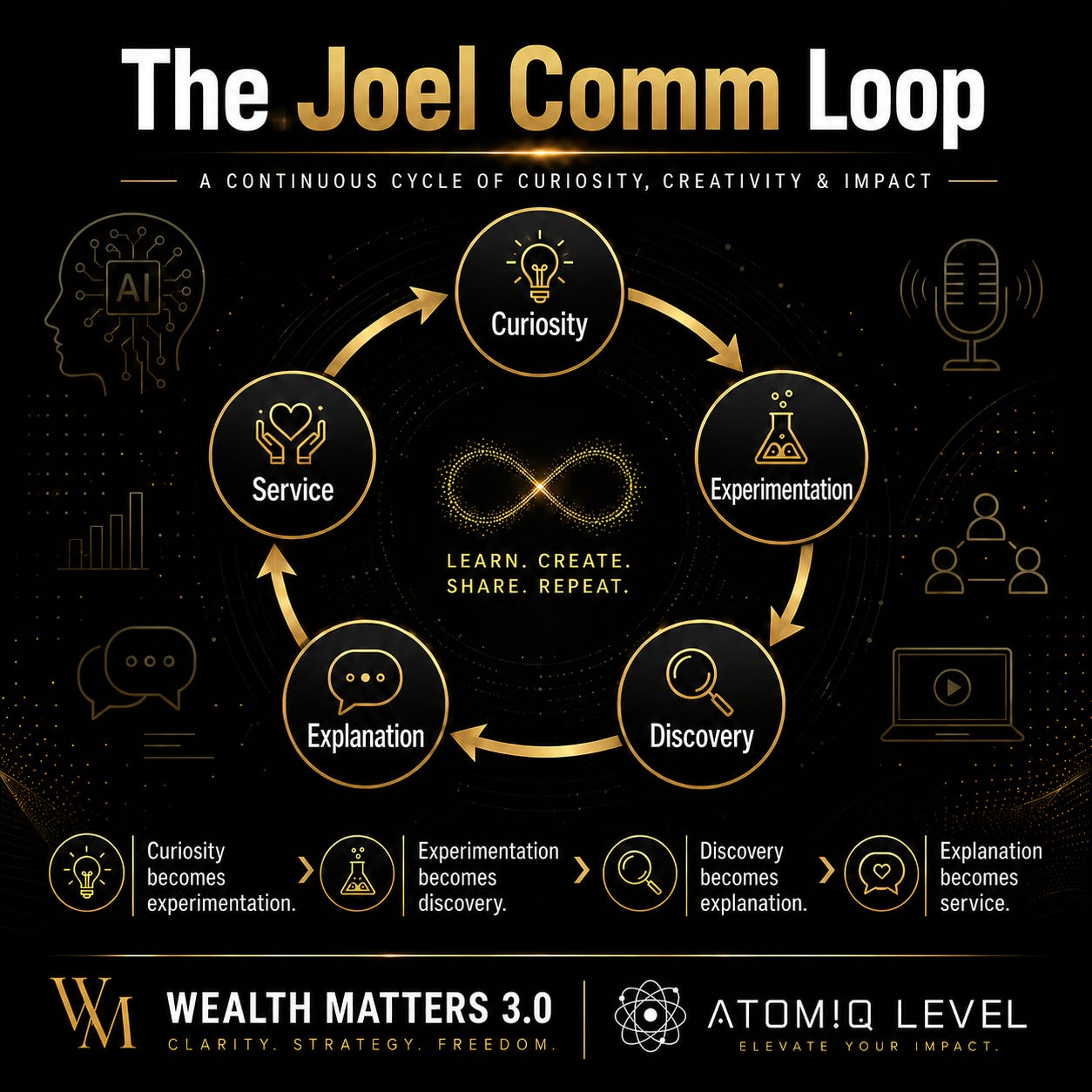
That is the Joel Comm loop. Curiosity becomes experimentation. Experimentation becomes discovery. Discovery becomes explanation. Explanation becomes service.
The Wilderness Before Bad Crypto
One of the most honest parts of this conversation is Joel’s willingness to talk about the in-between seasons. Not the big win. Not the big launch. Not the moment when the audience is growing and the phone is ringing.
The dry places.
In 2017, while writing The Fun Formula, Joel was in one of those wilderness seasons. The book’s own thesis was challenging him while he was writing it. Be curious. Take risks. Trust the process. Wait for serendipity.
But waiting is not easy when you are the one doing it.
Joel was wondering what came next. He was not actively chasing some new massive thing. He was trying to trust the process he was telling other people to trust.
Then came Travis Wright.
Joel and Travis had been messaging back and forth during the 2016 election cycle and realized they shared some similar views. After the election, Travis asked Joel what he thought about Bitcoin. Joel had heard of it, but had not fully understood it. Mining confused him. The whole idea seemed strange.
So they began learning together.
Then Travis joked that maybe they should take the conversation public and start a podcast.
Joel said, “Let’s talk.”
Two days later, the first episode of The Bad Crypto Podcast was out. And it blew up.
The Genius of Being Bad
The name was perfect because it removed the expert burden immediately. They were not saying, “We know everything.”
They were saying, “We are figuring this out in public, and you can come with us.”
That made the show accessible at exactly the right time. They launched in July 2017, just as the crypto bull market was going wild. The audience rode the wave with them. Then the market crashed. Then came the crypto winters. Then came NFTs. Then came another cycle. Through all of it, they kept publishing.
That may be one of the most important lessons from Joel’s story.
The wave matters. But the work matters more.
The Bad Crypto Podcast became one of the longest-running crypto podcasts in the world, now moving toward its tenth year with more than 10 million downloads and listeners around the globe. But its durability came from more than timing. It came from genuine fascination.
Joel and Travis were not pretending to care.
They cared.
They were learning in real time, and the audience could feel it.
Curiosity, Risk, and Trust
Joel’s framework from The Fun Formula is simple: be curious, take risks, and trust the process. Those three ideas sound easy until you have to live them.
Curiosity means allowing yourself to explore before you know the payoff.
Risk means stepping outside guaranteed income, stable expectations, social approval, and familiar identity.
Trust means not forcing the next chapter before it is ready to arrive.
That last one may be the hardest.
Because builders build. Creators create. Entrepreneurs push. Marketers market. Leaders want momentum. When momentum disappears, the silence can feel like judgment.
Joel knows that feeling. He has had moments where he has asked whether his greatest work was behind him. He has had seasons where the doorbell stopped ringing, the speaker requests slowed, the next big thing did not immediately reveal itself, and he wondered whether he was done.
Then disruption arrived again. This time, it was AI.
The Disruption Confidence Cycle
In this conversation, Joel introduces a framework he calls the Disruption Confidence Cycle.
It begins with disruption. Something changes. The web appears. Mobile arrives. Social media reshapes distribution. Blockchain creates a new money and ownership layer. AI begins democratizing intelligence. The world moves, and suddenly, what used to work no longer feels as stable.
Then comes doubt. Leaders ask themselves whether they are stupid for not seeing it sooner, foolish for trying it, or obsolete if they do not. They question their relevance. They wonder whether anyone will still care what they have to say, sell, teach, or build.
Then comes clarity. After enough pattern recognition, the experienced builder says, “Wait a second. I have been here before.” The details are new, but the shape is familiar.
Then comes confidence. The fundamentals remain. Curiosity still works. Experimentation still works. Judgment still matters. The tools may be new, but the human capacity to learn and apply them is not.
Finally comes momentum. Experience becomes an advantage. The person who has lived through multiple cycles starts integrating new tools with deeper judgment and begins moving again.
That is Joel’s gift in this episode. He does not talk about disruption like someone reading a trend report. He talks about it like someone who has lived the cycle enough times to recognize the emotional weather.
Disruption.
Doubt.
Clarity.
Confidence.
Momentum.
That is the map.
Joel also shared a free deep dive report on the elements of this framework, which you can download here if you haven’t already:
AI and the Question of Relevance
After moving to Puerto Rico in 2021 with his fiancée, Erin, Joel found community, beauty, and a different rhythm of life. The NFT market, his latest major creative wave, eventually collapsed. He still believes in digital collectibles, but the hype, greed, and crash changed the opportunity.
For a while, he was semi-retired. But Joel is not wired to stop creating.
By 2024 and 2025, he began feeling the discomfort again. The phone was not ringing the same way. He was not being asked to speak as much. Nobody was asking him to write books. He had been around enough disruptions to know AI mattered, but at first he could not quite find his place in it.
He used AI.
He watched AI.
He experimented with AI.
But it did not fully click.
The doubt returned.
Was he done?
Was AI the thing, and had he somehow missed his door into it?
Then came the practitioner moment.
“Talk to Me Like I’m a Fifth Grader”
In early 2026, Joel began seeing people on X and LinkedIn using OpenClaw and Claude Code. He did not know if he could set it up. He did not know how to code. He did not pretend to understand all the moving parts.
So he asked Claude to walk him through it like he was a fifth grader.
That one decision changed everything.
The AI told him to open a terminal. Copy this. Paste that. Find a host. Try this. Fix that error. Keep going. Within about two hours, Joel had an OpenClaw set up and doing a task for him.
Then he wondered whether he could build a website.
He had an artificial intelligence top-level domain sitting unused: artificialintelligence.studio. He used Claude Code to build out a site with four tools on it.
It was rudimentary. But it was live. And he built it.
That changed his relationship with AI. He was no longer only a user. He was a builder. He was a practitioner. The dopamine centers that had fired during every major creative exploration of his career lit up again.
The confidence returned because the reps returned.
Building for the Joy of Building
Once Joel became a practitioner, the projects began multiplying. He built tools. He built websites. He built games. He experimented with AI-generated infographics. He used tools like Google’s NotebookLM, Claude design features, and new image generation models to create things that previously would have required hiring designers, developers, coders, and teams across time zones.
He built a site called GrowingProfits.com with dozens of AI-powered tools and original content. He created free calculators and evaluators, including tools for entrepreneurs and side hustle ideas.
He built daily word games under AI for Everyone, inspired by the kind of daily puzzle experiences he and Erin enjoy.
He even created a retro-style 3D shooter game called Pound Break, where players rescue dogs and shoot bad guys with a water gun.
Was he trying to turn each of these projects into a venture-backed company?
No.
That is not the point. The point was the reps. The point was proof-to-himself.
The point was finding out what was possible when the cost of experimentation had collapsed to nearly zero.
This may be one of the most important takeaways for entrepreneurs, creators, advisors, and business owners right now. AI does not just reduce the cost of production. It reduces the cost of failure. It reduces the cost of curiosity. It allows a person to turn a dormant idea into a working prototype without waiting for permission, budget, staff, or a perfect plan.
That does not mean every idea should be built.
Joel and Chris both acknowledge the shadow side. Hyper-creative people can suddenly find themselves with fifty possible projects because the old constraints are gone. Just because you can build everything does not mean you should.
But before discipline comes discovery. And discovery requires reps.
AI for Everyone
Joel’s latest mission is AI for Everyone, a show and educational platform aimed especially at people around age 55 and older who feel intimidated, confused, frightened, skeptical, or simply out of the loop.
That audience matters because Joel understands something many AI insiders forget.
Our feeds are not the world.
The people posting endlessly on X about agents, coding tools, model releases, and AI workflows are not representative of the majority of humans. Most people are not trying to keep up with every new frontier model. They are not building with Claude Code. They are not using OpenClaw. They are not comparing image model outputs or creating AI-powered web apps.
Many are overwhelmed. Many feel behind. Many assume AI is for someone else.
Joel’s work is designed to meet them where they are. His upcoming book, AI Made Simple: Artificial Intelligence for Everyday Life, is written for that audience. It is not intended to become obsolete the moment a new model ships. It is written to empower people to think about how AI can be used in their business, their life, their creativity, their communication, and their everyday routines.
That is Joel’s lane. Not fear. Not hype.
Practical empowerment.
Simple. Easy. Useful. Fun.
The Advantage of the Experienced
A powerful thread running through this conversation is the idea that older leaders may have an advantage in AI if they stop disqualifying themselves.
Younger people may be faster with tools. They may adopt new interfaces more naturally. They may have less fear of experimentation. But experience has a pattern recognition advantage.
Joel has lived through enough cycles to know that no disruption stays frozen in its first form. The web changed. Social media changed. Crypto changed. NFTs changed. AI will change, too. What works today will not work forever. What looks like magic today will become infrastructure tomorrow.
The seasoned person has seen that before.
That matters because AI is not only a toolset. It is a new cycle of disruption, and cycles reward those who can move through emotional turbulence without losing themselves.
The question is not whether you can become a twenty-three-year-old coder. The question is whether you can become a practitioner with the experience you already have.
Joel’s answer is yes. And he is proving it by building in public.
The Reps Are the Strategy
Near the end of the conversation, Chris frames the moment clearly. A year from now, the latest frontier models may be able to produce the equivalent of thousands of hours of high-quality work in minutes. Even if innovation slows dramatically, the capability curve is still moving faster than most institutions, companies, or individuals can absorb.
That means the reps matter now. Not because every experiment becomes a business. Not because every project becomes a product. Not because every prompt produces genius. The reps matter because they build muscle memory.
They reduce fear.
They create pattern recognition.
They help you find your place.
Joel’s story is a living example. He did not reason his way into confidence from the sidelines. He built his way into it. He asked the tool to guide him like a beginner. He allowed himself to look foolish. He made simple things. Then graduated into more complex things. Then useful things. Then playful things. Then teachable things.
That is how the cycle moves. Disruption becomes doubt. Doubt becomes clarity. Clarity becomes confidence. Confidence becomes momentum.
Closing Thought
This ATOMIQ LEVEL conversation with Joel Comm is a reminder that reinvention is rarely clean while it is happening.
From the outside, a career like Joel’s can look like a series of smart moves: early computers, websites, Yahoo Games, books, Google AdSense, podcasting, crypto, NFTs, AI.
From the inside, it is more human.
Broken beginnings.
Faith.
Curiosity.
Risk.
Mistakes.
Exits.
Lean years.
Dry wells.
Serendipity.
Doubt.
Play.
Repetition.
Renewal and Reinvention.
Joel’s story matters because he does not pretend the AI moment is easy. He does not pretend everyone should become a technologist. He does not pretend that the tools are not overwhelming. He does not pretend he never wondered whether his best days were behind him.
He simply found his way back into motion.
For entrepreneurs, this episode is a reminder that the next wave may not arrive as a business plan. It may arrive as a toy you cannot stop playing with.
For creators, it is a reminder that your curiosity is still an asset.
For older professionals, it is a reminder that your experience is not obsolete. It may become your advantage if you combine it with new tools.
For business owners, it is a reminder that the cost of experimentation has collapsed.
And for anyone feeling overwhelmed by AI, it is a reminder that you do not have to understand everything.
You just have to start. Ask the tool to explain it like you are a beginner. Build something small. Take the reps. Find the fun.
Press play on this episode with Joel Comm, subscribe to his Substack, get AI Made Simple, and download the free Disruption Confidence Cycle report if you want to understand how a lifelong digital pioneer turned another disruption into another playground.
Because the future is not waiting for you to feel ready.
But the tools are ready to help you begin. The real risk is doing nothing!
~Chris J Snook
Thank you to everyone who tuned into my live video! Join me for my next live video in the app and subscribe!


