


The Genesis Mission
Building the Scientific Operating System for the AI Century
Part I of this series last Friday was the map. It traced the intellectual line from Vannevar Bush’s Science: The Endless Frontier to the emerging American strategy for science, artificial intelligence, energy, manufacturing, and national security. It argued that artificial intelligence (AI) is not merely creating another software category. It is applying pressure to the productive stack beneath the economy: computation, power, laboratories, data, engineering talent, manufacturing capacity, capital, and trust.
Today in Part II for you Wealth CMDR subscribers, we enter the machinery.
The subject now is the Genesis Mission:
What it is attempting to build,
Why the Department of Energy (DOE) sits at its center,
How closed-loop laboratories could change scientific work, and
What kind of public-private operating model will be needed to turn machine-speed intelligence into validated discovery and physical production.
The overview TL;DR placemat is below, but don’t cheat.
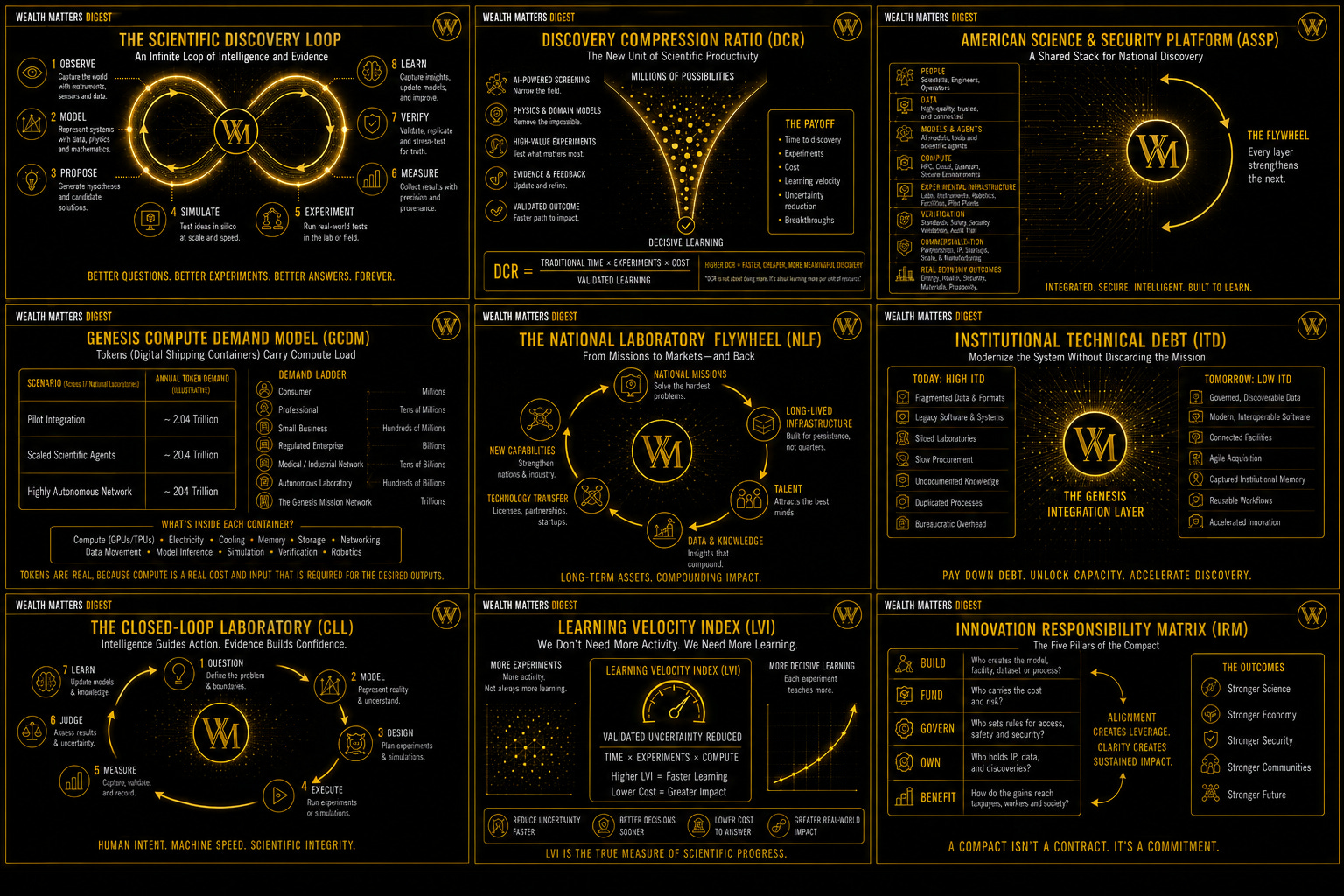
The formal name matters. This report uses the Genesis Mission throughout because that is the name established by the federal government and used by the DOE. I will occasionally describe its architecture through metaphors of my own, but I do not want to rename the initiative or blur the distinction between an official mission and my interpretation of what it could become.
The Genesis Mission was launched in November 2025 as a national effort led by the DOE to connect advanced supercomputers, experimental facilities, AI systems, and unique scientific datasets. Its stated goal is to double the productivity and impact of American research and innovation within a decade. The DOE now describes the American Science and Security Platform (ASSP) as the mission’s core technology engine: a coordinated AI-driven discovery system built from computing, data, facilities, and production capabilities that already exist across the federal scientific enterprise.
That is a very large ambition. It is also an unfinished one. Great missions in society often set humanity on a path previously thought impossible. The mission’s architecture is clearer than its ultimate implementation, and its most important questions—funding continuity, access, security, intellectual property, model governance, standards, commercialization, and measurement—will be settled through execution rather than announcement.
That uncertainty is not a reason to ignore the Genesis Mission. It is the reason to study it now.
Personal Notebook Entry: Wyoming, September 2020
In September 2020, I moderated a session during the Wyoming Technology Stampede called Quantum Entanglement. The title was partly literal and partly metaphor. We had assembled scientists, entrepreneurs, government leaders, investors, and technologists around the idea that when enough unusual particles collide, something unexpected can happen. My job, as I described it at the time, was to stay out of the way while connecting a few of the dots.
