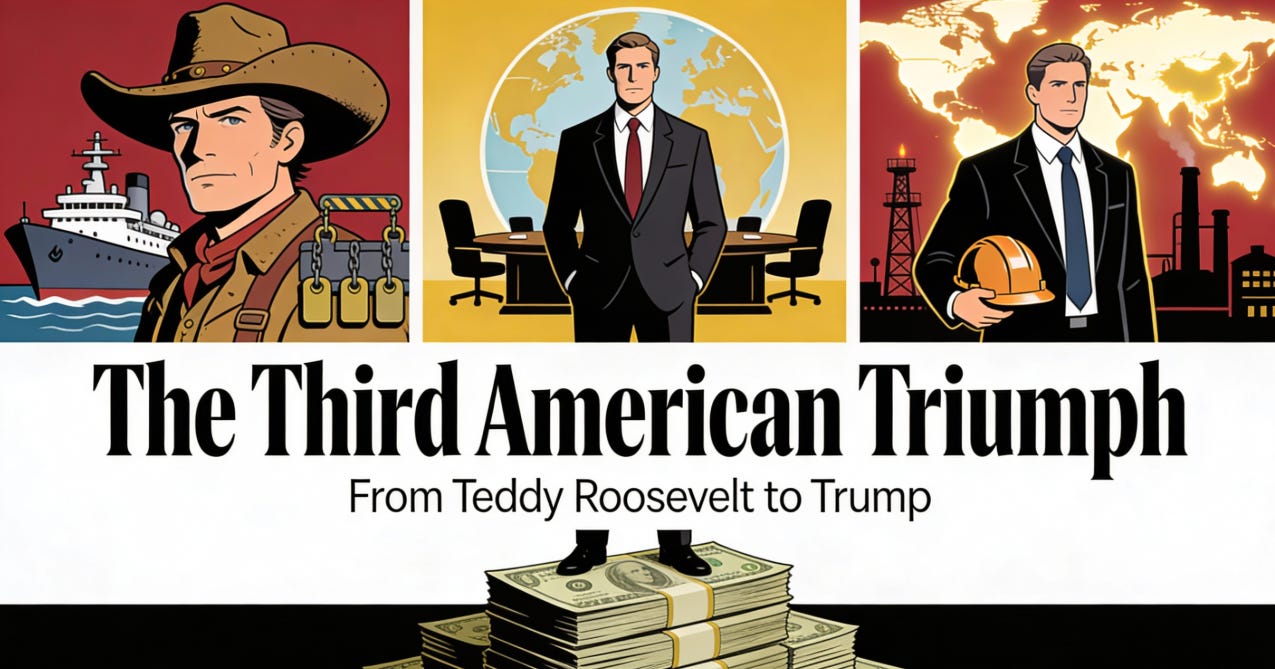
The Third American Triumph: From Teddy Roosevelt to Trump
A look back on today from 50 years in the future on the first 300 years of the American experiment
In the sweep of U.S. history, certain presidencies mark defining chapters in the expansion of American power and economic independence. The first grand inflection point unfolded under President Theodore Roosevelt, chronicled in Warren Zimmermann's book First Great Triumph: How Five Americans Made Their Country a World Power,
spotlighting Theodore Roosevelt's era with William Howard Taft as Secretary of War from 1904. Roosevelt's aggressive projection fused diplomacy, naval power, and territorial grabs post-Spanish-American War of 1898, securing Puerto Rico, Guam, and the Philippines via the Treaty of Paris, a Cuban protectorate, and the Panama Canal Zone through a U.S.-backed revolt against Colombia.
Expansion’s Territories and Costs
Roosevelt-Taft secured no new states by 1909, but transformed America into an imperial force: Arizona and New Mexico joined under Taft’s presidency in 1912.
Puerto Rico and Guam: Direct cessions for Atlantic-Pacific naval bases.
Philippines: Bought for $20 million; Taft pacified via concentration camps, ending bloody resistance that killed thousands of Filipinos amid U.S. disease tolls.
Cuba: Protectorate post-intervention; Taft governed provisionally in 1906.
Panama Canal Zone Engineered secession from Colombia after a rejected $10 million offer, fueled by banker manipulations, birthing a trade artery.
These acquisitions came at brutal moral costs: Filipino suppression echoed genocidal tactics, Panama violated sovereignty, fueling imperialism charges. A similar playbook from 1898’s annexation of Hawaii, justified as a strategic, economic, and “civilizing” necessity tied to America’s emerging role as a Pacific power under President McKinley.
Roosevelt’s Aryan Tendencies
Remembered by most textbooks and history courses in modern education as the “rough and ready, frontier-warrior” President, Theodore Roosevelt also embodied the era’s Aryan supremacism, deeming his Japanese counterparts“honorary Aryans, who alone, were fit to govern Asia’s other half—a view detailed in James Bradley’s The Imperial Cruise: A Secret History of Empire and War.
He covertly endorsed Japan’s 1905 Korea-Manchuria dominance via Taft-led cruise diplomacy, floating an “Asian Monroe Doctrine” that presaged Pacific wars. Great statesmen in history don’t always equal great people in the terms of normal society.
*Further reading on these primary historical records can be found in America in the World
Amoral Gains Are Now Celebrated Sans Context
Factually, these strategic imperialistic moves yielded Panama’s trade dominance, Pacific footholds rival-checking, and hemispheric sway. These have each become Manifest Destiny icons and long lionized without engineered revolts or racial pacts recalled. The point is that when future generations benefit from conquests with the convenience and stability they provide, the cost is conveniently reframed, justified, or outright forgotten. The point is that in historical terms, the words “great” and “good” are often at odds with each other unless an amoral lens is used as your viewfinder.
The second triumph arrived post-World War II via the 1944 Bretton Woods Agreement, pegging global finance to the gold-backed dollar and birthing IMF/World Bank under U.S. hegemony—a generational economic fortress.
The massive infrastructure buildout unleashed by the New Deal and then turbocharged after 1945 laid the physical backbone for America’s new financial order, turning abstract Bretton Woods promises into concrete power on the ground. Highways, ports, dams, power grids, and industrial capacity—funded and coordinated by the federal government—meant that when the dollar was installed as the system’s anchor, it was backed not just by policy but by unmatched productive capacity and logistics reach, allowing the U.S. to supply, finance, and secure the very trade flows the postwar monetary regime depended on.
The 1974 petrodollar arrangements with Saudi Arabia effectively reinforced and extended the second great triumph launched at Bretton Woods by binding global energy trade to the dollar and to U.S. financial markets. Whereas Bretton Woods had anchored the system through formal institutions and a gold-linked reserve currency, the petrodollar era replaced gold with oil as the key backing for dollar demand, compelling countries to hold and recycle dollars to buy energy. That shift helped sustain U.S. monetary dominance after the gold window closed in 1971, cementing the postwar architecture by tying the world’s most essential commodity chain to American financial and geopolitical power.
The CCP’s Multi-Decade Decay War Against America
China formally joined the World Trade Organization on December 11, 2001, after roughly 15 years of negotiation and market-opening commitments. The CCP then leveraged WTO access to pursue export-led growth, massive foreign direct investment inflows, and state-directed industrial policy, rapidly turning China into the central node of global manufacturing and supply chains.
By combining low-cost labor, subsidies, technology transfer (often coerced), and tight political control over capital and institutions, the party converted that integration into today’s concentrated economic and geopolitical power.
Since entering the WTO, the Chinese Communist Party (CCP) has waged quiet warfare against the American hegemony over recent decades, eroding U.S. core society through elite capture, IP theft, and financial manipulation, with universities as ground zero for its artful attack via its Thousand Talents Program (TTP).
Launched around 2008, TTP recruited overseas talent in AI, semiconductors, biotech, and aerospace, offering salaries, labs, and prestige to U.S.-based researchers—many undisclosed while drawing NIH/DoD grants, enabling “shadow labs” and tech transfers.
Combined with cyber-espionage, forced joint-venture IP grabs, renminbi currency undervaluation, and capital controls subsidizing national champions, this deindustrialized the West, fostering dependency and hollowed communities across middle America.
This is the Trump administration’s basis for why securing the Western Hemisphere—North to South America—emerges as the sole prudent path for enduring hegemony, ringfencing supply chains, minerals, and data to sustain the promise of freedom against such asymmetric predation. Tariffs, Greenland, Venezuela, etc. It’s all about China and Russia being relegated back to their respective subordinate places in the global hierarchy.
Parallels: Leadership Teams Across Triumphs
Each triumph featured a core team blending vision, execution, and resolve, navigating zero-sum geopolitics amid domestic uproar:
The third great triumph (should it come to pass) rests on the Trump administration’s aligned belief and intuition that the next century will be organized around four stacked layers of power, and that they must be sequenced correctly rather than treated as disconnected themes.
AI as the command layer comes first because whoever controls the models and compute effectively sets the rules of perception, targeting, and coordination for everything else—military, markets, and media alike.
Bitcoin as the settlement layer then offers a censorship‑resistant, supranational clearing rail that can sit beneath and alongside the dollar system, giving the American bloc both an escape valve and a weapon in a post‑fiat environment.
Rare earths and energy form the physical substrate under both AI and Bitcoin, because data centers, fabs, and hash power ultimately reduce to minerals, grids, and fuel, which is why hemispheric security and resource corridors have become the quiet centerpiece of current strategy.
And Greenland, in this frame, becomes the symbolic crown vault—a northern keystone of ice, minerals, and strategic basing that completes a ring of control once Latin America, the Caribbean, and key Middle Eastern alignments are brought into a Western hemisphere–centric architecture.
Seen together, the third American triumph is less about one man’s personality and more about a brutally pragmatic hierarchy:
Program the world (AI),
Settle value on rails you influence (Bitcoin and the dollar),
Secure the inputs (rare earths and energy),
And lock down the geography that makes all three defensible for generations.
Maduro’s Fall: Economic Warfare’s Surgical Edge
Overnight markets telegraph precision dominance:
Maduro’s ouster transcended Caracas—a calibrated strike dismantling China’s shadow energy tendrils via proxy autocrats and gray flows, with Venezuela as linchpin fueling Beijing’s buffers. Oil dipped not from barrels short, but from architectures exposed.
Xi’s peripheral feeds are fracturing. U.S. reach rendered legible, keystone yanked from cheap corridors to China—stocks tumbled on proof, not petroleum.
This redefines warfare:
No broad tariffs, but proxy decapitations erasing rival bridgeheads.
Borders hold via deleted supply webs—Trump’s team extends Roosevelt’s writ, Bretton Woods’ ledger into 21st-century shadows,
The American hegemony’s quiet reassertion.
Practical Takeaways
Look past present-day media headlines and partisan propaganda from all sides. These cycles have always played as zero-sum statecraft with territories seized, currencies weaponized, elites captured.
Today’s economic dealmaking sets the baseline for all future diplomacy, just as Roosevelt’s canal and the Bretton Woods dollar did before. History favors those who secure the board first, and the Trump administration seems to not only understand that, but is embracing the execution layer of that ideology with vigorous precision, caring only what people will say and think about it in 50 years, and less what they think or say today.
Portfolio Implications for Everyday Investors
This third triumph reshapes investment landscapes by prioritizing onshoring, energy dominance, and hemispheric trade, delivering near-term (2026-2031) volatility in China-exposed assets but mid-term (2032-2040) booms in secure supply chains.
Tilt portfolios toward U.S. manufacturing ETFs, critical minerals (lithium, rare earths from allied mines), defense contractors, and energy infrastructure—expect 10-20% annualized gains from tariffs reviving steel, semis, and autos—while shorting or hedging Asia-dependent tech and consumer goods vulnerable to decoupling.
Boom Towns vs. Decliners: Where to Invest and Relocate and Where to Move Away
Hemispheric fortification crowns strategic U.S. regions and allies as winners, while coastal globalist hubs fade:
Position in these boom zones for real estate appreciation (20-30% near factories/ports), job growth in advanced manufacturing, and stable governance—echoing how Panama’s seizure minted century-long assets from calculated risks.
Stardate 2076: A Look Back from the Tri-Centennial of America
Fast-forward 50 more years, and we look back to the Trump (47th) administration’s third triumph:
Reclaiming industrial sovereignty via tariffs,
Manufacturing revival,
Energy independence—now amplified by hemispheric fortification against CCP encroachments—mirrors Roosevelt’s assertive patriotism amid offshored decay.
MIT’s 1972 Limits to Growth predicted a 2040 collapse from depletion sans intervention. Envisioning survival via fusion/AI efficiencies past that brink, 2076 chroniclers may praise Trump’s pivot insulating America from decline, akin to Roosevelt’s buffers weathering early shocks.
By 2075, at the midpoint of the next century-long cycle, these decisions will look like prescient nationalism: locking in a hemispheric bloc of free nations, preserving U.S. primacy in a fractured, multipolar world, much as the “hard” choices around Panama quietly kept critical trade lifelines open into the 2020s.
My Parting Thoughts
In the end, the work we do on our present-day place and our small role in history is both an inner and outer dance. Each citizen has to reconcile personal conscience, faith, and informed patriotism with a clear-eyed view of power, incentives, and risk in the real world. That means speaking up intelligently — less reactively voting, writing, building, dissenting—without surrendering moral standards to any party, media narrative, or cult of personality, even as the geopolitical game grows sharper and more zero-sum.
It also means managing a portfolio the same way: not for the world we nostalgically wish we still lived in, but for the world that actually exists and is visibly emerging. Tilting capital toward resilient assets, resilient regions, and resilient alliances, so that your capital, like your voice, is positioned to protect your family, serve your country, and remain free enough to matter in whatever comes next,
Yours in health and wealth,
~Chris J Snook
Related Posts
Hegemony 101: How Trump Checkmated Putin, Xi, and Proxies—While You Feared the ‘Strongman'
Before jumping to knee-jerk reactions shaped by fear-mongering media or paid protests designed to hijack your thinking and trigger hate or fear of Trump, pause for a short history and macro-economic …
Sources
First Great Triumph: 5 Americans Made Country World Power (PDF)image.jpeg
First Great Triumph: How Five Americans Made Their Country a World Powerwikipedia
Spanish–American War – Wikipediareason
William Howard Taft – Wikipediathetyee
Panama – Reason Magazinethehill
William Howard Taft, 27th President – American History Centralbarnesandnoble
World of 1898: International Perspectives on the Spanish–American War – Library of Congressamericanhistorycentral
William Howard Taft – Walter Stahramericanheritage
The Law of the Land: William Howard Taft – Ohio Memorymalwarwickonbooks
The Strange Affair of the Taking of the Panama Canal Zone – American Heritagereddit
The Imperial Cruise – Wikipediawikipedia
Iconic Teddy, White Supremacist – The Tyeeohiomemory.ohiohistory
Teddy Roosevelt and the Dark Side of American Foreign Policychristiancentury
The Imperial Cruise: A Secret History of Empire and War – Reviewguides.loc
MIT Predicted Society Would Collapse by 2040 – The Hillwalterstahr
MIT Predicted in 1972 That Society Will Collapse This Century – VICEwikipedia


The Bretton Woods parallel here is brilliant but dunno if most people realize how fragile that whole postwar settlement actually was when it launched. Setting the dollar as the anchor currency wasnt just a policy flex, it required the physical infrastructure you mentioned plus massive political capital to get war exhausted allies to sign on. What really amplified it though was timing. Europe and Asia were rebuilding from scratch so there was no alternativeeconomic system ready to compete. Trump's version faces a much tougher board because China already built paralel trade corridors and has 20 years of WTO integration baked in.