


A Letter From Me Before We Start
Every once in a while, I come across a document that completely changes how I see the world.
Not because it predicts the future with perfect accuracy. History has a funny way of humbling anyone who claims certainty. Rather, it’s because the document reveals how serious people inside important institutions are thinking about the future before those ideas become obvious to everyone else.
Those moments have become some of my favorite intellectual rabbit holes.
Years ago, it was Satoshi Nakamoto’s Bitcoin white paper. More recently, it has been the work coming out of the Department of Energy around artificial intelligence for scientific discovery, conversations with leaders like Dario Gil, formerly the head at IBM Research, currently Undersecretary of Science, and discussions with entrepreneurs such as Conner Prochaska, the current Director of ARPA-E, whom I first met at a quantum entanglement roundtable in Wyoming. Those conversations challenged many of my assumptions about where artificial intelligence was actually heading. They made me realize that while the public debate was largely focused on chatbots and productivity tools, some of the smartest people I encountered were talking about something much bigger: rebuilding the scientific and industrial capacity that underpins an entire civilization.
When the White House Office of Science and Technology Policy published Science: A New Golden Age, I recognized that same feeling almost immediately.
It wasn’t because every recommendation struck me as flawless. No government report ever does. It wasn’t because I agreed with every policy proposal or political priority. I don’t. What caught my attention was something deeper. The report revealed an emerging worldview—one that connects artificial intelligence, scientific research, manufacturing, energy, education, national security, and economic competitiveness into a single strategic narrative.
As I worked through all 123 pages, I found myself filling the margins with notes that had less to do with politics and far more to do with capital allocation. If the authors are directionally right, even if they’re imperfect in execution, then they’re describing the early architecture of an economic transition that could shape the next several decades.
That’s the kind of document I think is worth reading. Or, perhaps more accurately, worth translating.
Because most people don’t have the time—or frankly the desire—to spend an afternoon working through a dense government report. Even if they did, it’s not always obvious why they should care. That’s where I believe Wealth Matters can provide value.
One of the recurring themes of this publication has been that the biggest opportunities often emerge where two worlds intersect. For years, I’ve described those worlds as the financial economy and the real economy.
The financial economy is where we price assets, allocate capital, trade securities, and debate interest rates. It’s the world of markets, portfolios, and balance sheets.
The real economy is where people design semiconductors, build power plants, manufacture medical devices, train skilled workers, discover new materials, write software, operate farms, transport goods, and solve practical problems that improve human life.
The two are inseparable.
Eventually, every financial asset becomes a claim on productive capability somewhere in the real economy.
The challenge is that markets often become captivated by the visible layer of innovation while paying much less attention to the systems quietly making that innovation possible. During the internet era, we celebrated websites while thousands of miles of fiber-optic cable were being buried beneath our feet. Today, we marvel at increasingly capable AI models while giving comparatively little attention to the electrical grid, transmission infrastructure, advanced manufacturing, scientific laboratories, and computational systems required to support them.
That’s why this report felt different.
It doesn’t merely ask how America can build better artificial intelligence. It asks what kind of nation America must become to sustain scientific leadership over the next generation. That’s a much larger question, and one that carries implications far beyond Washington.
For entrepreneurs, it raises questions about where future demand is likely to emerge.
For investors, it challenges us to think beyond the application layer and toward the infrastructure that enables entire industries.
For financial advisors and family offices, it suggests that preserving wealth over the next twenty years may require understanding structural change more deeply than quarterly earnings.
And for business owners, it asks an even more personal question.
Is the business you’ve spent decades building positioned to benefit from this next era of industrial transformation, or is it optimized for an economy that is quietly disappearing?
Those aren’t questions I can answer for you. They’re questions I hope we can explore together (fill up the comments).
One of the unexpected joys of publishing Wealth Matters has been discovering that some of the best insights don’t come from me at all. They emerge from thoughtful readers who challenge assumptions, expand on an idea, or connect two dots I hadn’t yet seen. This report is no different. Consider it less of a lecture and more of an invitation into an ongoing conversation.
As you’ll see throughout these pages, I’m not interested in predicting the future with false precision. I care much more about identifying the forces that make certain futures more likely than others. The headlines will change. Elections will come and go. Technologies will rise, mature, and occasionally disappoint.
But systems evolve more slowly.
Institutions matter. Infrastructure compounds. Scientific capability builds upon itself. And when those forces begin moving together, history often accelerates.
I hope that by the time you finish Part I, you’ll see Science: A New Golden Age not as a government report, but as one of the earliest public blueprints for what could become the defining economic transition of our generation.
Whether that transition unfolds exactly as its authors envision is almost beside the point.
Understanding the direction of travel is what matters.
Because if history teaches us anything, it’s that the people who recognize structural change before it becomes consensus rarely have perfect foresight.
They simply learn to ask better questions earlier than everyone else. That’s what this report is really about. Let’s begin.
To understand why a science report published in 2026 deserves the attention of entrepreneurs, investors, and advisors, we first need to go back more than eighty years to another report that quietly changed the course of American history.
The real risk is doing nothing,
~Chris J Snook
Chapter 1: The Letter That Started Two Centuries
On November 17, 1944, as World War II entered its final chapter, President Franklin Delano Roosevelt sent a letter that would quietly shape the next eighty years of American prosperity.
It wasn’t addressed to a famous general, an industrial titan, or a cabinet secretary. Instead, Roosevelt wrote to an engineer named Vannevar Bush, who had spent the war coordinating America’s scientific research efforts through the Office of Scientific Research and Development. Bush wasn’t a household name then, and he isn’t one now. Yet his influence on the modern world rivals that of many of the political leaders whose names fill our history books.
Roosevelt’s question was deceptively simple.
The extraordinary scientific mobilization that helped the Allies win the war had produced radar, advances in medicine, new manufacturing techniques, and laid the groundwork for technologies that would transform civilian life. Once the fighting ended, what should become of that scientific capability? Should it simply dissolve back into universities and laboratories, or could it become the foundation for a more prosperous and secure nation?
Bush spent months wrestling with that challenge.
His response became a report titled Science: The Endless Frontier. Published in July 1945, it argued that scientific discovery was not merely an academic pursuit. It was a national asset. If the United States continued investing in basic research, cultivating scientific talent, and creating institutions capable of translating discovery into practical innovation, the economic and social returns would extend far beyond the laboratory.
History proved him remarkably right.
The decades that followed saw the creation and expansion of institutions that became synonymous with American innovation. Federal research support helped fuel breakthroughs in medicine, computing, aerospace, telecommunications, agriculture, and materials science. Universities became engines of discovery. National laboratories pushed the boundaries of physics and engineering. Entrepreneurs commercialized technologies that had begun as fundamental research. Entire industries emerged from investments whose value was impossible to measure when they were first made.
Looking back, it’s easy to assume those outcomes were inevitable. They weren’t.
They reflected a deliberate decision to view science as productive infrastructure rather than discretionary spending. Bush wasn’t arguing for research because it sounded noble. He believed scientific capability was one of the most powerful long-term investments a nation could make because it continually expanded what future generations would be capable of building.
That idea feels almost obvious today. In 1945, it was revolutionary.
More Than a Historical Curiosity
Most people have never read Science: The Endless Frontier. Until recently, I hadn’t either.
Like many foundational documents, it’s referenced far more often than it’s actually studied. Yet after spending time with both Bush’s report and the recent White House report Science: A New Golden Age, I couldn’t shake the feeling that they were in conversation with one another across eight decades.
Both documents begin with the same underlying premise. Scientific leadership isn’t an accident.
It must be cultivated.
Institutions matter.
Talent matters.
Infrastructure matters.
Long-term investment matters
The difference is that the challenges facing America in 1945 and 2026 are profoundly different.
Bush was writing for a nation emerging from a world war into an era of industrial expansion. The defining technologies of his time were rooted in chemistry, physics, aviation, electronics, and manufacturing. The challenge was translating wartime scientific capability into peacetime prosperity.
Today’s report begins from a different starting point. The United States is no longer trying to build an industrial economy.
It’s trying to maintain leadership during an era where artificial intelligence, biotechnology, quantum computing, advanced manufacturing, and energy systems are reshaping nearly every sector of the economy simultaneously.
The tools have changed. The underlying question has not.
How does a nation continue creating the conditions that allow extraordinary discovery to become broad prosperity?
That, more than anything else, is the thread connecting these two reports.
Why Entrepreneurs Should Care
At this point, you might reasonably be wondering why an entrepreneur, investor, or financial advisor should spend time thinking about seventy-five-year-old science policy.
The answer is simple. Because major economic cycles rarely begin with stock charts. They begin with priorities.
Before there are trillion-dollar companies, there are national priorities that encourage certain kinds of research. Before there are venture capital booms, universities are training new generations of scientists and engineers. Before entire industries exist, there are laboratories solving problems that initially appear too expensive, too uncertain, or too far removed from commercial reality.
Markets are exceptional at pricing success once it becomes visible. They are far less adept at recognizing the invisible foundations being laid years earlier.
That’s one reason I find documents like these so fascinating.
They offer a glimpse into how institutions are attempting to shape the future long before Wall Street assigns a ticker symbol to the outcome.
That doesn’t mean governments determine winners and losers. Markets still do that remarkably well.
But governments often influence which problems receive sustained attention, which capabilities become strategically important, and where public investment creates opportunities for private enterprise to flourish.
Ignoring that relationship leaves an incomplete picture of how innovation actually works.
The End of One Frontier
When Vannevar Bush wrote Science: The Endless Frontier, the frontier he imagined was scientific.
Today, our frontier is becoming computational.
Artificial intelligence isn’t simply another technology layered onto the existing economy. It’s becoming a general-purpose capability that accelerates scientific discovery itself. Machine learning models are helping researchers identify new materials, simulate protein structures, optimize energy systems, and compress years of experimentation into weeks or even days.
That changes the nature of progress.
Scientific discovery is no longer advancing only through human intuition and experimentation.
Increasingly, it’s being amplified by machines capable of recognizing patterns across datasets too large for any individual researcher to process.
If Bush argued that science should become a permanent national capability, today’s report argues that the combination of science and artificial intelligence may become the defining capability of the twenty-first century.
That’s a profound shift.
And it’s why I believe Science: A New Golden Age deserves to be read not as an isolated policy document, but as the opening chapter in what may become America’s second great scientific era.
The Second Endless Frontier
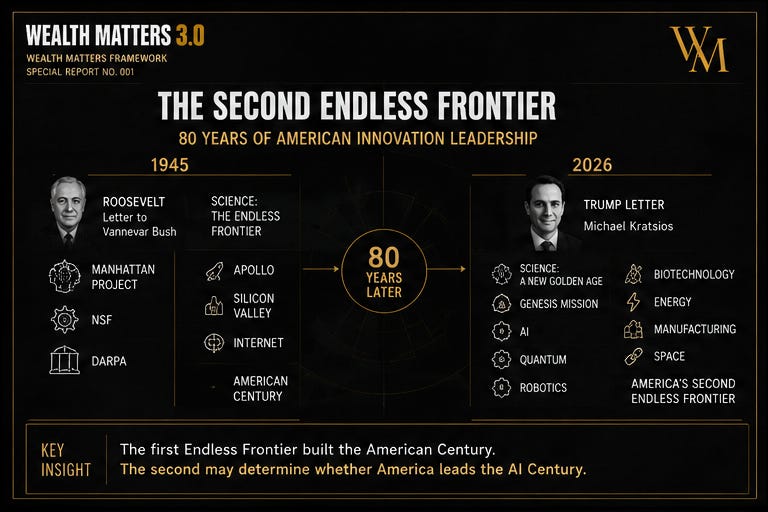
A visual timeline connecting Roosevelt’s 1944 letter, Vannevar Bush’s 1945 report, the postwar innovation boom, Michael Kratsios’ 2026 report, and the emerging AI century.
Wealth Matters Translation
Every generation inherits a different frontier.
For our grandparents, it was electrification, aviation, and industrial manufacturing.
For our parents, it was personal computing and the internet.
For us—and for the generations that will inherit the decisions we make today—the frontier is increasingly defined by artificial intelligence, scientific capability, energy abundance, and the infrastructure required to support them.
The names and technologies will continue changing. The underlying pattern rarely does. History rewards the people who recognize a new frontier while most of the world is still debating whether it exists.
That realization raises another question.
If Vannevar Bush quietly helped shape the first great scientific century, who is helping shape the second?
That’s where our story turns next, to the man who up until 2 days ago nobody had ever heard of, but who has been quietly architecting the future of American innovation for the last decade across two administrations and the private sector.
Chapter 2: The Quiet Architect
History tends to remember the people who announce a new era more readily than the people who design the institutions that make it possible.
Presidents stand at podiums. Founders ring opening bells. Investors celebrate the companies that emerge as obvious winners. Meanwhile, a smaller group of policy architects, research leaders, engineers, and institutional builders works in the background, deciding which problems deserve sustained attention and what machinery will be required to solve them.
Michael Kratsios belongs to that quieter category.
Most Americans could not identify him in a photograph. Many investors who can name the chief executives of every major artificial intelligence company would struggle to explain what the White House Office of Science and Technology Policy does, much less name the person leading it. Yet Kratsios now occupies a position from which he can influence the direction of American science, artificial intelligence, quantum computing, biotechnology, energy, and advanced manufacturing at a moment when those fields are beginning to converge.
That does not make him an oracle, nor does it guarantee that every policy he recommends will succeed. It makes him something more interesting: an institutional architect positioned near the junction where government priorities, scientific capability, national security, and private capital increasingly meet.
Understanding that role helps explain why Science: A New Golden Age deserves closer attention.
A Career Built at the Intersection
Kratsios’ résumé is unusual because it crosses several worlds that typically operate apart from one another.
He began his career around technology investing and company building before entering government during President Trump’s first administration. He became the fourth Chief Technology Officer of the United States, where his portfolio included artificial intelligence, quantum information science, 5G, broadband, and autonomous systems. In 2020, he also served as acting Under Secretary of Defense for Research and Engineering, effectively becoming the Pentagon’s senior technology official at a time when emerging technologies were being treated less as commercial conveniences and more as strategic national capabilities. (U.S. Department of War)
That combination matters.
The private technology world tends to ask whether something can be built, scaled, and monetized. The defense establishment asks whether it can survive contact with an adversary, strengthen national capability, and be deployed under conditions where failure carries consequences. Science agencies ask whether the underlying discovery is rigorous, reproducible, and important enough to expand the frontier of knowledge.
Kratsios has spent time near all three questions.
After his first period in government, he joined Scale AI as a managing director, working on corporate strategy and the application of artificial intelligence across industries. That experience placed him closer to the operational realities of training data, enterprise adoption, model deployment, and the widening gap between what AI can demonstrate in a laboratory and what organizations can reliably use in the field. (Scale Events)
He returned to government in 2025 and was confirmed as the thirteenth director of the White House Office of Science and Technology Policy. In that role, he serves as the president’s chief science and technology adviser and oversees the development of the administration’s science and technology agenda. He also co-chairs the President’s Council of Advisors on Science and Technology, whose announced membership includes leaders from semiconductors, computing, software, biotechnology, energy, and advanced technology. (The White House)
That career path is not simply a collection of impressive titles. It reflects a consistent focus on the systems surrounding technological progress: how emerging capabilities are funded, governed, commercialized, secured, and translated into national advantage.
Those are precisely the systems this report is trying to redesign.
The Importance of People Who Build Institutions
We often tell the history of innovation through the breakthrough itself. The transistor. The microprocessor. The internet. The smartphone. The large language model.
That storytelling is understandable because inventions are tangible. They give us a clean moment to celebrate and a recognizable object around which to organize the narrative. Institutional architecture is much harder to see. It is made of funding mechanisms, research networks, procurement rules, shared infrastructure, standards, incentives, and long-term relationships between universities, government laboratories, private companies, and capital markets.
Yet those invisible structures frequently determine whether a breakthrough remains isolated or becomes transformative.
Vannevar Bush understood this in 1945. His lasting contribution was not a single invention. It was a framework for organizing the American scientific enterprise after the war. He helped articulate why public support for basic research could coexist with private commercialization, and why the country needed durable institutions capable of sustaining discovery beyond any single project or administration.
Kratsios appears to be asking a related question for a much more complex age.
What kind of scientific system does the United States need when artificial intelligence can accelerate discovery, national laboratories hold enormous stores of data and computing capacity, private companies control much of the frontier technology, and geopolitical competitors are pursuing the same strategic capabilities?
That is not a question one company can answer. It is an institutional design problem.
The Letter Behind the Report
In March 2025, President Trump sent Kratsios a letter deliberately echoing Roosevelt’s 1944 request to Vannevar Bush. The letter asked how the United States could secure leadership in artificial intelligence, quantum technology, and nuclear energy; revitalize the scientific enterprise; reduce unnecessary administrative burdens; and ensure that scientific progress improved the lives of Americans. (The White House)
The symbolism was intentional.
Roosevelt had asked Bush to imagine how wartime scientific mobilization could be converted into peacetime progress. Eighty-one years later, Kratsios was asked to reconsider the scientific architecture built in response to that earlier challenge.
His answer, published on July 21, 2026, was Science: A New Golden Age. In the letter transmitting the report, Kratsios described it as a map for renewing America’s foundations and extending its scientific and technological strength into what he called a “Second American Century.” The White House characterized the document as the first comprehensive rethinking of the country’s science and technology enterprise since Science: The Endless Frontier. (The White House)
That is a sweeping claim, and it deserves scrutiny rather than automatic acceptance.
Government reports are easy to announce and difficult to implement. Institutions resist change. Funding priorities shift. Agencies compete. Political attention moves quickly, while scientific progress often requires patience measured in decades. There is a vast distance between publishing a strategic vision and building the operating capacity necessary to achieve it.
Still, serious investors and business leaders should not dismiss a document simply because execution is uncertain. The more useful question is what the document reveals about the problems the government believes are important enough to organize around.
In this case, the answer is clear. The administration views scientific leadership, artificial intelligence, advanced energy, computation, and industrial capacity as interconnected parts of national power rather than separate policy categories.
That worldview is already beginning to produce concrete initiatives. The Genesis Mission, for example, is designed to bring federal scientific data, computing infrastructure, national laboratories, and artificial intelligence together around ambitious research challenges. The administration says the mission aims to create a new operating model for American science and accelerate the translation of discovery into practical outcomes. (The White House)
Whether the program ultimately achieves those ambitions remains to be seen. What matters now is that the architecture is moving from rhetoric toward institutions, budgets, infrastructure, and execution.
That is usually when capital should begin paying attention.
The People I Keep Encountering Around This Question
Kratsios is not the only quiet architect shaping how I think about this transition. In late summer 2020, I organized and moderated an 8-hour Quantum Entanglement Roundtable at the University of Wyoming where I met Conner Prochaska and Dario Gil. The conversation was technical but practical, focused on vision, mission, local and national strategy, but the larger implication stayed with me. Quantum science was not being discussed as an isolated laboratory curiosity. It was part of a broader conversation about energy, national laboratories, industrial competitiveness, scientific infrastructure, job creation, and the country’s ability to convert discovery into commercial capability.
I have felt something similar following the work of Dario Gil, the director of IBM Research. What I respect about leaders like Gil is their willingness to think beyond the fashion cycle surrounding any one technology. The more interesting question is not whether AI, quantum computing, semiconductors, or advanced materials will matter independently. It is how they begin reinforcing one another inside a new scientific system.
Kratsios, Prochaska, and Gil operate from different institutional positions, but I think they share an important characteristic. They are focused less on the novelty of a particular tool and more on the architecture required to make technological progress durable, useful, and strategically meaningful.
That distinction has shaped my own thinking. The public tends to encounter innovation through products. Institutional builders encounter it through systems. Both perspectives matter, but the second often becomes visible only after the first has already produced enormous economic value.
That is how conviction should be built: not by repeating a narrative, but by exposing it to people with enough experience to challenge it.
Unpack this with me on an ATOMIQ LEVEL AMA Featuring Charlie Garcia this week!
On Tuesday, July 28, I will continue exploring these questions during an ATOMIQ LEVEL conversation with Charlie Garcia. I am particularly interested in how Charlie, who has advised six Presidents (across both parties), worked across business, government, intelligence, capital markets, and education, interprets the institutional changes now taking shape. The goal is not to manufacture agreement. Anyone who reads or knows Charlie understands that the debate is the point and he will bring his A-game to pressure-test whether the same patterns become visible from different vantage points.

Quiet Influence, Enormous Consequences
There is a temptation to reduce this story to personalities. To turn Kratsios into either a visionary hero or a political target, depending on the reader’s preferred tribe.
That would miss the point.
This report matters because the position he occupies allows a particular set of ideas to move through the machinery of government. Those ideas concern how research is funded, how scientists access computing resources, how federal data is organized, how emerging technologies are commercialized, how public institutions collaborate with private companies, and how scientific work is connected to national missions.
None of that is glamorous. It is, however, consequential.
The people who redesign institutional plumbing rarely become household names. Yet they influence which discoveries move quickly, which businesses gain access to new opportunities, which regions attract infrastructure, and which countries retain the capacity to lead.
That is why I call Kratsios “The Quiet Architect”.
He is not inventing the future alone. No one does. He is helping design the system through which thousands of scientists, engineers, entrepreneurs, investors, agencies, laboratories, and companies may attempt to build it together.
The report bearing his name therefore deserves to be read at two levels. The first is the obvious one:
What recommendations does it make?
The second is more revealing:
What does it believe is preventing American science from converting its extraordinary talent and resources into progress quickly enough?
The answer leads us to the central diagnosis at the heart of this Special Report.
Chapter 3: America Doesn’t Have an Innovation Problem, The Real Bottleneck Is Throughput
When most people hear that America is falling behind in science or innovation, they instinctively assume the problem is a shortage of intelligence. We don’t have enough brilliant researchers. We don’t graduate enough engineers. We don’t invest enough money. We aren’t taking enough risks.
Those explanations contain pieces of the truth, but after reading Science: A New Golden Age, I became convinced they’re not describing the central problem.
America is not suffering from a shortage of ideas. It’s struggling to convert ideas into capability quickly enough. That distinction may sound subtle, but it changes almost everything.
Innovation is often portrayed as a moment of inspiration—a scientist making a breakthrough, an entrepreneur founding a company, or an engineer inventing a revolutionary technology. Those moments certainly matter, but they represent only a tiny fraction of the work required to change the world.
Between discovery and widespread adoption lies an enormous amount of institutional friction.
Research must be funded.
Experiments must be replicated.
Data must be shared.
Infrastructure must be built.
Regulations must be navigated.
Supply chains must be established.
Factories must be constructed.
Workers must be trained.
Capital must be deployed.
Markets must develop.
Only then does an invention become an industry. When those intermediate steps slow down, scientific progress doesn’t stop. It simply accumulates faster than society can absorb it. That, I believe, is the real concern embedded throughout Science: A New Golden Age.
The report is less worried about America’s ability to produce breakthrough ideas than it is about the nation’s ability to move those ideas through the system efficiently enough to maintain leadership. In other words, this is a throughput problem.
Discovery Is No Longer the Limiting Factor
One of the more fascinating consequences of artificial intelligence is that it doesn’t merely create new products.
It changes the pace of discovery itself.
Researchers can now analyze biological data at scales that were previously impossible. Materials scientists can model compounds before manufacturing them. Engineers can simulate designs that once required years of physical experimentation. Pharmaceutical companies can narrow millions of molecular possibilities into a manageable number of promising candidates. National laboratories are increasingly combining high-performance computing with machine learning to accelerate everything from fusion research to climate modeling.
Discovery itself is becoming faster. Ironically, that makes everything surrounding discovery even more important.
Imagine widening the mouth of a river while leaving the downstream channels unchanged. Water doesn’t stop flowing. It simply begins to back up. The same thing happens inside innovation systems.
When scientific output accelerates but permitting, manufacturing, infrastructure, workforce development, and commercialization continue moving at yesterday’s pace, the bottleneck shifts downstream.
Artificial intelligence doesn’t eliminate friction. It exposes where friction already exists.
That observation became one of my biggest takeaways from this report. For years we’ve debated whether AI will replace human workers. A more interesting question may be:
What happens when scientific discovery begins arriving faster than institutions can process it?
Innovation Happens Inside Systems
One of the recurring mistakes we make when discussing innovation is focusing almost exclusively on individuals. We celebrate visionary founders. We admire Nobel Prize winners. We remember inventors.
Those people deserve recognition, but they rarely succeed alone. Innovation is a systems activity.
Every major breakthrough depends on an ecosystem of universities, research institutions, private companies, investors, skilled trades, manufacturers, infrastructure providers, regulators, customers, and capital markets working together—often without realizing how interconnected they are.
Silicon Valley wasn’t created because one entrepreneur had a brilliant idea. It emerged because universities, venture capital, semiconductor research, defense spending, manufacturing capability, and entrepreneurial culture reinforced one another over decades.
The same pattern appears throughout history.
The aerospace industry wasn’t built by aircraft manufacturers alone.
The biotechnology revolution wasn’t created solely by pharmaceutical companies.
The internet wasn’t simply the product of software engineers.
Every enduring innovation ecosystem combines scientific discovery with institutional capacity. That’s the larger story Science: A New Golden Age is trying to tell.
America’s scientific institutions remain extraordinary. Its universities continue attracting remarkable talent. Its entrepreneurs continue building world-changing companies. Its capital markets remain among the deepest in the world. The challenge is making those strengths operate more cohesively.
The New American Innovation Engine
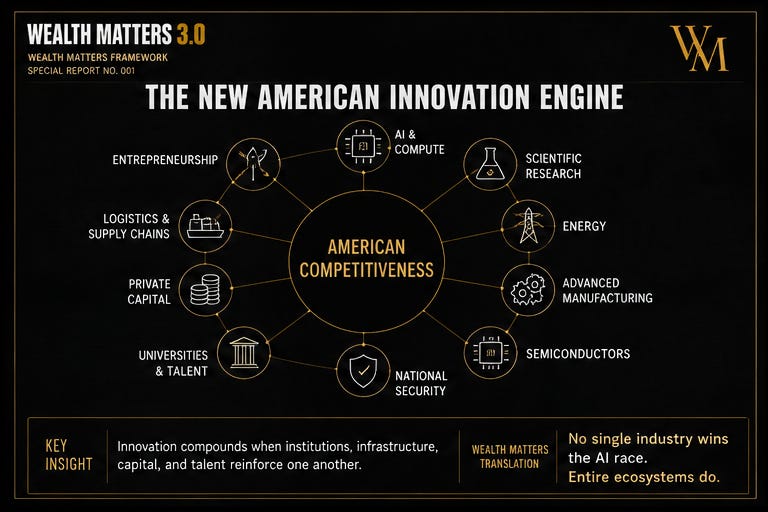
How to Read This Framework
Innovation doesn’t move in a straight line. It behaves more like a flywheel.
Scientific research generates new knowledge.
Artificial intelligence accelerates that research.
Universities educate the next generation of scientists and engineers.
National laboratories provide specialized infrastructure.
Entrepreneurs translate discoveries into businesses.
Capital funds expansion.
Manufacturing scales production. Markets reward successful execution.
Those returns then finance the next cycle of research. When each component reinforces the others, innovation compounds. When one component slows down, the entire system loses momentum.
Wealth Matters Translation
This framework fundamentally changed how I think about investing. For years, I’ve been conditioned—like most investors—to search for the next breakthrough company. Increasingly, I’m asking a different question.
Which parts of the innovation engine become more valuable regardless of which company wins?
That’s a much more durable lens. Individual companies come and go. Systems tend to compound.
Throughput Is an Investment Thesis
This is where I believe the report quietly transitions from science policy into economics. If America’s challenge is improving throughput, then every effort to remove friction creates opportunity somewhere else.
Accelerating permitting changes infrastructure demand. Modernizing transmission expands investment in the electrical grid. Reducing barriers to advanced manufacturing benefits industrial automation.
Improving access to computational resources strengthens demand for semiconductors, networking, cooling, and energy. Expanding scientific research increases demand for specialized talent, laboratory equipment, data infrastructure, and software.
Notice what’s happening. The report isn’t simply advocating for more research. It’s describing an attempt to increase the velocity at which scientific capability becomes economic capability.
That distinction is easy to overlook.
It’s also where I think investors should begin paying attention. Markets don’t merely reward invention. They reward systems that consistently convert invention into productivity.
The Questions That Matter
As I finished this chapter of the report, I found myself writing several questions in the margin of my notebook. I still have more questions (as you will see and read) than I have complete answers. Perhaps that’s why they continue to occupy my thinking.
What if the most valuable businesses of the next decade aren’t the ones creating intelligence, but the ones helping society absorb it?
What if the greatest constraint isn’t computational power, but institutional capacity?
What if America’s competitive advantage ultimately depends less on inventing breakthrough technologies than on building the fastest system for translating discovery into widespread economic value?
Those questions may prove more important than asking which AI model has the highest benchmark score.
Because benchmarks measure capability.
History rewards implementation. That realization leads naturally to the next chapter. If innovation depends on national systems rather than isolated breakthroughs, then the next question becomes obvious.
Who decides which systems matter enough to build?
And how do those decisions eventually reshape entire markets?
Four Favors Before You Continue.
Hit the ❤️. The algorithm is a validation machine that needs your cheap dopamine to keep us in the top of your feed.
Hit the 🔄 restack. Somebody’s life will change passively today, and you can get the credit for bringing it to them from both of us.
Hit 📤 share. You know exactly one person in your email list or text stream who needs something on their playlist or reading wire today.
Drop a comment. Give me your take, your additional facts that harden or contradict the thesis, or your biggest unanswered concern. I reply to the ones that make me laugh, cry, make me think, or make me money. Preferably all of the above.
Chapter 4: When Nations Decide What Matters
Now we will explore how strategic missions quietly become multi-trillion-dollar markets. Markets like to believe they discover the future independently. They do not.
They interpret signals, price probabilities, reward execution, and eventually direct enormous amounts of capital toward the opportunities that appear most promising. Yet many of the markets we now consider inevitable began long before investors could model their revenue, estimate their margins, or purchase shares in the companies that would eventually dominate them.
They began when a nation decided a problem mattered enough to solve.
The interstate highway system was not born from a transportation exchange-traded fund. The semiconductor industry did not emerge because analysts identified an attractive total addressable market. The space economy was not launched by a venture-capital pitch deck. The early internet was not justified by an advertising model.
Each began as a strategic capability before it became a commercial opportunity.
That sequence matters because it reveals something Wall Street often recognizes late: national priorities can create economic gravity. When a government repeatedly directs attention, procurement, research funding, infrastructure, regulation, and institutional capacity toward a difficult objective, private capital begins organizing around the resulting demand.
The public mission does not guarantee commercial success. It does, however, alter the terrain on which commercial success becomes possible.
That is why Science: A New Golden Age should not be read merely as a collection of scientific recommendations. It is also a statement about which capabilities the United States believes will matter enough to organize around for years—perhaps decades—to come.
The report identifies artificial intelligence for science, quantum systems, fusion energy, space exploration, advanced semiconductors, biotechnology, critical materials, and next-generation manufacturing as interconnected strategic priorities. It recommends mission-driven programs capable of bringing government, universities, national laboratories, philanthropy, and private industry together around ambitious outcomes. (The White House)
This is not a prediction that every program will succeed. It is evidence that the machinery of national attention is beginning to move.
For investors, business owners, and families trying to prepare for the next economy, that is a signal worth understanding.
Missions Change the Time Horizon
Private markets are extraordinarily good at funding opportunities with visible customers, plausible margins, and a credible path to liquidity.
They are less naturally suited to problems that may require fifteen years of research, specialized infrastructure, uncertain scientific breakthroughs, and capital expenditures too large for any single company to absorb. The future value may be enormous, but the route between today’s experiment and tomorrow’s market can be too long, uncertain, or politically exposed for conventional capital.
National missions extend the time horizon. They allow a society to pursue capabilities whose strategic importance may be clear long before their commercial model is. They provide continuity across scientific disciplines, create early customers through government procurement, support infrastructure that many companies can use, and absorb risks that would otherwise prevent an ecosystem from forming.
This does not mean government is better than markets at choosing companies. It means government and markets often perform different functions.
Government can define a mission, build foundational infrastructure, support basic research, and purchase capabilities before commercial demand is mature. Private enterprise can then compete over execution, reduce costs, improve usability, discover applications, and scale the most valuable outcomes.
The distinction is easy to miss because we usually encounter the final product without seeing the institutional scaffolding beneath it.
We remember the iPhone, not the decades of publicly supported research that helped produce its component technologies.
We remember commercial satellites, not the national space programs that developed launch capability, navigation systems, materials, sensors, and a generation of aerospace talent.
We remember biotechnology companies, not the patient accumulation of federally funded research that made many of their discoveries possible. By the time the market appears obvious, the mission has often been compounding for years.
Apollo Was More Than a Moonshot
The Apollo Program is frequently invoked whenever leaders want to make an initiative sound ambitious. Most of those comparisons are superficial.
Apollo was not important simply because the United States placed human beings on the Moon. It was important because achieving that objective required thousands of organizations to improve their capabilities at the same time.
Materials had to become lighter and stronger. Computers had to become smaller and more reliable. Communications had to function across unprecedented distances. Manufacturing tolerances had to improve. Systems engineering became a discipline of national importance. Universities trained new scientists. Contractors expanded production. Entire regions developed specialized industrial expertise.
The mission created a destination. The process of reaching it created an economy.
That is the deeper mechanism investors should study. A sufficiently difficult national objective does not produce one market. It creates a cascade of constraints, and each constraint becomes a reason to invent, build, finance, hire, or acquire something new.
A fusion mission requires more than a reactor. It requires advanced magnets, specialized materials, power electronics, precision manufacturing, control systems, scientific computing, skilled labor, regulatory expertise, and eventually an entirely new operating and maintenance ecosystem.
A quantum mission requires more than a quantum computer. It requires cryogenic systems, photonics, fabrication, error correction, sensing, secure communications, new software, specialized facilities, and customers capable of applying the technology to real problems.
A lunar mission requires more than a rocket. It requires launch infrastructure, energy systems, robotics, communications, navigation, life support, logistics, construction, materials, and an expanding commercial supply chain.
An AI-for-science mission requires more than a frontier model. It requires organized data, provenance, secure computing, scientific foundation models, laboratory automation, robotics, high-performance networks, verification systems, and institutions capable of adopting a new way of conducting research.
This is how a strategic objective becomes an investable landscape. Not all at once. One constraint at a time.
The Constraint Cascade
This leads to one of the most useful mental models in this report.
A national mission begins with a desired outcome. That outcome reveals technical constraints. Those technical constraints create infrastructure requirements. Infrastructure requirements produce procurement, labor, energy, real estate, financing, and supply-chain demand. That demand attracts entrepreneurs and private capital. The resulting businesses eventually create financial assets.
The sequence looks like this:
National Mission
↓
Scientific and Technical Constraints
↓
Infrastructure Requirements
↓
Industrial Demand
↓
Private-Sector Formation
↓
Capital-Market Opportunity
Wall Street generally enters near the bottom of this cascade. The most valuable strategic insight often exists near the top. That does not mean an investor should attempt to speculate on every policy announcement. Most announcements fade. Budgets change. Administrations change. Programs become delayed, diluted, or abandoned.
The better question is whether a mission is beginning to develop institutional permanence.
Has it received statutory authority?
Is an agency responsible for implementation?
Is money being committed?
Are facilities being built?
Are procurement pathways emerging?
Are universities creating programs around it?
Are private companies beginning to hire, partner, and invest?
Are multiple administrations or institutions converging on the same strategic need?
Once several of those conditions appear together, a policy preference begins becoming an economic system. That is when the signal becomes more durable.
Three Lenses on the Same Future
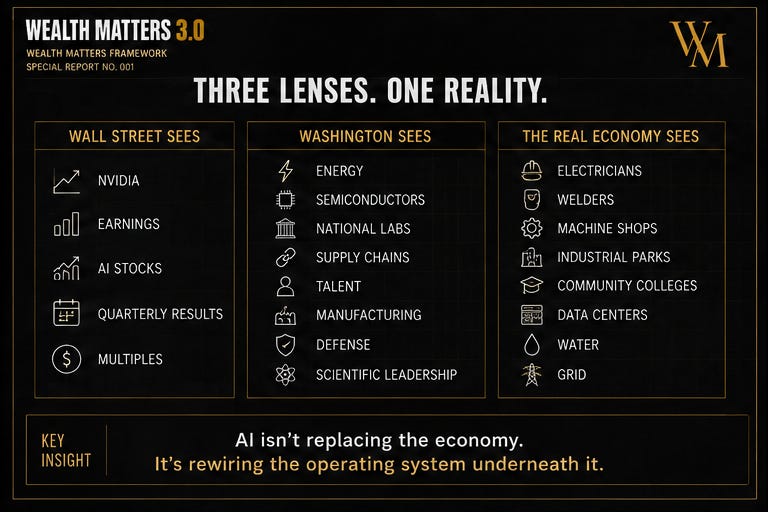
Wall Street tends to see emerging technology through the language of securities, earnings, valuation, and liquidity.
Washington sees it through the language of national power, security, resilience, scientific leadership, and strategic dependence.
The real economy experiences it through factories, laboratories, power systems, skilled workers, regional development, supply chains, land, equipment, and operating businesses.
These are not competing interpretations. They are three lenses focused on different layers of the same transformation.
Wall Street asks:
Where will financial returns appear?
Washington asks:
Which capabilities can the nation not afford to lose?
The real economy asks:
What must physically be built, operated, repaired, powered, secured, and staffed?
The mistake is choosing only one lens. An investor looking exclusively through Wall Street’s lens may recognize the most visible beneficiaries while missing the physical bottlenecks beneath them. A policymaker looking only through Washington’s lens may identify strategic importance without understanding commercial incentives. An operator immersed solely in the real economy may see rising demand without recognizing the larger institutional force creating it.
The opportunity comes from triangulation. When all three lenses begin pointing toward the same constraint, attention is warranted.
Wealth Matters Translation
The financial economy prices expectations. Washington establishes priorities. The real economy absorbs the work. When those three systems align, capital formation can accelerate with remarkable force.
That alignment is more useful than any single government announcement because it tells us a priority is escaping the page and entering the world. Scientists begin receiving grants. Companies begin responding to contracts. Utilities revise demand forecasts. Manufacturers expand capacity. Skilled labor becomes scarce. Land near strategic infrastructure becomes more valuable. Private equity begins consolidating fragmented suppliers. Public markets eventually recognize the earnings.
By then, the opportunity may look obvious. The Wealth Matters discipline is to notice the alignment earlier.
The Genesis Mission as an Operating Example
The Genesis Mission offers a timely example of this process moving from policy into institutional form.
Launched by executive order in November 2025, the initiative directed the Department of Energy to create an integrated platform connecting federal scientific datasets, supercomputers, AI systems, foundation models, research instruments, and potentially autonomous laboratories. The stated ambition is not simply to fund more research, but to change the operating model of research by allowing AI agents and scientists to work across shared data and computational infrastructure. (The White House)
In July 2026, the administration announced more than $5 billion in federal commitments and expanded Genesis into a whole-of-government effort involving more than fifteen agencies. The announced projects include autonomous laboratories, AI-assisted materials discovery, quantum systems, biological modeling, and the analysis of more than 150 petabytes of space data. (The White House)
The dollar figure is significant, but the operating architecture is more important.
The Department of Energy’s national laboratories already possess extraordinary scientific instruments, specialized datasets, secure facilities, supercomputers, and thousands of scientists and engineers. Genesis proposes connecting those assets into what the executive order calls the American Science and Security Platform: a shared environment through which models can be trained, experiments designed, simulations conducted, hypotheses tested, and discoveries translated more quickly. (The White House)
This is the throughput thesis becoming institutional.
The mission is not based on the belief that America lacks scientific talent. It begins from the recognition that the country already possesses enormous capability but has not organized that capability into a sufficiently cohesive, AI-native system.
Whether Genesis ultimately achieves its stated ambition to double the productivity and impact of American science within a decade remains unknown. The measurement alone will be difficult, and execution across agencies will be complicated. (The White House)
Yet the direction is unmistakable.
AI is being repositioned from a category of software products into infrastructure for national scientific capability. That is a much larger market story than chatbots.
The Mission Is Not the Market
There is an important distinction here. A national mission is not itself an investment thesis. It is the beginning of one.
Investors still need to determine who captures value, which businesses possess durable advantages, where competition will compress margins, and whether public support creates a real market or merely temporary revenue. Government funding can accelerate an ecosystem, but it can also distort incentives, reward political access, or sustain projects that would not survive commercial scrutiny.
The existence of a mission should therefore change the questions we ask, not suspend our judgment.
Who owns the scarce asset?
Which constraint becomes harder as the mission scales?
Where does recurring demand develop?
Which capabilities are difficult to replicate?
What remains valuable even if the flagship program changes?
Who benefits from several missions simultaneously?
That final question may be the most important. A company providing a specialized component for only one government program may face concentration risk. A business supplying power-management systems, precision manufacturing, secure data infrastructure, advanced materials, or laboratory automation across AI, quantum, fusion, biotechnology, and aerospace occupies a different strategic position.
The best businesses may not depend on one mission succeeding. They may benefit because several missions strain the same underlying capacity. This is where the Constraint Cascade becomes particularly useful. It shifts our attention away from the most glamorous destination and toward the bottlenecks shared across multiple paths.
America’s Four National Missions
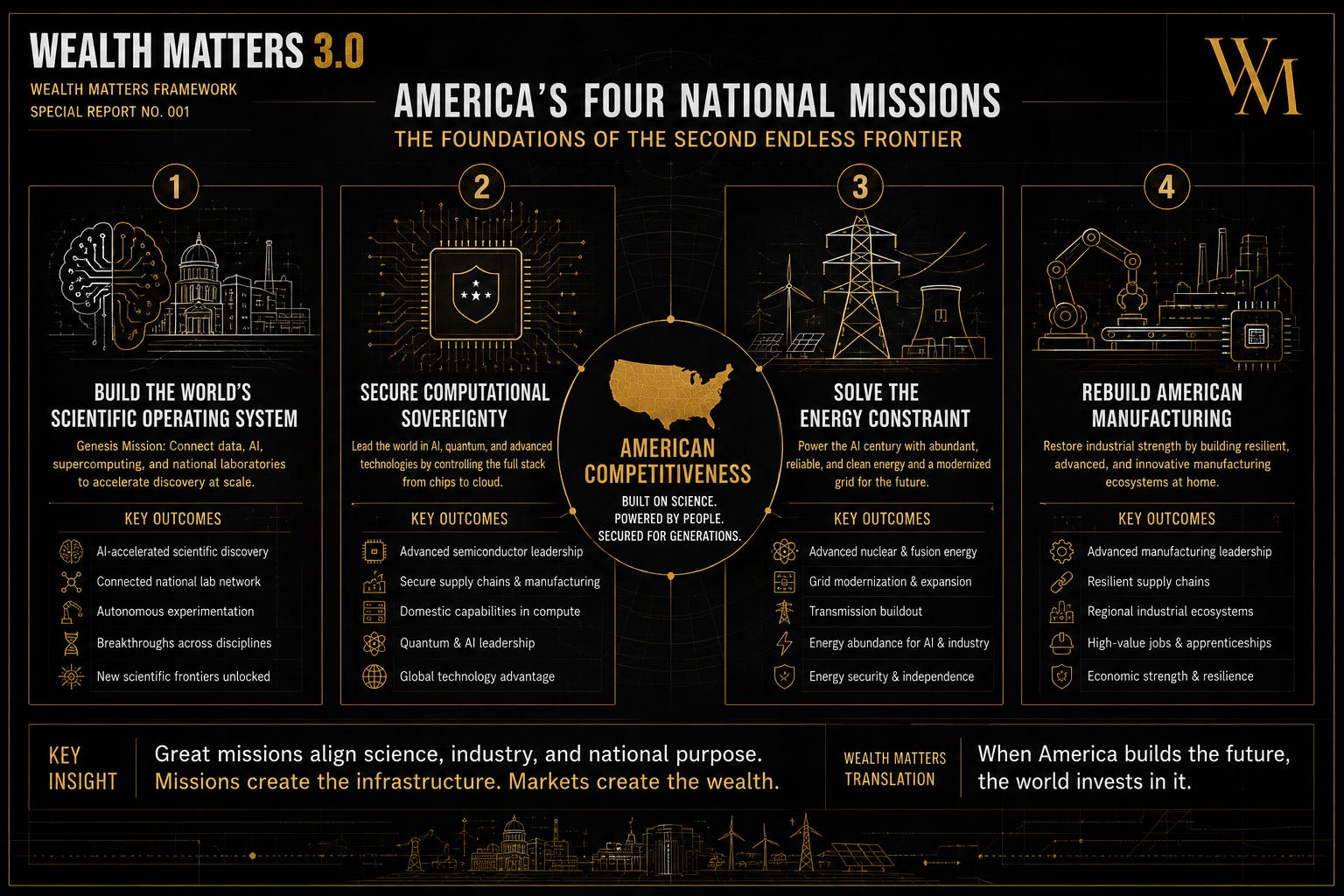
The report contains a broader range of technological priorities, but four mission families provide a useful way to organize the emerging landscape:
AI for Scientific Discovery
The objective is to use advanced computation, federal data, scientific models, and increasingly autonomous laboratories to accelerate the rate at which hypotheses become validated discoveries.
Energy Abundance
The objective is not merely to produce more electricity. It is to create an energy system capable of supporting data centers, advanced manufacturing, defense production, transportation, scientific facilities, and a more electrified economy without making reliability a luxury.
Quantum and Advanced Computation
The objective is to move quantum systems from scientific promise toward applications in sensing, communications, materials, security, and computation while strengthening the semiconductor and high-performance-computing base beneath them.
Space and the New Industrial Frontier
The objective is to establish sustained capabilities beyond Earth while developing the launch, communications, energy, robotics, logistics, materials, and manufacturing systems required to support them.
These missions overlap.
AI accelerates materials discovery for fusion and aerospace. Quantum sensors improve navigation and scientific measurement. Advanced semiconductors support AI, defense, space, and autonomous systems. Energy abundance determines how much computation and manufacturing the economy can support. Space missions create demand for materials, robotics, communications, and distributed energy systems that may later find applications on Earth.
The overlap is not incidental. It is the thesis. We are not watching four separate technology stories. We are watching the early formation of a connected industrial system.
Wealth Matters Translation
Most portfolios are organized by sectors. However, the future may be organized by missions.
Traditional sector labels divide the economy into convenient categories: technology, industrials, utilities, healthcare, materials, communications, real estate. Yet a national mission cuts horizontally through those classifications.
AI for science may involve a semiconductor company, a utility, a laboratory-equipment manufacturer, a data-center operator, an industrial landlord, a cybersecurity provider, and a biotechnology firm.
A fusion program may touch mining, power electronics, construction, insurance, advanced manufacturing, software, robotics, and workforce development.
A space economy may require energy generation, telecommunications, materials, logistics, defense systems, and financial services.
Thinking in missions does not replace fundamental analysis. It gives fundamental analysis a more complete map. Instead of asking only which sector will outperform, we can ask which capabilities several strategic missions will compete to acquire.
That is often where scarcity—and therefore pricing power—appears.
The Geography of National Purpose
National missions also have a geographic dimension. Scientific and industrial capability does not exist everywhere equally. It clusters around laboratories, universities, manufacturing corridors, energy resources, ports, military installations, specialized workforces, and regions with the physical capacity to support expansion.
This matters because an investment cycle is never distributed evenly.
A new semiconductor facility creates demand for more than fabrication equipment. It requires water, electricity, roads, construction, housing, suppliers, maintenance, logistics, technical education, and local services. A national laboratory expanding AI infrastructure may influence data-center development, secure networking, specialized contractors, and the surrounding talent market. A fusion cluster could reshape demand for industrial real estate, precision components, grid connections, and skilled trades throughout a region.
The first-order investment is often visible.
The second- and third-order effects are where locally informed operators may possess an advantage over distant capital.
A family that owns an industrial services company near a strategic manufacturing corridor may be better positioned than an investor attempting to select the eventual winner in quantum computing. An electrical contractor, cooling specialist, testing laboratory, machine shop, cybersecurity provider, or workforce-training business may participate in the same transformation through recurring demand rather than technological speculation.
This is what it means to translate a national mission into the real economy. Someone must do the work.
When Policy Becomes CapEx
There is a moment in every serious national initiative when rhetoric must become capital expenditure.
Land must be acquired.
Power must be contracted.
Facilities must be designed.
Equipment must be ordered.
Networks must be secured.
People must be trained.
Supply agreements must be signed.
At that point, the mission begins appearing in corporate backlogs, utility forecasts, municipal planning documents, construction pipelines, and labor markets.
This is where investors should become more disciplined, not less.
The existence of large announced budgets can produce euphoria. Every company near the theme begins describing itself as essential. Valuations expand before revenue appears. Capital rushes into suppliers whose capacity may prove interchangeable. The story becomes easier to sell than the economics are to defend.
The antidote is to follow the physical constraint.
What cannot be produced quickly?
What requires certification?
What depends on scarce technical knowledge?
What has long lead times?
What must be located near a particular asset?
What is consumed repeatedly rather than purchased once?
What carries switching costs because failure would threaten the mission?
Those questions help separate thematic exposure from durable value creation.
The Signal Before the Security
This report is called Understanding the AI Century Before Wall Street Does for a reason. Wall Street will understand the AI century. Eventually.
It will build models, create indexes, finance expansion, underwrite transactions, and package the opportunity into products available to nearly every investor. That process has already begun at the most visible layer of the AI economy.
The question is whether the rest of the system has been priced with equal imagination.
The power plants.
The substations.
The copper.
The cooling systems.
The secure facilities.
The scientific instruments.
The industrial land.
The precision manufacturers.
The skilled trades.
The private data environments.
The regional banks and specialty lenders capable of financing smaller suppliers.
The succession plans required when aging owners suddenly discover that the family manufacturing company they expected to sell quietly has become part of a strategically important supply chain.
These are not side stories. They are where national ambition encounters physical reality. And physical reality is where the next chapter begins.
Because once a nation decides what matters, capital does not flow directly to the final objective. It moves through layers. Some are highly visible. Others remain almost entirely ignored.
The most consequential question for investors is not simply where capital is going. It is what must exist underneath the destination for any of it to work.
Chapter 5: Where the Capital Flows Next
Reading tomorrow’s balance sheet before it appears in today’s earnings is the edge every investor wants.
Every investment cycle develops its own language. During the dot-com era, investors learned to talk about eyeballs, traffic, and network effects. During the shale revolution, the vocabulary shifted toward acreage, break-even prices, and drilling productivity. The mobile era brought app stores, engagement, and customer-acquisition costs. Cloud computing taught markets to think in subscriptions, recurring revenue, and infrastructure delivered as a service.
The artificial-intelligence cycle has given us tokens, parameters, inference costs, context windows, agents, and compute.
Those concepts matter. They help us understand what is happening at the visible edge of the technology. Yet I suspect they are not the language that will ultimately explain where much of the enduring wealth is created.
The more consequential vocabulary may be far less glamorous.
Megawatts. Transformers. Interconnections. Cooling. Copper. Industrial land. Water. Secure data. Precision manufacturing. Technical labor. Permitting. Certification. Maintenance.
These are the nouns of the real economy. They rarely generate the same excitement as a new model release, but they describe the physical constraints that determine whether the AI century can be built at all.
This is where the central argument of Part I reaches its practical conclusion.
Artificial intelligence may begin in software, but it does not remain there. It spills into science. Science spills into energy. Energy spills into infrastructure. Infrastructure spills into manufacturing, real estate, labor, finance, and regional development. Each layer creates new demands on the layer beneath it.
Capital follows those demands. Not perfectly. Not all at once. And rarely in a straight line. But it follows.
The Application Layer Is Only the Beginning
Visible products usually dominate the first stage of an emerging technology cycle. That makes sense. Applications are where ordinary people encounter a new capability. The browser made the internet tangible. The smartphone made mobile computing personal. Chat interfaces made generative artificial intelligence accessible to hundreds of millions of people who had never written code or trained a model.
Applications become the story because applications can be experienced.
Infrastructure is easier to ignore. Most people did not think about fiber-optic networks while sending their first email. They did not study semiconductor supply chains while downloading an app. They did not ask where cloud servers were located each time they streamed a movie.
The underlying systems became noticeable only when they failed, became scarce, or suddenly grew expensive.
AI is following a similar pattern, except the physical requirements may be larger and more immediate. Training and operating advanced models require enormous computational resources. Computation requires electricity, cooling, chips, networking, secure facilities, land, equipment, and capital. Scientific AI adds another layer by connecting models to specialized data, laboratories, robotics, experimental facilities, and high-performance computing.
The Department of Energy’s Genesis Mission makes that architecture unusually visible. Its stated goal is to integrate the country’s leading supercomputers, scientific facilities, AI systems, quantum capabilities, and unique datasets into a coordinated platform for discovery. DOE describes the American Science and Security Platform as the mission’s core technology engine, integrating computing, experimental infrastructure, data, and production capabilities into a single AI-driven system. (Genesis Mission)
That is not an app.
It is an industrial platform for producing knowledge. Once we see AI through that lens, the investment landscape becomes much larger.
The AI Civilization Stack
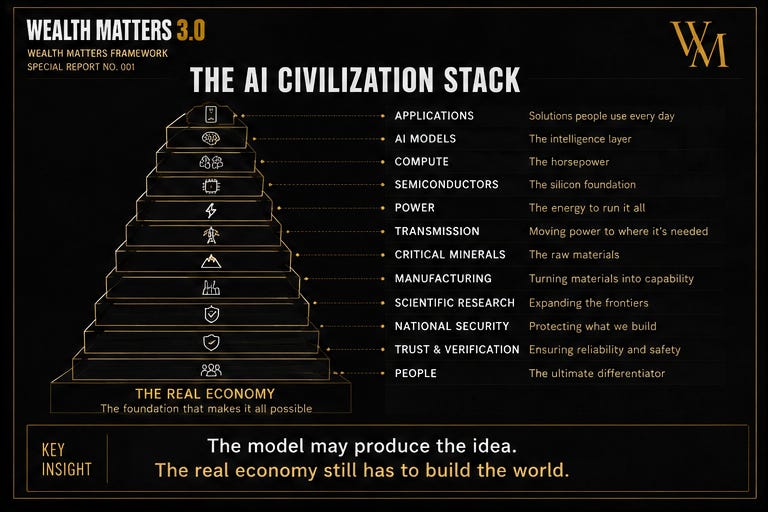
The easiest way to understand the emerging capital cycle is to think in layers.
At the top sits Intelligence.
This includes the frontier models, scientific models, agents, software applications, and interfaces through which people interact with artificial intelligence.
Beneath that sits Computation.
This layer includes semiconductors, servers, high-performance computing, cloud infrastructure, networking, memory, storage, and the increasingly specialized hardware required to train and operate advanced systems.
Beneath computation sits Energy.
Every data center, laboratory, fabrication facility, autonomous system, and advanced manufacturing plant ultimately depends on reliable power. That means generation, transmission, substations, transformers, grid management, backup systems, fuel supply, and the regulatory and financial structures that allow capacity to be built.
Beneath energy sits Industry.
This includes the factories, machine shops, robotics providers, cooling systems, electrical contractors, engineering firms, construction companies, testing laboratories, component manufacturers, and specialized suppliers that turn plans into physical capability.
Beneath industry sits Materials and Place.
Copper. Uranium. Steel. Aluminum. Rare earths. Cement. Water. Industrial real estate. Transportation corridors. Ports. Warehouses. Land near power. Communities capable of housing and supporting the workforce.
At the base sits Trust.
Cybersecurity. Data provenance. Identity. Legal rights. Scientific verification. Compliance. Governance. Insurance. Custody. Institutional confidence.
The stack is not meant to imply that one layer is more important than another. It illustrates dependency.
The intelligence layer cannot scale without computation. Computation cannot scale without energy. Energy and computation cannot scale without industry. Industry cannot scale without materials, land, labor, and logistics.
None of it can endure without trust. The higher the ambition rises, the more pressure moves downward. That pressure is where many of the next capital opportunities may emerge.
Wealth Matters 3.0 Translation
Most investors begin at the top of the stack because that is where growth is easiest to see. The more durable question may be what becomes scarce underneath it.
A successful AI application can create enormous value, but it can also be displaced by a stronger model, a lower-cost competitor, or a feature added by a larger platform. The constraint beneath several applications may possess a different economic profile.
A limited grid connection does not care which chatbot wins.
A transformer manufacturer may benefit from data-center growth, manufacturing reshoring, electrification, utility modernization, and scientific infrastructure at the same time.
A precision machine shop capable of meeting demanding defense, aerospace, semiconductor, or nuclear specifications may participate in several national missions without needing to predict the ultimate technology winner.
An industrial property with expandable power, secure access, water, and proximity to skilled labor may become more valuable because many forms of advanced industry compete for the same physical characteristics.
This does not mean the lower layers are automatically better investments. Capital-intensive businesses can destroy value. Commodity producers can overbuild. Utilities can face regulatory constraints. Construction cycles can turn. Industrial properties can be purchased at prices that assume impossible growth.
The point is not to replace software enthusiasm with infrastructure enthusiasm. It is to understand the complete system before allocating capital within it.
Capital Flows Down Before Earnings Flow Up
One reason structural transitions are difficult for markets to interpret is that spending and profits appear at different times.
Before a new scientific platform produces a breakthrough, someone must purchase the computing equipment.
Before a manufacturing facility generates revenue, someone must acquire the land, secure power, obtain permits, construct the building, install equipment, hire workers, and qualify the production process.
Before an energy project sells electricity, someone must finance development, interconnection, equipment, transmission, and construction.
Capital expenditure appears first. Productivity appears later.
This creates a familiar pattern. The most visible technology companies announce ambitious spending plans. Their suppliers receive orders. Utilities revise load forecasts. Developers pursue land near transmission. Equipment lead times extend. Contractors build backlogs. Private equity searches for fragmented service businesses. Credit markets finance expansion.
Only later do the full economic consequences become visible in revenue, margins, and productivity statistics. By the time the financial statements tell the complete story, much of the positioning may already have occurred. That is what I mean by reading tomorrow’s balance sheet before it appears in today’s earnings. It is not clairvoyance. It is dependency analysis.
What must be purchased before the promised outcome can exist?
Power Becomes Strategy
For much of the digital era, electricity was treated as a utility input rather than a strategic constraint. That assumption is breaking down.
The AI economy does not merely require more electricity. It requires power with specific characteristics: dependable, available on a commercially useful timeline, located near the right infrastructure, supported by transmission, and increasingly capable of meeting security and resilience requirements.
The Genesis Mission makes the link between energy and scientific leadership explicit. DOE is organizing its national laboratories, computing resources, scientific instruments, and public-private partnerships around national challenges spanning energy, manufacturing, critical materials, biotechnology, quantum systems, and national security. Its initial challenge set includes securing data-center leadership, advancing nuclear energy, improving industrial productivity, strengthening critical-minerals supply, and developing AI-driven autonomous laboratories. (The Department of Energy’s Energy.gov)
Those missions will not compete only for scientists. They will compete for electrons. This changes the strategic value of generation assets, grid equipment, interconnections, and regions capable of adding dependable power. It also makes energy policy inseparable from technology policy.
The country that produces the best model but cannot power its deployment has not secured leadership.
The company that designs a promising new industrial process but cannot obtain an interconnection may possess intellectual property without productive capacity.
The community that attracts a major facility but cannot support the required housing, water, transportation, or workforce may discover that an announcement is not the same thing as an operating economy.
Energy abundance is therefore not one sector inside the AI story. It is a precondition for the story.
Copper, Transformers, and the Return of the Unfashionable
Every technology boom eventually rediscovers the importance of old industries.
The internet required trenching, cable, towers, cooling, and electrical systems. E-commerce required warehouses, trucks, packaging, logistics software, and enormous labor networks. Cloud computing required data centers, generators, chillers, steel, concrete, and fiber.
AI will be no different. The sophistication of the intelligence does not eliminate the physicality of the system. It increases it.
Consider a transformer. It does not possess a charismatic founder. It does not demonstrate human-like reasoning. It is unlikely to dominate social media discussion.
Yet without transformers, electricity cannot be moved and converted at the voltages required across the grid. Without grid equipment, new generation and large loads cannot be connected reliably. Without connections, promised data centers, factories, laboratories, and charging systems remain drawings.
The same logic applies to copper.
It is embedded in transmission lines, electrical equipment, buildings, motors, electronics, data centers, industrial machinery, and transportation systems. When several large capital cycles demand more electrification simultaneously, the material beneath them becomes strategically important.
Again, strategic importance does not guarantee an attractive investment at any price. Commodity markets are cyclical. Supply eventually responds. Substitution occurs. Political risk matters. New mines are difficult to permit and develop. But ignoring the material layer because it feels less sophisticated than the application layer is a category error.
Intelligence may be weightless (bits). Its infrastructure is not (atoms).
Industrial Real Estate Becomes Operational Infrastructure
Real estate investors are accustomed to thinking in categories.
Office.
Retail.
Multifamily.
Industrial.
Data centers.
Life science.
Those categories are useful, but the next industrial cycle may reward a more functional way of thinking.
What can the property do?
Does it have access to sufficient power?
Can that power be expanded?
Is there water?
Does the building support heavy equipment, specialized ventilation, secure operations, laboratories, clean rooms, cooling, or higher floor loads?
Is it near a national laboratory, university, military installation, port, airport, manufacturing corridor, or technically skilled workforce?
Can it be permitted for uses that nearby communities may resist?
Is there room for expansion?
How resilient is the site?
Industrial real estate increasingly becomes part of the operating stack rather than a passive container around it. A generic warehouse and a strategically located advanced-manufacturing site may both be labeled industrial, but their economic roles are not the same. One provides space. The other provides access to a scarce combination of power, infrastructure, labor, logistics, and regulatory permission.
That distinction becomes more valuable as national missions collide with local constraints.
Wall Street may model the tenant. The operator must understand the site.
The Opportunity Hidden Inside Existing Businesses
The AI century will not be built only by startups. Much of it may be built by companies that already exist but are not yet recognized as technology businesses.
An electrical contractor.
A specialty engineering firm.
A cooling-services provider.
A testing and certification laboratory.
A precision manufacturer.
A secure document-management company.
An environmental-services business.
A commercial HVAC operator.
A data-integration firm.
A regional industrial distributor.
A workforce-training provider.
A family-owned business with decades of customer relationships and technical knowledge may discover that its capabilities sit directly inside a rapidly expanding constraint. This is where the opportunity becomes particularly relevant to the Wealth Matters audience.
A large portion of the American real economy remains privately held. Many critical suppliers are operated by founders approaching retirement. Their succession plans may be incomplete. Their systems may depend heavily on personal relationships. Their capital structures may not support the investment required to scale into a new demand cycle.
The market may suddenly value what they built more highly than the owners expected. But increased strategic relevance does not automatically make a company transferable. An aging founder can own an essential business and still possess a fragile asset.
Customer concentration, undocumented processes, outdated equipment, weak management depth, informal cybersecurity, poor financial reporting, and unresolved estate planning can prevent a family from capturing the value created by a favorable market.
This is one of the most important bridges between the AI century and generational wealth. The opportunity is not simply to invest in the transition. It is to prepare existing operating businesses to survive, scale, and transfer through it.
Private AI and the Trust Layer
As artificial intelligence moves deeper into scientific, financial, legal, manufacturing, defense, and family-office environments, the trust layer becomes more important.
Many organizations cannot simply pour their data into public tools.
They hold intellectual property, client records, regulated information, trade secrets, scientific data, family records, defense-related materials, or operating knowledge whose loss would create permanent damage. They need to know where data is stored, who can access it, how models use it, what can leave the environment, and whether outputs can be verified.
This creates a growing role for private and controlled AI systems. Not because every organization needs to train a frontier model. Most do not. They need an intelligence environment appropriate to the sensitivity of their work.
The distinction is similar to the one between the public internet and a private network. Both use computing and connectivity, but they serve different risk requirements.
Inside the AI Civilization Stack, trust is not a compliance box added at the end.
It is structural.
A scientific system without provenance can produce conclusions that cannot be defended.
A financial system without privacy can violate the obligations on which the client relationship depends.
A manufacturing system without cybersecurity can expose designs, processes, or supply chains.
A family-office system without governance can turn convenience into vulnerability.
The more valuable the intelligence becomes, the more valuable trusted control over that intelligence becomes.
Bitcoin and the Energy-Intelligence Convergence
Bitcoin belongs in this discussion, but perhaps not for the reason many investors expect.
The most common debate treats Bitcoin primarily as money, a speculative asset, digital gold, or an alternative financial system. Those arguments matter, but the network also sits at the intersection of energy, computation, capital formation, and digital property.
Bitcoin mining converts electricity and specialized computation into a globally transferable digital asset. That process can create demand for power in locations where transmission constraints, curtailment, stranded generation, or uneven consumption would otherwise reduce economic value. It also introduces a flexible load that can respond differently from many traditional industrial users.
This does not mean every energy project should include Bitcoin mining or that every mining company represents a sound investment. The industry remains exposed to commodity-like economics, equipment cycles, financing risk, policy shifts, and intense competition.
The more durable insight is that computation is becoming a participant in energy markets.
AI data centers, scientific computing, advanced manufacturing, and Bitcoin mining all translate energy into different forms of economic output. They compete for some of the same physical inputs while creating different load profiles, operating requirements, and financial characteristics.
In the next economy, energy strategy and digital-asset strategy may become increasingly difficult to separate.
That matters to utilities. It matters to landowners. It matters to infrastructure investors. It matters to communities evaluating large loads. And it matters to families whose portfolios contain both financial assets and operating exposure to the real economy.
The Family Office Question
A family office should not respond to this transition by chasing every technology theme. Its advantage should be patience, flexibility, and the ability to think across generations. The more useful exercise is to map exposure across the stack.
Where does the family’s wealth already depend on energy, computation, manufacturing, real estate, materials, or trust?
Where is that exposure intentional?
Where is it accidental?
Does the operating business benefit from the new capital cycle, or face disruption from it?
Does the family own assets in regions likely to attract infrastructure investment?
Are there concentrated risks in public technology securities that create the illusion of diversification while depending on the same underlying narrative?
Does the family possess liquidity to participate when private opportunities emerge?
Are estate, tax, governance, cybersecurity, and succession structures prepared for the possibility that an existing business becomes significantly more valuable?
What knowledge, relationships, or operating capabilities does the family possess that the broader market cannot easily replicate?
Those questions produce a different portfolio conversation. The objective is not merely exposure to AI. The objective is resilience and participation across the economic system AI is reorganizing.
The Advisor’s Role Changes Too
Financial advisors will be asked increasingly sophisticated questions about artificial intelligence, private markets, infrastructure, Bitcoin, business succession, and concentration risk.
The weakest response will be to treat each as a separate product category. The stronger response is to help clients understand the dependencies connecting them.
A founder may hold most of the family’s wealth in a manufacturing business that benefits from increased infrastructure spending. The public portfolio may also be concentrated in large technology companies dependent on the same AI-capital-expenditure cycle. The family may own commercial real estate in a region facing changing power and water demands. The estate plan may assume a valuation that no longer reflects the business’s strategic position.
Those are not four unrelated planning issues. They are one system.
The future of advice belongs to professionals capable of coordinating across that system without pretending to be experts in every technical field. Their value lies in framing the right questions, assembling the right specialists, recognizing interdependencies, and helping families make decisions that remain coherent across investments, businesses, taxes, estate planning, risk, and governance.
AI may automate more analysis. It will not eliminate the need for judgment. It will make fragmented judgment more dangerous.
A Better Way to Follow the Money
When evaluating an emerging national mission, I now work through five questions.
What is the stated objective?
The destination matters because it tells us what policymakers, scientists, and institutions are trying to accomplish.
What prevents that objective from happening today?
This reveals the active constraints rather than the public narrative.
What must be built, purchased, trained, permitted, or secured to remove those constraints?
This translates mission into real-economy demand.
Which constraints are shared across several missions?
Shared bottlenecks often possess more durable demand than suppliers dependent on one program.
Who captures value after competition, financing, regulation, and execution are considered?
This prevents a compelling theme from becoming an undisciplined investment. Those questions will not produce a ticker symbol. They produce something more valuable first. A map.
Wealth Matters Translation
Capital does not flow toward the future in one clean wave. It moves through the stack.
The public notices the application.
The market funds the computation.
The utility confronts the load.
The manufacturer receives the order.
The contractor builds the facility.
The community absorbs the growth.
The family office evaluates the asset.
The advisor tries to make the parts coherent.
The estate plan eventually determines who owns the result.
That is the full wealth cycle. The AI century will not be understood by studying artificial intelligence alone. It will be understood by following the dependencies.
How You Get Positioned Before Wall Street Does
The title of this report makes a provocative promise: Understanding the AI century before Wall Street does.
I do not believe Wall Street is asleep. The largest financial institutions employ extraordinary analysts. The market has already recognized many of the obvious beneficiaries. Capital is pouring into semiconductors, data centers, power generation, infrastructure, and AI-related companies.
But markets can understand a trend financially before society understands it structurally.
That distinction matters.
The first phase of the AI trade has largely rewarded those closest to the model and compute layer. The next phases may be broader, messier, more physical, and more regional. They may reach deeply into businesses that never describe themselves as artificial-intelligence companies.
That is where the real economy enters the story.
It is also where ordinary families, business owners, and long-term investors may possess an overlooked advantage. They often understand the local contractor, industrial supplier, land constraint, workforce shortage, operating bottleneck, or succession problem better than a distant analyst does.
Their edge is not faster information. It is proximity to reality. The challenge is learning to recognize that local reality as part of a much larger system. That is what the first five chapters of this report have attempted to provide.
A historical lens.
An institutional lens.
A throughput lens.
A national-mission lens.
And finally, a capital-allocation lens. Together, they lead to one conclusion.
Artificial intelligence is not simply creating another technology sector. It is reorganizing the productive stack beneath modern civilization. The opportunity is enormous.
So is the risk of misunderstanding it.
The End of Part I
The first Endless Frontier gave America a system for financing discovery. The second asks whether we can build a system capable of absorbing discovery at machine speed.
That question cannot be answered by a model alone.
It will be answered in laboratories, power markets, factories, machine shops, data centers, industrial corridors, private businesses, investment committees, and family conversations about what should be built, protected, owned, and passed forward.
Part I was designed to help you see the transition.
Part II will move from the map to the machinery. We will enter the Genesis Mission, the Department of Energy, the National Laboratories, AI for Science, autonomous laboratories, scientific foundation models, private AI, and the emerging infrastructure through which American institutions hope to accelerate discovery itself.
Then, in Part III, we will turn that system into a practical playbook for capital allocation, business strategy, advice, and generational wealth.
Because recognizing the frontier is only the beginning. The next question is what we intend to do about it.
The Frontier After the Paywall
The first five chapters of this report have been free because I believe every reader deserves access to my best effort at explaining the world as I currently understand it.
Not a teaser. Not a compressed summary. Not a collection of vague conclusions designed to create artificial urgency.
The historical context matters. The institutional architecture matters. The throughput problem matters. The national missions matter. The AI Civilization Stack matters. Without those pieces, any discussion of strategy would become little more than another list of sectors, companies, and themes competing for attention.
That is not what I want this report to become.
My goal has been to give you an honest contextual lens before asking you to make any decision about what comes next. You should understand the map before anyone tries to sell you a route.
At this point, the central argument should be clear.
Artificial intelligence is not simply creating a new category inside the technology sector. It is accelerating scientific discovery, increasing demand for computation, placing pressure on energy systems, reshaping industrial priorities, and forcing institutions to reconsider how knowledge moves from the laboratory into the economy.
The opportunity is larger than the application layer. The consequences extend far beyond public markets. And the families, business owners, advisors, and investors who recognize the full system may be better prepared than those who focus only on the most visible winners.
The remaining parts of this report move from understanding into implementation. That is where the work becomes more specific.
What Comes Next
In Part II: Project Genesis, we will examine the machinery now being assembled beneath the policy language.
We will look more closely at the Department of Energy, the national laboratories, AI for Science, autonomous laboratories, scientific foundation models, high-performance computing, federal data, private AI environments, and the challenge of turning extraordinary public assets into a more productive national scientific system.
We will also explore the people and institutions shaping this effort, including ideas raised in my conversations with leaders working across science, technology, government, capital, and the real economy.
The question will no longer be simply what America says it wants to build.
We will ask how the system might actually operate.
In Part III: The Investor’s Playbook, the focus shifts again.
We will translate these structural changes into decisions involving capital allocation, operating businesses, utilities, power, copper, industrial real estate, Bitcoin, private markets, advisors, family offices, succession, and generational wealth.
That section will include the strategic and tactical moves I believe deserve consideration now, what I am personally watching, how I am thinking about my own exposure, and the questions I would be asking if I were advising a family whose future depended on getting this transition directionally right.
Mine does. That is why I am taking the subject seriously.
What Paid Subscribers Receive
Paid subscribers will receive the full report (plus all the other existing benefits) over the next week before it is republished elsewhere as a finalized premium PDF for $199.
They will also receive the discussion around it.
The interviews.
The updates.
The corrections.
The evolving frameworks.
The questions that change as new information emerges. A static report can capture a moment in time. A living publication can continue pressure-testing the thesis as the world changes.
That distinction matters to me because I do not believe serious research should end at publication. It should become the beginning of a better conversation.
If your business, portfolio, advisory practice, or generational wealth plan depends on understanding how the AI century may reshape the real economy, I invite you to continue into Parts II and III.
If it does not, I still hope you will join the discussion below.
Tell me where the argument feels strongest.
Tell me where it breaks.
Tell me what I missed.
The best Wealth Matters conversations have never been built around agreement. They have been built around readers willing to make the thinking more rigorous.
The first part of the report was the map. The next two parts are the field manual and you will get them and the rest of the year and all the archives for as little as 16 cents per day.
Questions I’m Still Asking (So Please Join In)
The more time I spend with this subject, the less interested I become in simple predictions.
I do not need to know exactly which company wins, which model becomes dominant, or what the market will price six months from now to recognize that the productive system beneath the economy is changing.
Still, uncertainty matters. Your comments and our collective discussion make us all wiser, so leave your comments on any in the thread.
Several questions remain unresolved in my mind, and the answers may determine whether the Second Endless Frontier becomes a broad era of prosperity or another period in which extraordinary capability produces highly concentrated gains.
Can Institutions Absorb Intelligence as Quickly as Models Can Produce It?
Artificial intelligence may accelerate the generation of hypotheses, designs, software, and scientific insights. But discovery is not the same as deployment.
What happens when models produce more promising ideas than laboratories can test, regulators can evaluate, factories can manufacture, or organizations can implement?
Does the economic value of intelligence become constrained by the speed of physical verification?
If so, laboratory capacity, testing infrastructure, permitting, certification, manufacturing, and skilled labor may become more important than many investors currently assume.
Who Owns the Scientific Data Layer?
Public institutions hold enormous stores of scientific data accumulated through decades of taxpayer-funded research.
Private companies possess models, computational infrastructure, proprietary datasets, and increasingly sophisticated tools for extracting value from that information.
How should those assets interact?
Who receives access?
Who owns the resulting intellectual property?
How are national-security concerns balanced against scientific openness?
Can a public-private system accelerate discovery without allowing a small number of platforms to capture most of the economic value?
The answers may shape the next generation of scientific institutions.
Does AI Strengthen the National Laboratories or Centralize Power Elsewhere?
The national laboratories possess capabilities few private organizations can replicate: supercomputers, scientific instruments, secure facilities, specialized talent, and decades of institutional knowledge.
AI could make those assets dramatically more productive. It could also shift influence toward the private companies providing models, cloud systems, data infrastructure, and software layers.
Will the laboratories become more central to the innovation system, or increasingly dependent on a small number of commercial platforms?
That relationship deserves far more attention than it currently receives.
Can the Grid Expand Fast Enough?
Almost every major mission discussed in this report increases electricity demand.
AI.
Advanced manufacturing.
Semiconductor fabrication.
Scientific computing.
Electrification.
Defense production.
Quantum systems.
Space infrastructure.
The strategic ambition is enormous. The grid beneath it is aging, fragmented, heavily regulated, and often slow to expand.
What happens if investment in intelligence moves faster than investment in power?
Do energy constraints delay the transition, redirect it toward particular regions, or force businesses to build more of their own generation?
And who bears the cost when public infrastructure must support private demand on an unprecedented scale?
Will Energy Abundance Become a National Consensus?
Many technological ambitions depend on substantially greater energy production. Yet energy systems remain politically fragmented. Different regions have different resources, regulations, preferences, and tolerances for new infrastructure.
Can the United States develop a durable strategy that combines reliability, affordability, security, environmental responsibility, and speed?
Or will the country continue trying to build a twenty-first-century computational and industrial economy on top of a twentieth-century permitting and transmission system?
The answer may determine far more than utility returns.
Which Bottlenecks Are Truly Durable?
Every investment cycle produces apparent scarcity. Some bottlenecks persist for years. Others disappear as capital arrives, capacity expands, technology improves, or demand disappoints. Transformers may remain constrained. Copper production may struggle to keep pace. Power interconnections may grow more valuable.
Industrial land near expandable energy may command a premium. Skilled labor may become increasingly scarce. But none of those conclusions should be treated as permanent truths.
Which constraints are difficult to solve because they require time, expertise, certification, geography, or political permission?
Which merely look scarce because the current cycle surprised suppliers?
Separating temporary tightness from structural scarcity may be one of the most important disciplines in the coming decade.
Does the AI Century Reward Scale or Specialization?
The largest technology companies possess extraordinary advantages in capital, data, talent, distribution, and infrastructure.
That may allow them to dominate large portions of the intelligence and computation layers. Yet the real economy is fragmented. Scientific disciplines are specialized. Industrial workflows are specific. Regulated environments require contextual knowledge.
Could the AI century therefore produce a strange combination of extreme concentration at the foundation and enormous opportunity at the edges?
If so, the best small and mid-sized businesses may be those capable of embedding intelligence inside highly specialized, trusted workflows the largest platforms cannot serve well on their own.
What Happens to the Middle of the Market?
Public discussion often focuses on frontier laboratories and trillion-dollar technology companies. But the American economy depends heavily on middle-market businesses.
Manufacturers.
Contractors.
Engineering firms.
Distributors.
Testing companies.
Professional-services firms.
Regional infrastructure providers.
Many of these businesses possess valuable capabilities but lack the capital, technical systems, cybersecurity, management depth, or succession planning required to participate fully in the next industrial cycle.
Who helps them modernize?
Who finances the transition?
Who acquires those that cannot make it alone?
And how do families prevent strategically important businesses from being sold under pressure because the founder never built a transferable enterprise?
This may become one of the largest overlooked opportunities in the entire system.
Will Private AI Become Standard Infrastructure?
Public AI tools are convenient, powerful, and rapidly improving. But many organizations cannot use them freely with proprietary, regulated, confidential, or strategically sensitive information.
Will private AI environments become a standard layer of infrastructure for financial firms, law practices, manufacturers, healthcare organizations, family offices, defense suppliers, and scientific institutions?
Will these systems run locally, in private clouds, through sovereign infrastructure, or as controlled hybrids?
And who becomes the trusted integrator responsible for making them useful without making them dangerous?
The answer may create an entirely new class of service businesses.
Can Advisors Expand Their Role Without Losing Trust?
Families will need help interpreting a more complex environment involving public markets, private infrastructure, operating businesses, digital assets, tax structures, succession, estate planning, cybersecurity, and AI.
That creates an opportunity for advisors to become more valuable. It also creates the temptation to stretch beyond their competence.
Can the next generation of advisors become effective quarterbacks across a family’s full economic system without pretending to be engineers, attorneys, tax specialists, security experts, or venture investors?
Can they build trusted networks around the client while retaining responsibility for coordination?
Or will advice become even more fragmented at the moment families need coherence most?
Does Bitcoin Become Infrastructure, Collateral, or Both?
Bitcoin is already understood by different groups as a monetary asset, speculative vehicle, treasury reserve, network, payment rail, and digital property.
Its relationship to the energy system adds another dimension.
Could flexible computation help monetize stranded or curtailed energy, support new generation, or create alternative financing structures?
Could Bitcoin become more deeply integrated into family balance sheets, corporate treasuries, infrastructure projects, or collateral markets?
Or will volatility, regulation, custody, and leverage continue limiting its role in institutional portfolios?
Will USD stablecoins become the rails by which sanctioned access to the agentic economy across open and closed models gets maintained by the global hegemon in this next world order?
The question is not whether Bitcoin belongs in every strategy. It is whether the asset’s role in the next economy remains much broader than conventional portfolio categories imply.
Who Captures the Productivity Dividend?
If artificial intelligence materially increases scientific and industrial productivity, the economic gains could be enormous. But gains are not distributed automatically.
Do they accrue primarily to model owners?
Infrastructure providers?
Skilled workers?
Shareholders?
Consumers?
Governments?
Asset owners?
Communities surrounding new development?
Or do they become concentrated among those who already control capital and critical infrastructure?
The political and social durability of the AI century may depend on whether productivity gains are felt broadly enough to create legitimacy.
A golden age cannot be defined only by aggregate output. It must eventually become visible in ordinary lives.
What Happens When National Missions Conflict?
AI infrastructure requires power. Advanced manufacturing may require the same power. Communities may resist the facilities needed to support both.
Scientific openness may conflict with national security. Private commercialization may conflict with public access. Speed may conflict with oversight. Energy abundance may conflict with local environmental priorities.
The Second Endless Frontier will not unfold through perfect alignment. It will unfold through trade-offs, and what likely is going to look a lot like regulatory capture.
Which institutions are capable of making those trade-offs competently, transparently, and quickly enough to maintain public trust?
That may prove as important as any technical breakthrough.
Are Families Prepared for Assets to Change Character?
A family-owned machine shop may have been valued as a modest operating business for decades.
Then a national mission, supply-chain shortage, or strategic acquisition wave may suddenly make its capabilities far more valuable.
A piece of industrial land may become critical because of power access.
A local contractor may become essential to data-center expansion.
A privately held supplier may discover that its customer relationships carry national-security implications.
When an asset changes character, everything around it may need to change as well.
Insurance. Governance. Cybersecurity. Capital structure. Estate planning. Leadership development. Succession. Tax strategy. Liquidity planning. Are families prepared to recognize that transition before an outside buyer does?
Can We Preserve Human Agency Inside Machine-Speed Systems?
This may be the most important question of all. Artificial intelligence can improve judgment.
It can also create the illusion that judgment has been outsourced.
Scientific systems may become more automated.
Investment decisions may become more model-driven.
Advisory work may become increasingly predictive.
Businesses may rely on agents to execute complex workflows.
At what point does convenience weaken understanding?
How do we preserve accountability when decisions emerge from systems no individual fully comprehends?
How do we ensure that intelligence remains a tool for expanding human agency rather than replacing the responsibility that comes with it?
The future of wealth is not merely about owning more productive assets. It is about retaining the capacity to make wise decisions about them.
Join the Discussion
These are the questions occupying my notebook today.
Some will become clearer as Parts II and III unfold. Others may remain unresolved long after this report is published.
That is not a weakness. It is the nature of investigating structural change before consensus has formed. I would rather name the uncertainty than hide it.
Which question matters most to you?
What important question is missing?
Where do you believe this thesis underestimates the opportunity?
Where does it underestimate the risk?
Leave your answers in the comments. Subscribe and upgrade today because I can’t make it any cheaper than 16 cents per day to get your mind fully engaged in this discussion over the coming year.
The frontier becomes more useful when we examine it together.
The real risk is doing nothing.
~Chris J Snook
This is a epic book. Nicely written
With so many prognosticating about what the future looks like, my favorite three words are still "I don't know".