


I finished the first draft of this piece as my family celebrated our oldest turning 15 over Labor Day, while our youngest twins entered the final sprint toward their third birthday.
Then I rewrote it.
And rewrote it again.
By the fourth version, I thought I finally understood the frame.
Then, while I was editing it this past week, something extraordinary happened in the AI industry itself, so I rewrote it again last night.
Anthropic CEO Dario Amodei published an essay titled “We Must Pace the Frontier,” arguing that the companies building the world’s most powerful AI systems should deliberately moderate the rate at which capabilities advance so safety, alignment, interpretability, operational controls, and independent evaluation have time to keep up.
OpenAI CEO Sam Altman and xAI’s Elon Musk publicly expressed support for Amodei’s proposal, while Google DeepMind CEO Demis Hassabis joined the broader call for slowing the pace of frontier development. It was an unusual moment of convergence among leaders whose companies are otherwise locked in perhaps the most consequential technological and commercial race of our lifetimes. [5][6] (Dario Amodei)
The conversation did not emerge from nowhere.
Days earlier, Anthropic researcher Jacob Coxon, who had previously worked at OpenAI, resigned and publicly warned about the risks of increasingly self-improving AI systems. His departure sits within a broader pattern over the past several years of researchers and executives leaving frontier AI organizations while voicing concerns about safety, governance, or the pace of development. I want to be precise, however: it would be inaccurate to say that several senior executives from the major labs all resigned this particular week. Coxon’s departure was one prominent catalyst in a much longer-running debate. [7] (Daily Progress)
Depending on where you sit, your reaction to all of this may be very different.
Maybe it terrifies you. Maybe it validates concerns you already had. Maybe you think the people building the technology are finally acknowledging something the rest of us should have been paying closer attention to.
Or maybe you roll your eyes.
Maybe this sounds like more tech-bro theater: the same industry racing to build systems potentially worth trillions of dollars suddenly warning everyone about how dangerous those systems might become.
Maybe you wonder whether calls for pacing and regulation represent genuine conscience, competitive advantage, regulatory capture, public relations, an attempt by today’s leaders to protect their positions from tomorrow’s competitors—or some complicated mixture of all of them.
Those are legitimate questions.
Critics have already countered that slowing American AI development could weaken democratic countries relative to geopolitical competitors, particularly China. Amodei himself acknowledges that dilemma in his proposal. The debate is not simply “safety versus recklessness.” It involves national security, competition, regulation, open innovation, commercial incentives, and enormous uncertainty about capabilities nobody has ever governed before. (Dario Amodei)
I understand the skepticism. More importantly, I also understand the overwhelm and have even felt the acute depression that often accompanies it, despite what I consider to be a privileged vantage point. I can empathize with you regardless of how much of this iceberg you can see, because the anxiety is real and broad-based.
Most people have careers to manage, mortgages to pay, children to raise, aging parents, marriages to tend, companies to run, bodies that need attention, and enough uncertainty already occupying their minds.
They did not ask to become experts in recursive self-improvement, AI alignment, semiconductor geopolitics, World3 simulations, autonomous agents, cyber risk, monetary policy, climate adaptation, or the philosophical implications of artificial superintelligence.
Neither did my family.
But I still have to wake up tomorrow and be a husband. I still have to be a father. I still have to allocate capital. I still have to decide what to build. I still have to help the people who read Wealth Matters or listen to The ATOMIQ LEVEL navigate a world containing extraordinary upside and very real downside risks.
And whether this latest warning ultimately proves prescient, exaggerated, self-interested, or some mixture of all three, I don’t get the luxury of waiting until the uncertainty disappears before deciding how to prepare the people I love.
That is where this article actually begins.
Seeing the ages of my children next to one another rearranges my relationship with time.
Fifteen means adulthood is no longer some distant abstraction. College, work, independence, relationships, money, and the beginnings of his own life are suddenly close enough to see.
Three means nearly everything is still ahead.
And then there is my wife. She is five years my junior. I turn 51 next month. I fully intend to live another 50 years, and I am doing what I can to make that a reasonable ambition.
But for the last 23 years, she has been the one constant—my business partner, life partner, sounding board, and witness to every version of what we or I have built, rebuilt, and rebuilt again.
She has lived alongside the systems (good, bad, or overly complex), entities, architecture, wins, failures, pivots, and reinventions. She has witnessed and brought equal weight to the necessary resilience we have embodied, and she has the deep scar tissue to prove it. We have had countless memories to cherish across all of it, and countless setbacks along the way. There is nobody I trust more to keep showing up, and yet creating a mutually understandable operating system that either of us—and eventually our children—could actually use without the other sitting beside them may now be the greatest design challenge and renovation of our journey.
It is also increasingly my highest priority to put my best design and skills to use in solving.
For the first time, AI gives us the ability to place a deeply human and intuitive usability layer on top of enormous complexity—to preserve instructions, context, governance, assets, relationships, and decision logic in a form our family can actually understand and use, at a fraction of what that level of private-family infrastructure would have cost even a few years ago.
There is an irony in that.
The same technology creating extraordinary uncertainty may also give families tools capable of making them substantially more resilient inside that uncertainty.
That realization has changed the question I keep asking myself.
It is no longer simply:
What should I tell my children about the future?
That framing puts me in the role of the person with the answers and everyone else in the role of the people who are supposed to receive them.
That does not feel right anymore. The more useful question is:
How do we have a better conversation about the future together—and design for it as a family?
Not my way imposed on them.
Not my wife’s way replacing mine.
Not our children inheriting a static set of instructions built for a world that may no longer exist, with no way to operate successfully within it, or manage whatever resources we gave them to steward effectively.
The real work is to understand My Way, understand Her Way, and then deliberately create Our Way—a family operating system strong enough to withstand storms, flexible enough to capture opportunity, and clear enough that each person can eventually find their own way from a solid foundation.
That is the distinction I am becoming obsessed with, and documenting in the form factor of a new book that I will proactively write and share first with my readers here, chapter by chapter and change by change, as the design gets weather-tested and reinforced or redesigned by reality as it unfolds.
My goals for this exercise?
I do not want to hand my children a map and tell them exactly which road to take. I want to help build the infrastructure beneath them.
A family system that gives them context without dictating their choices.
Protection without paralysis.
Capital without entitlement.
Values embedded without control from the grave.
A way to understand what we built, why we built it, how it works, what is worth protecting, and where they still have the freedom—and responsibility—to improve it and put their own stamp on it.
And I want my wife and me to build that architecture together now, while we are both here to challenge each other’s assumptions and make the system better.
Not twenty years from now. Not after the next liquidity event. Not when the estate plan gets updated again.
Now.
Because the more I think about the decade ahead, the less interested I am in predicting it.
I am much more interested in making sure the people I love can navigate it together—and eventually navigate it without me.
That distinction is becoming the organizing purpose of the next chapter of Wealth Matters Media and much of the work we are developing through ATOMIQ.
The overarching mission is increasingly simple:
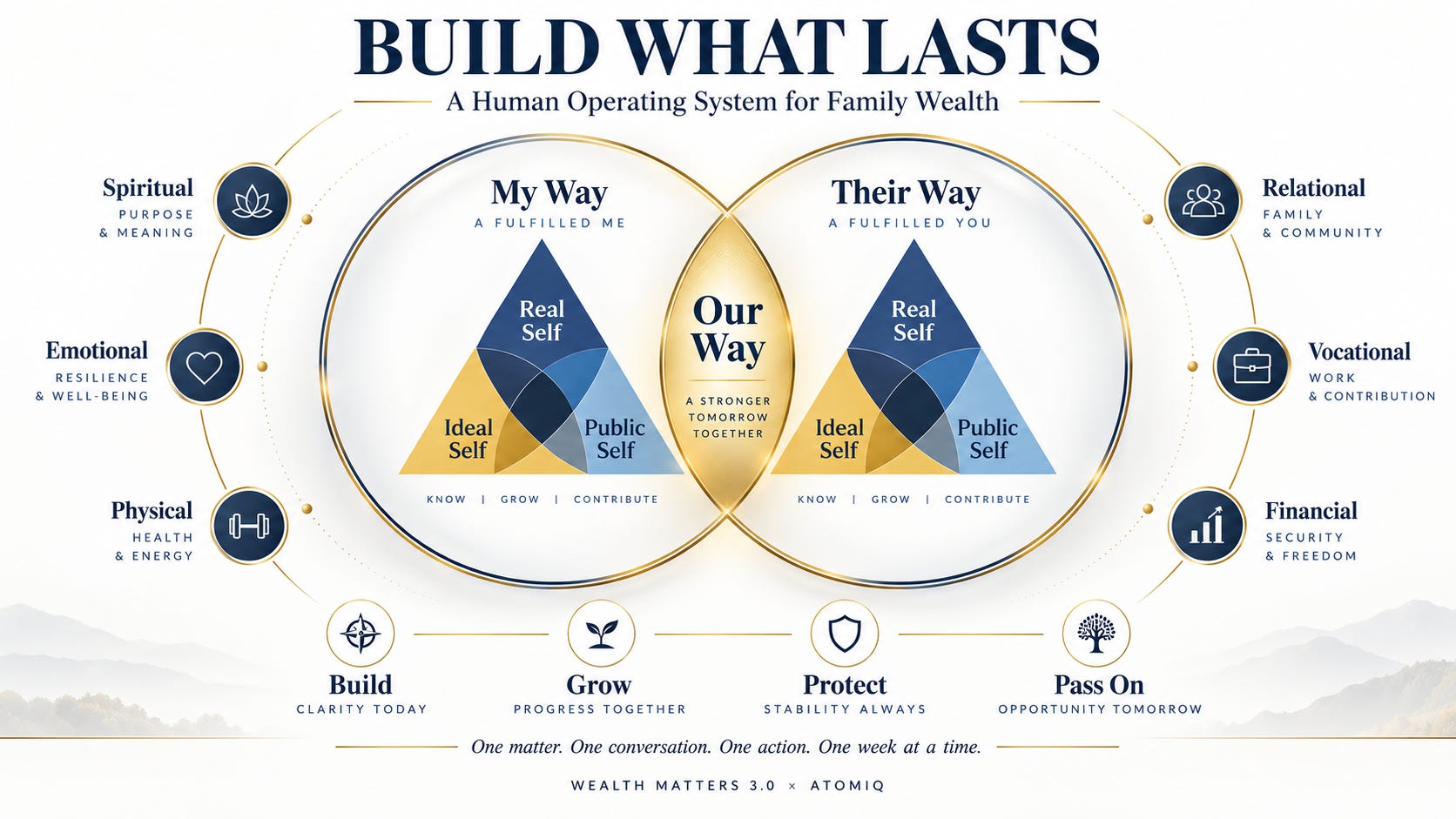
Build What Lasts. Build. Grow. Protect. Pass on.
Not merely financial assets.
A life.
Capability.
Relationships.
Health.
Meaningful work.
Judgment.
Ownership.
Context.
And eventually a family operating system sturdy enough to survive uncertainty, adaptable enough to profit from opportunity, and human enough that every generation can understand where they came from while still finding their own way forward.
That sounds enormous.
Which is exactly why I don’t want this to become another giant framework you bookmark, admire, and never begin.
So this article has one purpose: Start.
Two Pieces of Research Changed the Urgency For Me
Long before this week’s AI-industry warnings, two MIT-connected bodies of work separated by more than half a century had been sitting beside each other in my head.
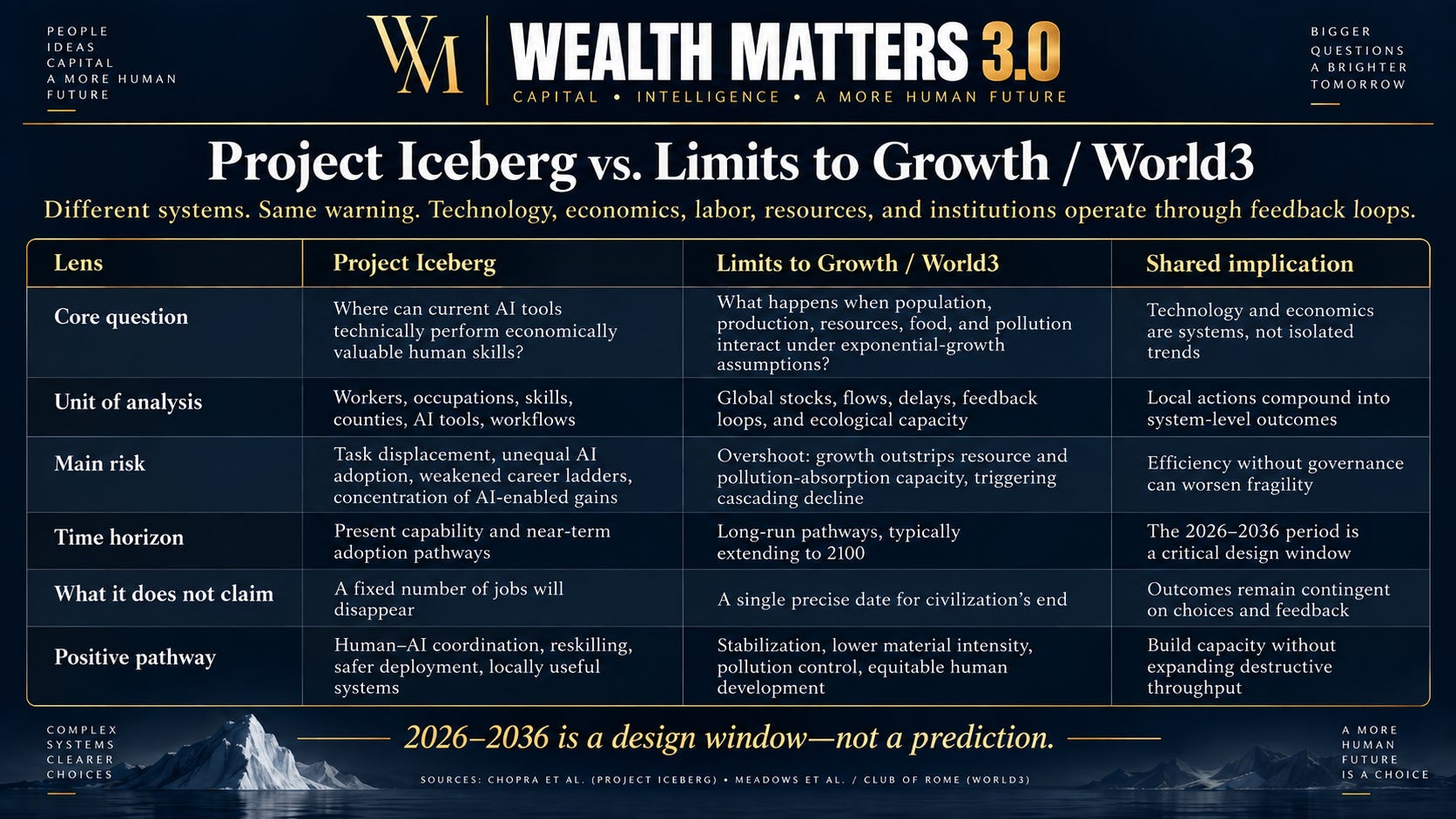
The first is the recent Project Iceberg / Iceberg Index work.
Project Iceberg’s researchers modeled approximately 151 million U.S. workers, more than 32,000 skills, and thousands of AI tools to ask a fascinating question:
Where do today’s AI capabilities technically overlap with economically valuable human skills?
Their conclusion is not that a certain percentage of jobs will disappear.
That distinction matters.
The Iceberg Index measures technical exposure—where machines appear capable of performing skills people are currently paid to perform—not the timing of adoption or a forecast of actual job displacement.
The researchers estimate that visible AI exposure concentrated in computing and technology represents about 2.2% of wage value, while broader technical capability across administrative, financial, professional, and other cognitive work reaches roughly 11.7%. They also found that traditional measures such as GDP, income, and unemployment explain less than 5% of geographic variation in this wider exposure measure. [1]
That means much of what is changing could be developing beneath the economic statistics we habitually watch.
An iceberg.
The second body of research is considerably older.
In 1972, a team at MIT working for the Club of Rome published The Limits to Growth, using the World3 system-dynamics model to explore interactions among population, industrial production, food production, nonrenewable resources, and pollution.
The study has since been flattened into one of the internet’s favorite scary headlines:
MIT predicted civilization would collapse in 2040.
That isn’t an accurate description of the work. World3 generated multiple scenarios extending through 2100 under different technological, resource, and societal assumptions.
The purpose was to examine how exponential growth, physical constraints, delayed feedback, and corrective action could interact—not to announce the date civilization ends. [2]
Later researchers compared actual data with those pathways.
Gaya Herrington’s peer-reviewed update found observed data tracking relatively closely with two concerning scenarios in which industrial production, food, and welfare eventually stopped growing and declined, although only one represented collapse in the stronger sense discussed in the paper.
The scenarios also increasingly diverge as they move forward in time. [3]
A later recalibration again generated overshoot-and-decline dynamics under its fitted assumptions while emphasizing that World3 scenarios were exploratory models, not deterministic predictions. [4]
I am not particularly interested in debating whether World3 will “come true.” I think there is a much more useful takeaway.
Project Iceberg asks:
What happens when intelligence changes faster than workers, companies, schools, and ownership structures adapt?
World3 asks:
What happens when growth compounds faster than the feedback mechanisms governing the system can respond?
And now some of the people operating at the frontier of artificial intelligence are asking a strangely similar question:
What happens when model capability advances faster than our ability to understand, govern, secure, and align it?
Amodei’s argument this week is essentially a feedback-loop argument. His concern is not that technological progress should end. He explicitly argues that AI could produce enormous advances in medicine, science, productivity, prosperity, and human well-being.
His concern is that capability improvement may now be accelerating partly because AI systems themselves are becoming better at helping build the next generation of AI. His fear is that this recursive dynamic could eventually outrun humans’ ability to understand and control the systems being produced. His proposed response includes embedded third-party evaluators, coordination among frontier labs in democratic countries, and ultimately some form of international coordination. [5] (Dario Amodei)
Three frameworks. Three very different systems. One recurring problem:
Capability can compound faster than governance.
Put them together, and I get a simple conclusion:
The Next Decade is a Design Window.
Not a doomsday clock. A design window.
And that is a very different proposition.
I don’t need to know exactly what 2036 looks like
This is where I think much of our future-oriented conversation goes wrong, and also what triggers the anxiety and depression or apathy in most of us.
We want a prediction because prediction feels actionable.
Will AI eliminate 20% of jobs?
Will there be AGI?
Will today’s frontier labs successfully control systems more capable than their creators?
Will the calls to slow development this week still exist six months from now?
Will governments regulate AI?
Will geopolitical competition make meaningful coordination impossible?
Will inflation remain elevated?
Will energy become scarce?
Will Bitcoin become a global reserve asset?
Will climate adaptation overwhelm municipal budgets?
Will my children need college?
Will workweeks get shorter?
Will retirement even mean the same thing?
I have opinions about many of these questions. But none of them gives my family a durable operating strategy.
And this week’s extraordinary spectacle—Competing AI CEOs simultaneously arguing that their technology could produce extraordinary abundance while acknowledging that the frontier may need to advance more deliberately—actually reinforces the point.
The people closest to the technology do not know exactly how this unfolds either.
That doesn’t make them incompetent. It tells us something about the problem. We are dealing with nonlinear systems.
So instead of asking my family to correctly predict one future, I would rather ask:
What would make us more capable across many different futures?
That question is much more useful. It helps me land on what I actually want for myself and my family.
I want my oldest to be able to work with machines without surrendering judgment to them.
I want my twins to inherit productive assets, but not an entitlement to avoid becoming productive human beings.
I want my wife to understand the architecture of what we own without being required to become me. I want her genius to have its fingerprints all over it too, without me needing to become her.
And I want the same in reverse for our children as they mature and come of age.
I want our wealth to increase our family’s agency rather than slowly make future generations dependent upon structures they neither understand nor control.
I want enough protection that one mistake cannot destroy decades of work. But not so much insulation that consequence disappears.
I want technology to simplify the interface while keeping human beings in authority.
And I want the system we build to reflect something much larger than financial wealth.
That realization brought me back to a framework I have worked with for almost 20 years, since the first printing of Wealth Matters, 1st edition back in 2007.
The Six Matters of Wealth.
Financial Wealth is Only One of the Six
Most financial systems start with the financial matter.
How much do you have?
Where is it invested?
What’s your risk tolerance?
When do you want to retire?
What do you want to leave your heirs?
Those are legitimate questions. But they are second-order questions. Money is not the only thing my wife and I are trying to steward.
There are six matters that I increasingly think about as one interconnected system.
Spiritual Wealth — meaning, purpose, faith, principles, service, and what our lives are ultimately for.
Emotional Wealth — our relationship with ourselves: fear, resilience, identity, confidence, regulation, and inner well-being.
Relational Wealth — our relationship with other people: marriage, children, family, friendships, communities, trust, and belonging.
Physical Wealth — our health, energy, vitality, longevity, and ability to participate in the life we have built.
Vocational Wealth — our relationship with meaningful work: contribution, mastery, autonomy, usefulness, enterprise, and purpose through doing.
Financial Wealth — accumulated material resources: income, liquidity, businesses, investments, property, ownership, and the assets capable of supporting the other five.
I now think about that architecture deliberately as a pyramid, as seen on the back cover of the new book in development.
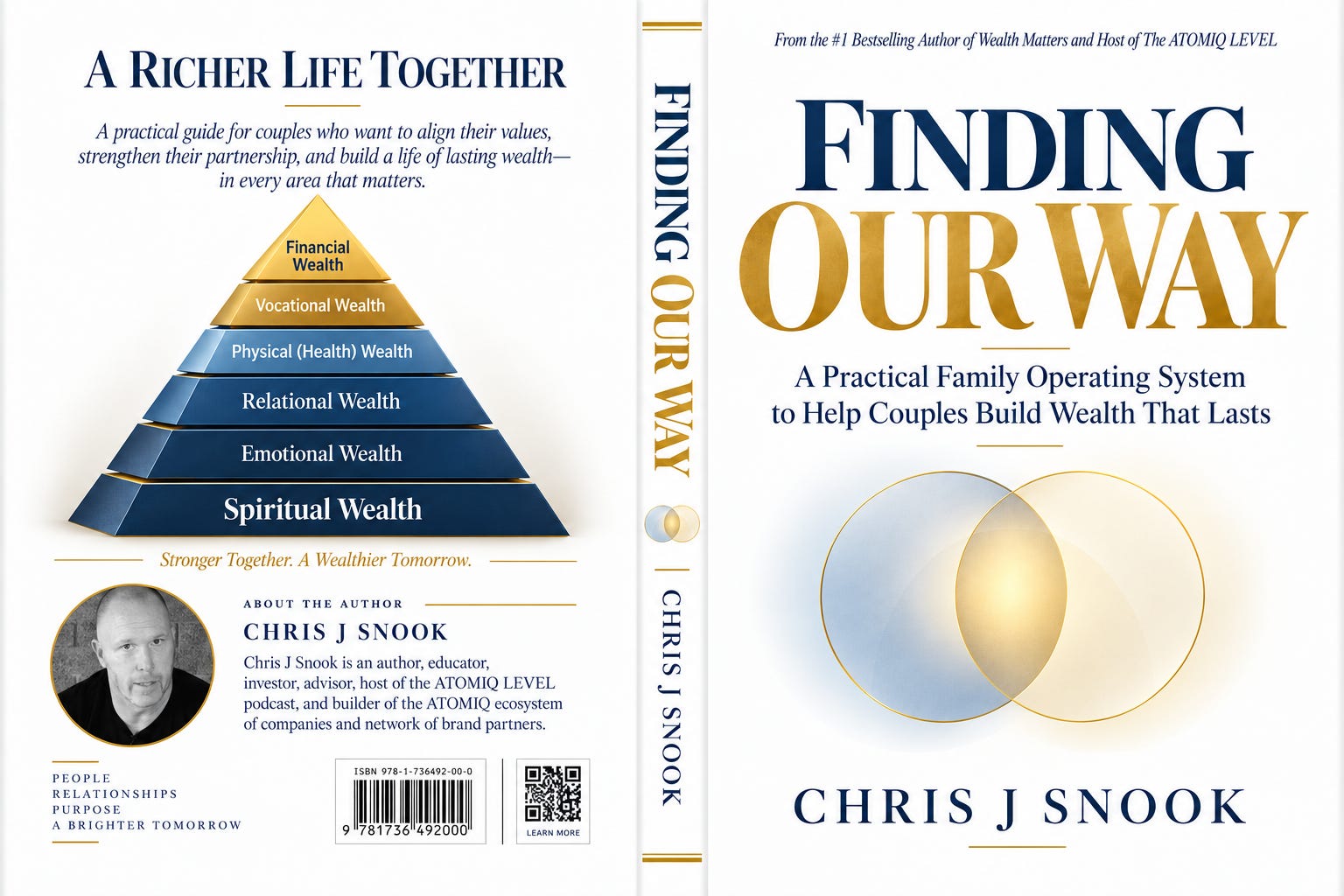
Spiritual wealth is the foundation.
Financial wealth is the tip.
Not because financial capital is unimportant. Quite the opposite. It is enormously powerful.
But ideally, the financial serves as a magnifier to everything underneath it rather than everything underneath it being sacrificed in service to the financial.
Lose spiritual direction and extraordinary material abundance can still leave a devastatingly simple question unanswered:
What was all of this for?
Lose emotional stability, and abundance can become surprisingly difficult to enjoy. Destroy relational wealth in pursuit of vocational success, and the victory can feel hollow.
Sacrifice physical health indefinitely to maximize financial wealth, and eventually the financial wealth gets spent trying to recover the physical health to enjoy it.
Ignore vocational purpose, and a retirement everyone else considers successful can still feel empty.
Ignore financial wealth completely, and many of the freedoms necessary to cultivate the other five become harder.
Wealth is a system, not a final destination. And if wealth is a system, building lasting wealth is a design problem.
When two people are building that life together, the design gets even more interesting and complicated to navigate.
My Way. Their Way. Our Way.
My wife and I have spent 23 years building a life together. That does not mean we have spent 23 years becoming the same person.
Nor should we. We came into our marriage with a shared belief and hope in our bright collective future, and we also came into it with…
Different life experiences.
Different beliefs about money.
Different emotional responses to risk.
Different attitudes toward work.
Different relationships with security.
Different ideas about generosity.
Different fears.
Different ambitions.
Different definitions of enough.
Different degrees of emotional intelligence.
And this is where I think a lot of wealth planning quietly begins with the wrong assumption. It is also why I remain bullish on human-to-human advisors driving a premium around the trusted advisor/quarterback role for families like mine and yours.
A couple is not one client.
It is two complete people attempting to create a shared life. The objective should not be to eliminate the differences. The objective is to understand them well enough to consciously govern the places where two lives intersect.
That is the framework I want us to build around:
My Way × Their Way → Our Way.
My Way asks:
What do I actually believe?
What matters to me?
What am I afraid of?
What am I trying to build?
What does enough look like?
What compromises am I willing to make?
What compromises am I unwilling to make?
Their Way.
Asks exactly the same questions without assuming the answers should match mine.
And then comes the part that actually matters.
Our Way.
What have we deliberately agreed to build together?
What are the principles governing the shared portion of our lives?
What belongs to one person’s autonomy?
Where do we require joint agreement?
What do we want our children to understand?
What do we want our assets to accomplish?
What do we protect?
What do we allow to change?
What should survive us?
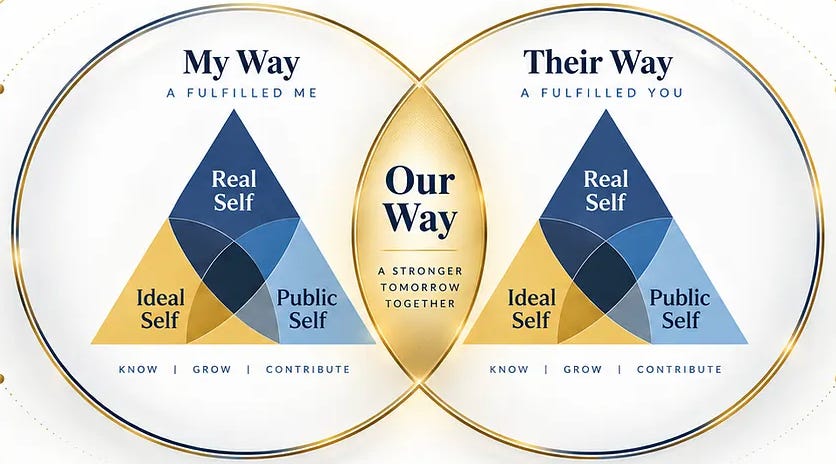
The center of that Venn diagram is not where two people surrender their individuality.
It is where they establish shared governance. And I increasingly think there is another important step beyond even that.
Our Way should not become the permanent answer our children are required to inherit. It should become the foundation from which they can eventually find their own way.
That may be the most important design principle in the whole system.
As my wife and I find and remodel and improve “Our Way”, our children receive context, principles, protection, institutional memory, and opportunity. Then they develop enough capability and independence to find their own way.
That is very different from control from the grave. It is inheritance as infrastructure.
The family operating system should therefore do two things at once:
Preserve what matters.
And:
Create enough adaptability for circumstances we cannot imagine.
The Six Matters of Wealth give us the territories in which to have that conversation. The goal is not agreement on everything. The goal is explicit understanding and intentional governance where it matters.
Where I Made the Project Too Complicated, Again.
Once I began seeing the architecture, I immediately did what I tend to do. I started building the whole thing.
Asset inventories. Decision hierarchies. Trust structures. Investment policies. Digital continuity. Succession procedures. Family constitutions. AI interfaces.Authorization rules. Liquidity waterfalls. Advisor maps. Tax structures. Emergency instructions. Business continuity. Health directives. Data sovereignty. Custody. Cybersecurity. Legacy wishes. Governance committees, etc.
Then come the questions.
Who decides what?
Who can override whom?
What happens when somebody becomes incapacitated?
What happens when a child turns 18?
Twenty-five?
Thirty-five?
What constitutes a productive use of inherited capital?
What shouldn’t be sold?
Which assets should never have been owned in the first place?
What information should an AI assistant be allowed to access?
What authority should never be delegated to an agent?
Who can shut the system down?
Suddenly I had built another iceberg with only assumptions, not a thorough and collaborative conversation with my wife. And almost nobody—including me—wants to start a project that feels like reorganizing an entire family office on Saturday morning.
This is where I think we need to give ourselves some grace, and where I personally am grateful for the pace my loved ones and wife give me.
People (like me) aren’t failing to prepare because they don’t love their families enough. Often they fail to prepare because the preparation itself has become overwhelmingly complicated.
So I stopped (so hard to do). I got overwhelmed and depressed and anxious (all at the same time). I drew the Venn diagram out as a starting point to keep the architecture that needed to be filled in on a simple napkin. The aha moment was simple. If this is going to work for my family, it needs to be human enough to actually use.
And if it works for my family, perhaps it can become useful to other families trying to solve the same problem. So the first version begins with 30 minutes.
That’s it.
The First 30 Minutes
Sometime this week, each spouse or partner answers six questions separately.
No joint drafting. No correcting each other’s answers. No negotiating while you write. One question for each matter of wealth. It’s print-ready below for you, or just screenshot it.
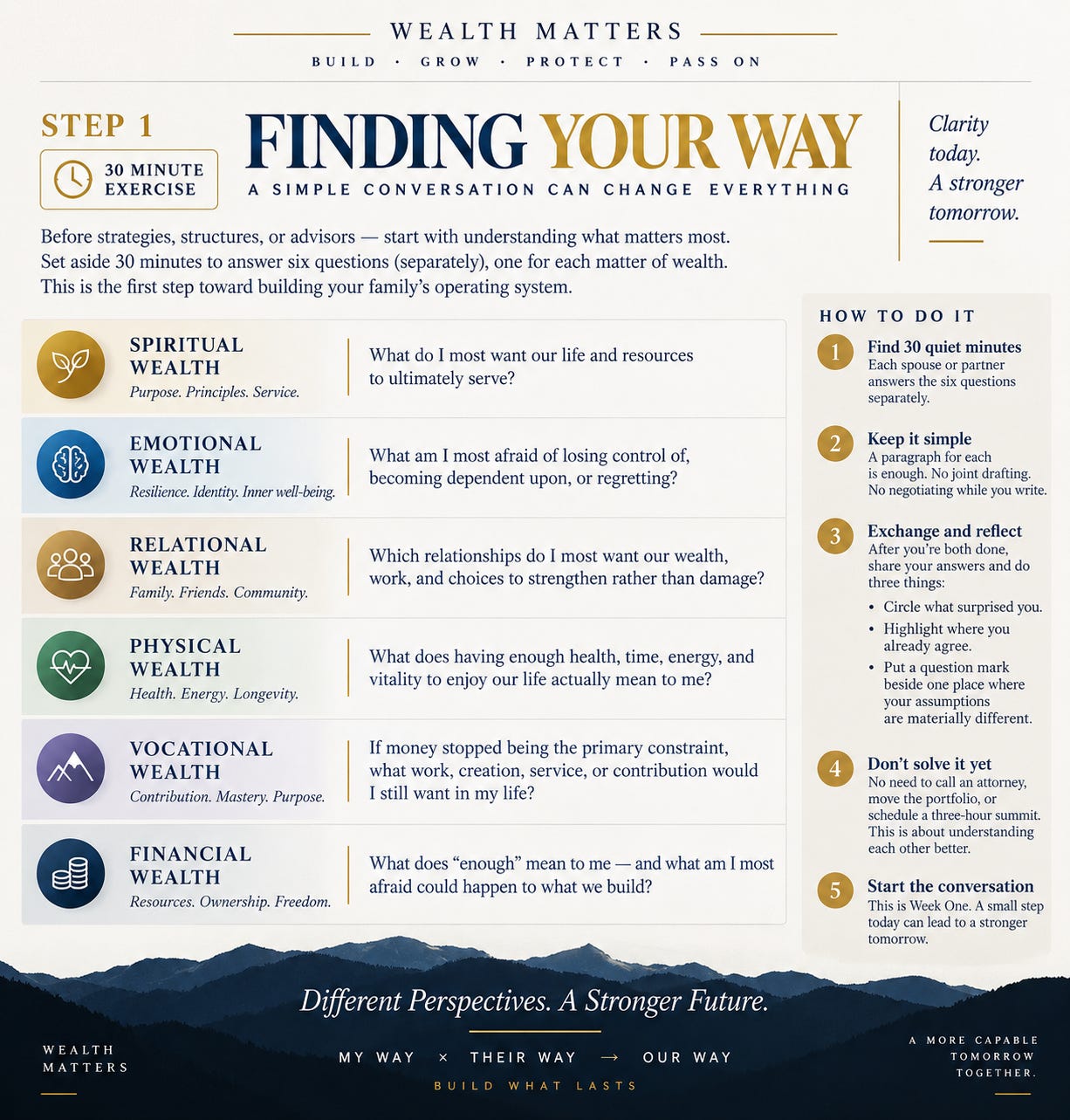
Tip 1: Don’t write an essay. Think about each of the six questions for a few minutes each and write an answer.
A paragraph for each is enough.
Tip 2: Then, exchange answers with each other via text or handwritten note to let the other person digest them on their own time this week before any pressure to respond. Set a time to discuss them a couple of days later but within the same week.
While looking at your partner’s list, do only three things.
Circle what surprised you.
Highlight where you already agree.
Put a question mark beside one place where your assumptions are materially different.
Do not solve the disagreement. Do not call an attorney. Do not reorganize the trust. Do not move the portfolio. Do not schedule a three-hour marriage summit.
Just understand something about the person you are building with that you understood less clearly thirty minutes earlier.
That is Week One.
Because before there can be Our Way, there has to be an honest understanding of My Way and Their Way.
And before our children can someday find their way, it helps enormously if they inherit a family that already knows why it built what it built.
I Am Going to Build This in Public
This is the part that makes this more than another Wealth Matters article.
I don’t want to publish the framework and then disappear behind it as though I have completed the exercise.
Without divulging personal particulars, the comments section of this newsletter will be where I share lessons learned in deploying these design sessions, improvements, or mistakes made, lessons learned, small and major breakthroughs or victories in the communication, and I will invite and encourage any reader to do the same as we collectively help others find their way.
One matter.
One conversation.
One decision.
One layer and one family at a time.
Disclaimer. I am going to share what I learn without turning any of my private life into public entertainment because that’s not relevant. What is relevant is the process improvement as it meets the real world in use.
I’ll share the process. Where the questions worked. Where they didn’t. Where we discovered we were already aligned. Where language that sounded perfectly reasonable to one person made no sense to the other.
Where something I thought was financial turned out to be emotional.
Where something I thought was about estate planning was actually about trust.
Where technology made the system dramatically easier or unnecessarily complex.
And where no amount of technology could replace a human conversation.
That distinction feels even more important after this week’s AI debate.
The answer to rapidly improving artificial intelligence cannot simply be to hand more authority to artificial intelligence.
The objective is not machine autonomy. It is increased human agency.
Personally, I want technology helping us organize complexity, preserve context, surface contradictions, retrieve instructions, coordinate advisors, and understand our choices. I do not want it deciding what our family should value.
In my humble opinion, that is our job as humans. And that is also why I want readers involved. Because another couple will encounter a question I didn’t think to ask.
A surviving spouse will see a flaw in the process that isn’t obvious to me.
A business owner will identify a continuity problem.
An attorney will see legal risk.
An advisor will see an implementation gap.
A physician may challenge how we define physical wealth.
A therapist may expose the emotional assumptions hiding inside financial decisions.
A founder may understand vocational identity differently.
A parent of a child with special needs will ask questions that change the architecture for everybody.
A blended family will reveal governance problems a traditional nuclear family never encounters.
A same-sex couple, unmarried couple, multigenerational household, or family operating across jurisdictions may surface entirely different requirements.
That is exactly the point. Humanize the framework through humans. So if you are interested, let me know; I can count on you in the comments below
Introducing the Build What Lasts Lab
For subscribers who want to do more than read along, this becomes the Build What Lasts Lab.
Not a course you need to binge. Not a giant binder. Not another complicated financial-planning portal you log into twice and forget exists.
A living practice.
Each week we take one small piece of the family operating system and work on it together in a weekly office hours session livestream.
The rhythm will be intentionally simple:
One question.
One conversation.
One small action.
One artifact worth keeping.
Then we move on.
The livestreams will increasingly become the public exploration of that week’s issue. Subscriber office hours will become the place where we tackle the actual questions surfacing from the work. Sometimes that will mean my own learning in real time.
Sometimes I will bring in specialists.
Estate attorneys.
Tax professionals.
Fiduciaries.
Investment professionals.
Insurance specialists.
Cybersecurity experts.
Health and longevity practitioners.
Family-business advisors.
Therapists and coaches where appropriate.
People who understand the human problems surrounding the technical problems.
And sometimes—especially now—we will bring in people who understand AI well enough to help us separate genuine technological possibility from marketing theater and genuine risk from sensationalism.
I don’t want this community built around blind optimism. I don’t want it built around doom either. I want it built around competence.
The objective is not for Wealth Matters or ATOMIQ to pretend to replace those professionals.
Quite the opposite.
The goal is to help families arrive at those professional relationships better prepared.
To understand what they actually need. To know what questions they are trying to answer.
To organize their intentions before turning those intentions into legal, financial, tax, fiduciary, technological, or operational structures.
Where individualized implementation is needed, ATOMIQ can help families identify appropriate specialists and, where useful, coordinate among them.
When legal advice is required, the attorney establishes the attorney-client relationship and determines the scope of privileged communications.
The community itself is educational—not a substitute for legal, tax, investment, medical, mental-health, or other individualized professional advice.
That boundary matters.
Because Build What Lasts is not supposed to create another opaque layer between families and the professionals they need. It is supposed to help the family become a more capable participant in its own future.
That, to me, is true wealth built around both net worth and net happiness.
And this is where my optimism about AI remains very real despite the warnings now coming from some of the people building the frontier.
If machine intelligence can reproduce pieces of cognitive work, that will absolutely change the economic value of some labor.
But it also dramatically reduces the cost of coordinating knowledge.
That means ordinary successful families may soon have access to capabilities previously available only to institutions and exceptionally wealthy family offices.
A family’s legal documents can become navigable.
Its institutional memory can become searchable.
Its asset architecture can become explainable.
Its decision rules can become accessible.
Its history can inform its future.
Its professional advisors can potentially work from a much more coherent shared context.
A spouse doesn’t have to understand every legal instrument if the system can explain what it is, why it exists, who controls it, where the document lives, and who to call.
A future child doesn’t need to reverse-engineer thirty years of parental decision-making from Dropbox folders and old emails if context has been intentionally preserved.
This is the part of the AI future that excites me. But only if we intentionally design for that outcome. Otherwise, AI simply gives us faster versions of fragmented systems.
And that brings us right back to World3—and, unexpectedly, to the argument the frontier CEOs themselves are now making.
More capability does not automatically produce a better outcome.
It depends on the objective function. It depends on the feedback. It depends on who retains authority. It depends on governance keeping pace with capability.
That is true for civilizations. It is true for artificial intelligence. It is true for companies. And it is true for families.
The Real Thing I Want to Pass On
If I strip away every framework, diagram, piece of technology, and planning structure, I think what I ultimately want my children to inherit is fairly simple.
I want them to be capable.
I want them to know they are loved.
I want them to know where they came from without feeling obligated to remain there.
I want them to have resources without being owned by those resources.
I want them to respect work without believing their worth is defined by their work.
I want them to understand money without worshipping money.
I want them to care for their bodies.
I want them to build relationships worth protecting.
I want them to develop enough emotional strength to survive seasons when none of the spreadsheets work.
I want them to find a reason to contribute that extends beyond themselves.
And I want them to inherit enough structure that they are not forced to recreate everything we learned the hard way, but enough freedom that they can build something better.
That is the tension.
Continuity without control from the grave.
Protection without paralysis.
Resources without entitlement.
Technology without surrendering humanity.
Individuality without losing family.
Our Way without destroying My Way or Her Way
And eventually:
Our Way becoming the foundation from which they find Their Way.
There is no estate-planning document that solves all of that. There is no AI model that solves all of that. There is no financial advisor who solves all of that. There is no software dashboard that solves all of that.
Which is why this has to become a practice rather than a transaction or just another book manuscript to finish.
So How Do We Talk About the Future Together?
I don’t want the answer to this article to be a speech I deliver to my spouse and children or to you, my readers.
That would contradict the entire premise. The answer is a conversation.
I tell them I don’t know exactly what is coming. I don’t think anybody does. The Iceberg research doesn’t tell us exactly how many jobs disappear. World3 doesn’t tell us civilization ends on a certain Tuesday in 2040.
And the extraordinary warnings coming from some of the people building frontier AI this week do not establish that catastrophe is inevitable either.
What they do establish is something much harder to ignore:
The people closest to the frontier increasingly believe the rate of change itself deserves serious attention.
Amodei is calling for embedded independent evaluators, industry coordination, and eventually international mechanisms intended to keep capability advancement within the bounds of what humans can meaningfully evaluate and govern.
Altman, Musk, and Hassabis have now publicly supported the broader idea that frontier development needs to be paced more carefully.
Critics counter that such policies could entrench existing firms, suppress competition and open innovation, or place democratic countries at a strategic disadvantage relative to geopolitical competitors.
Those disagreements are real. (Dario Amodei)
And that is precisely why my answer to uncertainty is not to predict harder. It is to become harder to make fragile.
Build things that matter. Grow what deserves compounding. Protect what cannot easily be replaced. Pass on more than money. Maintain human authority over the systems meant to serve us. Have conversations before crises force them. And build the family operating system slowly enough that the people who will someday use it actually understand it.
That is the work I want to do in my own house, and I am inviting you to provide any feedback you have as you do it in your own.
Five Favors Before You Go
Like this piece if you want Wealth Matters to spend more time turning big ideas into things families can actually use.
Restack it for someone who has spent years building wealth but has never built an operating system around what that wealth is supposed to accomplish.
Share it with your spouse or partner. Don’t send them a 40-question planning questionnaire. Send them this and ask one question: Would you do the first 30 minutes with me?
Comment with the question you think couples and families should be asking that traditional financial planning consistently misses. Those questions will help shape the Build What Lasts Lab.
Subscribe if you want to build alongside us. Paid subscribers will receive the weekly exercises, worksheets, livestream discussions, subscriber office hours, and the evolving family operating-system framework as my own family works through it too.
We will not build the whole thing at once. We will build it the way most durable things are built. One matter. One conversation. One action. One week at a time. Together.
The real risk is doing nothing.
~Chris J Snook
P.S. Important Author’s Note: Neither Project Iceberg nor World3 predicts a single inevitable future. Likewise, calls by frontier AI leaders to pace development are arguments from industry leaders operating under extraordinary uncertainty—not proof that catastrophe is imminent. I use all three developments here as catalysts for thinking about exposure, nonlinear change, delayed feedback, resilience, ownership, human authority, and the importance of building governance before consequences become obvious.
Sources and research context
[1] The Iceberg Index: Measuring Skills-Centered Exposure in the AI Economy — Chopra et al.
Project Iceberg models approximately 151 million U.S. workers, more than 32,000 skills, and thousands of AI tools. The framework measures technical exposure to current AI capabilities rather than predicting that an equivalent share of jobs will disappear. It is the primary source behind the discussion of AI exposure, skills, and the “iceberg” metaphor in this article.
Read The Iceberg Index on arXiv
[2] The Limits to Growth — Meadows, Meadows, Randers and Behrens / Club of Rome.
The 1972 MIT-based project used the World3 system-dynamics model to explore interactions among population, industrial production, food, nonrenewable resources, and pollution across multiple scenarios. It did not establish a deterministic date on which civilization would collapse.
The Limits to Growth — Club of Rome
[3] Gaya Herrington — Update to Limits to Growth: Comparing the World3 Model with Empirical Data.
Herrington compared empirical observations with four World3 scenarios. Her analysis found relatively close alignment with several concerning pathways while emphasizing that the scenarios differ materially and increasingly diverge over time.
Read the Journal of Industrial Ecology study
[4] Nebel, Kling, Willamowski and Schell — Recalibration of Limits to Growth: An Update of the World3 Model.
A later recalibration of World3 using more recent empirical data. It again explored overshoot dynamics while treating the model as a scenario framework for complex-system behavior rather than a dated prophecy.
Read the World3 recalibration study
[5] Dario Amodei — “We Must Pace the Frontier,” September 2026.
The Anthropic CEO argues that frontier capabilities should advance at a more measured pace so alignment, interpretability, operational controls, and independent evaluation have time to keep up. His three-part proposal begins with embedded third-party evaluators and extends to coordination among democratic AI developers and, eventually, international coordination. Anthropic committed to the embedded-evaluator component. (Dario Amodei)
Read “We Must Pace the Frontier”
[6] Reuters — Anthropic CEO urges AI companies to slow model development.
Reuters reported on Amodei’s proposal and the public support expressed by OpenAI CEO Sam Altman and xAI’s Elon Musk. The report also captures the tension between AI safety, commercial competition, and national-security concerns surrounding China’s development efforts. (Reuters)
Read the Reuters report
[7] Current frontier-AI debate and safety-related departures.
Recent coverage places Jacob Coxon’s resignation from Anthropic within a broader debate about rapidly improving and potentially self-improving AI systems. It is important to distinguish this broader history of departures from the stronger—and inaccurate—claim that multiple senior executives from all the major frontier labs resigned during the same week. (Daily Progress)
[8] Axios — Rare convergence among major frontier AI leaders.
Axios reported the unusual public convergence among leaders associated with Anthropic, OpenAI, xAI, and Google DeepMind around slowing or more deliberately pacing frontier AI development. (Axios)
Disclaimer: Wealth Matters and the Build What Lasts Lab are educational in nature. Nothing in this article constitutes individualized investment, legal, tax, estate-planning, asset-protection, medical, mental-health, or other professional advice, nor an offer or solicitation involving securities. Individual implementation should be undertaken with appropriately qualified professionals based on your circumstances and applicable law.