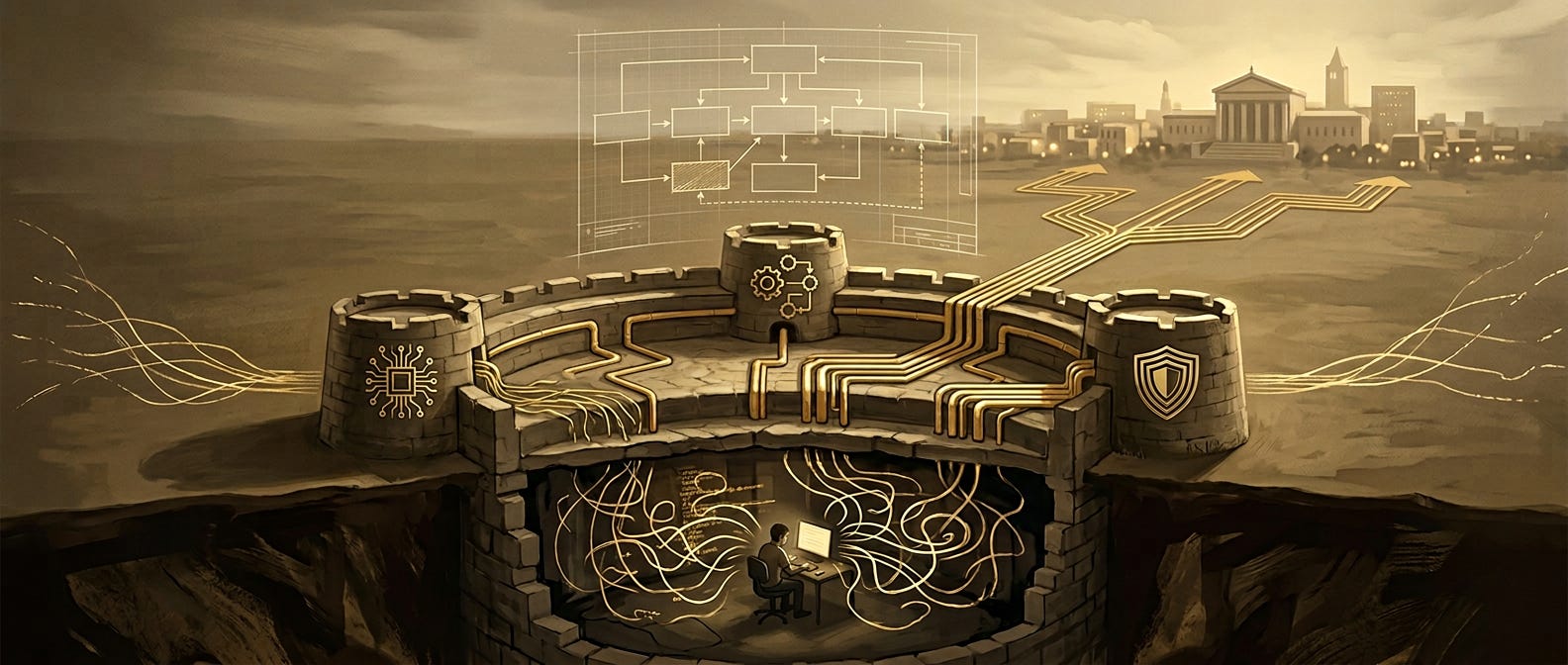
When Your Vibe‑Coding Project Becomes a Business (And Why It Needs Its Own Container)
Asset Protection Briefing in the Age of Agentic AI (Vol: 7 of 9)
At a certain point, your “vibe‑coding” project stops being a harmless basement experiment. It’s no longer just you or the kid running agents on a hand‑me‑down laptop, or the internal tool that quietly makes life easier for the family office.
It’s the moment when you (or other people) start wiring their lives, their money, and their reputations into something you wrote on borrowed time and shared Wi‑Fi. That’s the moment this chapter is written for.
In Shields & Succession terms, volume 7 is where the builder and the family have to answer three uncomfortable but necessary questions:
Is this a real business now?
Who else has a claim on it—capital, customers, regulators, or acquirers?
And do we spin it out, fold it in, or shut it down before it hurts someone we care about?
Everything you’ve set up so far in the first 6 volumes of this playbook (Dev Lab, Ops, Wyoming bedrock, house rules, and kill switches) now gets stress‑tested in the real world.
By the time you find yourself here, you’ve usually crossed at least one bright line. Real money is flowing in or out of your stack. Real customers (or your own internal portfolio of companies and processes) are depending on an agent you control.
Real regulators, platforms, or counterparties have started to notice you exist. Real family conversations are happening about “what this is” and “where it lives.”
The question is no longer whether this is serious; it is.
The question now is what shape this thing should take in the wider world—because the rapid evolution from “cool agent” to commercially viable company only works if it sits in the right container.
For our purposes, there are three archetypal paths: the basement project turns into a real business, outside capital and counterparties show up, or you decide whether to spin it out, fold it into the family system, or shut it down.
The rest of this piece walks those paths in plain language and then gives you a concrete 30‑day plan to align the builder and the family around a structure that can survive success.
From Basement Project to Board Ready
When the basement project becomes a real company, the earlier work you did in Volume 6 pays off. If you’ve done that work, you already have a Dev Lab entity that owns the experimental IP, staging infrastructure, and “we’re still figuring this out” code, plus an Ops company that fronts anything customer‑facing with contracts, billing, and support, along with a set of house rules, a ship checklist, and at least one adult in the loop.
The next question is:
What exactly is “the company” here, and where does it live in our portfolio?
You essentially have three options.
The first is to scale Ops up into the flagship: Ops stops being a thin front door and becomes the company that hires people, signs larger contracts, buys insurance, and becomes the primary brand regulators and counterparties see.
The second is to form a new top‑level entity—a HoldCo or OpCo—and plug Dev Lab and Ops into it, with a license from Dev Lab to use and evolve the tech, a services or migration relationship with Ops, and a clean cap table for investors, employees, and equity planning.
The third is to keep the whole thing as a family internal platform, intentionally capping external exposure so the stack becomes a durable edge for the family office or advisory practice rather than a growth‑at‑all‑cost venture.
The “right” answer here depends on your appetite for scrutiny—audits, SOC 2, regulatory filings—and your tolerance for outside influence on decisions. It also depends on whether the family sees this project as a legacy platform, a venture bet, or a private tool that quietly protects and compounds wealth. A family that wants intergenerational control may favor keeping Dev Lab as a separate IP‑owning entity and routing commercial risk through an Ops company; a builder with startup dreams may want the clarity of a single OpCo with clean governance and a clear path for outside capital.
Whatever you choose, nothing slows down either a deal or a crisis response like murky ownership, so you want clean, boring answers to some basic questions before anyone wires money or serves you papers.
Who actually owns the code and models—does Dev Lab own them, and if so, is it assigning them to the commercial entity or licensing them in a way that leaves some modules permanently in Dev Lab for R&D and never shipped “raw” to production?
What exactly does Ops own—customer contracts, SLAs, data‑processing agreements, runbooks, SOPs, dashboards, production integrations, and any trademarks, domains, or public‑facing brand assets, or does it merely have the exclusive license to distribute those trademarks, etc. from the HoldCo?
And what does the family own—equity in Dev Lab, Ops, or a HoldCo via trusts and holding companies, as well as any retained rights around identity, legacy, or the use of the family name.
A simple but tough test helps here:
If tomorrow you received either a serious inbound acquisition offer or a serious legal or regulatory inquiry, could the family’s counsel, in a week, map who owns what, who is responsible for what, and what is actually being bought, sold, or attacked?
If the honest answer is no, Volume 7 is where you fix that while the fire is still small.
Serious Innovation Should Be Taken Seriously
At some point in this evolution, someone with a fund, a logo, or a long email signature will say, “We love what you’re building. We’d like to invest.” If you or your kid grew up on startup media, this feels like validation. In Shields & Succession terms, it’s something more loaded: it’s an invitation to step into their structure—or to negotiate them into yours.
Before you take that first serious meeting, the family and the core builder(s) need to align on three things.
First, what is this money actually for: hiring key people, hardening security and compliance, buying the builder’s time back from school or other jobs, or scaling go‑to‑market experiments that have real risk?
Second, how much control you are truly willing to give away in the form of board seats, vetoes over budget or product direction, and deep information rights that cut down to the entity and trust level.
Third, what is non‑negotiable: for example, Dev Lab remaining an independent IP‑owning entity, certain high‑risk verticals being off the table without supermajority consent, or certain privacy and data‑segregation promises to the family and key clients being inviolable, no matter how good the term sheet looks.
If you walk into investor conversations without these lines drawn, you will draw them under pressure, or not at all. Investors understandably prefer one box that owns everything; it’s easier to model, easier to diligence, and easier to control. Your job is to be simple enough to work with without flattening everything you’ve built for the sake of convenience.
Practically, that looks like licensing, not selling, the core stack: the operating company gets broad rights to build, ship, and maintain products, but Dev Lab retains ownership of the underlying frameworks, internal tools, and R&D paths, with certain modules or safety layers kept proprietary to the family. It means keeping experimental work where it belongs: new agents, speculative integrations, and “let’s see what happens” systems start in Dev Lab, on Dev Lab infrastructure, under Dev Lab keys, and only vetted, hardened, documented components cross into the investor‑tracked entity.
And it means routing ownership through the family structure rather than through a teenager’s laptop: equity lives in the family’s existing holding and trust stack, while builder compensation is a mix of salary, options, and possibly profit shares, with voting control and long‑term stewardship aligned to the asset‑protection plan rather than short‑term hype.
Good investors will recognize this as thoughtful risk management. Note: The ones who insist everything must be dropped into a single Delaware C‑corp they fully control are effectively giving you a preview of the next five years of your life—and of how little regard they have for the family side of the equation.
Even with “good” investors, you will feel the standard playbook pushing you toward aggressive growth targets, roadmap promises that outrun your governance and safety, and a casual “we’ll fix the legal stuff after the next round” attitude.
The Shields & Succession lens forces you to ask whether, if this goes as “well” as the investors want on paper, the family will still like the outcome, and if it blows up, what is insulated and what is exposed. It also gives you a secure structure for boot-strapping this as a going concern that benefits you and your selected customers without outside capital infustion, while separating this from your other unrelated family and business assets.
You can write guardrails into the foundation now. One is a budget floor for security, compliance, and audit—a minimum percentage of spend that doesn’t get raided for growth when things get tight. Another is defining hard “no” zones: products or use‑cases the company will not pursue, even if the market begs, without explicit, documented consent from the family’s governance layer.
A third is drawing clear cliffs on data use: defined boundaries on sharing, training, or selling access to certain data lakes and log streams, even under pressure from large customers or investors.
If your project is doing anything interesting, someone with real authority will eventually ask, “What is this, exactly—and who is responsible?” That someone might be a platform’s trust and safety team, a financial regulator, a data‑protection authority, an enterprise client’s security review committee, or law enforcement with a subpoena.
Do You Have an Embedded “Kill Switch” Criteria?
How you posture yourself the first time this happens will shape how painful every subsequent interaction becomes.
The worst possible posture here is the one many developers instinctively reach for: “We’re just devs; see the MIT license,” “It’s open source, so not our problem,” or “I don’t know who owns what, I just push code.” The better posture sounds like, “Here is the entity responsible for this system and a named contact; here is precisely what this agent can and cannot do and where it runs; and here is our incident‑response process, including logs and kill‑switch procedures.” Internally, that posture requires a designated point person or small committee for formal inquiries, along with predetermined thresholds for when to involve counsel and insurance, when to notify customers, and when to turn systems off preemptively.
The family‑level goal is straightforward: be the kind of counterpart that grown‑up institutions want to keep working with, without casually sacrificing your rights or your carefully built structure just to make a scary email go away. That requires another hard discipline: knowing when to shut something down.
One of the toughest muscles for a builder to develop is the willingness to walk away from something that “works” from a user or revenue perspective but is no longer safe in the way it’s built.
Clear shutdown triggers help. You know you’re there when you can no longer honestly describe what the system can do end‑to‑end; when you cannot patch or mitigate a serious vulnerability on a responsible timeline; when the architecture is so entangled that each “fix” creates two new blind spots; or when a core vendor or platform changes a policy in a way that undermines your safety assumptions.
From a Shields & Succession perspective, it is always better to retire a product early than to let it become the thing that drags an entire family through a multi‑year legal and reputational fire. A clean shutdown, communicated clearly to customers and counterparties, is a sign of maturity, not failure.
There’s another vulnerability sitting in the middle of all of this that most families don’t see until it’s too late: the builders themselves. Traditional family planning often assumes the moneyed elder is the single point of failure. With agentic systems, you often have a second one—the person who actually understands how all the moving parts fit together.
People change. The builder graduates, moves abroad, starts another company, burns out, gets sick, or simply loses interest. The question the family has to answer is what happens to the system when that happens. You’re planning for continuity in three domains: operational understanding (how the pieces talk to each other), architectural intent (why it was designed the way it is), and ethical boundaries (what this system is not supposed to do, no matter how easy it would be to flip the switch).
There are practical moves you can make now. One is to write the “if I disappear for 6–12 months” memo: a plain‑English architecture diagram, a map of where the kill switches are and how to use them, and a list of known risks and “do not touch” areas.
Another is to name at least one successor brain: a sibling, co‑founder, trusted engineer, or advisor who can step in to stabilize the system, not necessarily to innovate, and give them enough access and context now rather than in the middle of a crisis.
A third is to codify authority: who can hire a new technical lead, who can commission external audits or rewrites, and who has final say if a new lead wants to cross lines the original builder refused to cross.
The builder’s job is to be important and replaceable at the same time. The family’s job is to make sure their risk is tied to a system and a structure, not to one person’s willpower and availability.
Every stack eventually reaches an ending, even if that ending is just a quiet transition. There are three primary endgames:
1) Spinning out or selling the project to a strategic buyer, fund, or partner;
Folding it into the family office, a larger operating company, or a broader advisory platform;
Or a purposeful wind‑down where you stop commercial activity, keep or archive what matters, and retire the rest.
The best time to write the rules of the ending is when nobody needs them yet. That means answering, in your operating agreements, trust documents, and shareholder agreements, what is actually being sold if you sell: equity in Ops, a bundle of licenses from Dev Lab plus a team, or just customer contracts and front‑end assets while the deepest IP remains licensed but not sold.
It also means defining what the family keeps in any scenario: internal forks or “family versions” of agents, the right to use the tech for internal asset protection, planning, or research, and certain brand elements or narratives tied to family identity.
Finally, you should decide who can say “no” to the wrong buyer—whether trusts, boards, or family governance documents give someone veto power over exits to acquirers whose business models contradict your ethics, regulators you don’t trust, or jurisdictions you avoid.
If you don’t pre‑wire this, the default is simple: whoever controls the cap table and the board at the time decides under immense pressure and with whatever incentives they happen to have.
From a Shields & Succession posture, some of the best outcomes are not 100x unicorn exits at all. Sometimes the win is a modest sale that derisks the builder and funds more durable family projects, folding the tech into a family office stack that quietly improves risk management and operations for decades, open‑sourcing non‑dangerous layers to raise the floor for other families while keeping the riskiest bits properly contained, or seeding a foundation or donor‑advised fund with a slice of the proceeds aimed at digital safety, literacy, or talent development.
What matters is that the ending is chosen, not dictated by exhaustion, burnout, or a catastrophic incident. To make that choice real, you can run a 30‑day Volume 7 action plan, whether you’re the dorm‑room builder or the family advisor.
In Week 1, you map the inflection point by writing a one‑page “State of the Project” that covers revenue, if any; users and dependencies; and any regulatory or platform attention, then decide which scenario you are closest to: real company, investor attention, regulatory pressure, builder transition, or imminent exit or shutdown.
In Week 2, you clean up ownership and authority by clarifying in writing who owns Dev Lab, Ops, and any HoldCo, who owns the core IP and how it’s licensed, and who has authority to sign customer contracts, investor documents, and regulatory responses.
Week 3 is about writing the memo and the kill‑switch playbook: the builder writes the “if I disappear” memo and shares it with at least one family decision‑maker and at least one technical or operational successor, and together you define and test where the kill switches are, who can trigger them, and how you would communicate a shutdown to customers or partners.
Week 4 is where you pre‑wire the ending by updating or drafting basic language in operating agreements, trust documents, or shareholder agreements that cover what happens in a sale, what the family keeps, and who can veto certain exits or pivots, while deciding in principle whether you are optimizing for venture‑style growth, a family‑office edge, public‑good impact, or a staged blend of the three.
If you already know you want a customized blueprint tied to your specific agents, entities, and jurisdictions, this is the point to sit down with counsel and a planner who live in both worlds and have them turn this Volume 7 checklist into signed, enforceable documents rather than just good intentions. You can book an appointment with our team here if you feel ready for more clarity into your own implementation and structured design:
Volume 7 is the crossroads: business, capital, regulators, and endings.
In the next segment, Volume 8, we move one level up and one level out. There, we’ll look at how multiple agentic systems across siblings, branches, or operating companies start to interact with each other; how to design a family‑level “agent constitution” that sets common guardrails across different projects and generations; and how to integrate this entire stack—Dev Lab, Ops, trusts, DAOs, and real‑world businesses—into a single succession narrative your heirs can actually understand and execute.
In other words, Volume 7 decides what to do with this project; Volume 8 decides how every project from here on fits into the family’s long game. Thanks for reading this far and we will see you in the next segment.
~Chris J Snook and Matt Meuli
P.S. If you are ready to take a formal step in blueprinting a structure that not only provides for the most upside to your new AI project’s opportunity, but also protects your existing and separate assets from its activity, while simultaneously creating some exciting new tax advantages to reduce overall taxable income, then book a one-on-one call below.
Sources in Vol 7:
Software liability, negligence, and duty of care
Douglas G. Baird, “Tort Liability for Software Developers: A Law & Economics Analysis,” UIC JITPL (2010).
<https://repository.law.uic.edu/cgi/viewcontent.cgi?article=1705&context=jitpl>
NYU Law Review, “Software Torts and Software Contracts: Reframing the Developer’s Duty.”
<https://nyulawreview.org/issues/volume-100-number-5/software-torts-and-software-contracts-reframing-the-developers-duty/>
Cyber Resilience Act and risk allocation
Open Source Security Foundation (ORC WG), “The European Union’s Cyber Resilience Act.”
<https://orcwg.org/cra/>
European Commission, “Cyber Resilience Act – Open Source.”
<https://digital-strategy.ec.europa.eu/en/policies/cra-open-source>
Open source, responsibility, and liability debates
Jack Goldsmith & Stuart Russell, “Questioning the Conventional Wisdom on Liability and Open Source Software,” Lawfare (Apr. 17, 2024).
<https://www.lawfaremedia.org/article/questioning-the-conventional-wisdom-on-liability-and-open-source-software>
Atlantic Council, “Design Questions in the Software Liability Debate” (Mar. 23, 2025).
<https://www.atlanticcouncil.org/in-depth-research-reports/report/design-questions-in-the-software-liability-debate/>
Wyoming entities, DAOs, and digital‑asset structure
Wyoming Secretary of State, “Decentralized Autonomous Organization (DAO) – FAQs.”
<https://sos.wyo.gov/Business/Docs/DAOs_FAQs.pdf>
Kurtin Law Group, “Wyoming’s Digital Assets and DAO Laws and How to Use Them.”
<https://kurtinlaw.com/wp-content/uploads/2023/01/Wyoming-Digital-Assets-Laws-01.2023.pdf>
Wyoming Corporate Services, “New LLC Law – Wyoming Corporate Services.”
<https://wyomingcompany.com/new-llc-law/>
Nolo, “LLC Asset Protection and Charging Orders: An Overview of State Laws.”
<https://www.nolo.com/legal-encyclopedia/llc-asset-protection-charging-orders.html>
Wyoming Statutes §34‑29‑102, “Classification of Digital Assets as Property; Applicability to Uniform Commercial Code.”
<https://law.justia.com/codes/wyoming/title-34/chapter-29/article-1/section-34-29-102/>
Family trusts and digital‑asset planning
Grupp Law, “The Benefits of a Wyoming Private Family Trust Company.”
<https://grupplaw.com/insights/wy-private-family-trust-company/>
Two Ocean Trust, “Protecting Crypto Wealth with Trust Planning.”
<https://www.twoocean.com/post/protecting-crypto-wealth-with-trust-planning>


