


Why you should read this: Brookfield has made one of the clearest institutional declarations yet that the next great AI opportunity sits in deployment, not merely model development. I agree with that thesis. Where I diverge is on architecture. Brookfield is backing a deployment company explicitly built around OpenAI.
For a large alternative asset manager like Brookfield, that can still be a rational and highly profitable financial decision, but most advisory firms, private-equity portfolio companies, and regulated enterprises do not have the same capital structure, liquidity objectives, or investment motivations. They need to think much more carefully about whether they are building a portable and sustainable AI capability—or creating a permanent dependency they won’t be able to afford in the future.
Brookfield recently published a worthwhile discussion between Anuj Ranjan, CEO of its Private Equity Group, and David Bonasia, a Managing Partner in Brookfield Private Equity, about Brookfield’s investment in the newly created OpenAI Deployment Company.
The conversation, which I have picked apart and given my own grade below in this post, is worth hearing directly from the source. You can find it here, and use it to tell me what you think in the comments about your own takeaways and my thoughts below.
Brookfield’s thesis is straightforward: model capability is no longer the primary bottleneck. The difficult work now involves integrating intelligence into actual companies, reorganizing workflows, changing human behavior, improving data foundations, and producing measurable operating results. I agree
Brookfield has committed $500 million to that thesis. That receipt shows their conviction.
OpenAI says the Deployment Company is launching with more than $4 billion of initial investment and will embed Forward Deployed Engineers into companies to connect OpenAI models with enterprise data, systems, controls and business processes. OpenAI also states plainly that DeployCo is majority-owned and controlled by OpenAI and will operate as an extension of OpenAI.
That last sentence is where this gets particularly interesting.
Because I believe Brookfield is directionally right about the market and strategically incomplete about the architecture.
The deployment thesis is right
For the past several years, the artificial-intelligence conversation has revolved around models.
GPT versus Claude.
Gemini versus Llama.
Closed-weight versus open-weight.
Who has the biggest context window?
Who has the highest benchmark score?
Who releases the next frontier model?
Those questions matter, but they are not the principal problems stopping most enterprises from extracting value from AI anymore.
A financial advisory firm does not lack AI because GPT is not intelligent enough. It lacks usable intelligence because its knowledge is fragmented. For instance:
The CRM understands part of the client.
The portfolio system understands another piece.
Planning software holds another.
Estate documents sit inside PDFs.
Tax information lives elsewhere.
Email contains years of relationship context.
Compliance policies may exist as documents rather than executable rules.
And the firm’s most valuable institutional tacit knowledge often remains trapped inside the heads of senior professionals.
Brookfield understands this.
Its investment thesis is that returns from AI should accrue not only to companies creating models, but also to those capable of deploying them at scale inside real operating businesses against actual P&L results.
I think that is exactly right. But it is only the beginning.
My framework starts where traditional deployment ends
I have been framing enterprise AI through four increasingly important layers and have written extensively in previous posts about them:
→ System of Record
→ System of Intelligence
→ System of Workflow
→ System of Trust
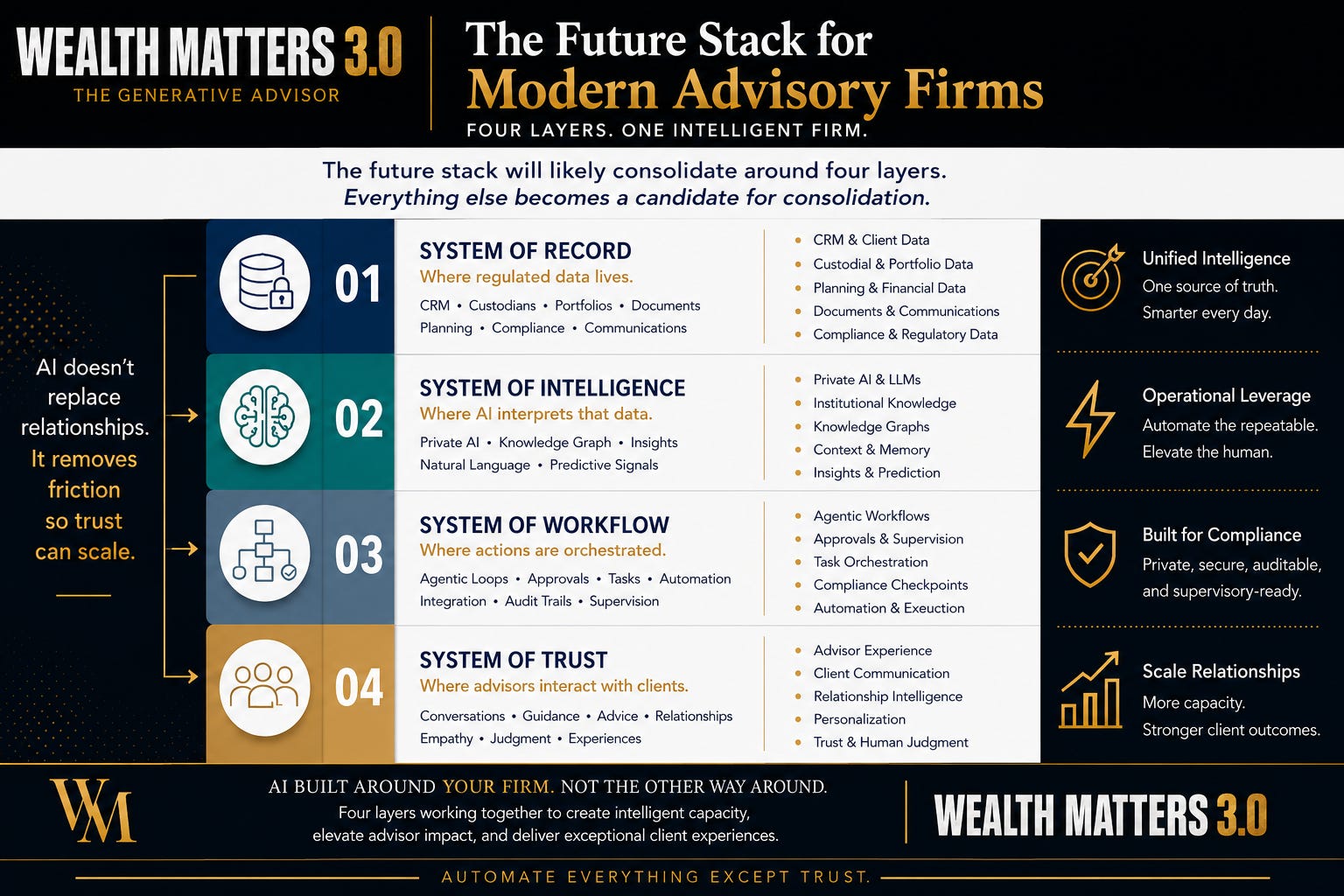
The System of Record contains what the business knows.
The System of Intelligence determines what that information means in context.
The System of Workflow turns intelligence into coordinated action.
And the System of Trust determines who ultimately has authority, accountability, and responsibility.
That final layer is particularly important in wealth management and other regulated professions. The goal should not be replacing the trusted advisor. It should be making the trusted advisor exponentially more capable.
Which is why I keep coming back to one principle:
Automate everything except trust.
Brookfield gets much of this operating logic right.
First, they correctly recognize AI as a CEO and operating-management problem rather than merely a CIO initiative.
Second, they emphasize organizational muscle memory.
Third, they emphasize clean data.
Fourth, they understand that deployment must ultimately produce measurable economic value.
And they see implementation as potentially analogous to Enterprise Resource Planning (ERP), a technology category that created decades of consulting, integration, and managed-services revenue.
All of that makes sense. But the ERP analogy also teaches us something else that they have either failed to mention or considered too lightly in my humble opinion for others to rush in and copy.
What you integrate eventually becomes difficult to leave
The most important question in enterprise AI is not merely:
Can this platform produce value?
It is:
What do I own after five years of producing that value? And what do I have to permanently lease-back forever to stay competitive?
Imagine a wealth-management enterprise spending years encoding:
client relationships, portfolio decisions, investment philosophy, tax history, estate-planning structures, family dynamics, compliance precedent, communication preferences, advisor reasoning, workflow rules, permissions, agent instructions, evaluation frameworks, and institutional knowledge.
That is not simply data anymore.
It becomes the operating system of intelligence of the enterprise.
If that intelligence is architecturally inseparable from one vendor or model’s infrastructure, the company can technically own its files while functionally renting its nervous system.
That is where I believe enterprise leaders need to be much more careful immediately.
Rent the model. Own the intelligence.
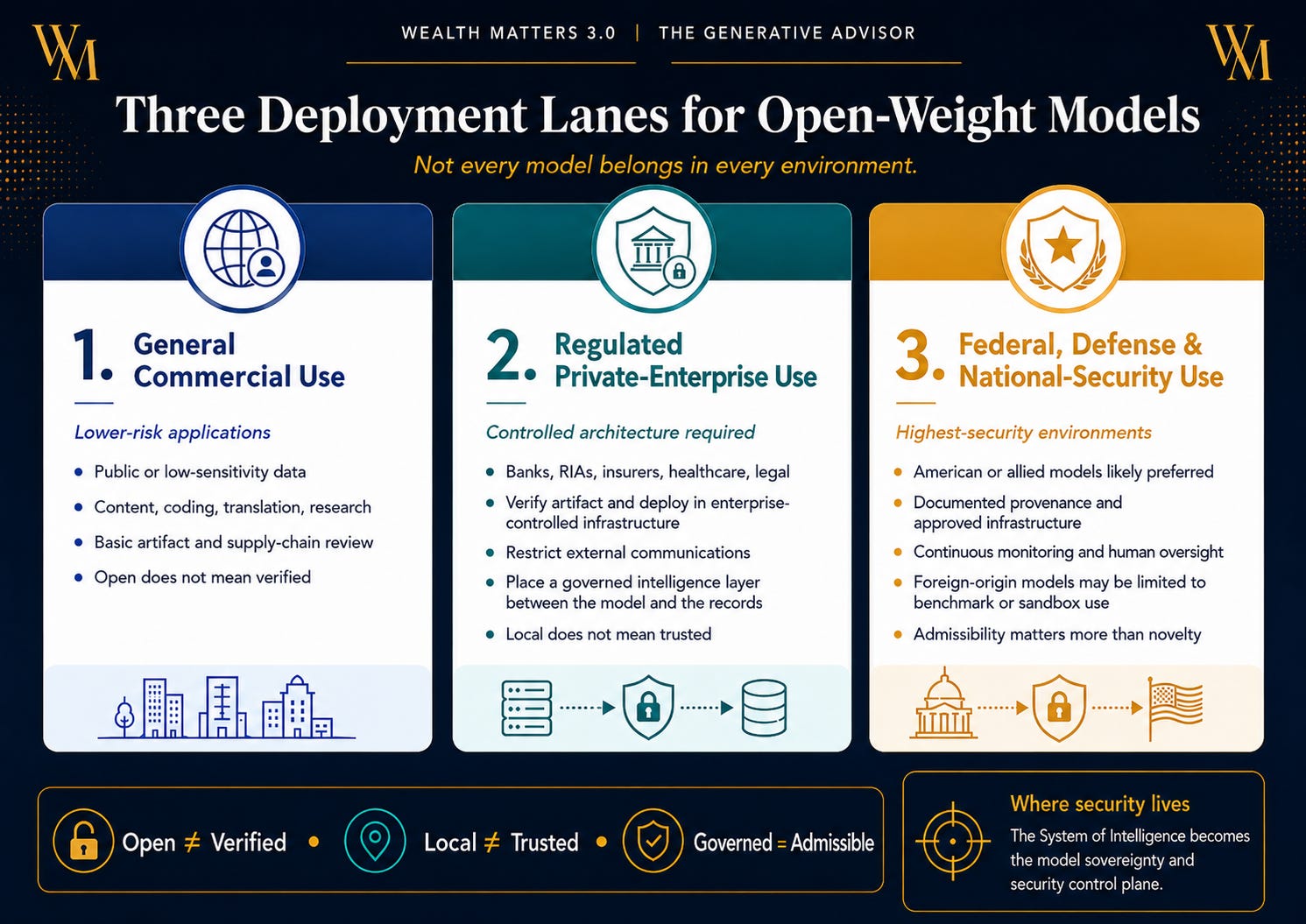
That does not mean avoiding OpenAI, or any of the frontier models.
Quite the opposite.
I expect the world’s best enterprises to use enormous amounts of frontier intelligence. The objective is simply to ensure that OpenAI—or Anthropic, Google or anybody else—is not the permanent container around the enterprise’s proprietary system of intelligence.
The model should be a component or ingredient, NOT the landlord. The Silicon Valley “attract then extract” business model they are all applying now to intelligence itself is the existential threat every firm faces to their competitive differentiation in the coming years.
The best architecture is likely hybrid
This is also why I do not believe the answer is some ideological declaration that cloud AI is bad and everything must run locally.
That would simply be another form of architectural rigidity. Different workloads require different kinds of intelligence.
A difficult strategic reasoning problem may warrant a frontier model.
A highly confidential client workflow may belong in a controlled private-cloud environment.
A repetitive classification process may be handled much more economically by a specialized Small Language Model.
A sensitive trust document or defense workflow may need to remain on-premises.
An edge environment may require inference close to the point where data is generated.
The goal is therefore not one model. It is intelligent orchestration across models and inference environments. I increasingly think of this as an inference hierarchy:
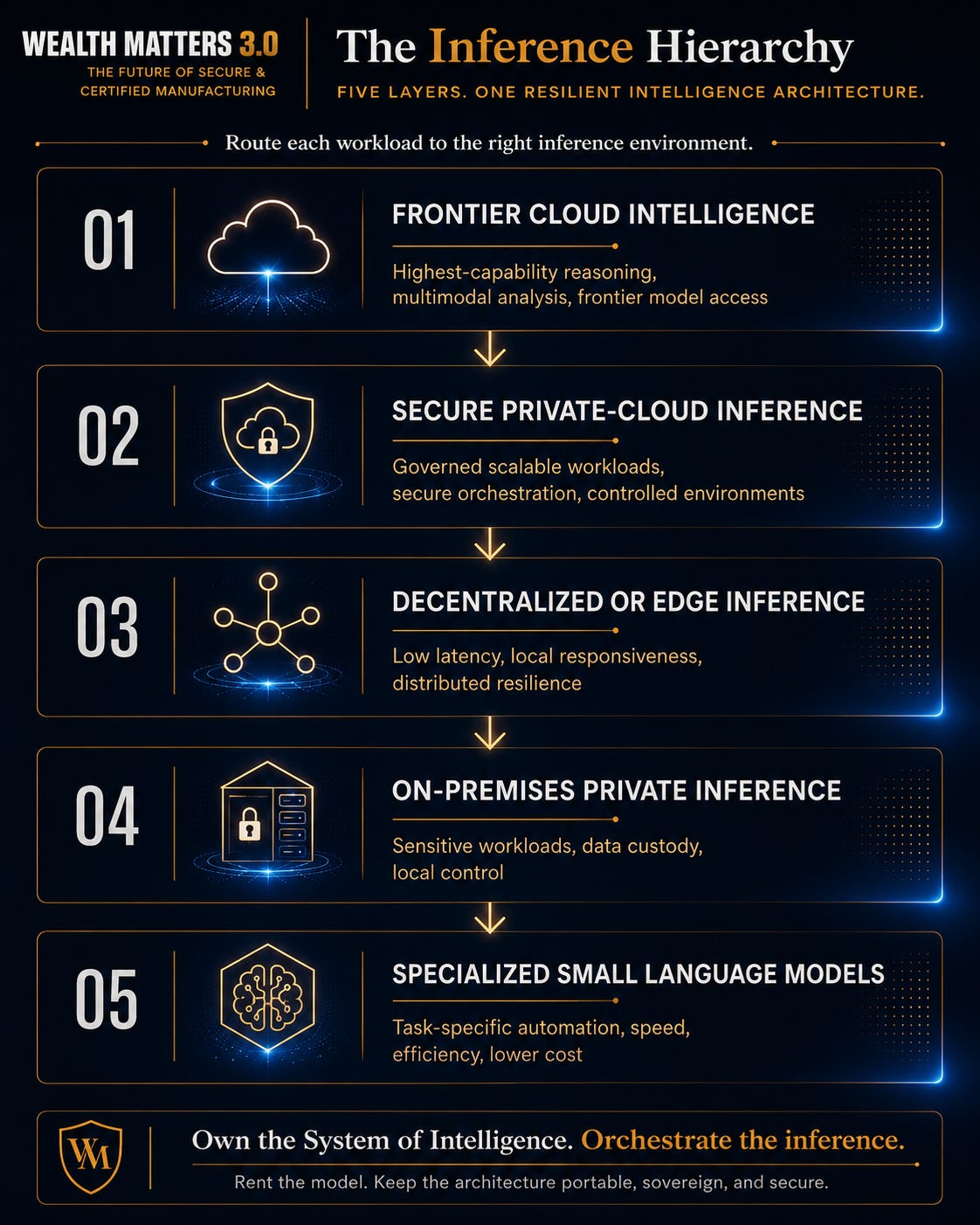
Frontier cloud intelligence
↓
Secure private-cloud inference
↓
Decentralized or edge inference
↓
On-premises private inference
↓
Specialized Small Language Models
The System of Intelligence sits above all of them and determines which resource gets which workload based on sensitivity, complexity, latency, economics, governance, and performance.
That is a materially more resilient architecture.
And sometimes the cheapest model is the smartest model to use
This becomes especially powerful as Small Language Models (SLMs) improve. A company does not need the world’s most sophisticated frontier model to answer every question.
Sometimes it needs:
“Extract these fields.”
“Classify this document.”
“Compare this transaction against this policy.”
“Route this request.”
“Determine whether these required documents exist.”
“Check these portfolio constraints.”
“Identify this anomaly.”
Those may eventually be tasks for highly specialized local models costing a fraction of frontier inference.
That is not a compromise. It can be superior engineering.
The objective is to reserve expensive frontier intelligence for problems where frontier capability creates incremental economic value.
Everything else should be routed toward the safest and most economical model capable of performing the task.
The Private AI Lockbox becomes another layer of the architecture
That is also where an on-premises Private AI Lockbox becomes strategically interesting. Think about the most sensitive intelligence inside an advisory firm or regulated enterprise:
personal financial statements,
trust documents,
tax information,
estate structures,
private-company capitalization records,
controlled contractual information,
identity records,
proprietary intellectual property,
regulated communications.
Some information may have no compelling reason to leave a controlled environment at all. An on-premises environment can support local retrieval, local models, and secure connections to broader infrastructure when required.
The principle is not that every workload stays inside the box. The principle is:
the enterprise decides what leaves it.
That is sovereignty.
An alternative approach
Brookfield’s thesis has actually reinforced one of the reasons ATOMIQ believes the market is ready for the nBrain Managing Partner model we have partnered with nBrain to scale via franchising.
DeployCo is institutional confirmation that AI deployment itself is becoming an enormous economic category.
But the large-enterprise model naturally gravitates toward enormous organizations, large transformation budgets, and major consulting teams.
There is another market underneath it.
Established lower middle market SME type companies in regulated industries that need essentially the same transformation but do not need—or cannot justify—a multibillion-dollar deployment ecosystem.
That is exactly the market nBrain is designed around.
The current nBrain model focuses on small and medium-sized enterprises across regulated categories including wealth and financial services, defense and government contracting, healthcare and life sciences, legal and accounting services, and oil-and-gas services.
Its forthcoming franchise core design is unusually simple:
The client owns the intelligence.
The Managing Partner (franchisee) owns the relationship.
nBrain operates the technical production capability behind it.
The customer owns its data, custom code, repositories, agents, workflows, institutional knowledge and System of Intelligence. The Managing Partner remains the strategic relationship owner. nBrain provides architecture, engineering, integrations, security, governance, infrastructure and ongoing managed production.
That distinction matters.
The Corporate AI Value Creation Office concept at Brookfield may be one of the most interesting Managing Partner profiles we see in our roadmap of ICPs (Ideal Customer Profiles).
Brookfield created an internal AI Value Creation Office to coordinate AI transformation across a large collection of portfolio companies.
I think that organizational structure may become increasingly common across private-equity firms, family offices, holding companies, and other owners of multiple operating businesses.
And it creates one of the most interesting potential ideal customer profiles for an nBrain Managing Partner franchise.
Imagine an RIA, law firm, Accountancy, or private-equity platform establishing its own AI Value Creation Office.
Instead of that office functioning primarily as a committee that selects outside AI vendors, it could effectively operate its own turnkey deployment capability through an nBrain Managing Partner business.
The internal office already possesses the most difficult asset:
relationships.
It knows the CEOs.
It knows the portfolio.
It understands the investment theses.
It understands each company’s operating priorities.
It can identify patterns across portfolio companies.
It knows where productivity improvements matter most.
The nBrain Managing Partner structure gives that organization a way to pair those internal relationships with a centralized technical delivery engine without requiring the value-creation office itself to build an engineering company from scratch.
In effect:
Build your own DeployCo, but make it portable.
The portfolio companies build Systems of Intelligence they own.
The internal value-creation team becomes the trusted relationship layer.
nBrain supplies architecture, engineering, integration, security, governance, and continuing Intelligence Under Management™.
Then the enterprise can use OpenAI wherever OpenAI is best. Claude wherever Claude is best. Gemini where Gemini wins. Open-weight models like Kimi K3, Gemma 4, etc. where economics or privacy favor them.
Local inference when custody matters. Small Language Models where specialization beats scale.
That is a fundamentally different strategic posture from organizing the intelligence architecture primarily around a single frontier provider. Sure, OpenAI at this point is too big to fail, but letting them harvest your decades of tacit knowledge is not required (and borderline irresponsible) to benefit from their utility and likely long-term survival.
One franchise. Potentially an entire portfolio.
This is where the economics become particularly interesting.
A private-equity sponsor does not necessarily need a different consulting engagement every time one of its operating companies begins an AI transformation.
The AI Value Creation Office can become an internal center of expertise and relationship management while a standardized deployment infrastructure supports portfolio companies underneath it.
One Managing Partner relationship with nBrain could potentially expand across:
operations, finance, customer support, sales, compliance, knowledge management, maintenance, data, security, and additional portfolio companies.
The objective shifts from purchasing individual AI projects toward continuously managing the intelligence infrastructure of the portfolio.
That is exactly what I mean by Intelligence Under Management™.
Go-live is not the finish line. It is the beginning.
Somebody must remain accountable for monitoring, securing, maintaining, optimizing, and expanding that intelligence over time.
Brookfield’s decision may still make perfect sense—for Brookfield
There is another nuance here that investors should understand. Alternative asset managers do not always make technology decisions for the same reasons that operating companies make them.
Private equity has capital structures.
Funds have investment periods.
LPs ultimately need liquidity.
Managers need realizations.
Capital must eventually move through a cycle from acquisition to value creation to monetization. That can create perfectly rational situations in which the highest-return financial decision is not identical to the theoretically optimal long-duration enterprise-architecture decision.
I am not claiming that this was Brookfield’s motivation for the OpenAI investment. Brookfield publicly describes its rationale around AI deployment, productivity, and value creation.
But the distinction matters conceptually, for those looking to model their strategy for AI deployment off of the Brookfield use-case.
A private-equity investor like Brookfield can potentially earn an attractive financial return from owning part of an ecosystem even if that ecosystem creates vendor concentration for some of its customers.
Those two things are not mutually exclusive.
An investor asks:
Can this investment generate an attractive return on capital?
An enterprise architect should ask:
Will this architecture preserve my strategic freedom ten years from now?
Different questions. And they can produce different answers.
For Brookfield, investing in a major deployment platform may provide strategic insight, portfolio access, operating leverage, and potentially attractive financial returns.
For everyone else, simply copying the architecture is not necessarily the smartest use of capital. And since ROIC is also a metric even Brookfield-types care about, I submit for your consideration that the model I describe above is the true Goldilocks solution for both sovereignty and capital allocation and ROI from your AI deployments, because you could comparable performance for a fraction of $500m investment. And if you don’t have $500m laying around you now have the same if not a better competitive advantage with a major validation point to buffer you in the boardroom.
Your AUM and your IUM require different thinking
This is especially relevant for wealth managers and investment firms because two forms of capital are now beginning to converge.
We already understand Assets Under Management. AUM tells us how much financial capital somebody has entrusted to us to steward.
But the generative organization increasingly has another balance sheet—whether accountants recognize it yet or not. I am calling it
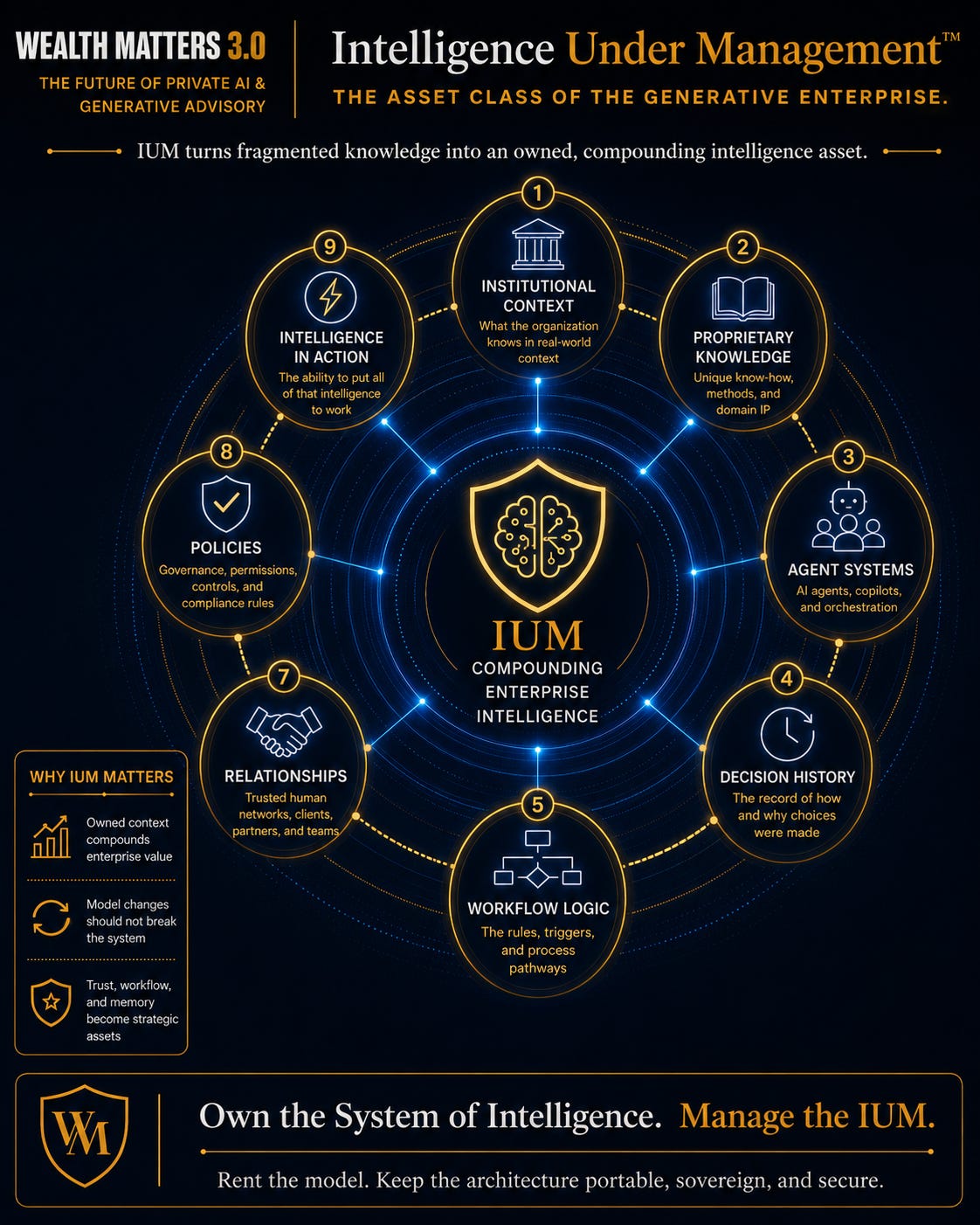
Intelligence Under Management™ (IUM). IUM includes:
institutional context,
proprietary knowledge,
agent systems,
decision history,
workflow logic,
organizational memory,
relationships,
policies,
and the ability to put all of that intelligence to work.
You should not necessarily manage those two forms of capital according to identical assumptions. With AUM, diversification has been foundational investment wisdom for generations.
We diversify managers. We diversify custodians. We diversify asset classes. We diversify counterparties. We think obsessively about concentration risk.
And then, remarkably, with AI companies sometimes contemplate building their entire future intelligence architecture around one technology provider. Why?
If concentration risk matters for capital, it should matter even more for your system of intelligence.
For everyone outside the unusual economics of very large alternative-asset platforms, there may be a better use of AUM and a more strategically certain approach to IUM than making a large capital commitment to one model ecosystem.
You do not necessarily need to own the AI company. You need to own your AI architecture.
A fraction of the capital. Much more optionality.
Brookfield can reasonably invest $500 million because Brookfield is Brookfield. Most organizations could not and should not attempt to replicate that strategy.
Nor do they need to.
The interesting opportunity created by increasingly modular AI infrastructure is that an established regulated company can begin constructing its own System of Intelligence for a tiny fraction of the capital required to own part of the model or deployment provider itself.
The more important comparison is conceptual.
Brookfield has invested hundreds of millions into ownership exposure to a deployment platform built around one frontier provider.
A regulated SME, advisory firm or portfolio-company group can instead focus its capital on owning the intelligence asset being deployed inside its own enterprise while still using the best frontier models available.
That is a very different return proposition.
The intelligence flywheel ultimately compounds
Brookfield is correct that infrastructure and deployment reinforce each other. I would add another flywheel inside the organization:
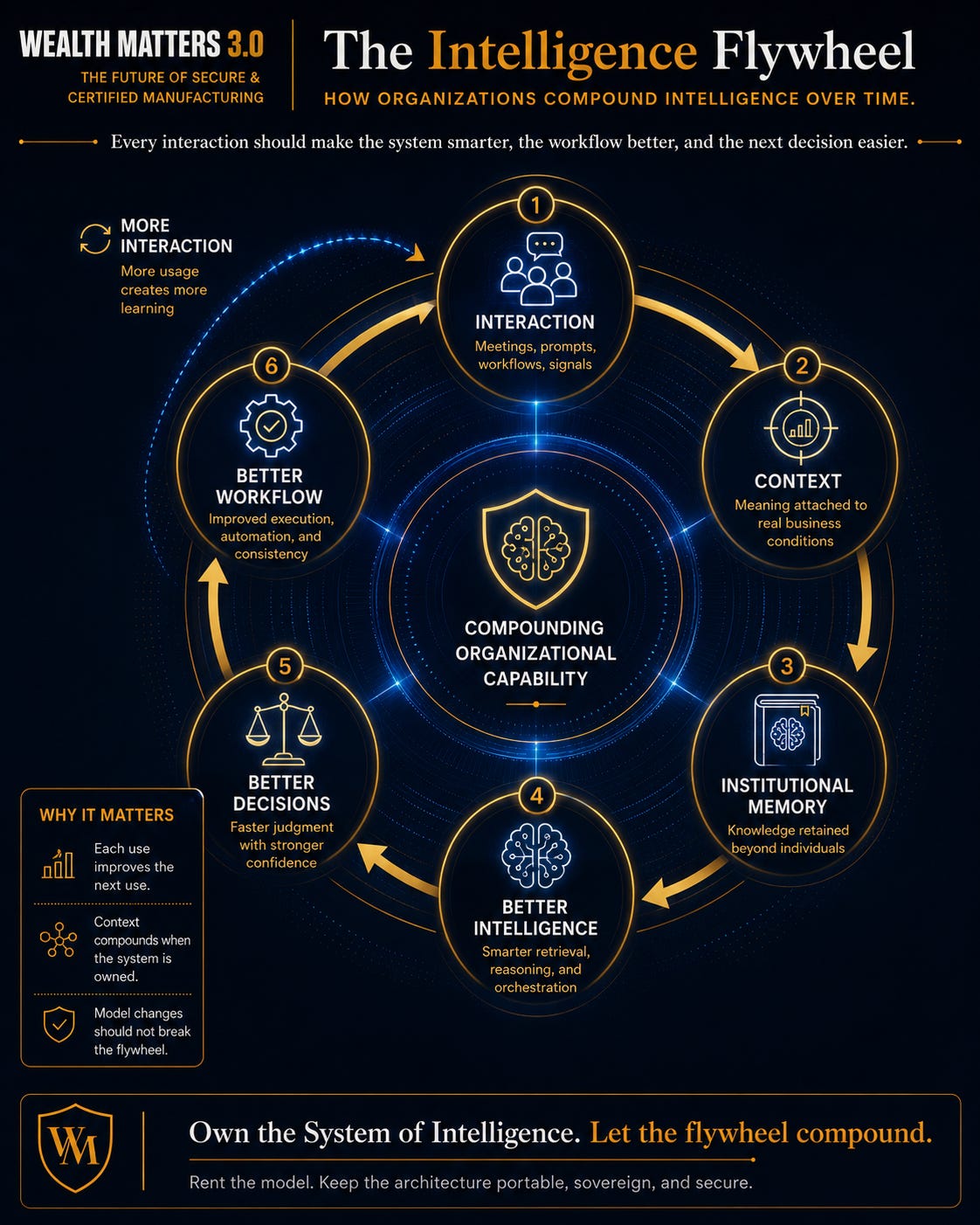
Interaction
→ Context
→ Institutional Memory
→ Better Intelligence
→ Better Decisions
→ Better Workflow
→ More Interaction
Every client meeting improves context. Every decision creates precedent. Every exception teaches the system. Every workflow generates feedback. Every integration increases the useful surface area of the intelligence.
That creates compounding organizational capability.
And if the architecture is portable, the company retains that compounding asset regardless of which model wins next year’s (or next week’s) benchmark.
The real question is not whether OpenAI wins
OpenAI may remain extraordinary. It may become even more dominant. The better it becomes, the more I would want the option to use it.
But that is not the same thing as wanting my enterprise architecture to become inseparable from it.
The generative advisor should increasingly think like a sophisticated allocator of intelligence as well as capital.
Route each workload to the appropriate model.
Use frontier intelligence when it earns its cost.
Use secure cloud when it provides the right balance.
Use decentralized inference where resilience matters.
Use the Private AI Lockbox where custody matters.
Use open-weight models where control and economics matter.
Use Small Language Models where narrow specialization makes more sense.
And maintain one durable layer above all of them:
Your System of Intelligence.
That is your asset. That is where context compounds. That is where your operating knowledge resides. And that is ultimately what you want under management.
Want to see what this could look like inside your own firm?
The easiest way to understand the difference between using AI and beginning to build a real System of Intelligence is to see the architecture translated into your own operating environment.
nBrain has created a personalized AI playbook experience that builds a custom-written 75-page AI playbook around your organization, use cases and operating priorities.
You can receive it digitally as a PDF and request a printed version for your team.
Get your personalized printed + PDF AI Playbook here:
Create your personalized nBrain AI Playbook

The point is not to show you another collection of generic AI use cases. It is to begin asking the more important questions:
Where does your proprietary intelligence live today?
Which workflows should use frontier models?
Which should remain private?
Where could open-weight or Small Language Models reduce inference cost?
Which information belongs in a secure cloud environment?
What should stay on-premises?
And what would it take to build a System of Intelligence that survives the model underneath it?
That exercise is where Intelligence Under Management™ stops being a concept and starts becoming an operating architecture.
Brookfield validates the market for deploy co investment. nBrain represents another way to capture it.
The Brookfield/OpenAI transaction is one of the strongest validations yet of the deployment economy. I think Brookfield is right that enormous value will accrue to organizations capable of integrating intelligence into real businesses.
The optimization I would make is simple:
Do not make deployment and dependency synonymous.
A Corporate AI Value Creation Office should not merely become good at buying AI. It can become the internal relationship and intelligence office for an entire portfolio.
A generative advisor should not merely become an expert user of somebody else’s copilot. They can become the steward of a client-owned System of Intelligence.
A regulated SME should not have to build its own artificial-intelligence engineering department. It can own its intelligence while a managed infrastructure organization like nBrain operates the technical layer beneath it.
That is precisely why ATOMIQ believes the nBrain Managing Partner franchise opportunity belongs in the market now.
A private-equity sponsor, family office, advisory network, or operating platform can increasingly envision something that previously required enormous consulting and engineering organizations:
Its own AI Value Creation Office.
Not simply an internal committee selecting vendors. A real deployment capability.
An internal relationship layer powered by its own nBrain Managing Partner operation, supported by centralized production and managed infrastructure, while the portfolio companies themselves retain ownership of the Systems of Intelligence being created.
That makes the nBrain Managing Partner particularly interesting for executives who already possess what technology companies struggle hardest to manufacture: trusted access to the enterprise.
This comes in the form of the CEO relationships, the operating relationships, the domain expertise, the reputation, and the understanding of where value actually gets created.
Pair those assets with a model-agnostic, portable infrastructure layer and suddenly the organization does not have to choose between OpenAI and sovereignty.
It can have both.
Use OpenAI aggressively where it produces the best result. Use another frontier model when that model becomes superior. Use open-weight inference when cost, privacy, or customization favors it. Move sensitive workloads into secure private infrastructure. Run narrow workloads through SLMs. Keep certain intelligence entirely inside an on-premises Lockbox.
The customer continues accumulating the real asset: Intelligence Under Management™.
That is a much more durable way to think about AI transformation.
Deploy the models.
Orchestrate the inference stack.
Own the intelligence.
Manage the IUM through an agnostic deploy co like nBrain.
Automate everything except trust.
For qualified executives, corporate AI Value Creation leaders, and relationship-driven professionals interested in building that capability as a business, you can learn more and request information about future nBrain Managing Partner franchise opportunities here:
Explore the nBrain franchise opportunity and inquire about the waitlist
Five favors before you go.
This post was free by design.
Your attention to this issue matters more to my mission than your money. If more advisors, operators, investors and enterprise leaders understand that the next AI decision is not simply which model to buy, but what intelligence they intend to own, then this article has done its job.
Part 2 of this report later behind the paywall this week will go much deeper. It is written specifically for the professionals who are actively deploying capital—or preparing to deploy it—into their AI strategy. We will get into the weeds on how to manage Intelligence Under Management™, including specific tools, infrastructure choices, model-routing considerations, recommended integrations, governance layers and practical ways to maximize what I call ROI²:
Return on Investment × Respect for Independence.
In other words: not simply how much economic return your AI architecture generates, but how much strategic control, portability and sovereignty you retain while generating it.
Before you continue:
Like this post if the distinction between renting models and owning your System of Intelligence is useful. It helps signal that this is a conversation worth expanding.
Restack it so another advisor, operator, private-equity executive or business owner starts asking the ownership question before making a large AI commitment.
Share it directly with someone currently building an AI strategy, evaluating a frontier-model partnership, standing up an AI Value Creation Office or allocating capital toward enterprise AI.
Comment with the question you want answered in Part 2. Tell me where you are in the deployment cycle, what architecture you are considering, or where you see the biggest tension between capability, privacy, cost and independence. I want the next installment to address the decisions practitioners are actually wrestling with.
Subscribe to Wealth Matters. Wealth Matters is reader-supported and independent by design. I love doing this work in service of readers who are trying to build, protect and steward what lasts. For less than $1 per day you can go from curious to serious and join the Wealth CMDR community where you get a seat in the room that I live in to make sense of this future for myself with the best minds and specialists I can find to grow and protect my networth and net happiness. Let me welcome you ahead of the click below and say thank you!
The Real Risk is Doing Nothing!
~Chris J Snook
Sources & Further Reading
Brookfield — Deal Debrief: OpenAI Deployment Company
Anuj Ranjan and David Bonasia discuss the rationale behind Brookfield’s investment, enterprise deployment, operating integration, and the emerging services opportunity around AI.
Listen to Brookfield’s original Deal Debrief
Brookfield Asset Management — Brookfield to Invest $500 Million in Strategic Partnership with OpenAI
Brookfield’s original announcement detailing the $500 million commitment to the OpenAI Deployment Company.
Read Brookfield’s investment announcement
OpenAI — Launch of the OpenAI Deployment Company
OpenAI’s explanation of DeployCo, its Forward Deployed Engineer model, capitalization and position as a majority-owned and controlled extension of OpenAI.
Read OpenAI’s DeployCo announcement
OpenAI — Introducing OpenAI Frontier
Additional background on enterprise agents, workflow integration and the growing importance of deployment infrastructure beyond model capability alone.
Read about OpenAI Frontier
Brookfield — AI Infrastructure Opportunity Spotlight
Broader context on Brookfield’s investment thesis across compute, infrastructure, energy and AI deployment.
Explore Brookfield’s AI infrastructure thesis
nBrain — Private AI Managing Partner Franchise
Information regarding nBrain’s private AI infrastructure, Managing Partner opportunity and qualification process.
Learn more at nBrainFranchise.com
nBrain — Personalized AI Playbook
Generate a customized 75-page playbook exploring how private AI and owned intelligence architecture could apply to your organization.
Get your personalized printed + PDF AI Playbook
The portability argument holds, and there is a cheap test for whether a company actually has it. On 30 July this year OpenAI cut the price of one model by roughly 80% overnight. Every enterprise on that model got the same email. Only the teams holding their own labelled evaluation set could prove within a week that the cheaper option still passed on their own tasks, and those were the only ones who took the saving. Everyone else stayed on the expensive tier because switching was an unpriced risk rather than a measurement.
So portability is not really an architecture property. It is a measurement property. The abstraction layer is the easy half and plenty of firms have one. The hard half is owning a labelled set of your own cases, with your own pass criteria, that lets you swap the model underneath and prove nothing broke. Gartner puts LLM observability in about 15% of generative AI deployments today. The other 85% cannot answer why an answer came out the way it did, which means they cannot evidence a switch even when the abstraction layer would allow it. Dependency shows up as the inability to prove you can leave, long before any contract says so.