


For years, we’ve been told America is entering the largest wealth transfer in history. Depending on the estimate, somewhere between $80 trillion and $100 trillion will move from Baby Boomers to younger generations over the next two decades.
Most articles focus on the money. Most families don’t.
Because if you’re a Gen Xer staring down this transition, the thing keeping you awake at night probably isn’t how much you’ll inherit.
It’s whether you’ll know what to do when the phone rings.
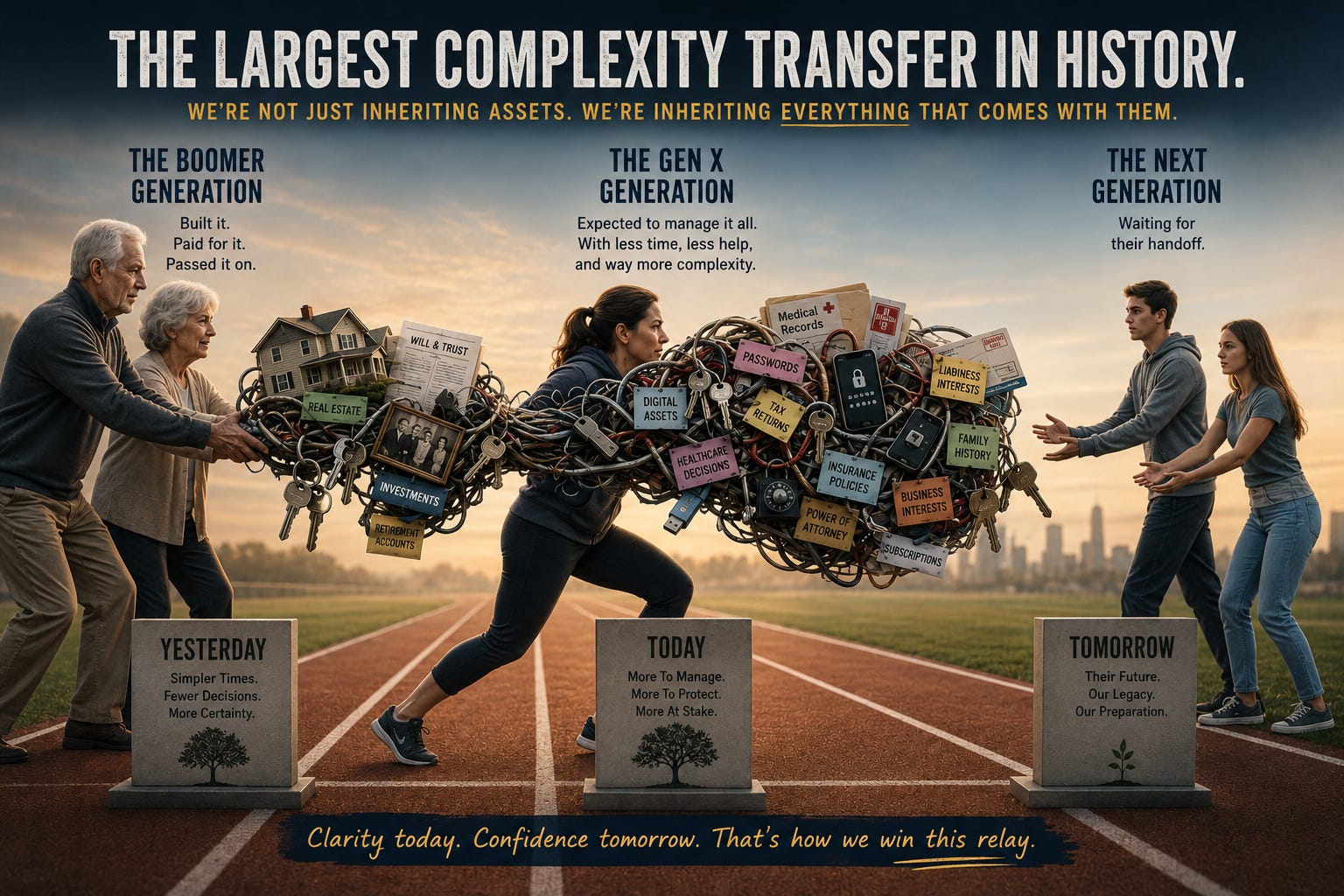
The truth is that most Gen Xers aren’t worried about inheriting wealth. They’re worried about inheriting more complexity and responsibility.
The Gen X Irony
Gen X may be the first generation in modern history that simultaneously worries about funding their children’s future, protecting their parents’ past, and preserving their own retirement.
They are expected to become the bridge between generations at precisely the moment many feel the least financially prepared themselves.
Researchers call GenX the Sandwich Generation. That label no longer feels sufficient. Many Gen X households are now supporting aging parents, helping adult children, managing careers, planning for retirement, and navigating their own cost-of-living increases, job insecurity, and health concerns simultaneously.
In many ways, Gen X has become the custodian and IT department of the family operating system. The problem is nobody ever handed them the user manual. This may explain why inheritance isn’t what most Gen Xers talk about when the conversation turns to aging parents.
The money is rarely the first concern. The responsibility is.
The Inheritance Nobody Talks About
There is a running joke among Gen Xers that we were the “figure it out yourself” generation.
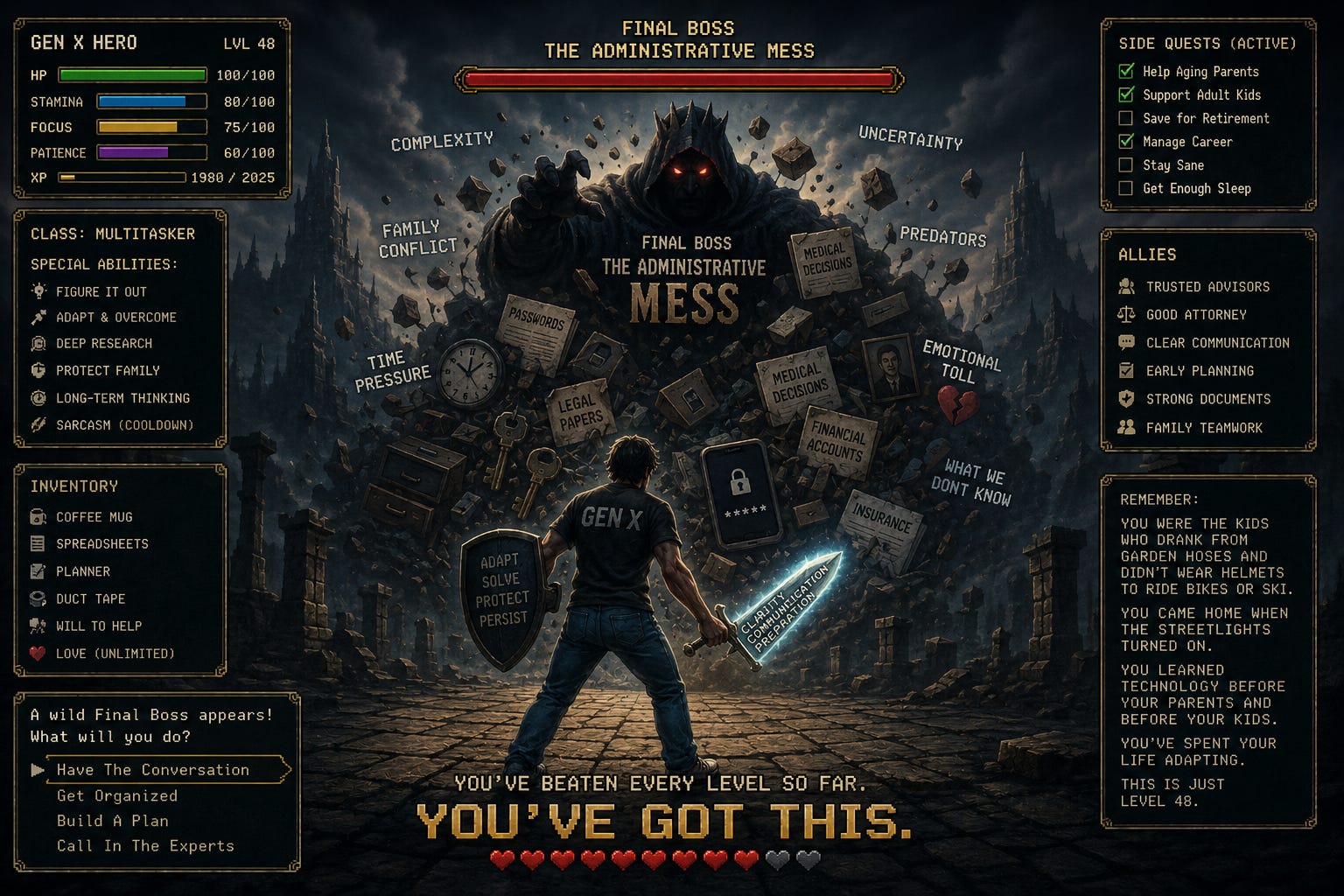
Hell, they were the kids who drank from garden hoses and didn’t wear helmets to ride bikes or ski, right? They came home when the streetlights turned on. They learned technology before our parents and before our children. They’ve spent most of their lives adapting. They were the original gamer generation, and now they’re about to battle one final boss.
The Family Operating System.
And unlike the VCR clock, nobody is leaving them the instruction manual.
The headlines call it the Great Wealth Transfer. However, for many Gen X adults, it feels more like the Great Responsibility Transfer.
Because what arrives first is rarely money. It’s decision-making. It’s caregiving. It’s coordination. It’s crisis management. It’s becoming the adult in the room while quietly wishing someone else could fill that role.
The Question Beneath Every Question
When families finally start discussing succession planning, the questions usually sound practical.
Do Mom and Dad have a will?
Is there a trust?
Who has power of attorney?
What accounts exist?
Who are the advisors?
Where are the passwords?
What happens if someone becomes incapacitated?
But underneath every one of those questions sits another. A much more important one.
Do we have clarity before a crisis forces us to find it?
Because when clarity is absent, conflict fills the vacuum. And conflict has a way of showing up at exactly the wrong moment.
The Mess Gen X Actually Fears
What may surprise many people is that Gen X is one of the least inheritance-dependent generations in modern history. Most are not counting on an inheritance to fund their retirement.
Many have already assumed that healthcare costs, long-term care expenses, inflation, taxes, or simple longevity may consume a meaningful portion of whatever assets ultimately remain.
The fear is not the absence of assets. The fear is the absence of organization and understanding. The inheritance Gen X worries about isn’t a portfolio.
It’s a three-ring binder nobody can find. A trust nobody understands. A phone nobody can unlock. Accounts nobody knows exist. A safe deposit box with no key. A family disagreement nobody addressed. An aging parent whose memory has started to fade. A sibling conflict waiting to happen. The fear isn’t receiving too little. The fear is untangling too much.

The Predators Are Already Circling
This is the part many families underestimate. The greatest threat to family wealth often isn’t market volatility. It’s vulnerability. The predators rarely arrive after death. They often arrive before it.
Financial scams.
Romance scams.
Identity theft.
Fraudulent caregivers.
Questionable contractors.
Manipulative acquaintances.
Aggressive salespeople.
Opportunistic relatives.
Bureaucratic systems that don’t care how overwhelmed a family may be. Many Gen X children quietly carry a fear they rarely articulate.
Will I spend the next decade protecting my parents instead of enjoying my remaining years with them?
That fear is real.
Because as parents age, protecting them often becomes less about investing and more about governance. Less about returns. More about oversight.
The Password/2FA Problem
Twenty years ago, estate planning was largely a legal exercise. Today, it is increasingly a technology and personal opsec (operational security) exercise.
Where is the will?
Now has company.
Where is the password manager?
Who has access to the phone?
Who controls the authenticator app?
Who can access email?
Who knows the recovery codes?
Who can access cloud storage?
What happens to cryptocurrency wallets?
What happens to subscription services, online accounts, and digital assets?
The modern estate is no longer just physical. It is digital. And for many families, the digital estate may create more friction than the financial estate.
The Grief Nobody Talks About
There is another challenge that very few people discuss. Anticipatory grief. Anticipatory grief is the grief that begins before the actual loss.
Gen X is often watching this happen and experiencing it in real time. Their parents are slowing down. Their parents are forgetting things. Their parents are becoming less independent. Their parents, who once solved every problem, now need help solving their own more frequently.
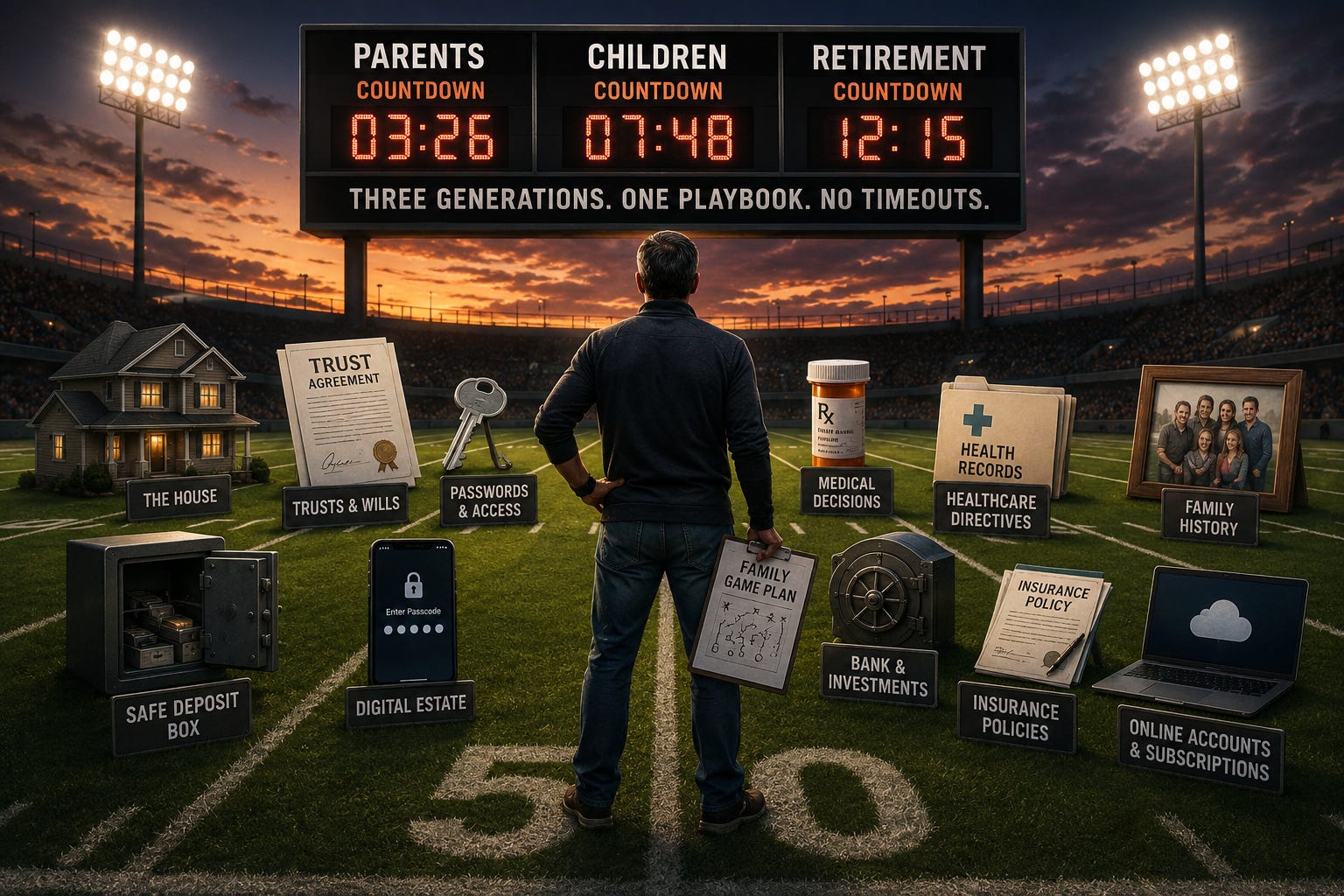
At the exact moment, Gen X is being asked to become the family quarterback. It’s a strange emotional paradox. You don’t want the promotion. But eventually you realize you’re already doing the job.
The Succession Burden Gap
There is a concept that deserves more attention.
The Succession Burden Gap.
For most of history, inheritance meant receiving assets. Today, inheritance increasingly means receiving administration.
The complexity surrounding family wealth is growing faster than the wealth itself. Assets. Liabilities. Insurance policies. Healthcare directives. Passwords. Subscriptions. Tax filings. Business interests. Family governance. Digital identities. Medical decisions.
The modern family balance sheet contains far more moving pieces than previous generations ever faced.
Inheritance is no longer simply a transfer of assets.
It is increasingly a transfer of responsibility.
And unless families intentionally transfer information before they transfer assets, the largest wealth transfer in history may also become the largest complexity transfer in history.
The Family Balance Sheet Nobody Tracks
Every family has two balance sheets.
The first contains assets and measures dollars.
The second contains trust and measures understanding.
Most families spend decades building the first. Very few intentionally build the second. Yet when a crisis arrives, the trust balance sheet often becomes the more valuable asset.
Do people know where things are?
Do expectations align?
Have difficult conversations occurred?
Does everyone understand the plan?
The strongest families are rarely the ones with the largest estates. They are the ones with the fewest unanswered questions.
A Better Way Forward
The good news is that most of these risks are solvable. Not with another financial product. Not with another investment, but with conversations.
Start simple.
Ask your parents:
What would happen if one of you became incapacitated?
Where are the important documents?
Who are your advisors?
What accounts exist?
What do you want us to know that we’ve never discussed?
What matters most to you if your health changes?
What are you worried about?
Then listen. Not as an heir. As a steward. Because the goal isn’t to figure out what you’re getting. The goal is to understand what you’re protecting and what chaos you are avoiding when you are also managing grief and loss.
Final Thought
The greatest wealth transfer in history may ultimately have less to do with money than information. The families that navigate the coming decades most successfully will not necessarily be the wealthiest, but they will be the clearest.
They will also be..
The ones who transferred knowledge before transferring assets.
The ones who documented the plan before the crisis.
The ones who replaced assumptions with conversations.
The ones who built both balance sheet assets and trust.
Succession is not ultimately about transferring wealth. It’s about transferring confidence. And confidence begins with clarity. Not after a loss. Before one.
You Are Not Alone:
Every Wednesday 1pm EST/10am PST Join ATOMIQ LEVEL AMA “Matt Chats” hosted by Chris J Snook
If this article struck a nerve, you’re not alone.
Every week, I hear from Gen X business owners, investors, professionals, and parents carrying these exact concerns.
That’s why I’m inviting you to join me and my longtime asset protection and estate planning counsel, Matt Meuli, for our free Wednesday ATOMIQ LEVEL “Matt Chats” Office Hours on Substack.
We’ll go beyond theory and tackle the practical realities families face every day:
How to start the conversation with aging parents.
What documents matter the most.
How to think about powers of attorney.
The digital estate problem nobody is discussing.
How to reduce future sibling conflict.
How to protect aging parents from financial predators.
How to organize family information before a crisis.
How to build a family operating system that survives uncertainty.
Bring your questions. Bring your concerns. Bring your parents if they’re willing. Because the conversation you avoid today often becomes the crisis you inherit tomorrow.
The real risk is doing nothing.
~Chris J Snook

Sources & Research Summary
Pew Research Center – The Sandwich Generation
Research on adults simultaneously supporting aging parents and children, and the emotional and financial pressures involved.
Northwestern Mutual Planning & Progress Study
Findings showing many Americans expect to leave inheritances while far fewer expect to receive them.Trust & Will Estate Planning Report
Estate planning preparedness by generation, including Gen X gaps in planning documents.Investopedia – Gen X Retirement and Family Support Trends
Analysis of Gen X supporting multiple generations while trying to save for retirement.Kiplinger – Sandwich Generation Retirement Challenges
Coverage of retirement savings sacrifices made by caregivers and multigenerational households.Morningstar – Gen X Retirement Anxiety Research
Data on retirement readiness and financial stress among Gen X households.Elder Law Answers – Inheritance Expectation Gap
Research showing a growing disconnect between what older generations intend to leave and what younger generations expect to receive.MarketWatch – Caregiving and Estate Planning Conversations
Guidance and research on family communication, caregiving, and planning before a health crisis.World Quality Corporation – Costs of Supporting Aging Parents
Discussion of healthcare, caregiving, and long-term care financial realities facing Gen X families.Choice Mutual – Great Wealth Transfer Estimates
Summary and aggregation of major forecasts estimating the scale of the coming intergenerational wealth transfer.