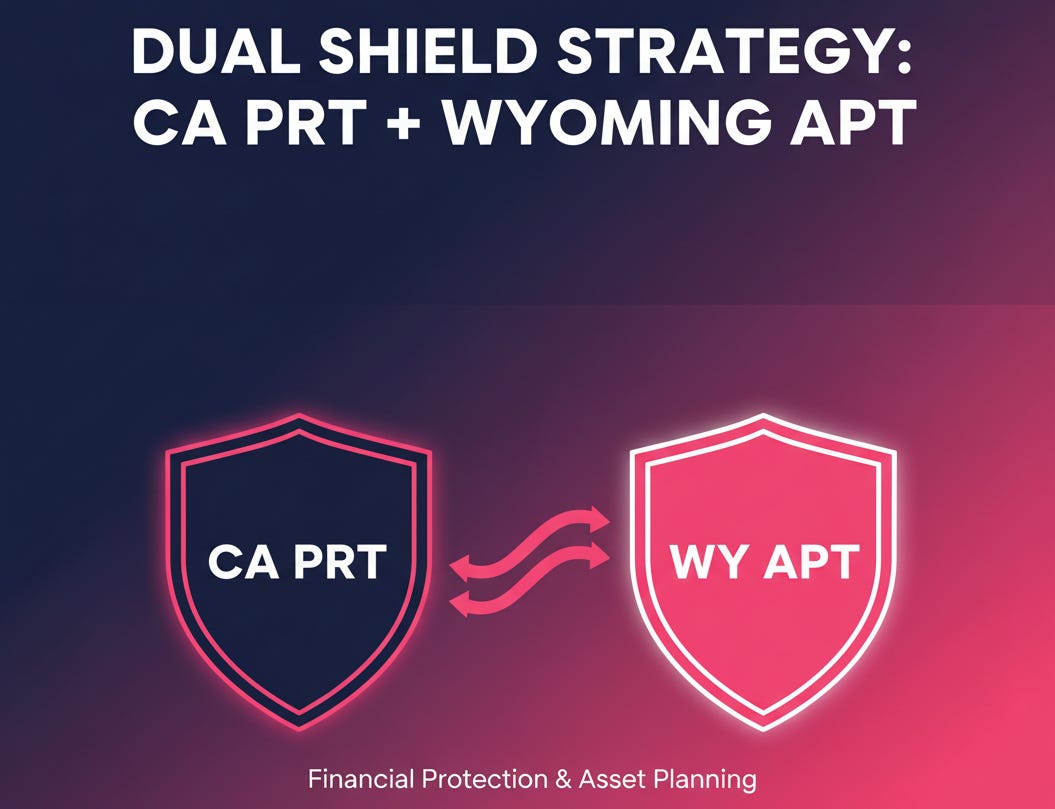
Your 2026 Dual Shield Asset Protection and Tax Mitigation Strategy
A Simple, Actionable Plan to Lock In Lawsuit Protection and Keep More Profit
A note to the reader: This concept can be modified by non-California owner-operators as well, with some custom tweaks for each State of residence. Reach out to book a consultation call here
Case Study: Tax-Deferred Retirement with Dual Shield Asset Protection
I recently met a California-based business owner (advisor) netting $750,000 in annual operating profit before taxes, with most of that exposed to lawsuits and California’s top 13.3% rate. Traditional employer-sponsored qualified retirement plans barely move the needle for self-employed owner-operators like this, leaving a large chunk of their after-tax wealth vulnerable.
A Solution a Couple of Mountain Ranges Away
Using a California Private Retirement Trust (PRT) converts surplus profits into exempt “retirement assets” under Code of Civil Procedure §704.115, while a Wyoming Asset Protection Trust (WAPT) adds a second wall of protection under Wyoming’s Qualified Spendthrift Trust statute. Together, they create a two-layer structure that targets both tax deferral and creditor protection for high-net-worth owners in high-risk professions. Now, let’s dig into it a bit more and get you some clarity on who you need on the team to execute something similar.
Why This Combo Works
California PRTs enjoy a broad exemption when they are “designed and used primarily for retirement purposes,” allowing assets in a properly structured plan to be fully exempt from execution. Courts look at the totality of circumstances—retirement modeling, funding pattern, and access—to decide whether the plan is genuine rather than a last-minute creditor dodge.
Wyoming Qualified Spendthrift Trusts, by contrast, focus on long-term asset protection and state-level tax advantages, but another state’s courts may scrutinize them when the settlor lives in a creditor-friendly jurisdiction like California. Using the PRT for the “retirement tranche” and the WAPT for multigenerational and excess assets separates purposes and strengthens both structures under their respective statutes.
Key definitions
A Wyoming Qualified Spendthrift Trust is the statutory creature in Wyoming law that people use for self‑settled asset protection (often called a Wyoming asset protection trust or domestic asset protection trust).
A Wyoming Delegated Asset Protection Trust is simply a qualified spendthrift trust that is drafted as a directed/delegated structure, where an investment advisor or trust protector directs investments while a Wyoming trustee retains legal title and distribution authority.
Relationship between the terms
In practice, when advisors talk about a Wyoming Asset Protection Trust, Wyoming DAPT, or Wyoming Qualified Spendthrift Trust, they are referring to the same underlying structure authorized by statute, provided it meets the requirements: irrevocable, Wyoming governing law, spendthrift clause, qualified Wyoming trustee, and proper funding.
A delegated asset protection trust is a design choice within that framework that shifts some powers (typically investment decisions) to an advisor while the Wyoming trustee still administers the qualified spendthrift trust for asset‑protection purposes.
Practical takeaway
When you see “Wyoming Delegated Asset Protection Trust” in marketing or documents, assume (but clarify) it is implemented as a Wyoming Qualified Spendthrift Trust that uses a directed/delegated trustee structure, not a separate statutory regime.
For legal or drafting purposes, the controlling question is whether the trust satisfies the Qualified Spendthrift Trust Statute; “delegated” just tells you how fiduciary duties and investment powers are allocated inside that same type of trust.
Target Client Profile
This strategy fits California owners ages roughly 45–65 with at least $5 million net worth and persistent exposure to malpractice, professional liability, or partner disputes. It particularly suits closely held corporations and professional practices where owners can sponsor a private retirement plan through the entity.
The core objective is to move from a situation where nearly all after-tax profit is exposed to judgment, into a structure where retirement and dynasty assets sit behind statutory protections while still compounding on a tax-deferred or tax-efficient basis. That shift can convert $200,000 or more per year of otherwise lost tax drag into compounding capital, depending on structure and rates.
Step 1: Assemble the Team
Courts scrutinize substance over form, so a California lawyer experienced with §704.115 designs the PRT to match the statute, while your Wyoming counsel ensures the WAPT meets the “Qualified Spendthrift Trust” requirements, including a qualified Wyoming trustee and governing-law provisions. A tax-focused CPA or actuary supports the retirement purpose with modeling and helps coordinate entity structure and deductions.
Independent trustees and administrators handle plan governance, valuations, and documentation, which is critical when judges examine control, funding history, and adherence to plan terms. Setup and ongoing costs in the tens of thousands per year are common but typically justified relative to the value protected for high-income practices.
Step 2: Design the PRT – Retirement Tranche
The PRT begins with a retirement needs appraisal showing how a defined corpus supports future withdrawals, reinforcing the “primarily for retirement” standard under California law.
Actuarial projections, age, lifestyle assumptions, and other resources help anchor contribution levels and reduce the risk that a court views the trust as merely a shield.
The sponsoring entity adopts a nonqualified private retirement plan, establishes a separate trust, and delegates investment and administration to independent parties while allowing participant-directed investment within documented guardrails. Assets contributed—such as equities, fixed income, or certain alternative exposures—grow inside a structure that can be fully exempt from execution so long as contributions and use remain consistent with retirement purposes law.
Step 3: Add the WAPT – Dynasty Layer
Once the retirement tranche is on track, surplus capital moves into the Wyoming asset protection trust after seasoning and careful timing to avoid fraudulent transfer concerns. Typical funding candidates include excess real estate, non-core business equity, supplemental life insurance structures, and investment portfolios earmarked for heirs.
A WAPT can be drafted as an irrevocable qualified spendthrift trust that allows the settlor to remain a discretionary beneficiary under defined standards while still benefiting from Wyoming’s strong spendthrift and tax environment. Dynasty provisions and generation-skipping planning let trust assets compound over multiple generations with minimal state-level tax friction.
Step 4: Annual Operating Rhythm
For the PRT, the annual cadence typically includes updated valuations, contribution recommendations against the actuarial target, and plan governance documentation that demonstrates ongoing retirement-focused use. Regular statements and adherence to plan rules help defend the exemption if ever challenged.
The WAPT requires trustee reporting, periodic investment reviews, and compliance with Wyoming statutory requirements, including attention to any distributions that might intersect with creditor or tax issues. Coordinating both structures in a single dashboard or family balance sheet view helps ensure consistent asset allocation and risk management across protected and non-protected pools.
Example: The $750K California Practice
Consider a 52-year-old California professional with $750,000 in pre-tax operating profit and meaningful malpractice exposure. By routing substantial, actuarially justified contributions into a PRT and channeling remaining surplus into a WAPT, the owner builds two distinct protected pools: one dedicated to retirement income and another oriented toward heirs and long-term legacy.consumerhelpcentral+3
Over a decade or more, the combination of tax deferral, compounding, and insulation from most civil creditors can result in materially higher protected net worth compared with leaving profits in the operating entity or taking fully taxable distributions each year. The exact numbers depend on returns, contribution levels, and tax rates, but the directional advantage is clear for high-margin, lawsuit-exposed practices.peaktrust+2
Risk Factors and Guardrails
Both PRTs and WAPTs require early planning and clean facts; transfers made after claims arise or with the intent to hinder creditors can be attacked under fraudulent transfer statutes and may reduce or eliminate protection. Courts assessing a PRT examine subjective intent, timing, control, and compliance with plan rules, so documentation and independent administration are crucial.
Domestic asset protection trusts, including Wyoming structures, also face potential scrutiny from bankruptcy courts or from non-recognizing states, reinforcing the value of anchoring retirement protection in home-state law and using the WAPT as a complementary, not standalone, solution. When done well and properly, however, they create a tested and difficult structure to penetrate (read this as more expensive or too expensive to attack) and help you sleep at night.
It’s one thing to earn it, but it’s a whole different strategy to keep it and protect it from confiscation! For the foreseeable future, it will be harder and harder to hold onto, so the time to design for this properly is now.
Yours in health and wealth
~Chris J Snook
Endnotes for Further Reading
https://www.consumerhelpcentral.com/california-pension-protection/
https://law.justia.com/codes/wyoming/title-4/chapter-10/article-5/section-4-10-510/
https://lsi-law.com/the-wyoming-qualified-spendthrift-trust-an-overview/
https://www.alperlaw.com/blog/wyoming-asset-protection-trust/
https://www.firstamtrust.com/trust/private-retirement-trusts/
https://grupplaw.com/insights/the-wyoming-qualified-spendthrift-trust/
https://saclaw.org/resource_library/exemption-from-the-enforcement-of-judgments/
https://blakeharrislaw.com/blog/wyoming-asset-protection-trust
https://www.captrust.com/resources/fiduciary-update-may-2025/


