


How to hard-refresh your portfolio, entities, intelligence, asset protection, estate and legacy architecture without forgetting the only reason any of it matters: building both net worth and net happiness.
Part III — The Question Comes Home
Part I and Part II of this report back in late July spent a lot of time looking outward. We looked at America. We looked at science. We looked at artificial intelligence, quantum computing, advanced manufacturing, energy, national laboratories, institutional capacity and The Genesis Mission.
We went backward to Vannevar Bush and Science, the Endless Frontier. We looked forward toward an emerging national architecture designed to connect supercomputers, experimental facilities, artificial intelligence, scientific datasets and human expertise into something more productive than any of those components standing alone.
Then, on July 22, the White House provided additional clarity that made the architecture even more interesting. The administration described The Genesis Mission as a White House-led, whole-of-government initiative involving more than 15 federal agencies, backed by more than $5 billion in federal commitments and 278 selected projects addressing National Science and Technology Challenges. The Department of Energy (DOE) remains central to the architecture through the American Science and Security Platform (ASSP), but the ambition is broader than one department or one set of national laboratories.
That clarification changed the way I think about one part of this report. The most interesting thing about The Genesis Mission may not be its scale. It may be its architecture.
The participating agencies are not being collapsed into one enormous new bureaucracy. They retain different missions, facilities, datasets, authorities, and areas of expertise while increasingly connecting those capabilities through shared infrastructure. Specialization remains, while coordination improves. The objective is not centralization of every function. It is interoperability among trusted functions.
Keep that idea in your head because we are going to come back to it.
After spending this much time thinking about national architecture, I took time over this past month to finish this report by bringing the question much closer to home. Governments are not the only institutions being forced to redesign themselves. So are businesses, advisory firms, families, and ultimately you and I.
If The Genesis Mission is attempting to make America’s accumulated scientific data, infrastructure, expertise, and institutional knowledge more usable by the next generation of discovery, then there is another question sitting underneath it that matters to every person reading Wealth Matters:
How do I make the knowledge, assets, relationships and judgment accumulated by this generation more usable by the next one?
That is where this stops being a report about government policy and becomes a report about wealth creation.
And I mean wealth in the broadest possible sense. Your assets matter. Your cash flow matters. Your business matters. Your portfolio matters. Your tax position matters. Your estate matters. But so do your relationships, health, reputation, knowledge, freedom, optionality, institutional memory, and the judgment your children will eventually need when you are no longer standing beside them explaining why you made the decisions you made.
I have become increasingly convinced that the families who survive and thrive through the next several decades will not necessarily be the ones that predict artificial intelligence most accurately. They will be the families that build architectures capable of adapting when their predictions are wrong.
That is a very different skill. It is also what I mean when I talk about becoming a Wealth CMDR™ in your life, and not just as a cute name for the upgraded subscriber level of this newsletter.
A Wealth CMDR™ is not someone who has accumulated a certain amount of money. There is no minimum balance required before you earn permission to think like one. A family with $2 million and a closely held business may have more operational complexity than a family with $20 million invested primarily in liquid securities. A founder with $200 million can still have an estate architecture held together by outdated documents, verbal understandings, and assumptions nobody has tested.
Net worth does not automatically produce command. A Wealth CMDR™ is the human being who accepts responsibility for coordinating the systems that build, protect, transfer, and continuously modernize a family’s financial operating system.
That last word matters: modernize. The architecture that got you here is not automatically the architecture capable of taking your family where it is going. Sometimes you need a hard refresh.
On a Mac, the command is familiar: CMD-R. Refresh. Reload. Pull the current state.
Not because everything underneath it is broken. Quite the opposite. A hard refresh matters because there is something worth preserving underneath it.
Chapter 11 — The Builder and the Steward
I have spent much of my adult life around builders: entrepreneurs, investors, operators, advisors, technologists, real estate people and founders. People who see an empty lot and imagine a building, see an inefficient company and imagine a better one, or look at a balance sheet and see what it could become instead of what it is today.
I love builders because builders move. They create. They take risks. They make things exist that did not exist before. But one of the uncomfortable truths about wealth is that the skill required to build something is not identical to the skill required to preserve it.
The builder asks, How big can this become?
The steward eventually has to ask, What happens to this if I’m not here?
Those are very different questions.
The first rewards optimism, speed, concentration and conviction. The second requires redundancy, documentation, governance, protection, humility and the willingness to imagine scenarios none of us enjoys imagining. That is why highly successful people can build extraordinary enterprises while leaving surprisingly fragile personal architectures behind them.
The business may have audited financial statements, key-person insurance, operating procedures, cybersecurity policies, employment agreements, succession planning and a board. Meanwhile, the founder’s family may have a revocable trust drafted nine years ago, three LLCs nobody remembers the purpose of, beneficiaries that have not been reviewed since another child was born, passwords in someone’s Notes app, insurance purchased for a problem that no longer exists, and an investment portfolio that evolved one transaction at a time without anyone ever zooming out to ask whether the pieces still make sense together.
That is not stupidity. It is human nature. Builders spend their energy building, which is exactly why Build & Protect has become such an important part of how I think about wealth.
Building without protecting creates fragility, while protecting without building creates stagnation. But I want to make one refinement here because I don’t think these are sequential phases. We don’t build for thirty years and then suddenly start protecting. We build through protection, and we protect in order to continue building.
That is a systems philosophy.
The emerging Genesis architecture reflects a similar logic at national scale. Scientific capability, industrial capacity, health, infrastructure, energy, security and technological leadership are not being treated as completely independent objectives. They reinforce one another.
A family’s version is obviously much smaller and more personal, but the principle holds. Portfolio architecture, business ownership, estate planning, asset protection, insurance, tax planning, family governance, cybersecurity, intelligence and quality of life cannot be optimized intelligently as a collection of unrelated projects. They are one system.
And there is another variable I want to add because it gets lost in traditional wealth management: net happiness.
I am not interested in maximizing a spreadsheet at the expense of the life the spreadsheet was supposed to support. A portfolio that produces another 80 basis points but causes you to spend every vacation checking your phone is not automatically a better portfolio. A tax strategy that saves money but creates an entity structure nobody in the family can understand or administer may not be a victory. An estate plan that perfectly minimizes one category of tax while guaranteeing decades of sibling warfare can be technically elegant and practically disastrous.
A family office with fifty people and seventeen dashboards is not necessarily more sophisticated than a family with five good professionals, clear rules, and the ability to find every important document in ten minutes. Complexity has a cost, and not merely a financial one. It has a cognitive cost, an emotional cost, a maintenance cost, a succession cost, and eventually a family cost.
This is why my personal objective function increasingly looks less like maximizing net worth and more like optimizing several things simultaneously:
Net Worth + Net Happiness + Optionality + Resilience + Legacy.
There will be trade-offs among them. That is the point.
Wealth is not an optimization problem with one variable. It is a living system.
A Wealth CMDR™ understands that.
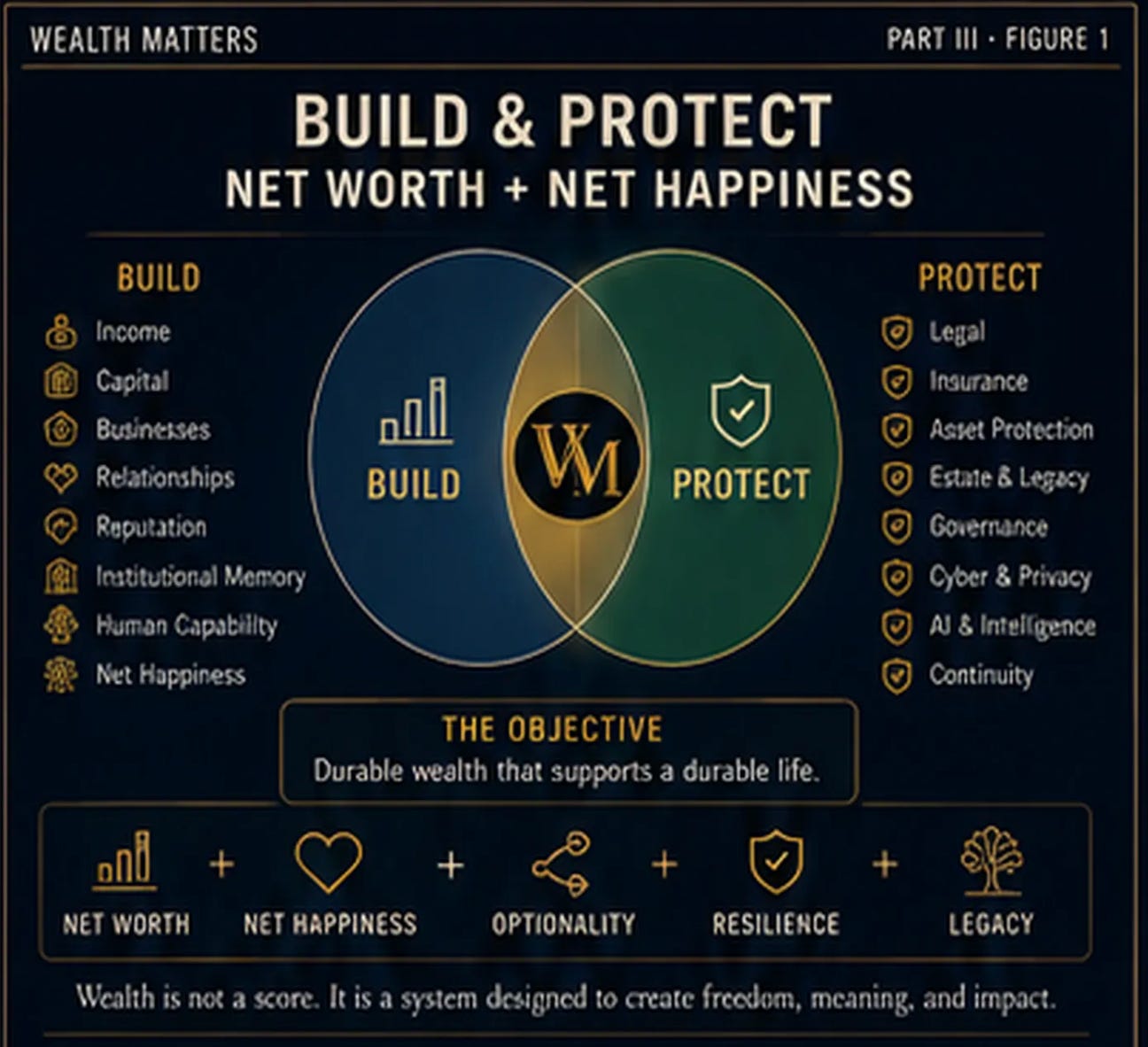
Key Insight: Durable wealth supports a durable life.
Chapter 12 — Your Family Already Has an Operating System
One of the central arguments in my recent Kimi K3 work was that the market pays too much attention to models and not enough to the architecture surrounding them. The model is not the strategy. The architecture surrounding the model is the strategy.
That idea applies just as powerfully to families.
Most families do not think they have a financial operating system, but they do. It simply developed accidentally. The brokerage account is part of it. The trust is part of it. The operating company is part of it. The LLC holding the rental property is part of it. The insurance policy purchased fifteen years ago is part of it. The CPA’s files are part of it. The estate attorney’s files are part of it.
The passwords are part of it. The family group text is part of it. The stories Dad tells about why he never borrows against real estate are part of it. The reason Mom refuses to sell a particular property even though everyone else thinks she should is part of it.
The problem isn't that the system doesn't exist. The problem is that nobody designed the whole thing as a system.
That is where the four-layer architecture I use for AI-native enterprises becomes useful at the family level.
