

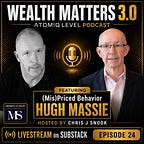


VIDEO INTERVIEW BELOW
An Aussie Who Lives and Innovates in Atlanta
Before Hugh Massie became the founder of DNA Behavior, before he built a scientifically validated system for measuring financial personality, and before he began helping advisors understand the hidden wiring behind their clients’ money decisions, he was something much more ordinary. He was an accountant—a CPA.
A tax specialist. A man trained in the hard numbers, the neat columns, and the precise logic of debits, credits, structures, returns, and reports.
He began his professional life in Australia, educated in accountancy and economics, eventually moving through the world of Arthur Andersen and into the technical craft of tax. On paper, it was a successful path. It was also, in retrospect, only the first chapter. Somewhere along the way, Hugh saw what many technically gifted professionals eventually see if they are honest enough to look past the spreadsheet.
The numbers were never the whole story.
Money was not just math. Wealth was not just performance. Risk was not just a questionnaire. And the client was not merely a balance sheet with a name attached. Behind every allocation was a person. Behind every portfolio was a pressure pattern. Behind every decision was a nervous system, a family history, a set of instincts, fears, ambitions, wounds, talents, biases, and unconscious defaults that no Monte Carlo simulation could fully explain. This was the genesis of the Pegasus Ratings Platform (which will be a big part of the future JV newsletter he and I decided to start writing called (Mis)Priced Behavior for Wealth Matters paid subscribers)
COMING IN JUNE 2026!

That realization changed the trajectory of his life. It took him from being what he jokingly calls a “reformed accountant” into a founder obsessed with one of the most important questions in modern wealth management:
What if we could objectively measure the human being behind the money?
From Accounting to the Human Operating System
Hugh’s transformation did not happen because he rejected finance. It happened because he saw its limits. After his early career in accounting and tax, he founded a wealth management and family office business in Sydney. From the beginning, his intention was different. He did not want to build another advisory firm centered around the advisor, the institution, the product shelf, or the investment model.
He wanted to build around the client.
Not in the generic marketing sense, but in the literal sense. Hugh wanted to understand how each person was uniquely wired, how they made decisions under pressure, how they communicated, how they trusted, how they feared loss, how they processed risk, and how they behaved when markets, careers, families, or life itself became uncertain.
That insight sounds obvious now, but it was quietly radical. The traditional wealth management industry had built itself around assets under management. The client was often sorted by investable assets, age, goals, risk tolerance, tax profile, and household structure. Those categories are useful, but they are incomplete.
Two clients with the same net worth may behave very differently. One may be a visionary founder who built wealth through risk and reinvention. Another may be a disciplined operator who built wealth through consistency and caution. A plumber who created first-generation wealth through years of skilled labor may have an entirely different relationship with money than a corporate executive who climbed through institutions and compensation packages.
Same net worth. Different wiring. Different fears. Different blind spots. Different coaching needs.
That is where Hugh’s work began.
The Discovery of Financial DNA
The breakthrough came when Hugh began asking whether every person had something like a financial personality. Not a superficial preference profile. Not a quiz built to flatter the user. Not a compliance form dressed up as discovery. He was looking for something deeper and more objective, something that could reveal how a person naturally behaves when pressure strips away the polite answers.
Hugh came to believe that under financial stress, people revert to instinct. They return to deeply ingrained behavioral patterns formed early in life. In the conversation, he describes this natural hardwiring as something shaped very early, from conception through roughly the first few years of life.
That early wiring does not determine everything, but it does shape a person’s default operating system. It influences whether they act fast or hesitate, whether they seek control or collaboration, whether they spend for experience or save for security, whether they take risks only in familiar domains or leap into the unknown because they can see a future others cannot. It shapes whether they become energized by pressure or destabilized by it.
The problem, Hugh realized, was that most financial advice was not built to measure any of this objectively. Traditional risk questionnaires could be gamed. Clients could answer based on who they wanted to be, who they thought the advisor wanted them to be, or how they felt in that particular season of life. The environment could contaminate the answer.
A bullish market could make someone feel brave. A crash could make the same person feel conservative. A recent inheritance, divorce, job loss, business exit, health scare, or family conflict could distort self-perception. So Hugh went looking for something more durable: a scientific measurement system, a behavioral baseline, and a way to understand the natural person beneath the financial mask.
By 2001, through work with psychologists and experts in Atlanta, DNA Behavior had developed a scientifically validated psychometric system designed to measure a person’s natural, hardwired behavior. The goal was not to put people in boxes. It was to give them a blueprint, a mirror, a language, and a more honest starting point.
The Blueprint of Strengths and Struggles
One of the most powerful ideas in this episode is Hugh’s insistence that every person has both strengths and struggles. That sounds simple, but in wealth management, it is profound, because a client’s greatest wealth-building gift may become their greatest wealth-preservation risk.
The entrepreneur who can recover from setbacks, innovate endlessly, and take bold action may also struggle to stop chasing the next idea long enough to let compounding work. The competitive wealth creator who thrives on winning may need coaching around how that intensity affects a spouse, children, partners, or employees. The fun-loving client who enjoys spending may not respond well to being told to “save more.” They may need a spending plan that creates boundaries without shaming their instinct for enjoyment.
The cautious client may protect capital well but miss important opportunities because fear feels like prudence. The visionary may see the future before others do, but may need guardrails around execution risk. This is where Hugh’s work becomes less like a diagnostic and more like a human translation layer.
Once the advisor understands the client’s behavioral baseline, the conversation changes. Instead of asking, “How much risk can you tolerate?” the advisor can ask, “How are you likely to behave when this plan gets tested?” Instead of saying, “Don’t panic in a downturn,” the advisor can prepare the client for the emotional experience of panic before the market gives them a reason to feel it.
Instead of offering generic advice, the advisor can coach the human being in front of them.
That is the difference between managing money and guiding a life.
Why Advisors Must Go First
Hugh makes a point in the conversation that should stop every advisor in their tracks. The advisor should go through the process first. Before asking clients to reveal their behavioral wiring, the advisor should understand their own. More than that, they should be willing to share it.
That transparency creates psychological safety. It tells the client: I am not diagnosing you from above. I am human too. I have strengths. I have struggles. I have defaults under pressure. I have blind spots that affect how I communicate, advise, and react.
That kind of vulnerability is not a weakness. It is a trust architecture.
If an advisor’s natural baseline differs significantly from a client’s, that matters. The advisor may need to adapt their communication style. They may need to bring in a team member. They may need to recognize that what feels obvious to them may not feel safe, clear, or motivating to the client.
This is especially important in families and partnerships. The person with the loudest voice may not be the true decision driver. The spouse who appears less financially engaged may carry the emotional authority. The founder who created the wealth may not have the behavioral skill set required to manage it across generations.
Objectivity matters because intuition is not enough. Guessing wrong in a financial advisory relationship can be expensive, not just in basis points, but in trust.
The Napster Moment for Wealth Management
The interview becomes especially urgent when Hugh and Chris turn toward the future of the advisory business. The old model is under pressure. Investment management is being commoditized. Passive investing has already compressed the perceived value of portfolio construction. AI and automation will only accelerate that pressure. If an advisor’s value proposition is primarily that they manage investments, rebalance portfolios, or select funds, then technology is coming directly for the fee structure.
Hugh compares this shift to a Napster moment. The music industry once believed its distribution model was permanent. Then technology dematerialized it, demonetized it, and rewired it.
Wealth management is facing a similar inflection point.
The old model centered on assets under management is not dead yet, but it is vulnerable. The industry can pretend otherwise for a while, especially during good markets, but compression is coming. When the next downturn arrives, many advisors may experience the double hit of falling asset values and clients questioning what they are really paying for.
That is why Hugh’s message is not gentle. Advisors need to transform while they still have margin. While revenue is still flowing. While clients still trust them. While there is still time to reinvest profits into a more durable model.
Because once the revenue starts falling, reinvention becomes harder.
The future belongs to advisors who can move beyond AUM and toward something bigger: maximizing a client’s lifetime economic value. That means understanding the whole human: career risk, longevity, health, family dynamics, behavioral patterns, entrepreneurial potential, children’s needs, aging parents, emotional resilience, AI displacement, liquidity shocks, legacy planning, and purpose.
The portfolio matters. But it is no longer enough.
From Quanta to Qualia
One of the most elegant frames in the conversation is the distinction between the quantitative and the qualitative. The industry has spent decades optimizing the quantitative side of wealth management: performance, allocation, risk metrics, tax efficiency, rebalancing, benchmarks, and reporting.
Technology has done a lot for that world. But the next frontier is the qualitative side, the human experience of wealth. The fears. The motivations. The emotional triggers. The communication patterns. The decision-making instincts. The deeply personal reasons people sabotage good plans or stick with bad ones.
Chris frames this as the movement from quanta to qualia.
That is where behavioral data becomes essential. AI can be a co-pilot, but only if it has the right human inputs. Without behavioral data, personalization remains shallow. With it, advisors can begin to scale a more human kind of advice, not just for a handful of ultra-high-touch clients, but across a broader client base.
That is the irony of this moment. Technology, used poorly, dehumanizes advice. Technology, used wisely, can help rehumanize it.
The White-Collar Whiplash Ahead
The conversation also moves into a looming challenge that many advisors are still underestimating: AI-driven career disruption. Chris calls it “white-collar whiplash.” Knowledge workers who assumed their incomes were stable may find themselves displaced, replaced, or forced into new forms of work faster than expected.
Advisors who only review portfolios may miss the more important risk sitting outside the portfolio: the client’s future earning power. If a client’s income drops, the plan changes. If their industry is disrupted, the plan changes. If they need to reinvent themselves into gig work, consulting, entrepreneurship, or a new career path, the plan changes.
Hugh’s answer is clear: advisors should be having these conversations now. Not coldly. Not by saying, “We need to adjust your portfolio because you might get fired.” But humanly, by showing the client that the advisor is on the journey with them. By helping them think through their talents, adaptability, opportunities, risks, and next moves before panic sets in.
That is what human-centric advising looks like.
It is not just asset allocation. It is life navigation.
The First-Generation Wealth Creator’s Dilemma
This episode is especially relevant for first-generation wealth creators. Chris points out that much of his audience is made up of people who built wealth themselves: founders, operators, investors, professionals, and entrepreneurs who developed the skills required to create wealth, but may not yet have developed the skills required to preserve, manage, protect, and transfer it.
Hugh agrees. The DNA required to create wealth is not always the same DNA required to manage wealth.
That one sentence may be worth the episode.
The founder who built the company may be poorly wired to slow down and steward capital. The high-income professional may be excellent at earning but weak at planning. The risk-taker may need structure. The saver may need permission to invest. The family leader may need help translating their instincts to the next generation.
This is where advisors have a massive opportunity. Not to sell more products, but to become more necessary. To become behavioral coaches, economic strategists, family translators, and trusted guides through a world where both markets and careers are becoming more volatile.
The Real Future of Advice
By the end of the conversation, the central message becomes unmistakable. The advisory business is not dying, but the old version is. The future does not belong to advisors who merely defend their fees. It belongs to those who deepen their value.
It belongs to those who understand that investment management is becoming easier to automate, while human trust is becoming harder to earn. It belongs to those who can help clients understand themselves before the market tests them. It belongs to those who can use AI without outsourcing judgment. It belongs to those who can move from managing assets to increasing lifetime economic value.
Most of all, it belongs to those who can sit with a client in the uncertainty of market loss, career disruption, family complexity, longevity anxiety, entrepreneurial risk, health costs, and legacy decisions, and say: We have already prepared for this.
I know how you are wired.
I know where you are strong.
I know where pressure may pull you off course.
And I am here to help you stay aligned with the life you actually want to build.
That is not a robo-advisor. That is not a model portfolio. That is not a quarterly performance report. That is a human relationship. And in the next era of wealth management, that may be the most valuable asset of all.
Why You Should Listen
This ATOMIQ LEVEL conversation with Hugh Massie is not just about DNA Behavior. It is about the future of money advice. It is about why the advisory industry must move from assets under management to humans under guidance. It is about why every client’s financial plan should begin with an understanding of how they are wired to behave under pressure.
It is also about the hidden gap between creating wealth and stewarding wealth, and why AI will destroy shallow advice while empowering advisors who are brave enough to become more human.
Most of all, it is about a former accountant from Australia who followed the numbers far enough to discover that the most important variable was never in the spreadsheet.
It was the person.
Press play, and you will hear a conversation about behavior, wealth, technology, and trust that every advisor, founder, investor, and first-generation wealth creator needs to understand before the next market shock, career disruption, or family decision reveals what their financial DNA has been telling them all along.
The Real Risk Is Doing Nothing!
~Chris J Snook


