The Small Business Owner’s Quietest Risk
There is a kind of wealth that does not announce itself.
It does not show up first as a liquidity event, a headline, a private equity transaction, or a family office with a receptionist and a conference room named after the founder.
It shows up as a business. A shop. A practice. A contracting company. A local manufacturer. A dental office. A distribution business. A service firm. A restaurant group. A cigar lounge. A family-run operating company where the owner still knows the customers, still checks the bank balance, still fixes the problem nobody else can fix, and still wonders why payroll always seems to arrive faster than expected.
That is who we were talking to in this Matt Chats episode. Not the billionaire who has a succession committee. Not the Silicon Valley founder, already surrounded by bankers. Not the family with a private trust company, a governance charter, and a next-gen education program.
We were talking to the owner whose net worth is mostly trapped inside the small business they built.
The person who looks wealthy on paper, lives well from the cash flow, supports employees, owns some assets, maybe pays for a few personal expenses through the business, and assumes there will be time later to figure out the liquidity exit.
That assumption may be the most expensive thing on the balance sheet.
Because for many small business families, the business that created the wealth is also the asset most likely to evaporate when the founder leaves, dies, gets sick, burns out, or finally admits they do not want to die at the desk.
If you want to speak directly with Matt Meuli’s firm for a complimentary one-on-one pre-consult, call:
Colorado residents: (970) 820-0090
Residents of all 50 states and territories: (307) 463-3600
Humans answer the phone during business hours.
You can also visit YourTrustedPlanner.com to learn more about Matt’s work, workshops, estate planning, business succession, Wyoming asset protection structures, and planning services.
This article and conversation are educational. Matt Meuli is an attorney and Certified Exit Planning Advisor, but he is not your attorney unless you formally engage his firm through a signed engagement agreement and the firm accepts you as a client. Nothing here should be treated as individualized legal, tax, financial, valuation, succession, estate, or asset-protection advice.
A Quick Word From Our Wealth Matters 3.0 Ecosystem Brand Partner
Before we get deep into this conversation with Matt Meuli, I want to thank one of our Wealth Matters 3.0 ecosystem brand partners: PEBL.
PEBL is a company I personally use across my own portfolio companies and personal strategy because hiring abroad or remote should not require founders, operators, family offices, or distributed teams to spend months building employment infrastructure before they can bring great people into the business.
Hiring abroad or remotely can take months when you do it on your own, but with PEBL, you can hire in over 185 countries in minutes and have your new hire onboarded by Monday.
PEBL is normally $399 a month per employee — already a no-brainer for what you get — but right now there’s a limited-time offer on their site that makes it even easier to get started.
Go to hipebl.ai.

Terms and conditions apply.
The Wave Is Already Here
I opened this episode with data because the scale matters.
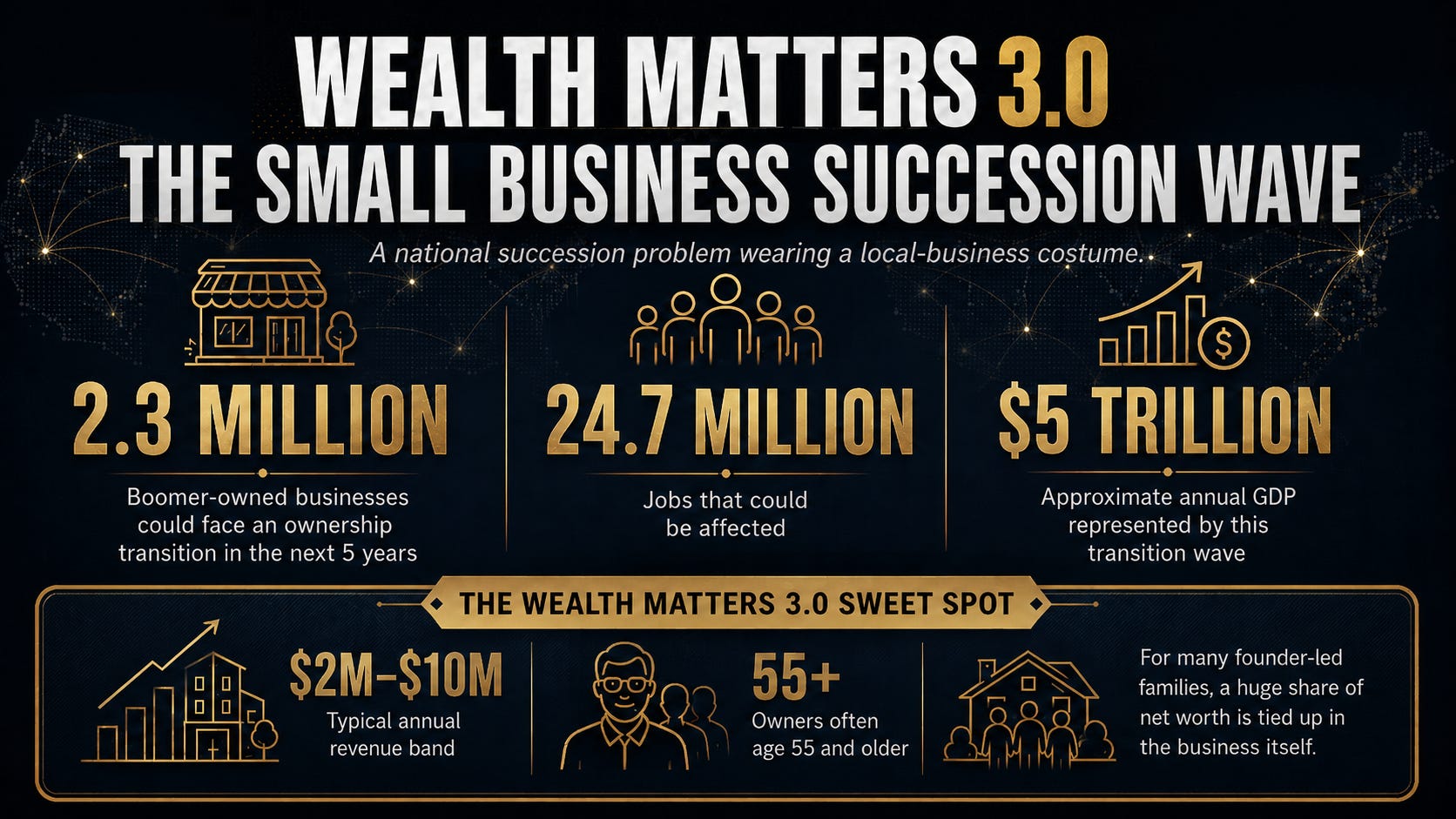
According to the numbers we discussed from SBA and Project Equity-related sources, roughly 2.3 million boomer-owned businesses could face an ownership transition in the next five years. That transition could affect 24.7 million jobs and represent approximately $5 trillion in annual GDP.
That is not a niche estate planning issue.
That is a national succession problem wearing a local-business costume.
And inside that wave is the sweet spot we keep seeing in Wealth Matters 3.0: businesses doing roughly $2 million to $10 million in annual revenue, often owned by people 55 and older, with a huge percentage of the owner’s net worth tied up in the company.
The irony is that many of these businesses work.
They produce income.
They fund a lifestyle.
They support families.
They employ people.
They have customers.
They have a reputation.
They have a strong community presence.
But they may not have transferable value.
That is the sentence that should make every founder sit up a little straighter. A business can create income for the owner and still be hard to sell. The question to ask is:
Do I own a business or a job?
A business can fund a family for decades and still collapse when the founder disappears. A business can feel valuable because it has been meaningful, exhausting, profitable, and central to your identity, while still being structurally unready for an outside buyer, a child successor, a management buyout, or an orderly wind-down.
That is the gap we explored with Matt.
Not “Do you have a business?”
The harder question is:
Can your business value survive your absence?
The Strategy Nobody Wants to Name
Matt called it plainly. Some business owners have an exit strategy, but it is not a good one.
They die at the desk.
Nobody likes saying that out loud because it feels harsh. But it is a real strategy by default. The owner keeps working. The business keeps depending on them. The family keeps assuming something will be figured out later. The kids are not aligned. The books are not normalized. The value is not known. The successor is not trained. The buyer is not identified. The management team is not ready.
Then time makes the decision. That is not succession. That is surrender dressed up as a work ethic.
I understand why it happens. Most small business owners are not lazy. They are the opposite. They are so used to solving today’s fire that the future fire keeps getting postponed. They are working in the thing, not on the thing. They are answering the call, making the sale, managing the people, reviewing the tax number, dealing with the bank, replacing the truck, fixing the vendor issue, calming the customer, and wondering when the next vacation can happen.
The problem is that succession punishes delay. The business does not become transferable because you finally feel ready. It becomes transferable because you designed it to become transferable before you needed it to be.
The Hidden Balance Sheet of Meaning
One of the most important parts of this conversation had nothing to do with tax, valuation, documents, or legal structure.
It had to do with meaning.
Imagine the owner nails the financial exit. The business sells. The proceeds are invested. The dividend or income stream replaces the lifestyle. The kids have what they need. The spouse is secure. The tax bill is managed. The owner is technically free.
Now what?
You have 10, 20, maybe 30 years left.
Where do you go on Monday?
Who needs you?
Who calls you?
What problem gets you out of bed?
What replaces the meaning you spent 40 years building through customers, employees, vendors, leadership, stress, identity, decision-making, and responsibility?
This is why many owners avoid succession planning. It is not only the paperwork. It is the grief. It is the loss of identity without a meaningful replacement waiting in the wings.
The business may have taken time away from the family, but it also gave the owner an identity. It gave them relevance. It gave them authority. It gave them a scoreboard. It gave them a place to be useful.
Exiting the business without planning for the emotional transition is like selling the house and forgetting you still need somewhere to live.
That emotional reality does not excuse the delay. It explains it.
Three favors before you continue.
Hit the ❤️. The algorithm is a validation machine that needs your cheap dopamine to keep us at the top of your feed.
Hit the 🔄 restack. Somebody’s life will change passively today, and you can get the credit for bringing it to them from both of us.
Hit 📤 share. You know exactly one person in your email list or text stream who needs something on their playlist or reading wire today.
Drop a comment. Tell me your war story, your related triumph, or your biggest unanswered concern. I reply to the ones that make me laugh, cry, make me think, or make me money. Preferably all of the above.
Your Family Is Already Invested
Matt made one of the best points of the hour when he reframed the family. Even if your spouse and kids do not legally own shares, they are already invested.
They invested time.
They invested patience.
They invested in missed dinners with you.
They invested their weekends.
They invested the stress you brought home.
They invested in the vacation you cut short.
They invested the money you put back into the business instead of into the family balance sheet.
They invested the emotional oxygen required to support someone building and running a company.
That makes them shareholders in a deeper sense. Not necessarily legal shareholders. Human shareholders.
And the strange thing about small business families is that the people most affected by the business often know the least about it.
They may not know what it earns.
They may not know what it is worth.
They may not know what debt it carries.
They may not know whether it can be sold.
They may not know whether one sibling wants it, another resents it, and a third simply wants cash to go live their own life.
They may not even know whether they want to stay long or exit their position.
That is the language I kept coming back to during the conversation.
Do you want to stay long? Or do you want to exit?
That one question can take a messy emotional conversation and make it slightly more adult. Not easy. But clearer.
When One Child Wants the Business, and the Others Want Fairness
The first audience question went straight to one of the most common family business fault lines:
What happens when one child is stepping in to run the business and the others are not involved?
This is where families confuse equal with fair, and fair with obvious. It is not obvious.
The child stepping in may work 80 hours a week, take the operational risk, deal with employees, carry the founder’s stress, and eventually grow the company beyond where it was when they inherited or acquired it.
The non-business children may look five years later and say, “Mom and Dad gave you the golden goose.”
Both sides may have a point. That is why valuation matters early.
Matt’s advice was to start by figuring out what the business is actually worth. Not what everyone thinks it is worth. Not what the founder feels it should be worth. Not what the children imagine it is worth because they grew up seeing cars, vacations, write-offs, and a certain lifestyle.
A real valuation.
Then, if one child is going to receive or buy into the business, the family can consider ways to equalize value for the others through other assets, life insurance, structured buyouts, notes, trusts, or different economic rights.
The goal is not to eliminate the possibility of conflict. You cannot stop someone from suing if they are determined to sue. The goal is to reduce ambiguity before resentment turns into a lawsuit.
Perceived Value Is Not Market Value
One of the examples I shared came from a cigar lounge conversation.
The owner described the value of a beer and wine license in that market. The business itself might have one kind of value as a going concern. It might generate revenue, throw off cash, employ people, and carry a multiple based on EBITDA.
But if the business were wound down, one specific asset—the liquor license—might be worth hundreds of thousands of dollars by itself because the local market restricts new issuance.
That creates three different values.
The operating value.
The liquidation value.
The perceived family value.
The kids may have a fourth value in their heads because they grew up around the lifestyle the business funded.
This is where family business succession gets messy. The balance sheet may say one thing. The market may say another thing. The operating reality may say something else. The emotional memory of the business may say something else entirely.
No spreadsheet automatically resolves that. But a spreadsheet beats silence. A valuation beats guessing. A structured conversation beats a Thanksgiving ambush five years after Dad is gone.
The Annual Report Your Family Never Got
Public companies have to report to shareholders. Small business owners often do not.
That governance freedom is part of the appeal of owning a private company. No quarterly earnings calls. No public market pressure. No analysts asking questions. No activist investors pounding the table or attempting a takeover.
But inside the family, the lack of communication creates its own cost.
Your spouse and children may be the people most exposed to the business outcome and least informed about the business condition.
That is upside down. In my experience, it is the source of multi-party unspoken resentments that goes unseen for years until a conflict arises, and the main proprietor feels surprised.
Matt’s framing suggests a practical idea: treat the family like shareholders who deserve an annual report.
Not a formal public-company filing. A family business report.
Here is where the company stands.
Here is what it earns.
Here is what it owes.
Here is what it depends on.
Here is what would happen if I died.
Here is what would happen if I wanted to exit.
Here is what would happen if one of you wanted to take over.
Here is what the business might be worth today.
Here is what would need to happen for it to be worth more tomorrow.
Here is what I want.
Here is what I need to know from you.
That kind of conversation may feel uncomfortable, but the alternative is worse. Because a family that never got the annual report may write its own version later. And that version often includes resentment.
The Kids May Not Want What You Built
A lot of founders assume at least one child will want the business.
Some will. Many will not.
Some children worked in the business because they loved it. Some worked there because they were asked. Some worked there because it was the family thing. Some saw the business as a career. Others saw it as a springboard. Some want to run it forever. Some want to earn enough to leave.
Those are not minor differences. They are succession-defining differences.
A child can be involved in the business and still not want to own it.
A child can love the parent and still not want the parent’s life.
A child can respect what was built and still prefer a clean exit.
That is not betrayal. That is information.
Matt talked about bringing in resources from the certified exit planning world, including family counselors and family therapists, to help ask what each family member actually wants from the exit plan.
That may sound soft to hard-charging founders. It is not soft. It is risk management.
A family therapist may save more enterprise value than a lawyer if the real problem is unspoken resentment, mismatched expectations, or children who are too loyal to tell the founder the truth.
The Business May Not Be Worth What You Think
One of the hardest truths in this episode is that a business can support a lifestyle without being attractive to a buyer.
Private equity may not want it because it is too small.
Strategic buyers may not want it because the systems are not mature.
Competitors may want the customers but not the operation.
Employees may want continuity but lack capital.
Children may want the distributions but not the work.
The founder may want a retirement number that the business cannot support.
A buyer looks at transferable cash flow, management depth, customer concentration, systems, margins, recurring revenue, normalized expenses, owner dependence, documentation, contracts, liabilities, and growth prospects.
The owner often looks at the sacrifice. Those are not the same.
This is why exit planning starts before the exit. Because if the business is too owner-dependent, the first job is not finding a buyer. The first job is making the business less dependent on the owner.
That may mean documented processes, clean books, management development, customer diversification, better contracts, normalized financials, clearer roles, and a real leadership bench.
In other words, professionalizing the business before you need the business to be professional.
Lifestyle Business or Transferable Enterprise?
There is nothing wrong with a lifestyle business.
A lifestyle business can be beautiful. It can feed a family, support employees, fund vacations, buy houses, pay for school, and create a meaningful life.
But a lifestyle business is not always a transferable enterprise. That distinction matters. A transferable enterprise has value beyond the founder’s daily presence. A lifestyle business may only have value because the founder is still inside it.
The problem is not the lifestyle. The problem is confusing lifestyle cash flow with enterprise value.
If the founder’s retirement plan assumes the sale of the business, then the business has to be prepared for sale.
If the founder’s family inheritance plan assumes the business continues, then the business has to be prepared for continuity.
If the founder’s succession plan assumes one child takes over, then the child has to be prepared, compensated, and aligned.
If the founder’s fairness plan assumes the other children are equalized, then the value has to be measured and the economics structured.
Hope is not an exit plan.
The Fire Sale Nobody Wants to Imagine
One in three businesses owned by people over 50 may have trouble finding a buyer. That is the kind of statistic that should land heavily.
Because the fire sale is not usually a dramatic event. It often looks like exhaustion.
A health event.
A spouse saying “Enough.”
A founder realizes too late that the kids do not want it.
A competitor is offering a lowball number.
A key employee is leaving.
A lender is tightening.
A customer concentration issue becomes systemic.
A death that turns the business into a pile of decisions nobody is prepared to make.
The value does not always disappear because the company was bad. It disappears because the transition was not designed. That is the preventable tragedy. Not every business can be sold for a dream multiple. Not every child should take over. Not every company needs to last forever.
But every owner deserves to know the real options before time compresses them into one bad choice.
Why This Is Shields and Succession
This episode sits perfectly inside the Shields and Succession thesis.
Shields are the defense.
Asset protection, entity structure, insurance, titling, risk management, creditor protection, and the practical architecture that keeps what you built from being needlessly exposed.
Succession is the offense.
Who runs it next? Who owns it next? Who gets paid? Who exits? Who stays long in the enterprise? Who has voting control? Who has economic rights? Who is treated fairly? Who needs liquidity? Who needs training? Who needs to hear the truth before the funeral, the illness, the lawsuit, or the fire sale?
A family business transition is not just a legal event. It is a financial event, emotional event, governance event, tax event, operational event, and identity event.
That is why a stack of documents is not enough. A plan has to become a family’s system.
Why You Should Press Play
Press play if your business is worth more to your family than your family currently understands.
Press play if most of your net worth is tied up in a closely held operating company, professional practice, or local enterprise.
Press play if you have children and secretly assume one of them will take over, but you have never asked them whether they actually want to.
Press play if you think the business is worth millions but have never had a real valuation.
Press play if you are the child who works in the business and wonders how this will ever be fair to the siblings who do not.
Press play if you are the non-business child who loves your family but does not want to be dragged into a future fight over something you never wanted to operate.
Press play if you are an advisor, attorney, CPA, or planner serving founder-led families and want a more human vocabulary for succession conversations.
Press play if you are still planning to die at your desk because it feels easier than deciding what comes next.
This episode is not about forcing every owner to sell. It is about forcing the question before the question becomes a crisis. The small business owner is one of the most underappreciated wealth creators in America.
They build without applause.
They hire before they are comfortable.
They pay taxes before they know what is left.
They absorb the stress the family never fully sees.
They create jobs, cash flow, reputation, and community value.
Then, too often, they leave the hardest question unanswered.
What happens when I am no longer the one holding this together?
That question is not morbid. It is respectful. Respectful to the spouse who stood beside the risk. Respectful to the children who grew up inside the business’s shadow. Respectful to the employees who depend on continuity. Respectful to the customers who trust the company. Respectful to the founder who deserves more than a default exit written by exhaustion, illness, or death.
The business bought your freedom. Now build the plan that lets it survive you.
Call Matt’s team if this hit home:
Colorado residents: (970) 820-0090
Residents of all 50 states and territories: (307) 463-3600
Bring the awkward question. Bring the family tension. Bring the unsigned buy-sell agreement. Bring the child who wants in. Bring the child who wants out. Bring the business you built. Bring the number you hope it is worth. Bring the fear that it may not be worth it without you. That is what my ATOMIQ AMA “Matt Chats” are designed to deliver you the safe place for crucial conversations.
Because the real risk is doing nothing.
~Chris J Snook
Thank you to everyone who tuned into my live video! Join me for my next live video in the app.