This episode of ATOMIQ LEVEL featured Dr. Gary Epler, a pulmonary and critical care doctor, former Harvard Medical School teacher, Substack bestseller, and the creator of the Alpha 12 framework. We opened the show by framing this as a conversation about the “net happiness” side of Wealth Matters 3.0 — the part of the mission that asks not only how we grow and protect net worth, but whether the life we are building is worth inhabiting with clarity, energy, kindness, and agency.
Subscribe to Dr. Gary Epler’s Alpha 12 newsletter on Substack. That is the primary guest CTA from the transcript. No guest phone number was provided in the transcript.
DISCLAIMER: This article is educational and reflective. It is not medical advice, mental-health advice, neurological diagnosis, or individualized clinical guidance. Dr. Epler’s Alpha 12 / Beta 14 framework is his model, and I am using it here as both a conversation framework and a metaphor for something many of us feel in modern life: the battle to remain human, calm, clear, creative, and kind inside an environment engineered to keep us reactive.
A Word From An Ecosystem Brand Partner
Before we get into this topic further, I want to thank one of our Wealth Matters 3.0 ecosystem brand partners and Wealth CMDR PRO Subscribers: PEBL.
PEBL is a company I personally use across my own portfolio companies and personal strategy because hiring abroad or remote should not require founders, operators, family offices, or distributed teams to spend months building employment infrastructure before they can bring great people into the business.
Hiring abroad or remote can take months when you do it on your own, but with PEBL you can hire in over 185 countries in minutes and have your new hire onboarded by Monday.
PEBL is normally $399 a month per employee — already a no-brainer for what you get — but right now there’s a limited-time offer on their site that makes it even easier to get started.

Terms and conditions apply.
The Fight Is Not for Attention-It Is for State.
Some conversations feel like they belong in the “wellness” category until you realize they are actually about leadership, investing, parenting, marriage, entrepreneurship, technology, trust, judgment, and civilization.
This one was that.
Dr. Gary Epler came onto ATOMIQ LEVEL with the energy of a man who has spent decades inside the most concrete version of human fragility — pulmonary and critical care medicine — and then decided that the next chapter of his work would be about keeping people out of the ICU of the mind.
That phrase is mine, not his, but it is how I heard him.
Gary began his career as a pulmonary and critical care doctor. He worked with the CDC on tuberculosis management, traveled the world, trained in Boston, discovered a previously undescribed inflammatory lung disease, taught at Harvard Medical School, and spent years helping doctors diagnose and treat patients more effectively. Eventually, he said he “put himself out of business” because he taught people how to diagnose and treat the disease so well that they no longer needed to send him patients. About five years ago, he stopped seeing patients and turned his attention toward improving lives at scale.
That is not a typical pivot.
Most physicians who discover a disease, teach at Harvard, and build a clinical reputation do not leave the exam room to talk about brainwave states, quantum biology, kindness, and what it means to think like a human being. But that is precisely why the conversation mattered to me. Gary is not coming at this from the shallow end of “good vibes.” He is coming at it from a life spent with oxygen, disease, diagnosis, fear, recovery, and mortality.
His seven-word philosophy is simple:
Know who you are moment by moment.
For Gary, that means knowing where you are thinking from. If you are thinking from the anger center, you will be angry. If you are thinking from the stress center, you will be stressed. If you are thinking from the human brain, the frontal brain, he says you become capable of the two traits he considers most human: kindness and helping each other.
That is where the conversation started, but it quickly became something bigger.
Because in 2026, “know where you are thinking from” is no longer just a personal development concept. It is a survival question inside a world that has learned how to monetize your nervous system.
We Are Living Through a Multi-Decade Malicious Denial-of-Service Attack on Human Thinking
A denial-of-service attack in technology works by overwhelming a system with too many requests, so legitimate users cannot get through. The server is not necessarily broken. It is saturated. The signal is crowded out by the flood.
That is the metaphor I kept coming back to during this conversation.
Our minds are not broken. They are saturated.
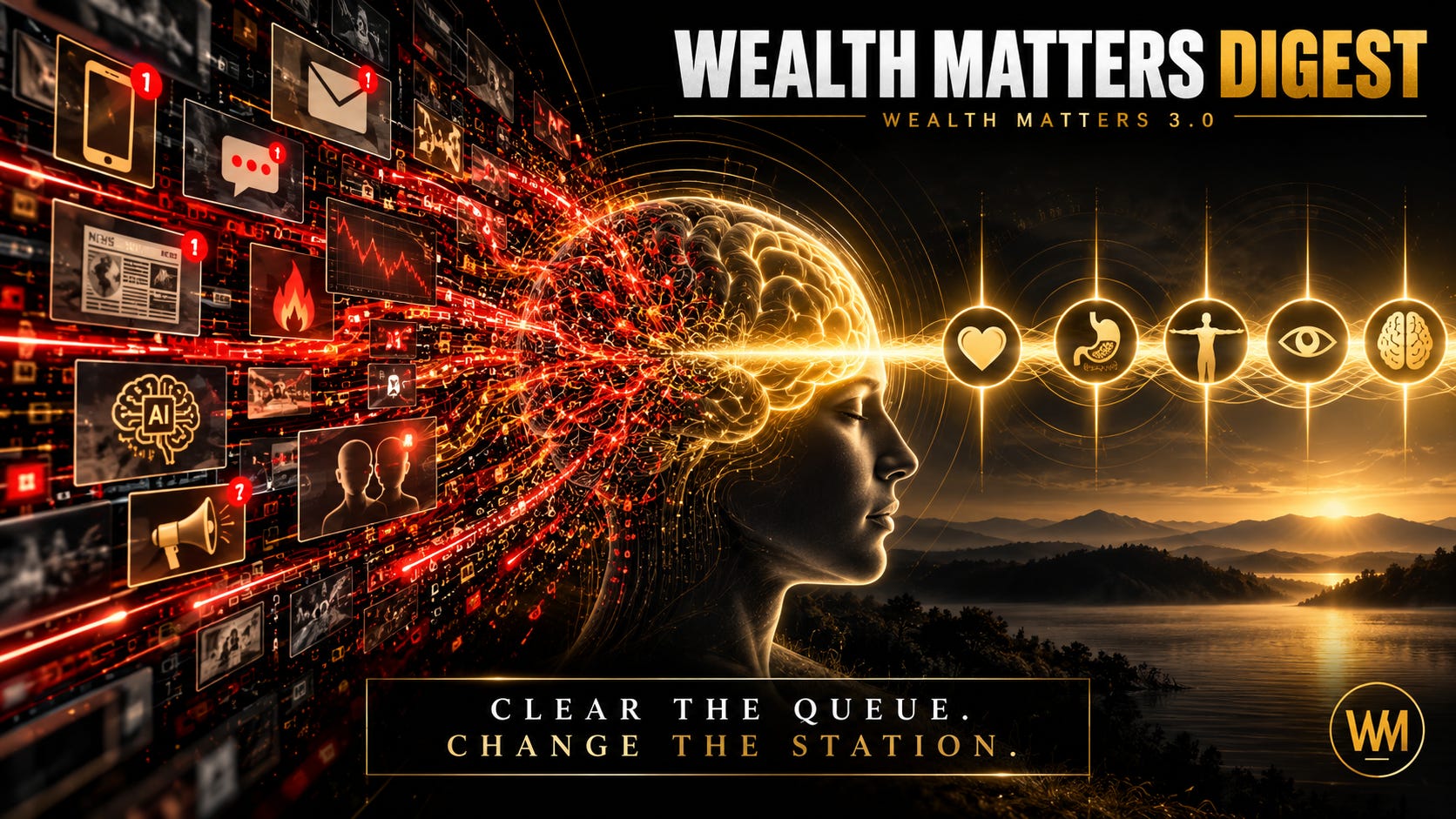
A malicious denial-of-service attack on a server floods the system until normal requests cannot be processed. A modern digital denial-of-service attack on the human mind floods consciousness with alerts, outrage, comparison, doom, novelty, notifications, status threats, identity threats, pseudo-urgency, and algorithmically selected emotional bait until the deeper signal cannot get through.
Gary calls the reactive state Beta 14. He calls the human, creative, kind, clearer state Alpha 12. His language is his language, and I am not presenting it as settled clinical consensus. But as a metaphor and as a working model, it hit me right between the eyes.
Because the experience is obvious.
We have more screens in our lives than ever. That is not going backward. We are seeing entire consumer markets form around ice baths, sauna, red light therapy, meditation apps, breathwork, retreats, grounding, digital detox, nervous-system regulation, and nature-based resets because the need state is being felt at mass. We need to unplug, but many of us no longer know how. I said in the conversation that if you are 25 today, you have grown up with 25 years of being “algorithmically denied access” to your human brain. If you are 50 or 65, you have watched the degradation happen more gradually and probably do not want to admit how reactive you have become.
That is not just my intuition.
Pew Research Center reported in 2024 that most U.S. teens use social media and have a smartphone, and nearly half say they are online almost constantly. Common Sense Media’s smartphone-use research found that teen participants checked their phones on average more than 100 times per day, with TikTok as the longest-duration app in the study and some participants using it more than seven hours in a day. The U.S. Surgeon General has warned that children and adolescents spending more than three hours per day on social media face double the risk of mental-health problems, including symptoms of depression and anxiety.
None of that proves Gary’s Alpha 12 framework in a clinical sense, but it does validate the battlefield.
We are not living in a neutral attention environment. We are living inside an engineered engagement environment. The American Psychological Association’s advisory on adolescent social media use specifically warns that social media should not interfere with sleep and physical activity, and notes that social comparison and excessive focus on photos and feedback are associated with poorer body image, disordered eating, and depressive symptoms, especially among girls. A PNAS Nexus study found that engagement-based social media algorithms can amplify emotionally charged content beyond user choice or stated preference.
That is the denial-of-service attack. Not one dramatic villain. A thousand tiny pings. A thousand identity threats. A thousand comparison loops. A thousand pieces of content optimized to make the primitive brain click before the human brain can choose.
Alpha 12 and Beta 14
Gary’s basic model is that our primitive brain has a purpose. It helps us survive infancy. It helps us obey parents, learn social rules, and get through childhood. It even helps us become independent as teenagers. He is not demonizing the primitive brain. He is saying it has a job, and that job is not supposed to run the adult human life forever.
According to Gary, by around age 25 the human brain has fully developed, but nobody tells us, “You now have a human brain. Start using it.” Instead, many people continue to operate from primitive loops. In his framework, the primitive brain runs on Beta 14, while the human brain requires Alpha 12.
The way he described it reminded me of changing the wrong setting on a radio. I told him that many of us are on the wrong station and then turn up the volume trying to change the music. Gary said that was exactly the situation. We were talking about brainwaves, about 12 and 14, about the difference between the state where the primitive loop dominates and the state where the human system can function.
His personal discovery story came from Cape Cod. He woke up on a Saturday morning with the kind of negative loops many people know too well: problems, worries, repetitive thinking. Then he went down to the beach, saw the early sliver of sun over the North Atlantic, began running, and noticed that he felt fantastic. Ideas came quickly. The experience felt like meditation, but energized. He called it Alpha 12 — “meditation on steroids,” in his words — and contrasted that with Beta 14, the primitive-brain frequency.
That is the model.
Alpha 12 is not passive calm. It is not zoning out. It is not spiritual bypassing. It is not pretending the world is easy. It is a state of engaged, energized, human clarity.
Beta 14 is not always evil either. It can serve survival. But when it becomes the default setting for modern work, relationships, money, media, politics, and self-talk, it becomes a tax on everything that matters.
Five favors before you continue.
Hit the ❤️. The algorithm is a validation machine that needs your cheap dopamine to keep us at the top of your feed as one of the positive pings to keep your human mind in action.
Hit the 🔄 restack. Somebody’s life will change passively today, and you can get the credit for bringing it to them from both of us.
Hit 📤 share. You know exactly one person in your email list or text stream who needs something on their playlist or reading wire today.
Drop a comment. Tell me your biggest insight, your greatest challenge, your counter-argument or gap in the conversation, or a recent related triumph. I read every one, and I reply to the ones that make me laugh, make me think, or make me money. Preferably all three.
Subscribe. This newsletter and these office hours are 100% reader and listener-supported. The free conversations create awareness. The other side of the paywall is where the playbooks, resources, archives, and office-hours context help turn that awareness into massive action for your net worth and your net happiness.
Name the Frequency Before It Names You
One of the most practical things Gary said was not mystical at all.
Name it.
If you are blaming, complaining, criticizing, trying to be somebody else, living your job description instead of your life, or spinning inside self-referential stress, he calls that Beta 14. Name it as such. Do not make it your identity. Do not make it your personality. Do not treat it as a profound moral failure. Recognize it as a state.
That matters because a named state can be interrupted. A nameless state becomes the weather.
Gary said he believes a major source of stress is thinking about yourself. His language there is intentionally blunt. He connects that self-referential loop to the cingulate brain region, which he described as a large region behind the amygdala. He referenced functional fMRI studies as part of how he came to think about where people are “thinking from,” and he said that the work is to recognize those loops and shift out of them.
Again, I am not asking readers to accept every claim as clinical doctrine. I am asking you to pay attention to the utility of the question:
Is this thought helping me respond as a human, or is it keeping me in a primitive loop?
That question alone can change a day.
You can be stressed about the business, the market, the marriage, the child, the deal, the diagnosis, the inbox, the political feed, the algorithm, the reputation risk, the unresolved conversation, the person who misunderstood you, the thing you should have said, the thing you should not have said, or the thing you cannot control.
Or you can name the loop. Then you can choose the next state.
Gary offered practical interrupters: run, cold shower, kindness toward yourself, conditioning yourself to recognize thoughts, and daily practice. He described a 30-day conditioning regimen of recognizing your thoughts and learning how to stop them, even if only 90 seconds a day.
That may sound small, but in a denial-of-service attack, even a little capacity recovered matters.
The Five Centers of Human State
Gary described five centers that, in his model, operate properly in Alpha 12 and do not function the same way in Beta 14.
The first is the heart.
He says the heart generates kindness. His practical example was almost embarrassingly simple. Saying “be kind to yourself” feels different from giving yourself a short pleasure hit. The pleasure of a sundae may last seconds. The phrase “be kind to yourself,” when actually felt, can change the whole body’s tone for the day.
That is not a small distinction. A lot of modern self-care is really stimulation.
Kindness is different. Stimulation distracts. Kindness reorients.
The second center is the gut. Gary described the gut as a real center of risk management and nutritional intuition. In his framework, the gut can tell you whether to trust someone, whether to work with someone, whether something is dangerous, and whether the body is receiving the right signals. But he also said you cannot hear it properly if you are in Beta 14.
That is useful for Wealth Matters readers because wealth is not only numbers. It is judgment. It is who you trust. It is whether the deal feels wrong even when the spreadsheet looks beautiful. It is whether the person across the table is aligned with your interests. It is whether your nervous system is giving you a warning or whether fear is keeping you from moving.
Gary made a critical distinction there: fear in Beta 14 becomes panic. Fear in Alpha 12 becomes warning.
That is one of the most useful lines in the whole conversation. Fear is not always the enemy. Misread fear is the enemy.
The third center is the body. Gary believes strength and daily physical work matter. He used athletes as the example, especially quarterbacks and Wayne Gretzky. The great athlete is not merely calculating angles in real time. The great athlete is reading energy, timing, space, pattern, and possibility before the ordinary mind can compute it.
That is true in business too. The best founders, investors, negotiators, and operators are not merely doing slower math.
They see the field earlier. They read the room. They feel the timing. They know when the puck is going to arrive.
The fourth center is the senses. Gary said the senses can read a room, detect risk, and gather the information needed to know whether someone may do you harm.
The fifth is the human brain. This is where Gary moves into quantum language — quantum tunneling, quantum entanglement, quantum field of information — and where some listeners may lean in while others may lean back. He says the frontal human brain requires Alpha 12 and that humans, unlike other species, can connect to a field of information in ways that resemble but exceed what artificial intelligence can do with written knowledge.
This is where I choose to stay both curious and disciplined. The literal mechanism is something readers can debate. The practical implication is hard to dismiss.
There are states where you are more creative, more compassionate, more perceptive, more strategically aware, more physically alive, more generous, and less trapped in the little tyrant loop of self-protection.
There are also states where you are reactive, defensive, blaming, comparing, doomscrolling, overexplaining, overcorrecting, performing, posturing, and turning every input into a threat.
You know both states. So do I. The question is which one gets the operating chair.
AI Is Not the Enemy. Losing the Human Is.
One of the reasons I wanted this conversation on ATOMIQ LEVEL is that I spend so much of my work thinking about artificial intelligence, systems of intelligence, workflow automation, and the future of professional judgment.
I am bullish on AI.
I am not bullish on humans outsourcing the only things that make them worth trusting.
In the conversation, I referenced E.O. Wilson’s famous frame that humanity has Paleolithic emotions, medieval institutions, and godlike technology. Whether we are talking about AI, social media, algorithmic feeds, financial markets, or high-speed information warfare, the gap between our technological capacity and our emotional maturity is the issue.
That gap is now investable. That gap is now monetized. That gap is now a product strategy.
AI can summarize, simulate, generate, optimize, code, design, search, retrieve, and increasingly act. But AI does not replace the need for human state. In fact, it makes human state more important. The more powerful the tools become, the more dangerous it is to hand them to people operating from panic, vanity, grievance, resentment, insecurity, or status hunger.
I said in the conversation that I am still bullish on humanity because humanity is the first quantum machine. That was my language, not Gary’s. My point was that judgment, trust, and human discernment remain the things society needs most, and those are still deeply human. Gary responded by saying that from his Alpha 12 state, he does not see the same fear-based frame. He loves every moment because he is living from Alpha 12, and he wants a human civilization — something he does not believe we have fully built yet.
That phrase landed. A human civilization. Not merely a technological civilization. Not merely a financial civilization. Not merely a consumption civilization.
A human civilization. That is the real work.
The Free Conversation Is the Gateway. The Playbooks Live Behind the Paywall.
The conversations on ATOMIQ LEVEL and the article follow-ups are ALWAYS free, because the insights and access to the discourse with the most brilliant minds in finance, business, and tech that I benefit from are my generous and strategic gateway drug.
The other side of the paywall is where you get the full playbooks, the office hours, and the archives distilled in a broader and more actionable context.
It is where, for $1 per day or less, you can go from conversation to planning and protecting your net worth and your net happiness.
So I will see you over there and welcome you to your journey of becoming a true Wealth CMDR.
Relationships Reveal Your Frequency
One of the more practical parts of the episode came late, when we moved into relationships.
I admitted something that I suspect many listeners will recognize. Sometimes trying to help someone out of their reactive state becomes a distraction from noticing that I am also in one. I can tell myself I am being loving, useful, strategic, loyal, generous, or analytical. But if I am battling with my needs and their needs inside my own head, I may simply be making the loop worse.
Gary agreed.
He calls the better version an Alpha 12 relationship. There may only be a few in a life. They are easy to identify because both people are operating from their truer selves, and the relationship carries a simple promise: I have your back.
That is the net happiness part. Net happiness is not a vibe. It is not a mood board. It is not the absence of pain. It is the quality of the state you live from and the quality of the people who can meet you there.
You can have net worth and no net happiness.
You can have access and no peace.
You can have followers and no true relationship.
You can have intelligence and no wisdom.
You can have information and no discernment.
You can have stimulation and no joy.
You can have a massive life and still be operating from a primitive loop.
That is why this conversation matters.
Choose the Station Before the World Chooses It for You
Near the end, I tried to summarize the practical choice.
If I “tap into the cloud” from a Beta 14 state, I am going to attract more Beta 14 back into my life. If I am listening to country music, I will find country music fans. If I am broadcasting fear, grievance, comparison, and reactivity, I should not be shocked when my environment reflects that signal back. Gary’s response was simple: you have to be your true self.
That is the hard thing. Not branding yourself. Not performing yourself. Not defending yourself. Not explaining yourself. Being yourself.
And then dealing with the consequences.
Gary said in the relationship section that being your true self may produce good consequences 99% of the time, but one or two percent of the time it may hurt. His conclusion was that the risk is still worth it.
That is a useful frame for founders, investors, parents, spouses, advisors, writers, and anyone trying to live with agency in a world that increasingly wants us reactive, programmable, and easier to sort into predictable behavioral buckets.
The algorithm does not need you to be evil. It just needs you to be interruptible. It needs you to be emotionally available to the next input. It needs you to confuse urgency with importance. It needs you to mistake stimulation for aliveness. It needs you to believe the volume is the problem when the real issue is the station.
Gary’s work, at its core, is an invitation to change the station.
Why You Should Press Play
Press play if you have ever woken up inside negative loops and wondered why your mind attacks you before the day even begins.
Press play if you sense that modern life has made you more reactive than you want to admit.
Press play if your phone, feed, inbox, alerts, market dashboards, and social platforms feel like a denial-of-service attack on your attention.
Press play if you are building wealth but losing access to the state that makes wealth worth having.
Press play if you want to understand Dr. Gary Epler’s Alpha 12 and Beta 14 framework in his own words.
Press play if you are interested in the distinction between primitive-brain loops and human-brain thinking.
Press play if you want a practical frame for kindness, gut instinct, fear, body intelligence, senses, creativity, and decision-making.
Press play if you work with AI, money, markets, clients, teams, or children and understand that judgment and trust are now premium human assets.
Press play if you are tired of being told to “calm down” and want a better model for recognizing the state you are in.
Press play if you believe net happiness deserves the same rigor as net worth.
And press play if you know that the next frontier of wealth is not merely more capital, it is more human capacity.
This interview is a reminder that the future will not belong to people who merely know more. It will belong to people who can remain human while knowing more.
Subscribe to Dr. Gary Epler’s Alpha 12 newsletter on Substack, and join us on ATOMIQ LEVEL for more conversations at the intersection of finance, business, technology, health, meaning, and the human operating system beneath it all.
The real risk is doing nothing.
~Chris J Snook
Thank you to everyone who tuned into my live video! Join me for my next live video in the app.