


Why You Should Listen to This Episode
This time, I was on the other side of the microphone. Not my usual seat. Less comfortable for sure, but there is never any new opportunity within our current comfort zone.
Niiamah Ashong, host of The Outliers Edge, invited me into a live coaching conversation and pushed me to dive into the why, who, what, and how behind ATOMIQ, the ecosystem of companies I’m building, and the mission I’ve spent the better part of three decades unknowingly preparing for.
What followed wasn’t a polished founder story or a pitch about financial products, AI, or the next great market opportunity.
It was a conversation about the things that become more important after you’ve made money, lost money, rebuilt businesses, accumulated scars, and discovered that the people you were doing it all for might someday inherit problems you never intended to leave them.
We talked about why I believe the greatest financial opportunity of the next two decades is also one of the greatest human challenges: helping families protect and transfer what they’ve built without destroying the relationships that matter more than the money.
And Niiamah challenged me on something I needed to hear. Maybe the biggest obstacle between my mission and the families who need it isn’t the sophistication of our solutions.
Maybe it’s my ability to communicate the problem through their hearts before attempting to explain it through their heads.
If you’ve built a business, accumulated wealth, experienced a painful setback, or begun asking yourself what the next chapter of your life is really supposed to be about, I suspect you’ll recognize something of yourself in this conversation.
Continue the Conversation
Subscribe to Wealth Matters 3.0 for weekly conversations, live office hours, practical perspectives on generational wealth, business exits, legacy planning, and the changing relationship between human intelligence and artificial intelligence.
You can also explore the broader ATOMIQ mission at ATOMIQ Studio and learn more about my work at ChrisJSnook.com.
And please leave a comment. Tell me what resonated, what challenged you, or what you think I’m missing. That’s exactly the kind of feedback I’m seeking.
No Time to Watch? 8 Takeaways
The real risk is doing nothing. What began as my entrepreneurial call to action has evolved into a much bigger warning about avoiding the difficult decisions that determine what happens to our families when we’re no longer here to make them.
Building wealth and transferring wealth are different games. The qualities that make someone a successful founder or investor don’t automatically prepare them to protect a family, transfer control, or create a functioning legacy.
Money is a magnifier, not the underlying problem. It amplifies unresolved expectations, resentment, insecurity, and relationship dynamics that already exist.
ATOMIQ exists to coordinate what families have accumulated. Financial advisers, attorneys, accountants, insurance specialists, technology providers, and family members need a coherent strategy—not a collection of disconnected professionals wearing different jerseys.
The coming generational wealth transfer is both an economic opportunity and a human responsibility. The scale of the transition creates a durable need for thoughtful, coordinated, relationship-centered guidance.
AI should expand human capability without requiring families and businesses to surrender ownership of their intelligence. Machines can dramatically reduce the cost of knowledge, administration, and analysis. They cannot replace the human trust and emotional context required for consequential family decisions.
My greatest professional strength can become a personal weakness. Connecting dots, processing complexity, and intellectualizing problems are powerful business skills. They are not substitutes for listening, presence, or emotional connection.
The ultimate goal is not to build something that depends forever on me. It is to help people create durable systems of wealth, intelligence, governance, and relationships that continue working when their founders no longer can.
The Game I’m Playing Now
Niiamah Ashong began our conversation with a question I appreciated immediately.
What game am I playing right now?
I’ve spent most of my life playing different games. Baseball. Football. Anything with a ball. Monopoly. Building businesses. Selling businesses. Trying to scale something faster than the market expected. Recovering from setbacks. Connecting people and opportunities. Learning industries I had absolutely no business understanding of or interest in when I was younger.
But the game I’m playing today is different. It’s a game about being useful first and foremost to my fellow man, and more loving to those who happen to love me back, and finding a deeper sense of meaning through it all.
I work with owner-operator entrepreneurs and high-net-worth families to help them build, grow, protect, and, most importantly, pass on what they’ve accumulated with as little unnecessary administrative and emotional burden as possible.
Building wealth is one skill set. Growing it is another. Protecting it requires a different kind of discipline.
But keeping it, and then passing it on without blowing up the things that matter more than the money, is where the real challenge begins.
I know that because I’ve experienced enough of the building, growing, losing, and rebuilding cycles to recognize that the mechanics of wealth creation are often simpler than the human consequences of wealth ownership.
A founder can spend thirty years building a business and another five years negotiating a successful exit, only to discover that nobody in the family knows what to do with the proceeds, who is supposed to make decisions, or what the founder actually wanted the wealth to accomplish.
The business might be worth $10 million. The relationships surrounding it could be priceless, and if you haven’t prepared those relationships or yourself for what comes next, you can destroy something far more valuable than the asset you spent your life creating.
That is the problem that I have created the ATOMIQ ecosystem of companies to help solve.
Our focus, especially among middle-class millionaire families with roughly $3 million to $30 million in accumulated assets, is on people who have enough to lose, something meaningful to pass on, and often lack the coordinated infrastructure available to substantially wealthier families.
They can’t afford the expense of a traditional single-family or multi-family office, but they absolutely need the benefits of having their financial, legal, tax, business, technological, and family decisions working together.
There are millions of high-net-worth people in some version of that situation living in a disparate desert of advice and coordination.
The more I looked at the problem, the more I realized I was one of them, and that solving the problem for my own situation would lead to a massive business of meaning and usefulness for others.
I Didn’t Come From Money. I Came From Something More Important.
I grew up in Trenton, New Jersey, in a middle-class family at a time when being middle class still meant something reasonably stable. A mile-ish from my house is the famous “Trenton Makes The World Takes” bridge. I am forever grateful that the world took me decades ago, but am equally grateful for where it all began.

We weren’t wealthy. We didn’t have some extraordinary investment portfolio or family business waiting for me to inherit. I didn’t grow up learning about private equity, trust structures, or capital allocation around the dinner table.
We had a loving home. It wasn’t without dysfunction; no family is. But there was stability, there was food on the table, and there was an underlying sense that I mattered.
We were rich in love. We weren’t particularly rich in money. And for whatever reason, those two things became connected in my mind as a young adult.
I wanted to become rich in love and money. That was one of the two goals I eventually crystallized for myself.
The other was that I wanted to be able to walk into any boardroom, any room full of important people, and have something meaningful to contribute.
Not because I wanted to impress everybody. I wanted to belong in the conversation because I had something valuable to say. After college, however, the market didn’t exactly reward the education I’d accumulated.
I was studying exercise physiology and nutrition in San Diego, pursuing a graduate path connected to my earlier interests in physical therapy. In the late 1990s, I discovered that the economic value of my education wasn’t nearly what I had imagined.
I was looking at earning roughly $36,000 a year in San Diego. I couldn’t make the numbers work. I started personal training. It was the kind of side hustle people talk about today, except we didn’t call it that then. I got good enough to produce six figures in annual revenue, but I was still fundamentally trading my time for money, and I was always broke.
So I went back toward business education, started an MBA, and became a voracious reader. I figured if I didn’t grow up knowing how the business world worked, I would have to teach myself.
What I didn’t understand then was that the next twenty-seven years would give me an education far more expensive than tuition.
I would build businesses that went from zero to tens of millions of dollars and back toward zero. I’d have exits. I’d have companies that never really got started. I’d work across finance, technology, software, analytics, wealth management, and markets I couldn’t have imagined entering when I was twenty-three.
There were victories, humiliations, extraordinary relationships, and some very expensive lessons, but something useful came from all of it.
I learned that my greatest ability wasn’t necessarily inventing the dots.
It was connecting them.
I can see the whole field. I can recognize relationships between industries, technologies, incentives, markets, and people that don’t seem obvious when you’re standing inside one narrow discipline.
I can bring five people together who otherwise might never have met and help them discover an opportunity that none of them could have produced alone.
That’s the ability I have come to trust most, but it took me a long time to recognize that the same ability that creates extraordinary opportunities can also create extraordinary complexity. And complexity becomes dangerous when somebody else has to inherit it.
The Question That Changed My Next Chapter
As I approached fifty-one, I found myself asking questions that weren’t particularly interesting to me at twenty-five or thirty-five.
What is all of this actually for?
I’ve made money, lost money, made some again, and bought things that I thought would make me feel more successful. I still like nice things. I don’t have any interest in pretending otherwise, but I reached a point where the next $10-30 million wasn’t going to make me want another $10-30 million worth of stuff.
What I wanted was the security, time, and impact that money could provide, especially after having experienced what it feels like to lose it.
I wanted to know that my family would be safe. That my wife wouldn’t inherit unnecessary burdens. That my children could have opportunities and freedom without being forced to become caretakers of systems they didn’t understand.
As I watched time move faster, and people I cared about disappear from my life, I started thinking much more seriously about what would remain when I wasn’t here.
There’s an uncomfortable truth in that.
You can spend your whole life telling yourself that everything you’re doing is for your family while building something that only you understand and only you can operate.
Your intentions can be honorable. Your architecture can still be a disaster. This was the hard truth I had to admit and begin to adjust.
If I leave my wife a collection of business interests, financial accounts, legal structures, insurance arrangements, and technology systems that require me to explain how they work, what exactly have I left her?
Have I created freedom or a well-intended prison?
Have I transferred an administrative job to someone who is already grieving?
The same question applies to our children.
We don’t own our kids. We get the privilege of being their parents, helping them develop their own way of thinking, and hopefully preparing them to live their own lives.
If the wealth we’ve created comes with an enormous burden of expectations, conflict, and confusion, what kind of gift have we really given them?
The more deeply I explored that question for my own family, the more holes I found in systems I had thought were reasonably sophisticated, and if I was discovering those holes after decades of business and financial experience, I began wondering how many other families were walking around with the same problems.
That’s when the mission became personal and professional. And that is ultimately what brought the ATOMIQ ecosystem into focus.
Why ATOMIQ Exists
For several years, I’ve been working through a basic question.
What is ATOMIQ, really?
Why do we have these different businesses, relationships, capabilities, and divisions? What is the connecting thread? How do they create value together rather than simply becoming another complicated collection of entrepreneurial interests?
The answer became clearer when I stopped thinking primarily about what we could sell and started concentrating on the problem I genuinely wanted to solve.
I want to help families organize the transition from wealth creation to wealth protection and eventually wealth stewardship.
That requires much more than picking investments.
A family might have an excellent registered investment adviser. They might have a talented estate-planning attorney, a CPA they’ve known for twenty years, an insurance professional, and several business or real estate holdings.
Each specialist might be highly competent, but often, those specialists don’t actually function as a team. They are free agents wearing different jerseys.
The accountant may not understand the insurance strategy. The insurance professional might not understand the business exit timeline. The investment adviser might not know the family governance issues. The attorney may have created a trust that hasn’t been properly coordinated with the assets or the beneficiaries’ actual circumstances.
Everybody is doing their job. Nobody is necessarily coordinating the game plan with a clear picture of what victory looks like for the family.
ATOMIQ is the generational wealth studio designed to help bring those pieces together.
Our role is to understand what the family is trying to accomplish, identify the transition points, and coordinate the right expertise, infrastructure, and resources through the ATOMIQ Partner Network and ecosystem.
That may involve business exit preparation, tax and estate strategy, investment and income planning, insurance architecture, technology, or preparing the next generation to understand what they’ll eventually be responsible for.
The regulated advice, legal work, tax opinions, and implementation belong with the appropriately qualified and responsible professionals. The studio’s broader role is to help keep the plan coherent and connected to the family’s goals.
I don’t believe every family needs every solution, but I do believe every family deserves to understand what problem each solution is supposed to solve.
And that distinction matters enormously to me.
I spent a long time learning how to sell. I can understand a product, recognize a need, and communicate value. But there’s a limit to my ability to sell something once I’ve understood its weaknesses or discovered that the client’s interests aren’t well aligned with the product’s incentives.
I can’t unsee those things.
If I believe in something, I can be exceptionally persuasive. If I don’t believe in it, I become the worst salesman on earth.
That reality made the last several years frustrating because I was searching for a market, a business model, and a purpose I could support without reservation.
I wanted my best financial years still to be ahead of me. I wanted to rebuild things that past mistakes had cost my family. I wanted to scale, but I couldn’t simply attach myself to an opportunity because there was a commission, a transaction, or an attractive margin in it.
The opportunity had to make sense to me as a customer, a business owner, a husband, and a father.
When I recognized that I needed coordinated generational wealth infrastructure for my own family, I finally found something I could believe in.
If I could build something good enough for my family, then I could stand behind helping another family access it.
The $124 Trillion Transition—and the People Behind It
During the interview, I referenced an estimate of approximately $124 trillion in assets changing hands over the coming twenty-two years.
That’s an extraordinary number.
It also represents an extraordinary amount of potential confusion, conflict, and opportunity.
The market forecasts and survey statistics I discussed are estimates that should be checked against their original research before being treated as independently verified facts. But even without assuming perfect precision, the underlying trend is difficult to ignore.
The Boomer and Gen X generations are approaching major transitions in ownership, retirement, inheritance, and control.
Some will sell privately owned businesses.
Some will pass companies to their children.
Some will transfer real estate portfolios and investment assets.
Others will discover that the next generation doesn’t want the business, doesn’t understand the investments, or hasn’t had the conversations necessary to govern what they’re receiving.
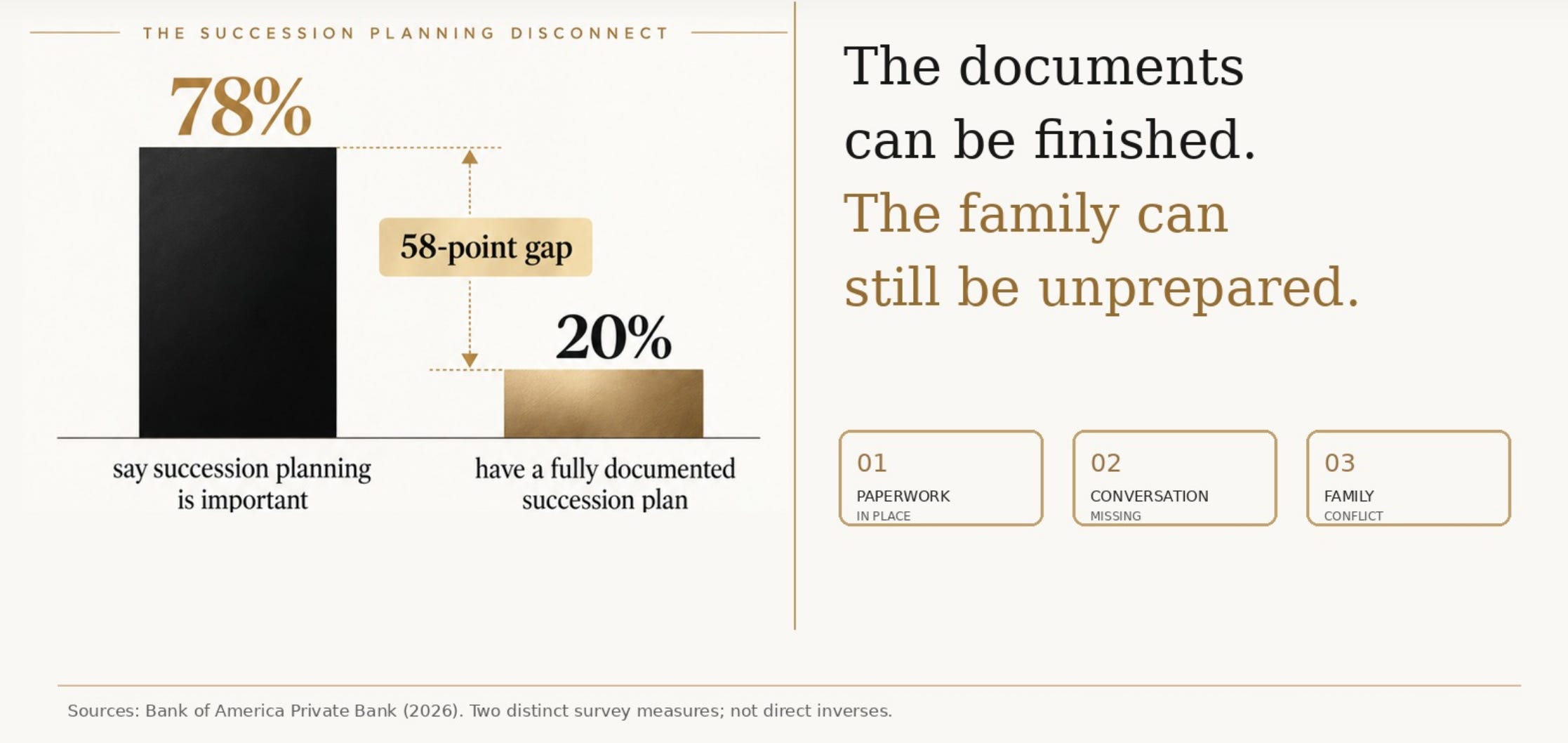
There is a profound difference between knowing you need a succession plan and actually having one that works. I described surveys during our conversation suggesting significant gaps between business owners who recognize the importance of succession planning and those who have a documented plan in place. I also spoke about the gap between having estate-planning documents and understanding, funding, and maintaining them.
Those aren’t merely paperwork problems. They’re problems of communication, coordination, and human behavior.
You might have the legal documents needed to transfer a business or investment portfolio. But does your spouse know where everything is? Do your children know who has authority? Does the successor understand what the business actually requires? Is there a shared understanding of what the money is intended to do?
And perhaps most importantly, have the people involved had an opportunity to express the expectations and resentments that money is likely to magnify?
You can divide $5 million among five beneficiaries with a calculator.
But…
You cannot use a calculator to resolve thirty years of a child feeling neglected because Dad was always working.
You cannot calculate away the resentment of someone who feels the family business took more from their childhood than it eventually gave them.
You cannot make somebody emotionally comfortable with an inheritance simply because the amount is objectively generous.
That’s why I believe this next period of generational wealth transfer will create such a meaningful opportunity for human-centered financial and family coordination.
Technology will make many administrative functions faster and less expensive, but the work of building trust, interpreting motivations, navigating conflict, and helping a family reach meaningful decisions remains deeply human.
I don’t need ATOMIQ to capture some enormous percentage of that market. I would rather build something that serves a manageable number of families exceptionally well, creates meaningful value for everyone involved, and remains sustainable for decades.
I can do that for the rest of my working life, and if we scale it correctly, the organization itself can continue serving families long after I’m gone.
Why I Believe in Artificial Intelligence—and Why Ownership Matters
Niiamah and I also explored the relationship between technological change and what it means to remain human.
AI is an important part of the broader ATOMIQ worldview.
I’m extraordinarily bullish on the technology and what it can accomplish. But I’m equally concerned about how casually business owners are being encouraged to surrender their most valuable institutional knowledge to platforms they don’t control.
I believe people should use frontier AI models where those models make sense, but I don’t believe that means a business owner should automatically place every proprietary process, customer relationship, document, decision history, and institutional memory inside a system controlled entirely by somebody else.
When alternatives exist, I want owners to understand those alternatives.
That includes open models and architectures where businesses can maintain greater ownership and governance of their intelligence.
There are real trade-offs. Private systems can require more infrastructure, expertise, maintenance, and discipline. They are not automatically better for every workload.
But if your business has spent twenty-five years building valuable knowledge, you should at least understand what it means to own that knowledge in a machine-readable, agent-enabled future.
I think this will become increasingly important for owner-operators planning an eventual exit.
A business that depends entirely on the founder’s memory, judgment, and relationships creates enormous succession risk.
A business that systematically captures its operating knowledge, documents its decision logic, and enables the next generation of employees and intelligent systems to execute its processes has the potential to become more resilient and transferable.
That is the thinking behind the broader system-of-intelligence opportunity, but there’s another side to this conversation.
AI can dramatically lower the cost of knowledge.
A family member can ask an AI system what a trust is, what an executor does, how various investment vehicles work, or why succession planning matters. They can become substantially more educated before ever meeting with a professional.
I think that’s fantastic. Yet information isn’t the same thing as wisdom, context, or trust.
If a business owner is preparing to hand over control of the company they’ve spent their life building, I don’t believe the ultimate decision will simply come down to which algorithm produced the best spreadsheet.
Human beings want to be understood.
They want somebody who understands their situation, has seen similar circumstances, and can help them navigate consequences that won’t show up neatly in financial projections.
The opportunity isn’t to choose between artificial intelligence and human advisers.
It’s to use the former to create greater capacity for the latter, and perhaps that is one of the biggest opportunities of the next twenty years: allowing technology to absorb more of the administrative burden so people can invest more energy into relationships, judgment, and meaningful presence.
The Moment Niiamah Stopped Me
One of the most valuable parts of our conversation occurred when Niiamah challenged the way I was communicating everything. (Yeah, he coached me up right on air, and I cherish that.)
I’ve spent years learning how to connect complex ideas, understand financial structures, and articulate solutions, and I can certainly explain why the demographic wealth transition creates a compelling market.
I can tell you about business owners without documented succession plans, outdated trusts, uncoordinated financial strategies, institutional knowledge trapped in people’s heads, and the incentives shaping the financial services industry.
But what Niiamah recognized was that the moment I really had his attention wasn’t when I was explaining the size of the market.
It was when I said I wanted families to pass on their wealth without blowing up the things that matter more than the money.
That was the moment he leaned in, and what’s funny is that I hadn’t consciously prepared the phrase.
It came out naturally.
He reflected it back to me, and suddenly I realized that one sentence had communicated something that I had spent months trying to explain through sophisticated positioning and messaging.
Here I was, building an entire ecosystem of capabilities and trying to describe the architecture to people who didn’t yet know why they should care.
Niiamah was essentially telling me that the architecture wasn’t the emotional entry point. The fear of losing your family while trying to protect their future was.
He challenged me to communicate through emotional intelligence before intellectual complexity.
It’s a distinction I intellectually understood, but wasn’t consistently applying.
I know how to sell to someone like me. I understand the founder who wants strategic control, efficiency, optimization, and the right financial structure.
What I haven’t fully mastered is communicating the same value to the spouse, partner, or family member who may define security very differently.
Their concern may not be maximizing investment returns.
It may be knowing that they won’t be left alone trying to untangle a business they never wanted to operate.
It may be understanding that their children won’t end up fighting.
It may be getting their husband or wife back from the endless phone calls, late-night emails, payroll crises, and deal negotiations.
That realization was uncomfortable, and incredibly useful, because it revealed that the most powerful expression of the ATOMIQ mission may not begin with the sophisticated things we can do.
It may begin with a simple question.
What are you building all of this for, and are you sure the people you’re building it for will actually benefit from it?
When Intelligence Gets in the Way of Connection
Niiamah’s challenge also exposed something else I’ve been working through personally.
I’ve always considered myself reasonably emotionally intelligent. Over time, I’ve also become much stronger at processing information, recognizing patterns, and connecting abstract ideas.
But the more I developed those intellectual capabilities, the easier it became to overuse them. I can intellectualize almost anything. Including somebody else’s emotions, and that’s a problem when somebody you love isn’t asking you to analyze what they’re feeling.
They’re asking you to hear them. There’s an enormous difference.
In business, being able to step outside a problem and find a workable solution is valuable. Being the person who can make sense of confusion can create tremendous value for clients and partners, but that same habit can become a liability in a marriage, a family relationship, or a conversation with someone who simply needs to feel understood.
I recognize that I have work to do there, and I don’t say that to invite sympathy or to pretend I’ve suddenly become enlightened. I say it because I think many accomplished entrepreneurs reach a similar point.
We’ve spent decades improving the skills that make us effective in the marketplace. We learn how to persuade, negotiate, overcome resistance, manage crises, and make difficult decisions.
Then we wonder why those skills don’t automatically make us better at the relationships that matter most.
It’s because they’re different skills, and sometimes the very things that make us effective professionally become the things that get in our way personally.
I’m trying to become more intentional about that.
I don’t want to discard the strengths that have served me. I want to recognize when those strengths are no longer the right tools for the situation, and I hope that the work I’m doing with other families will help me become better at applying those lessons within my own.
There’s a certain irony in being able to help another family work through complicated decisions more easily than you can work through similar decisions in your own home, but that’s also part of why independent advisers, coaches, and other trusted third parties can be so valuable.
They aren’t carrying the same emotional history.
They can help people see the whole field without requiring one family member to dominate the conversation, and sometimes the greatest contribution an expert can make is creating enough safety for someone to say what has gone unsaid for thirty years.
My Way, Your Way, and Finding Our Way
I’ve been thinking about another concept that emerged during the interview.
I call it Finding Our Way.
It might become a book someday. It might simply become a useful framework for thinking about relationships.
The underlying observation is straightforward. Every person enters a relationship with their own way of doing things.
I have my way.
You have your way.
When we decide to share a life, a business, a family, or a significant financial interest, a third thing emerges.
Our way.
The problem is that most people never consciously design that third thing.
It develops by default.
If one personality is more dominant, more decisive, or more comfortable navigating conflict, their way can gradually become the shared operating system.
That might seem efficient at first, but over decades, compromises that were never openly discussed can become resentments that were never resolved.
Money then magnifies whatever has been left unattended.
A successful exit, inheritance, family business transition, or unexpected death can expose tensions that have existed for decades.
That is one reason I believe wealth planning must include more than documents and financial projections.
Families need mechanisms for making decisions together.
They need ways to communicate expectations, clarify responsibilities, and recognize that the founder’s preferences aren’t automatically the same thing as the family’s shared priorities.
I want to get better at this in my own life, and I want ATOMIQ to help families build practical structures that make those conversations possible before a crisis forces them to happen.
Rehumanizing the Future
One of the ideas I shared with Niiamah was my belief that we’re moving toward a kind of rehumanization.
For the last fifteen or twenty years, technology has created extraordinary convenience while also training us to be constantly available.
We take calls on vacation. We answer messages during family dinners. We respond to social media notifications because we fear missing an opportunity, losing relevance, or disappointing somebody, and the very people we’re supposedly working so hard to provide for end up competing with our devices for our attention.
I’ve been guilty of it. I suspect most entrepreneurs have.
The irony is that we keep using technology to make ourselves more productive while often becoming less present, but I think the next wave of automation creates an opportunity to reconsider that tradeoff.
If intelligent systems can increasingly handle routine administration, organize knowledge, and help us make better-informed decisions, maybe we can reclaim some of the time we’ve surrendered to being constantly connected.
Niiamah challenged even my language around that idea.
He suggested that perhaps we shouldn’t simply be trying to return to being human. Perhaps the opportunity is to elevate what it means to be human.
I like that distinction, because the goal isn’t to abandon technology or romanticize the past.
The goal is to use extraordinary technology to make room for more meaningful human experiences.
That is relevant to wealth management. It’s relevant to business succession. It’s relevant to relationships, and it’s relevant to how I want to spend whatever time I have left.
The Real Risk Is Doing Nothing
I’ve been using the tagline “The Real Risk Is Doing Nothing” for about fifteen years. It originally meant something very entrepreneurial.
Start something.
Take the chance.
Leave the job you hate.
Build the business.
Make the move.
Don’t spend your entire life waiting for certainty before doing something that matters to you.
I still believe all of that, but the meaning has evolved as I have.
Today, doing nothing can mean failing to protect something you’ve already built. It can mean avoiding the conversation with your spouse about what happens if you die unexpectedly. It can mean leaving a business succession decision until a medical emergency or market downturn forces your hand. It can mean assuming your children understand your intentions because you’ve spent years providing for them. It can mean having a trust sitting on a shelf without knowing whether the people, assets, and responsibilities it was designed to govern are actually prepared. It can mean never making amends where you need to make them.
Never simplifying what you can simplify. Never delegating what someone else needs to learn. Never making the thing you’ve built capable of surviving without you, and that last one is especially important.
Entrepreneurs often spend their entire careers becoming indispensable. Then they reach the point where the most important thing they can do is make themselves less essential to the future.
That’s a profound shift.
It requires an entirely different definition of success. I no longer want to measure my success solely by how much I can build, how much I can earn, or how many opportunities I can create. I also want to measure it by how much unnecessary burden I can remove from the people I care about.
How much institutional knowledge can I preserve?
How much conflict can I help prevent?
How much better prepared can I leave my family?
How many other families can we help navigate the same transition with greater clarity and confidence?
How much can we build that will still function when I’m no longer the person holding it together?
Those are the questions increasingly shaping my work, and they’re why ATOMIQ is more than a collection of companies to me.
It’s my attempt to build an ecosystem around a problem I understand personally, believe matters enormously, and feel compelled to help solve.
The Final Question
Toward the end of our conversation, Niiamah asked whether the problem I was trying to solve was fundamentally about money or family.
My answer was that the problem is never really the money.
Money is an amplifier.
It magnifies whatever is already there. If a relationship is healthy, wealth can create extraordinary freedom and opportunity.
If a relationship is dysfunctional, money can make the dysfunction much more expensive and difficult to ignore.
If a founder is insecure, another $10 million doesn’t automatically eliminate the insecurity.
If a family has never learned to communicate, a larger inheritance doesn’t suddenly give them the language to do so.
“We’re all broke at different levels”, as a mentor once told me. There’s always a bigger number, another problem, another fear, another reason to postpone feeling secure.
The question, then, is not simply how much money you need. It’s what game you’re actually trying to play.
At twenty-five, perhaps the game is proving that you can build something.
At thirty-five, maybe it’s scaling a business and creating opportunities for your family.
At forty-five, it may be protecting what you’ve accumulated after learning how fragile success can be.
At fifty-one, at least for me, the game includes becoming a better husband, father, and human being while continuing to build a successful business.
Those goals aren’t mutually exclusive, but they do require tradeoffs, and if you don’t consciously decide what you’re optimizing for, the demands of whatever game you’re already playing will make those choices for you.
I still want to build. I still want my best financial years ahead of me. I still want to create meaningful businesses and opportunities. I still want to play hard, but I want to be much more conscious of what I’m trading to get there.
At some point, the most valuable thing you can buy with the wealth you’ve accumulated may be the freedom to stop sacrificing the very things you were trying to protect.
One Last Thought
I went into this interview expecting to explain why ATOMIQ exists. I came out with a clearer understanding of why the way I communicate that mission matters just as much as the technical sophistication of what we’re building.
Niiamah helped me recognize that the person who needs our help might not be moved by the size of the generational wealth transfer, the efficiency of a financial architecture, or the capabilities of an AI-enabled family office.
They might simply be lying awake at night wondering what would happen to their family if something happened to them tomorrow.
They might be worried that their spouse doesn’t know how to run the business.
They might know their children are already fighting over things that haven’t even been inherited.
They might have reached the point where the financial success they’ve spent their life pursuing has created a level of complexity they no longer want to carry, and they may never have said any of that out loud.
That’s who I’m increasingly thinking about when I sit down to write, build, or design something for ATOMIQ.
Not just the person who built the fortune. The people who have to live with what happens next.
I don’t have all of this figured out. I have more clarity about my purpose than I’ve ever had, but I still have plenty to learn about how to live it, and that’s okay.
Tomorrow I’ll put my boots on and give it another hell of an effort, because I still believe the same thing I believed fifteen years ago.
The Real Risk Is Doing Nothing!
— Chris J. Snook
Watch, Listen, and Join the Conversation
Thank you to Niiamah Ashong and The Outliers Edge for creating a space where this could be more than another conversation about entrepreneurship or success.
Niiamah’s willingness to challenge me, reflect back what he was actually hearing, and keep bringing the conversation toward the human experience made this interview especially valuable.
Explore Niiamah’s coaching work at The Outliers Edge.


