My ATOMIQ LEVEL conversation with my good friend, Co-author of Digital Sense, and creative tinkerer and genius, Travis Wright.
Some people are good at predicting the future. Others are good at building things. Far fewer have demonstrated the ability to recognize where technology is going, build practical applications before the opportunity becomes obvious, and then explain what they learned in a way that makes everyone around them want to try it.
My longtime friend and Digital Sense co-author Travis Wright is one of those people.
I have known Travis for roughly thirteen years. We met during the early days of Denver Startup Week, worked together, wrote a book together, explored the emerging token economy, and found ourselves moving through many of the same technological revolutions from different vantage points. Along the way, I’ve watched him repeatedly recognize patterns that most people either couldn’t see or weren’t paying attention to yet.
This latest ATOMIQ LEVEL conversation brought us together again, with Travis joining from Dubai, where he has been working at the intersection of traditional finance, digital assets, artificial intelligence, and entrepreneurial experimentation.
We spent nearly an hour and forty minutes unpacking a deceptively simple question:
What happens when the internet stops being something we merely use and starts becoming something that can build and operate itself?
Travis calls this emerging era the Fourth Web.
His framework is easy to remember. Web 1 gave us the ability to read information online. Web 2 made the web social and participatory. Web 3 introduced new forms of digital ownership. Web 4, in his formulation, adds autonomous intelligence capable of taking actions, coordinating systems, creating new software, and completing work on our behalf.
That is a significant shift, but the most compelling part of our discussion was not about the technology itself. It was about the kind of human being who can thrive alongside it.
Travis’s story begins with a child who learned to retreat into books, a three-year-old fascinated by an Atari Pong console, a college student who stayed awake for thirty-six hours building his first website, and a young comedian whose habit of observing the world became an unexpectedly powerful form of technological pattern recognition.
The same curiosity now powers his AI experiments, including automated intelligence publications, personalized learning environments, creator-economy platforms, and systems that can transform an idea into a functioning software prototype in less than a day.
For anyone worried that AI may be making their hard-earned expertise less valuable, this conversation offers a more productive way to frame the challenge. The objective is not to compete with machines at every task they can perform. It is to recognize what remains uniquely valuable about being human and use these tools to extend that value.
This episode is for entrepreneurs, advisors, parents, creators, professionals, and anyone who wants to protect both their net worth and their net happiness in a world where the pace of technological change is no longer waiting for us to catch up.
Connect With Travis Wright
Follow Travis at TravisWright.com and subscribe to his Agentic AI Economy newsletter on Substack, which we discussed throughout the episode. Travis also shared his experiments and thinking around the Fourth Web, digital assets, creator intelligence, and autonomous software.
His official website is the best starting point for following those projects and finding his current publications and social channels.
Disclaimer: This conversation is educational and informational. It includes opinions, predictions, personal experiences, technological demonstrations, and investment-related observations. Those should not be treated as guarantees, independently verified outcomes, or individualized financial, legal, medical, or technical advice.
The Little Red Truck That Helped Create a Technologist
When I asked Travis what shaped his worldview, I expected him to start with his early work on the internet, his marketing career, or his fascination with emerging technologies.
He surprised me. He went back to childhood and the sight of a little red truck.
Travis described growing up with a difficult stepfather. When he saw the truck approaching, he knew it was time to retreat to his room. That room became a place where he could read, listen to the radio, experiment, and occupy his mind with something other than the environment outside his door.
There is something deeply human about that origin story. The characteristics we later celebrate in successful adults do not always begin in circumstances anyone would choose for a child. Sometimes curiosity emerges from delight. Sometimes it becomes a refuge. Sometimes the same personality trait serves both purposes.
For Travis, reading and tinkering became habitual. He recalled being around three years old when his mother brought home an Atari Pong system. He was intrigued by the game, but what really captured his imagination was how the machine worked.
How did the knobs communicate with the screen? What did the switch do? How was this electronic device creating something interactive on the family television?
That distinction matters.
Some children encounter a new technology and become absorbed in what it lets them consume. Others become fascinated with how it was made.
Travis was drawn toward the second question.
By the time he reached the University of Kansas in 1996, that instinct had matured into a willingness to spend extraordinary amounts of time figuring out how unfamiliar technology worked. He remembered spending thirty-six hours in a computer lab, fueled by Mountain Dew, teaching himself how to build a website for his stand-up comedy persona, the Trapster.
He learned by doing. When he needed something, he figured out how to build it. When he discovered a new tool, he experimented until he understood what it might make possible.
That habit eventually took him through early search engines, domain investing, paid search, SMS marketing, social networking, content platforms, and the beginnings of what would become the modern digital economy.
The crucial pattern was not that Travis always knew which company would win.
It was that he recognized when an underlying human behavior was about to change.
Pattern Recognition Is Not the Same as Prediction
One of the questions I wanted to explore was what makes Travis’s approach different from that of other technology enthusiasts.
He has certainly been early to a number of trends. He described experimenting with search optimization before Google became dominant, buying online advertising through early paid-search systems, and using social platforms long before the modern social media industry existed.
He also described building a creative community called Method Lab, which incorporated several ideas that would later become major categories of internet business: user profiles, digital publishing tools, file hosting, streaming audio, and customized merchandise.
Travis recalled developing these ideas in the late 1990s and early 2000s, well before many later platforms became household names. His comparisons were retrospective; they are not proof that every subsequent business derived from his work. They do, however, reveal how he was thinking.
He was already asking how creative people might use connected digital systems to publish, share, collaborate, and make money.
When he attended the Web 2.0 Expo in San Francisco in 2007, he experienced an important realization: he had found a community of people who understood what he had been experimenting with from Kansas City.
The geographical distance had constrained his access to funding and networks, but it had not prevented him from recognizing the opportunity.
That became one of our most useful discussions because there is an enormous difference between being early to a technology and being positioned to benefit from it.
A person may correctly identify a coming revolution and still fail commercially. The timing may be wrong. The capital may be unavailable. The market may not be ready. Distribution may be missing. Or the founder may simply lack the particular combination of resources and relationships required to turn an idea into a durable business.
Travis knows that distinction personally.
He told me about experimenting with Bitcoin mining in 2010 and ultimately losing access to what he remembers as 55 bitcoin because he did not preserve the relevant data when his laptop failed.
We laughed about it, but the lesson was serious.
Recognizing value is not the same as preserving value.
And preserving value is not the same as capturing value.
This is particularly relevant to Wealth Matters readers. You can understand an opportunity, own an asset, and still fail to benefit from it because of poor custody, inadequate operational controls, insufficient liquidity, or a missing process.
In technology, as in wealth management, the architecture surrounding an asset can matter as much as the asset itself.
The Comedian’s Advantage
Travis also offered an unexpected explanation for his pattern recognition: comedy.
As a child, he often completed schoolwork early because he preferred reading lessons before class. That gave him time to ask questions and make jokes, neither of which always endeared him to his teachers.
He recalled repeated trips to the principal’s office and the corporal punishment that accompanied them in those days. What interests me about that experience is the skill it required him to develop.
Observational comedy depends on noticing something that other people have overlooked, connecting it to a familiar human experience, and communicating the connection quickly enough to produce a reaction.
That sounds remarkably similar to certain forms of entrepreneurial insight.
The comedian recognizes an incongruity. The entrepreneur recognizes an inefficiency. The investor recognizes a mispricing. The innovator recognizes a capability that could be applied in a context nobody has considered yet.
All four are looking for patterns hidden inside ordinary experience.
Travis doesn’t claim to be a great stand-up comedian. He considers himself better at improvisation, observation, and storytelling. But those abilities clearly influenced his approach to technology.
He watches something emerge and asks whether it matters today, whether it will matter later, and what other systems it might eventually affect.
Then he starts experimenting.
That is a useful discipline for anyone trying to navigate AI. You do not need to understand every model, technical architecture, or programming language before participating. You do need to cultivate the habit of observing what is changing and testing what the change makes possible.
The Four Webs: From Reading to Autonomous Action
Travis’s Fourth Web framework is one of the simplest explanations I’ve heard for the progression of the internet.
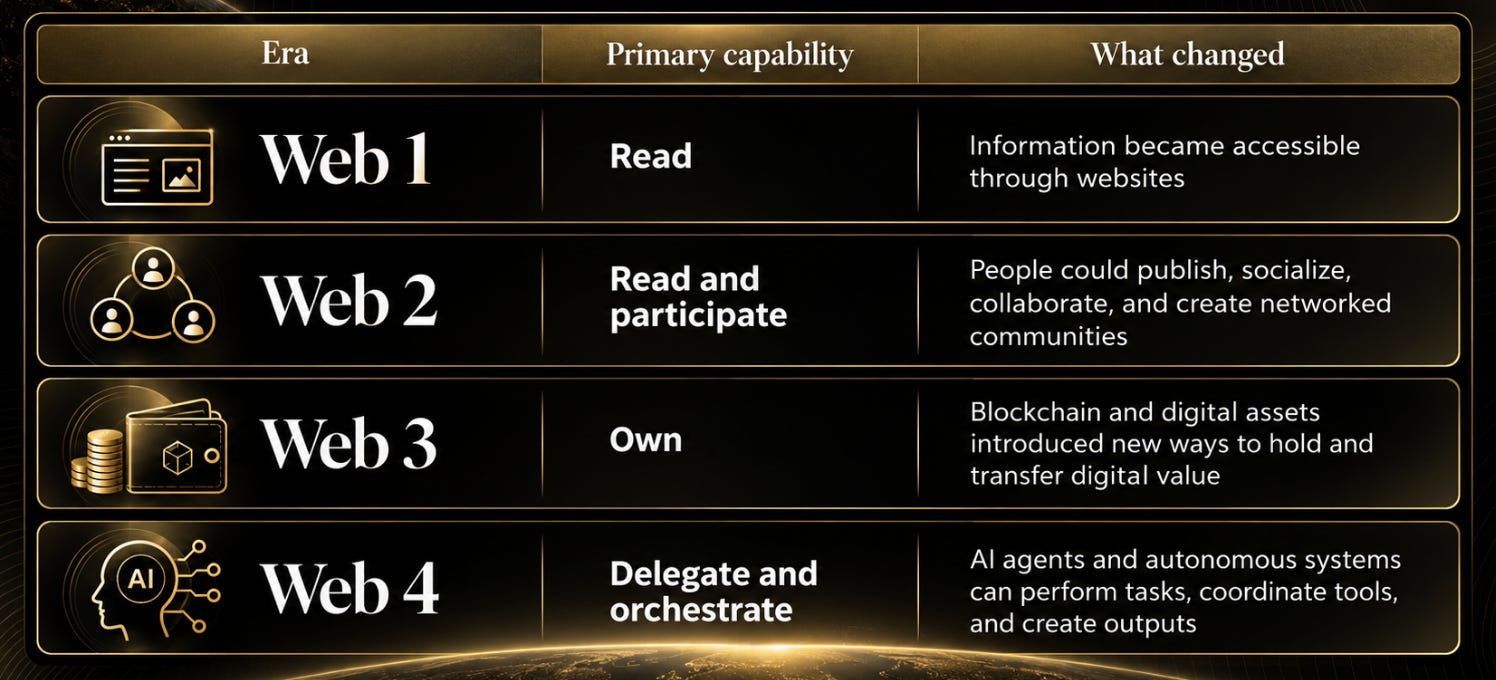
This is Travis’s conceptual framework rather than a universally adopted technical classification. The stages overlap, and the internet did not move neatly from one era to another on predetermined dates.
But as a model for understanding the direction of change, it is useful.
Web 1 was largely a publishing revolution. Web 2 transformed publishing into participation. Web 3 introduced a new conversation about ownership and digitally native value.
The Fourth Web, in Travis’s view, changes the relationship between humans and the systems they use.
Instead of manually performing every step, a person can increasingly describe an objective and ask a coordinated set of software agents to execute the work.
An agent may retrieve information, classify it, draft content, build an interface, update a database, generate an asset, or pass a task to another specialized agent.
That does not mean every system is truly autonomous, reliable, or safe enough to operate without oversight. Today’s capabilities remain uneven, and real deployments require authorization, testing, security, monitoring, and human accountability.
The meaningful change is that the human role begins shifting from performing individual digital tasks toward directing increasingly complex digital workflows.
This is what Travis means when he says the web is beginning to build itself.
He doesn’t mean the internet has become a conscious organism. He means the software development and operational work that previously required teams of humans can increasingly be supported by systems that generate and coordinate that work.
And he isn’t talking about this from a purely theoretical perspective.
He demonstrated what he has been building.
The Day the Alarms Went Off in Dubai
One of the most compelling stories in the episode began with Travis waking up to emergency alerts in Dubai.
He had relocated to the United Arab Emirates to work in digital assets and financial technology. During a period of regional conflict, he found himself confronting the same questions anyone would ask when news of nearby attacks begins arriving through phones, television, and social media.
What was actually happening? Which information could he trust? How close was the danger? Was the coverage exaggerating particular risks or overlooking others? What should he do next?
His response was characteristic. He started building software.
Travis described creating an intelligence dashboard that gathered reports from multiple sources, organized events geographically, and helped him compare different accounts of the same developments.
He also experimented with a synthesized newsreader voice that could summarize updates in a familiar broadcast style.
The system was originally a personal response to uncertainty. He later discontinued the public experiment, citing concerns about local restrictions on publishing sensitive conflict-related information.
That decision illustrates a useful distinction between technical capability and operational judgment. Being able to build a system does not automatically establish that publishing it is lawful, safe, or responsible.
More importantly, the underlying process remained useful.
Travis realized that the same workflow he had assembled to understand a dangerous situation could be repurposed to monitor the emergence of the Fourth Web.
That led to another project.
Building an Intelligence Wire Instead of Another News Feed
Travis demonstrated wire.fourthweb.ai, an experimental intelligence publication that he described as monitoring approximately 150–200 information sources.
Rather than displaying every incoming article in chronological order, the system groups related stories, synthesizes their implications, identifies patterns, and produces condensed articles organized around themes such as AI agents, digital assets, and human consequences.
He also demonstrated a rapid-reading interface using rapid serial visual presentation, allowing users to consume words sequentially at adjustable speeds.
Finally, he showed an automated audio briefing that turns the most significant recent stories into a short spoken update.
The result is more than a news aggregator.
It is an attempt to convert a flood of information into a structured process for identifying signals.
That is a distinction business owners should pay attention to.
Most companies are not suffering from a shortage of data. They are suffering from fragmentation. Their customer information lives in one system, sales activity in another, marketing analytics somewhere else, financial performance inside accounting software, and institutional knowledge inside the heads of employees.
They have records but lack a coherent system for producing intelligence from those records.
What Travis demonstrated is one possible approach to that problem: retrieve, organize, compare, synthesize, prioritize, and distribute.
The technology can make that process cheaper and faster, but the underlying questions remain human.
What information is reliable? What constitutes a meaningful signal? Which patterns matter to the business? Who is accountable when an automated system produces a wrong conclusion?
Those questions become more important as the speed of production increases.
Five Favors Before You Go
Hit the ❤️. The algorithm is a validation machine that needs your cheap dopamine to keep us at the top of your feed.
Hit the 🔄 restack. Somebody’s life will change passively today, and you can get the credit for bringing it to them from both of us.
Hit 📤 share. You know exactly one person in your email list or text stream who needs something on their playlist or reading wire today.
Drop a comment. Tell me your biggest insight, your greatest challenge, your counterargument or gap in the conversation, or a recent related triumph. I read every one, and I reply to the ones that make me laugh, make me think, or make me money. Preferably all three.
Subscribe. This newsletter and our Office Hours are 100% reader- and listener-supported. The free conversations and replay articles build awareness and access. Behind the paywall are the playbooks, resources, archives, and practical frameworks designed to turn that awareness into meaningful action for your net worth and net happiness.
The 24-Hour Business Prototype
Another demonstration brought the technological transition into sharper focus.
Travis described developing an early version of a creator-intelligence platform associated with GenZ.tv in approximately twenty-four hours.
The premise began with an observation about his own children.
He has two Gen Z children, and he has watched how their relationship with media and trusted creators differs from the media environment he grew up in.
They may not trust the traditional institutions that shaped older generations’ buying decisions. They may follow creators who have established relationships and credibility through consistent participation in online communities.
Travis believes that understanding those relationships will become increasingly valuable to advertisers, creators, and businesses.
He cited large figures for Gen Z purchasing power and creator-marketing spending during the conversation. Those estimates should be validated against their underlying definitions before being treated as market facts, but the business question does not depend on accepting a particular headline number.
Where does consumer trust live, and who controls the relationship with the audience?
That is the question.
Travis had already acquired the domain GenZ.tv. With modern AI development tools, he could begin translating the idea into a working product far more quickly than would have been economically realistic a few years ago.
The initial prototype was not the finished company. He was clear that substantial work remained in improving the intelligence, building the operating model, and developing the commercial opportunity.
Nevertheless, the exercise showed a meaningful change in entrepreneurial economics.
An idea that previously might have required a significant development budget and months of coordination can now sometimes be demonstrated, tested, and revised in days.
That doesn’t eliminate the need for product-market fit, capital, distribution, customer acquisition, compliance, security, or operational discipline.
But it can dramatically reduce the cost of discovering whether an idea deserves further investment. I think this is one of the most underappreciated benefits of AI for small and mid-sized businesses.
The value is not merely that certain tasks become less expensive. The value is that experimentation itself becomes more affordable.
A company can test ideas it previously could not justify funding.
A professional can build a tool for a problem that only a few people experience.
A founder can explore a new market without immediately hiring a full development organization.
That creates enormous potential for entrepreneurship, provided we do not mistake the ease of creating a prototype for the difficulty of building a durable business.
Culture Will Outlive Individual Technologies
One of the themes I kept returning to was the difference between technology adoption and human behavior.
We have seen extraordinary platforms disappear. Friendster did not become the dominant social network. Vine did not become the enduring short-video platform many expected. Entire generations of software companies have been replaced.
But the human behaviors those platforms helped reveal often persisted.
People continued socializing online, creating short videos, building communities, sharing identities, and looking for connection.
The particular company may disappear. The behavior can remain. That distinction matters in every technology transition.
When evaluating Web 4, I am less interested in whether a particular AI startup survives than in whether humans will continue demanding more capable tools that reduce friction, extend their abilities, and help them accomplish goals.
The answer seems likely to be yes.
The more difficult question concerns the cultural consequences.
What happens when people become accustomed to delegating thinking, writing, judgment, research, conversation, and even emotional interaction to artificial systems?
Travis and I agreed that some forms of augmentation make people more capable. We also discussed the possibility that certain uses of AI could weaken skills when people stop exercising them.
The distinction is not simply whether someone uses AI. It is how.
There is a meaningful difference between asking an AI system to decide on your behalf and using it to help you understand a decision well enough to make it yourself.
One reduces the burden of thought. The other can increase the quality of thought.
Those outcomes may look similar on the surface, but they produce very different forms of human development.
AI Cannot Replace Human Distribution Quite So Easily
This may have been the most important commercial insight in the episode.
Travis argued that AI can reproduce many forms of knowledge work, but it cannot simply assume possession of the human relationships, communities, reputations, and distribution channels that people have built over time.
That is particularly relevant to anyone who has spent decades developing expertise.
The traditional advantage of a professional was often access to specialized knowledge. An attorney knew the law. An accountant understood complex financial records. An advisor could interpret financial products. A consultant could build frameworks that a client did not possess.
That knowledge remains valuable, but its scarcity is changing.
Increasingly capable systems can produce first drafts, explanations, analytical models, and research assistance at extremely low marginal cost.
The professional advantage therefore shifts toward applying knowledge responsibly within a trusted relationship.
A machine can draft an explanation of an estate-planning concept. It cannot automatically become the person a family trusts to guide them through a painful dispute.
An AI agent can analyze customer data. It cannot automatically inherit the credibility of the founder who spent twenty years delivering on promises.
Software can generate an excellent marketing campaign. It does not automatically command the attention of an audience that has spent years deciding whom to believe.
Human distribution is difficult to create because it is rooted in accumulated behavior.
Promises kept. Problems solved.
Truth told when dishonesty would have been easier. Mistakes acknowledged. Relationships maintained. That is why I increasingly believe the scarcity premium in the AI economy will attach to judgment, trust, and human distribution.
These are not soft ideas. They are economic assets, and unlike a generic software output, they cannot always be reproduced simply by giving another system the same prompt.
Trust Is Hard to Earn and Easy to Lose
Travis and I discussed how years or decades of credibility can disappear in a moment.
The speed of technological production makes this especially important. A business may suddenly be capable of generating thousands of personalized messages, dozens of marketing campaigns, synthetic spokespersons, or automated customer interactions.
But the availability of those tools does not guarantee that using them will improve trust.
In some circumstances, automation creates convenience. In others, it creates distance.
A company that allows an AI system to speak with authority it does not possess may damage its reputation. A creator who uses synthetic media without appropriate disclosure may make the audience question what else is authentic. An advisor who relies on an automated summary without verifying the facts may turn a productivity gain into a fiduciary problem.
The technology can amplify competence. It can also amplify carelessness.
The future belongs neither exclusively to the people who reject automation nor automatically to the people who adopt the greatest amount of it.
It is more likely to reward those who know which tasks to automate and which responsibilities must remain human.
The Mastermind That Came Back to Life
The conversation became especially personal when Travis showed how he had revived an idea he had explored for years: a virtual mastermind involving perspectives associated with historical thinkers, entrepreneurs, spiritual teachers, and other influential figures.
The idea had existed long before modern generative AI.
He wanted access to an intellectually diverse group of perspectives that could challenge, encourage, and help him think through difficult problems.
Today, he has experimented with giving those perspectives conversational interfaces and synthesized voices. During the episode, he demonstrated a motivational message presented in a simulation of Steve Jobs’s voice.
The technology was impressive, but I was more interested in the reason he had built it.
Travis uses these systems to create a personal environment that encourages him to think, build, and follow through. He described using them to generate daily messages, reflect on his work, and prepare for important presentations.
Those experiences are simulations, not communications from the historical people represented. They should be understood as interpretive, AI-generated approximations rather than authentic statements, endorsements, or recoveries of anyone’s actual consciousness.
That distinction is necessary. But the underlying idea is worth exploring.
For years, people have used books, letters, recorded speeches, biographies, philosophy, and religious texts to seek guidance from people they will never meet.
Interactive AI introduces another form of engagement with that intellectual material.
Used responsibly, it can help a person compare frameworks, rehearse decisions, challenge assumptions, or discover new questions.
Used uncritically, it can create false authority. The value depends on whether the tool strengthens the user’s judgment or encourages the user to surrender it.
This became part of the conversation’s deeper tension between AI augmentation and human agency.
Why I Think Gen X Has a Unique Opportunity
Near the end of the episode, we discussed the generational implications of the transition.
Much of the current AI conversation treats older professionals as a workforce that must be retrained and younger professionals as the natural beneficiaries of the technology.
That framing is too simplistic.
People who have spent decades operating companies, negotiating with counterparties, raising families, navigating recessions, managing crises, and maintaining relationships possess something that newer entrants to the workforce may still be developing.
Context.
They know why certain processes exist. They know what went wrong the last time a company tried a particular strategy. They understand the hidden politics inside organizations, the consequences of making promises, and the difference between a decision that looks elegant on paper and one that can actually survive contact with reality.
Younger professionals may approach emerging tools with fewer assumptions, greater familiarity, and a willingness to experiment.
Neither advantage is complete on its own. Experience can become rigidity. Curiosity can become undirected activity. That is why I think the ideal relationship is reciprocal.
Older generations can contribute judgment, historical perspective, relational intelligence, and professional context.
Younger generations can contribute new patterns of use, emerging cultural understanding, and a willingness to question systems that older professionals may have stopped noticing.
AI can become a bridge between those forms of knowledge. But only if both groups remain curious enough to learn from each other.
The Paid Playbooks: From Conversation to Action
The conversations on ATOMIQ LEVEL and the article follow-ups are ALWAYS free, because the insights and access to the discourse with some of the most brilliant minds in finance, business, and technology that I benefit from are my generous—and strategic—gateway drug.
The other side of the paywall is where you get the full playbooks, the office hours, and the archives distilled in a broader and more actionable context.
It is where, for $1 per day or less, you can move from conversation to planning and protecting your net worth and your net happiness.
That is where awareness becomes an operating system.
So I will see you over there, and welcome you to your journey of becoming a true Wealth CMDR.
A Practical Playbook for the Fourth Web
I do not expect every Wealth Matters reader to become an AI developer, build a news-intelligence platform, or operate a network of autonomous agents.
That isn’t the point.
The more valuable lesson from Travis’s approach is that people can develop greater agency by becoming active participants in technological change rather than passive consumers of commentary about it.
Here is how I would translate this episode into a practical exercise for founders, professionals, and investors.
1. Identify the work that depends on repetitive coordination
Start by listing work that moves information from one place to another: research gathering, meeting preparation, proposal generation, reporting, customer follow-up, document organization, and recurring administrative processes.
Do not begin by asking which AI product to buy. Begin with the business problem and the desired result.
2. Separate information from judgment
For each workflow, ask what an automated system can gather, categorize, summarize, or draft, and which decisions require human review.
A useful initial rule is that AI can recommend an action, but consequential legal, financial, security, medical, or contractual actions should remain subject to appropriate human authorization and professional oversight.
3. Build one small experiment
Choose a bounded workflow that can be tested without exposing sensitive information or putting customers at risk.
Perhaps it is an internal competitive-intelligence brief, a private research assistant, a meeting-summary workflow, or a system that organizes the questions customers ask most often.
Define how success will be measured before building.
4. Create a trusted source of information
Travis’s news-intelligence experiments illustrate the importance of source aggregation and synthesis. For business applications, that begins with data quality, access controls, and traceability.
Automated outputs should distinguish verified source material from inference. Business information should be available only to authorized systems and people, with controls appropriate to its sensitivity.
5. Make curiosity operational
Set aside regular time to experiment, evaluate, and learn. Treat questions as part of the work, not as evidence that you are behind.
One of Travis’s strongest messages was that you do not have to pretend to understand a new tool. You can simply ask what it does, why it matters, what alternatives exist, and whether the result can be achieved another way.
That approach helps turn unfamiliar technology into practical knowledge.
6. Protect the trust layer
Before automating a customer-facing or employee-facing process, ask whether doing so will make the relationship better.
Speed is useful. Consistency is useful. Lower costs are useful. But none of them should be pursued without considering the human experience.
The customer should still know who is accountable.
7. Preserve your ability to operate without the system
Any agentic workflow that becomes important to a business should have documented ownership, credentials, backup processes, monitoring, and a practical way for authorized humans to intervene.
Automation should reduce fragility, not move all of it into a new black box.
8. Reinvest the time you recover
The most valuable question is what you do with the capacity automation creates.
Do you spend more time with customers? Build a better product? Strengthen relationships? Improve your financial plan? Explore a new market? Spend more time with your family?
If automation simply gives you more capacity to do work that does not matter, the technology may be impressive without making your life better.
That would be a poor trade.
What the Fourth Web Means for Net Worth and Net Happiness
For Wealth Matters readers, I see two connected implications.
The net-worth opportunity is that small businesses and individual professionals may be able to perform work that previously required much larger organizations. New products can be tested more cheaply, research can be synthesized more quickly, and valuable expertise can be embedded into repeatable systems.
This could increase productivity and open up new forms of ownership.
But the benefits will not necessarily be distributed evenly. The people who control trusted customer relationships, valuable proprietary data, specialized expertise, and effective distribution may have advantages that others struggle to reproduce.
The net-happiness question is more difficult. If technology can do more of our work, what do we want to do with the freedom?
We discussed robots, companionship, synthetic relationships, and the possibility that digital convenience could reduce ordinary forms of human interaction.
Neither Travis nor I believe that the answer should simply be to reject technological progress. But we both recognize that making something more efficient does not automatically make it better for human life.
It is possible to optimize every interaction until the experience itself becomes empty.
That is why the future of AI should not be evaluated exclusively through benchmarks, productivity statistics, market capitalization, or the number of jobs automated.
We also have to ask whether the tools are improving human agency, judgment, relationships, security, and the capacity to pursue meaningful goals.
Those are much harder things to measure. They may also be the things that matter most.
Why You Should Press Play
Press play if you are a business owner wondering how AI agents could improve your company’s research, sales, marketing, operations, or customer experience.
Press play if you have expertise that took decades to develop and want to understand why that experience may become more valuable when paired with the right technology.
Press play if you are curious about the transition from Web 1 and Web 2 to Web 3 and Travis’s emerging Fourth Web framework.
Press play if you want to hear how a lifelong technologist went from Atari Pong and early websites to creating sophisticated agentic workflows.
Press play if you are a creator, publisher, or marketer trying to understand the growing economic importance of trusted audiences and human distribution.
Press play if you are worried that using AI will make your thinking weaker and want to consider how it might instead make you more capable.
Press play if you are a parent trying to understand the technological and cultural environment your children will inherit.
And press play if you believe the next chapter of technological progress should create not merely more economic output but more opportunities for people to exercise their humanity.
The Most Important Thing Travis Said Was the Last
Our conversation ended with a wonderfully practical exchange about curiosity.
Travis encouraged listeners to stop treating unfamiliar technology as something they must master before they are allowed to experiment.
Ask questions.
If you do not understand the answer, ask another question.
If a system tells you to use a particular tool and you do not know why, ask what the tool does. Ask whether there are alternatives. Ask whether the project can be completed without it.
Use AI to build understanding as well as outputs.
We talked about the difference between needing more content and needing more context. Younger people may have access to enormous amounts of information but lack experience interpreting its importance. Older professionals may have decades of context but not enough familiarity with emerging capabilities.
Both can benefit from asking better questions.
Travis’s closing advice was to work smarter, not harder, and remain curious.
That sounds simple, but I think it captures the real challenge.
The Fourth Web may dramatically change the economics of building software, creating content, operating businesses, and coordinating intelligence. It may alter how people learn, work, earn, and form relationships.
No one knows precisely how the transition will unfold.
But the people most likely to preserve their agency will be those who continue learning, testing, questioning, and deciding what they want these systems to accomplish.
I have known Travis long enough to understand that his real advantage has never been a particular software platform. It is his willingness to remain a beginner. He sees something unfamiliar, gets interested, asks how it works, and begins building.
That was true when he was a child staring at an Atari console. It was true when he spent thirty-six hours teaching himself to publish a website. It was true during the social web and blockchain eras, and it remains true as AI systems begin taking on increasingly complex tasks.
The tools have changed enormously. The habit has not, and perhaps that is the most empowering part of the entire conversation. You do not need to know everything about the future to begin building a place for yourself in it.
You need enough curiosity to start, enough judgment to recognize what matters, and enough discipline to turn possibility into something real.
The real risk is doing nothing.
— Chris J Snook
Editorial note: The technological projects, timelines, personal accounts, business achievements, market estimates, and forecasts described in this article are drawn from the interview. Where independently unverified, they are presented as Travis’s experiences or opinions. Medical and speculative claims discussed during the conversation are not established scientific conclusions. This article does not endorse unverified health interventions, promise AI-driven business outcomes, or replace qualified professional advice.
Thank you to everyone who tuned in to my live video! Join me for my next live video in the app.