Most founders spend years trying to make themselves indispensable. They become the chief salesperson, the cultural center of gravity, the keeper of key relationships, the person who can solve the hardest client problem, and the one everyone calls when something breaks.
Then, one day, they decide they want to sell.
That is when the paradox becomes painfully clear. The very thing that helped them build the business can become the thing that suppresses its value. If the company cannot operate without the founder, then the buyer is not really acquiring an independent enterprise. They are acquiring a system whose most important component is preparing to leave.
This conversation with Haretina began in an unexpected place: organized crime.
She had written a provocative piece examining why certain criminal organizations have survived for more than a century despite wars, governments, prosecutions, technological change, and the deaths or imprisonment of generations of leaders.
The point was not to romanticize criminal behavior. Quite the opposite. Violence, coercion, corruption, and dependency are precisely what make those systems destructive.
The useful question was structural.
How does any organization survive its founders?
That question should matter deeply to every owner of a privately held company who expects, one day, to sell it, transfer it, recapitalize it, hand it to the next generation, or simply stop being the person required to hold the entire thing together.
Because eventually every founder discovers the same truth.
You are not building an exit when you build a successful company.
You are building an exit when you build a successful company that can survive you.
If you are looking to structure your post-exit transition, find your place in the ATOMIQ EX!T Journey Map below and DM me for a conversation.

Book a discovery call here:
The Resume That Made Me Pay Attention
Haretina does not approach business through the typical finance lens.
She was born in Greece to Albanian parents, studied tourism management, worked in hospitality, moved to the United Kingdom, earned a degree in criminology and criminal justice, worked in private security and with local government as a criminology analyst, and later completed an MBA specializing in financial technology. More recently, her work has included multi-asset brokerage across areas such as diesel, gold, and project financing, alongside geopolitical analysis.
That combination explains the questions she asks.
She is not primarily interested in whether a company trades at fifteen times earnings or eighteen. She starts further upstream. Who holds power? How is that power accessed? What institutions control information? Which structures have survived political upheaval, war, economic disruption, and technological change? What keeps people inside a network even when they technically have the ability to leave?
Her framework, as she described it during our conversation, combines politics, psychology, institutions, and power dynamics.
That is what led her to study one of the strangest business case studies I have encountered in some time: the organizational architecture of the Italian Mafia.
And that is what made me want to talk with her.
A Strange Case Study in Succession
Certain Italian organized crime organizations have existed in recognizable forms for more than a century. They survived changes in government. They survived fascism, wars, prosecutions, migration, technological change, financial modernization, and the removal of individual leaders.
Again, the lesson here is not moral.
It is structural.
Most privately held companies never survive anything close to that kind of generational transition. Many struggle to survive even the first transition: founder to professional management, founder to children, founder to buyer, or founder to private equity sponsor.
That should make an owner curious.
Why can some structures persist after the people who created them disappear, while legitimate companies generating tens of millions of dollars in revenue collapse once the founder takes his or her hands off the wheel?
The answer has little to do with charisma. It has almost everything to do with architecture. And readers of this newsletter know how much I LOVE the business architecture conversations.
Your Product Is Not the Structure
One of Haretina’s core observations was that even great technology depends on the structure built around it. Technology may change the economics of a business, but structure determines whether the organization can endure.
This is especially relevant right now because founders are being conditioned to believe technology itself is the moat.
We talk about AI models, automation, software platforms, proprietary data, APIs, workflows, and intellectual property. All of those can matter.
But none of them, by themselves, make a business transferable.
A buyer does not simply ask whether the company has good technology. A buyer asks whether the company still works when the founder is gone.
Who owns the customer relationships?
Who knows how the sales process actually works?
Who holds the institutional memory?
Who makes pricing decisions?
Who can resolve an angry client?
Who recruits key talent?
Who maintains relationships with suppliers, lenders, regulators, and strategic partners?
Who is responsible for quality control?
Who understands the company’s unwritten rules?
If the answer to too many of those questions is the founder, then the company may be profitable, but it is not yet fully institutionalized.
That distinction matters. A business can be large and still be founder-dependent.
It can generate $20 million, $50 million, or $100 million in revenue and still function, structurally, like a highly successful job built around one unusually capable person.
The Buyer Is Buying What Survives You
This is where succession and enterprise value begin to collide.
Founders naturally value the things they worked hardest to create. They remember the sacrifices, the years of reinvestment, the reputation they built, the relationships they developed, and the risks they took.
Buyers look at (and value) the company differently.
They ask what they get the day after you leave.
They are buying future cash flow.
Future customer retention.
Future management performance.
Future market position.
Future operating capacity.
Future institutional knowledge.
Future trust.
The less dependent those things are on you personally, the more transferable the enterprise becomes. Transferability is what converts business performance into enterprise value.
That is why succession is not an event that happens after the sale.
You build (or perpetuate) succession into the company years before the sale of controlling interest from your guardianship to someone new.
What Are You Really Selling?
One of the most interesting observations in the conversation involved what organized crime historically sold in places where formal institutions were weak.
The obvious answer would be violence.
Haretina’s argument was that violence was not really the product. It was an enforcement mechanism, and an expensive one at that. It attracted attention, created risk, and produced resistance.
The underlying product was certainty.
Where police could not protect property, where courts could not reliably enforce agreements, or where institutions were ineffective, someone else stepped into that vacuum and offered a guarantee—however illegitimate—that promises would be enforced.
That should make every business owner think.
What are your clients actually buying from you?
A financial advisor may technically sell advice or a model portfolio strategy, but the client may really be buying the certainty that someone competent will answer the phone when markets collapse and have hedged their risk against it in advance.
A construction company may technically sell labor and materials, but the customer may really be buying the certainty that someone will show up, finish the project, and stand behind (warranty) the work.
A cybersecurity company may technically sell software and monitoring, but the client may really be buying confidence that someone knows what to do at 2:17 a.m. when something goes wrong, or a malicious actor breaches the firewall.
A manufacturer may technically sell components, but its most valuable product may be the certainty that those components arrive every time, at specification, without bringing the customer’s production line to a halt.
This was Haretina’s formulation: become the supplier of certainty in a market that has very little of it.
For an owner thinking about exit, that raises an even more important question.
Is the certainty attached to the company?
Or is it attached to you?
Founder Trust Is Valuable—Until It Cannot Be Transferred
Many successful companies grow because the founder becomes exceptionally trusted.
Clients trust the founder’s judgment.
Employees trust the founder’s instincts.
Vendors extend flexibility because of the relationship.
Customers stay because they know whom to call.
That trust can be a tremendous asset during the growth years.
But it becomes a succession liability when all of it remains tied to the personal brand equity and trust in the founder, if it hasn’t been codified into the operating culture in parallel.
If the company’s reputation is really your reputation, then what exactly is the buyer buying?
This is why one of the highest-value things a founder can do in the years before an exit is deliberately move trust away from the individual and into the institution.
Introduce clients to other leaders.
Allow executives to own important relationships.
Build a recognizable process.
Create service standards.
Institutionalize communication.
This really hit home for me as my top priorities in 2027.
Make sure customers trust the company, not merely the founder.
Teach the organization how you think rather than requiring everyone to wait for you to think for them.
That may feel uncomfortable at first.
As founders/owner operators, we receive identity, status, and sometimes emotional security from being needed. We get meaning and validation from it as well. These aren’t bad things, but they require effort and thought to ensure a sustainable going concern whose value is easily transferable.
Ultimately, the company or practice becomes more valuable as the founder becomes less operationally necessary.
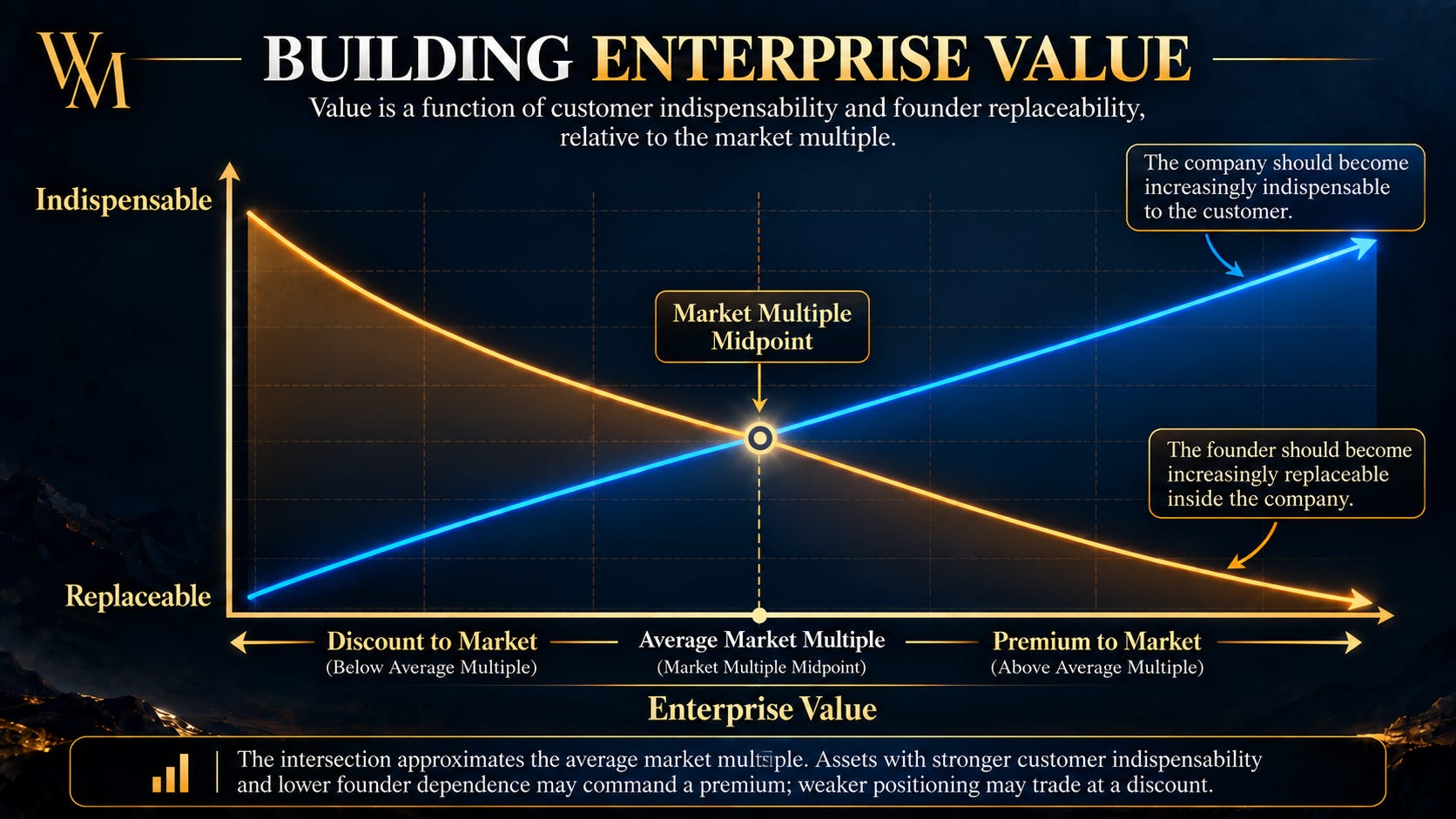
Indispensable to the Customer, Replaceable Inside the Company
There is an important distinction here.
The company should become increasingly indispensable to the customer.
The founder should become increasingly replaceable inside the company.
Those goals are not contradictory.
They are what a properly institutionalized business looks like.
A great company should be hard for customers to replace because its relationships, service, systems, reputation, knowledge, and consistency create meaningful value.
At the same time, no individual—including the founder—should represent an existential point of failure.
That is the architecture buyers pay for. The business remains indispensable. The individual becomes optional.
The Law of Replacement
During the conversation, I returned to a framework I have used for years.
There are three questions underlying nearly every commercial relationship.
Is there a need for what I do?
Can I fulfill that need?
How difficult am I to replace?
That third question matters enormously.
The value of a company is not just a function of demand. It is also a function of substitutability.
If your customers can replace you tomorrow with five comparable competitors and experience very little disruption, your pricing power is limited.
If your best employee can leave and take half the clients with her, your enterprise has a structural weakness.
If your supplier can replace you faster than you can replace them, they hold leverage.
If a buyer can replicate everything you have built for less than the acquisition price, your valuation will eventually reflect that reality.
But there is an important ethical distinction.
There is a difference between making yourself difficult to replace by trapping the customer and becoming difficult to replace because you are extraordinarily valuable.
One is captivity. The other is loyalty.
For a company being built toward exit, that distinction matters enormously.
Pricing Power Is a Symptom of Structure
Our conversation also moved into pricing.
The historical Mafia analogy showed something uncomfortable but economically interesting: predatory systems often learned not to extract so much from participants that the participants could no longer function.
Strip away the coercion, and the legitimate business principle is straightforward.
The best long-term commercial relationships create value for both sides.
A founder who optimizes every customer relationship for maximum short-term extraction may produce impressive gross margins while quietly damaging the durability of the enterprise.
The stronger question is not simply, “How much can I charge?”
It is, “How much value are we creating, how much can we fairly capture, and how much value remains with the customer so that this relationship remains attractive over time?”
That is how relationships compound. And recurring relationships are one of the things buyers value most. Pricing power is rarely just evidence that customers tolerate higher prices. It is evidence that the underlying relationship is difficult to replace.
Revenue Concentration Is a Succession Problem
Haretina also discussed diversification as a structural principle.
Organized networks historically diversified revenue sources because dependence on a single economic channel made the entire structure vulnerable.
The same logic applies to legitimate companies preparing for exit.
One customer representing 40 percent of revenue is not merely a sales problem. It is an exit problem.
One salesperson controlling the most important accounts is not merely an HR issue. It is a transferability problem.
One supplier controlling a critical component is not merely an operations issue. It is a valuation problem.
One software system that nobody fully understands is not merely an IT problem. It is a continuity problem.
One founder approving every important decision is not merely a leadership style. It is a succession problem.
Private business owners should think about concentration risk the way sophisticated investors think about portfolio risk.
Customer concentration.
Vendor concentration.
Talent concentration.
Knowledge concentration.
Capital concentration.
Platform concentration.
Decision concentration.
Relationship concentration.
Every concentration creates leverage for someone. The question is whether that leverage belongs to you.
The Company Needs Memory That Is Not Stored in Your Head
This is one of the most common structural weaknesses I see in founder-led companies.
The business has processes. They simply are not written down.
It has strategy. The founder carries it mentally.
It has customer intelligence. Certain employees know it.
It has cultural rules. Everybody has absorbed them informally.
It has pricing logic. The founder “just knows.”
It has a way of handling difficult situations. Nobody has documented the decision framework.
Everything works remarkably well until one of the people carrying the invisible operating system disappears. That is when everyone discovers how much of the business was never actually owned by the company.
It was rented from someone’s memory. A transferable company needs institutional memory.
That does not mean turning the organization into a bureaucracy. It means capturing what matters.
How decisions get made.
How clients are served.
How problems are escalated.
How pricing is determined.
What “good” looks like.
How leaders are selected.
How key relationships are maintained.
What the company refuses to compromise on.
If the business only knows how to operate because you are in the building, then succession planning is not complete.
Culture Is Part of the Asset
One of the strongest portions of the conversation concerned culture.
Haretina made the point that organizations survive not simply because of financial incentives but because strong cultures create expectations about behavior. She contrasted greed with loyalty and culture, arguing that businesses often forget they are ultimately dealing with human beings.
That has direct implications for succession.
Culture is not decoration. It is operating infrastructure.
A strong culture tells people what to do when there is no policy. It tells them which tradeoffs are acceptable. It determines how people treat customers when nobody senior is watching. It shapes who gets promoted. It communicates what the organization considers honorable and what it will not tolerate.
And if the culture disappears when the founder leaves, then the founder did not build a culture. The founder built a personality cult.
Those are very different things.
Buyers understand that distinction faster than owners sometimes do.
If you are buying a business because of its strong brand or reputation, then check this nuance by seeing if the reputation and culture you believe you are getting is felt when interacting amongst the rank-and-file team members and middle managers or front line.
Succession Means Transferring Judgment
This is why replacing yourself with a COO is not, by itself, succession planning.
Titles are easy to transfer. Judgment is harder.
The most difficult part of founder succession is transferring the accumulated pattern recognition the founder has built over twenty or thirty years.
Why is this customer dangerous even though the revenue looks attractive?
Why is this supplier worth paying more?
Why does this employee deserve another chance?
Why is this acquisition strategically wrong even though the spreadsheet looks good?
Why do we never compromise on this particular detail?
Why should we walk away from this opportunity?
Those decisions are usually the product of years of scars. The succession challenge is converting those scars into institutional wisdom before the founder walks out the door.
That process takes time.
Which is why an owner who plans to sell in three years should probably be thinking about succession today.
Salvador Dalí and the Difference Between Price and Value
Haretina told a story about Salvador Dalí that illustrates another important exit principle.
Dalí was known for dining at expensive restaurants. According to the story, when the bill arrived, he would sometimes sketch on the back of the check and sign it. The restaurant then had something potentially worth far more than the meal and often preferred to keep the signed drawing rather than cash the check.
Whether every version of that story happened precisely as retold is less important than the principle.
Dalí changed the unit of exchange. He did not simply negotiate the price. He introduced another form of value. That is sophisticated negotiation.
Great exits work the same way.
Price matters. But price is rarely the only variable.
Structure matters. Tax treatment matters. Working capital matters. Employment agreements matter. Earnouts matter. Equity rollover matters. Governance matters. Representations and warranties matter. Timing matters. Legacy matters. Treatment of employees matters. Real estate matters. Continuity of brand matters.
The best deal is not always the transaction with the largest headline number. It is the transaction that optimizes what the seller actually values.
You cannot know that until you understand what you are really negotiating for.
Stop Treating Every Counterparty Like an Enemy
Another theme in our conversation was negotiation psychology.
Haretina argued that many people enter negotiation assuming it is a fight. One party wins, the other loses, and whoever is tougher gets the better outcome.
That mindset frequently destroys value. If both parties are still at the table, there is probably a shared objective keeping them there.
The seller wants liquidity. The buyer wants a functioning asset.
Both want the transaction to close. Both want information. Both want certainty. Both want to avoid unnecessary surprises.
Once you recognize the shared problem, you can stop treating the counterparty as the problem.
This becomes especially important during an exit because the person sitting across from you today may become the steward of what you spent thirty years building. That is not an ordinary negotiation.
Tea Before the Carpet
Haretina also described the behavior of experienced carpet merchants in Istanbul.
The exhausted tourist walks into the shop expecting a sales pitch.
Instead, the merchant offers tea.
Where are you from?
How has the trip been?
How is your family?
Tell me about your home.
Only after rapport has been established does the conversation turn toward the product. Modern business has spent decades optimizing friction out of transactions. There are obvious benefits to that.
But we occasionally optimize the human being out of the transaction too.
That matters in succession.
Founders frequently assume customers are attached primarily to the product. Often they are attached to how the company makes them feel. For instance, do they feel recognized, protected, known, prioritized, and understood?
If you want those customers to remain after you exit, the organization must learn to reproduce that experience without you.
Automate Everything Except Trust
This is where the conversation intersects with the AI economy. We should automate repetitive work.
Administrative work.
Information retrieval.
Workflow management.
Routine analysis.
Scheduling.
Reporting.
Documentation.
Many forms of knowledge work.
But the more capability becomes automated, the more valuable accountable trust becomes. Someone still has to own the outcome. Someone still has to understand the context. Someone still has to tell the client the truth when the truth is uncomfortable. Someone still has to stand behind the recommendation. Someone still has to pick up the phone when the problem does not fit inside the workflow. This is why I keep returning to the same phrase:
Automate everything except trust.
For founders preparing for succession, however, there is an additional requirement. The trust cannot remain exclusively attached to you. It has to become an institutional asset.
Money Is Not the Only Thing People Value
Our discussion eventually moved into intelligence psychology and the different motivations that influence human behavior.
Money matters. But status matters. Recognition matters. Identity matters. Autonomy matters. Ideology matters. Belonging matters. Fear matters. Control matters.
This becomes especially relevant during succession.
Why is the founder struggling to leave?
It may not be money.
Why is a child reluctant to take over the business?
It may not be economics.
Why will the key executive not commit after the transaction?
It may not be compensation.
Why does the founder reject an objectively attractive offer?
Perhaps the offer threatens identity.
Why does the management team resist the incoming buyer?
Perhaps they are afraid of losing autonomy. If you treat every human motivation as a financial problem, you will misdiagnose many of the most important issues in a transition.
Successful succession requires understanding what people are actually trying to preserve.
A No Is Data
One of the negotiation ideas from the conversation was that a no can contain far more information than it appears to.
A buyer says no.
No to what?
The valuation?
The structure?
The concentration risk?
The founder dependence?
The customer contracts?
The management team?
The timing?
The diligence findings?
The industry?
The financing?
The amateur hears rejection. The sophisticated owner diagnoses the reason. The same principle applies years before a sale.
A key employee refuses more responsibility.
Why?
A customer will not sign a longer contract.
Why?
A manager will not make decisions without you.
Why?
A child does not want the family business.
Why?
Each no may be pointing toward the structural weakness you need to fix before succession becomes real.
The Fatal Flaw in the Mafia Model
Eventually, I asked Haretina the obvious question.
If these organizations were structurally so durable, what was the fatal flaw?
The answer gets to the heart of the distinction every legitimate business owner should understand. The system depended on dysfunction.
Its power increased when legitimate institutions were weak.
Its leverage increased when participants remained dependent.
Its value proposition depended, in part, on the environment remaining broken. That is the line ethical businesses cannot cross.
There is a profound difference between creating dependence by keeping customers weak and becoming indispensable by making customers stronger.
One model says:
You need me because you cannot escape me.
The other says:
You choose me because I continuously make your life, company, or financial position better.
One produces captivity. The other produces loyalty. Only one of those creates a business worth being proud to transfer.
Build Loyalty, Not Captivity
This matters more as business models become increasingly subscription-based and platform-driven.
It is easy to confuse lock-in with loyalty. Lock-in comes from making departure painful.
Loyalty comes from making the relationship valuable. A buyer should care deeply about the difference.
Customers who remain because cancellation is difficult are not necessarily durable customers.
Customers who remain because they believe the company consistently delivers more value than the alternatives are a genuine asset.
Founders should ask themselves this before exit:
If every customer could leave tomorrow with no switching cost, how many would stay?
That number tells you something important about the quality of your moat.
What Happens When You Are No Longer in the Room?
This is ultimately the succession question.
You are no longer on the weekly sales call.
What happens?
You are not approving pricing.
What happens?
The largest customer has a crisis and calls the company.
Who answers?
Your most talented employee receives an offer from a competitor.
Who convinces them to stay?
A supplier changes terms.
Who renegotiates?
An unexpected recession arrives.
Who makes the hard capital allocation decisions?
The buyer changes strategy.
Who protects the core values worth preserving while adapting everything else?
If every answer still ends with your name, you do not yet have a succession plan.
You have a future vacancy.
Build for the Day You Are No Longer in the Room
Founders often begin thinking about succession far too late because they treat it as a transaction.
It is actually a design philosophy.
A company built for succession looks different years before the owner leaves.
Relationships are distributed. Decision rights are clear. Leadership is developed. Institutional knowledge is captured. Customer loyalty attaches to the company. The brand means something independent of the founder. Managers understand how to allocate capital. Employees know what the organization stands for. The company knows what it will not do. The systems work without constant founder intervention.
That business is not only easier to sell. It is usually better to own before the sale.
The irony of exit planning is that the same things that make a company transferable also tend to make it more valuable, less stressful, and more resilient while you still own it.
Your Company Is the Product at Exit
Most founders spend their careers thinking about what the company sells. At exit, the company itself becomes the product.
The buyer examines its quality.
Its risks.
Its dependencies.
Its durability.
Its transferability.
Its management.
Its culture.
Its customer relationships.
Its financial performance.
Its ability to generate future cash flow.
Its ability to survive stress.
And its ability to operate when you are gone.
That means your final act as founder is not merely to grow the business. It is to make the business ownable by somebody else.
The Wealth Lesson
The ATOMIQ LEVEL podcast exists to decode the matters of wealth so we can think not only about growing and protecting net worth, but about protecting the conditions that create net happiness as well. The newsletter exists to provide the playbooks, insights, and peer-to-peer conversation threads to help prioritize what the audience I care to serve through our ATOMIQ company ecosystem needs and wants help with the most.
For entrepreneurs, their business is often the largest asset on the family balance sheet.
It is also frequently the least diversified, the least liquid, the most emotionally charged, and the most dependent upon a single human being.
That combination deserves more attention than it usually receives.
A founder can accumulate enormous paper wealth while remaining structurally trapped inside the company that created it.
That is not financial independence. It is concentrated dependence wearing a successful disguise. It is also a painful lesson that rears its head usually in mid-life or later for lifelong founder/operators.
The goal is not merely to own a valuable business. The goal is to create a transferable asset capable of continuing to produce value when you decide to stop operating it.
Four Favors Before You Go, and Four Tasks.
Like this post, share this post with the founder/owner operator you know needs to read this as they navigate their pre- and post-exit planning, comment, and subscribe.
Homework that will help
1. Take the founder-dependence test.
Write down the ten most important activities required to keep your company healthy. Sales, client retention, pricing, hiring, capital allocation, supplier relationships, strategic decisions, quality control, crisis management, and culture are good places to begin. Put your name beside every activity that still depends materially on you. That list is your succession backlog.
2. Identify where trust resides.
List your ten most important customers, employees, suppliers, lenders, and strategic relationships. Ask whether each relationship belongs to the company or primarily to you. Begin transferring the relationship before you need to transfer the company.
3. Find your concentrations.
Look for anything that could materially impair the business if it disappeared tomorrow: one customer, one executive, one vendor, one platform, one channel, one lender, one person carrying critical knowledge. Concentration is not just operational risk. It is valuation risk.
4. Write down how you make decisions.
Do not document every task in the company. Capture judgment. What causes you to walk away from revenue? How do you price? What makes a great hire? When do you fire a customer? Which margins matter? What will you never compromise? Those principles are part of the operating system the next owner will inherit.
5. Ask the hardest question now.
If you disappeared from the company for twelve months beginning tomorrow, would the enterprise become stronger, remain roughly the same, slowly deteriorate, or immediately begin to break?
Do not answer emotionally.
Answer operationally.
Your answer tells you how close you really are to being ready for an exit.
I started this conversation fascinated by the unusual premise of Haretina’s article. What can a 160-year-old criminal organization possibly teach legitimate business owners?
The answer turned out to be much more useful than I expected.
Organizations do not survive because the founder was charismatic.
They survive because power, knowledge, relationships, incentives, culture, and decision-making eventually move from the individual into the structure.
The technology can change. The product can change. The market can change. Leadership can change. The organization survives because the organization knows how to survive.
That is the standard every founder eventually faces. Not whether you built something impressive while you were there. Whether you built something capable of continuing after you are gone.
The Mafia survived its founders. Will your business?
The real risk is doing nothing.
~Chris J Snook
Thank you to everyone who tuned into my live video! Join me for my next live video in the app.