Connect With Matt Meuli
This article is paired with our weekly Shields & Succession / Ask Matt Anything Office Hours with an estate planning attorney Matt Meuli on ATOMIQ LEVEL.
As always, this conversation is educational. Matt is an attorney, but he is not automatically your attorney because you listen to this episode, read this article, or join the office hours. Nothing in this piece should be treated as individualized legal, tax, investment, financial, or fiduciary advice. The point is to give you better questions, better language, and better conversation starters for your own counsel, advisors, fiduciaries, and family.
Colorado residents can call 970-820-0090.
Residents from all 50 states who want to discuss Wyoming asset protection strategies, trust planning, and related preventive structures can call 307-463-3600.
You will talk to a human, and if the issue is outside Matt’s practice area, the team can help direct traffic toward a more appropriate referral source.
Disclaimer: Matt is an attorney but isn’t acting as your attorney in this article or AMA, so none of this should be construed as legal advice and is for educational purposes only.
The Crisis Usually Starts Before the Crisis
The hardest part about elder financial abuse is that it usually does not announce itself as elder financial abuse.
It shows up first as friction. A weird withdrawal. A missing bank statement. A new person on an account. A parent who suddenly cannot explain why they needed cash. A caregiver who now seems to be managing the phone. A spouse who looks ten years older than they did six months ago. A parent who remembers childhood in vivid color but cannot remember what happened yesterday. A ring that is no longer in the drawer. A golf group that quietly stopped happening. A bank employee who asks a question nobody in the family wanted to hear.
That was the center of this week’s Shields & Succession / Ask Matt Anything Office Hours.
We were responding to audience questions submitted after a recent Shields & Succession piece about the financial and emotional vulnerabilities that show up before death. The questions were not theoretical. They came from the zone families dread most: that muddy, emotional, confusing period where Mom or Dad may not be legally incapacitated yet, but something is changing, someone may be taking advantage, and nobody wants to overreact until the proof is obvious.
The problem is that by the time the proof is obvious, the damage may already be expensive.
That is why Matt and I keep coming back to prevention. We are not doing these conversations to scare people. We are doing them because the families who get crushed are often not reckless. They are loving. They are busy. They are polite. They are conflict-avoidant. They assume the person who has been trustworthy for twenty years will remain trustworthy forever. They assume the spouse who has always handled everything will keep handling everything. They assume the parent who is still charming on the phone is still safe with checks, passwords, caregivers, bank accounts, beneficiary forms, and financial decisions.
Sometimes that is true. Sometimes it is not.
The real risk is not that every person around your parents is a predator. The real risk is that you have no system for noticing when the story changes.
The Numbers Are No Longer Background Noise
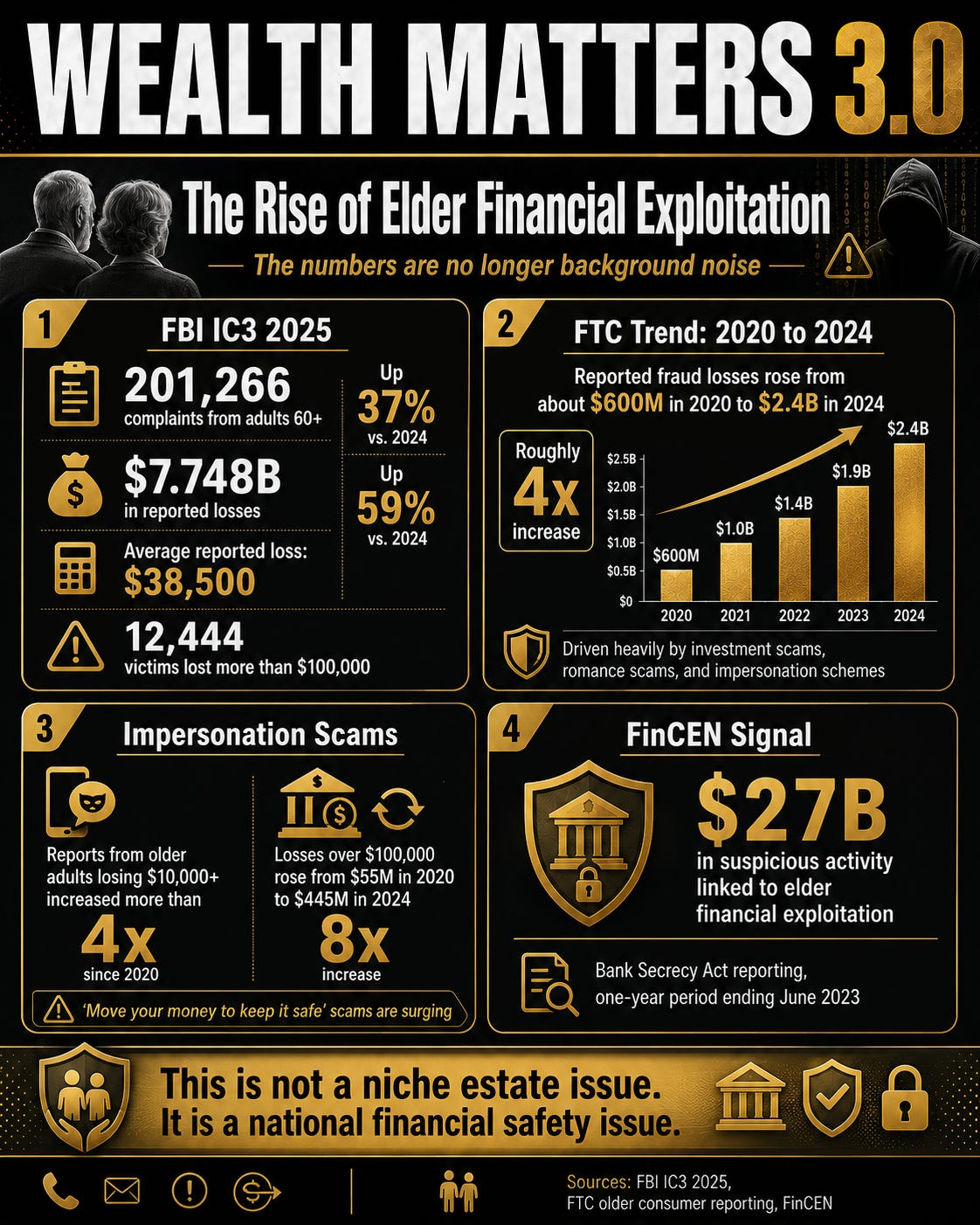
This topic deserves more urgency because the national data is moving in the wrong direction.
The FBI’s 2025 IC3 Annual Report showed 201,266 complaints filed by people age 60 and over, up 37% from 2024, with $7.748 billion in reported losses, up 59% from 2024. The average reported loss was $38,500, and 12,444 older complainants lost more than $100,000.
The FTC’s older-consumer reporting tells the same basic story from another angle. Reported fraud losses by adults age 60 and over increased roughly fourfold from about $600 million in 2020 to $2.4 billion in 2024, with much of the increase driven by six-figure losses, including investment scams, romance scams, and impersonation schemes.
The most frightening growth may be in the “move your money to keep it safe” category. FTC analysis found a more than fourfold increase since 2020 in reports from older adults who lost $10,000 or more to business or government impersonation scams. Reported losses among older adults who lost more than $100,000 to these impersonation scams increased eightfold, from $55 million in 2020 to $445 million in 2024.
And even those numbers may not fully capture the size of the problem. FinCEN reported that about $27 billion in suspicious activity linked to elder financial exploitation appeared in Bank Secrecy Act reporting over one year ending in June 2023.
So when we talk about putting “locks” on the family financial house, this is not paranoia. It is not fear marketing. It is not treating aging parents like children. It is recognizing that a massive transfer of wealth is underway, aging adults are a prime target, and shame, confusion, isolation, caregiver fatigue, and family silence are part of the attack surface.
The point is not to make your parents afraid. The point is to make the system safer before somebody tests it.
A Word About August’s Ecosystem Partner
Before we get into this topic further, I want to thank one of our Wealth Matters 3.0 ecosystem brand partners and Wealth CMDR PRO Subscribers: PEBL.
PEBL is a company I personally use across my own portfolio companies and personal strategy because hiring abroad or remotely should not require founders, operators, family offices, or distributed teams to spend months building employment infrastructure before they can bring great people into the business.
Hiring abroad or remotely can take months when you do it on your own, but with PEBL you can hire in over 185 countries in minutes and have your new hire onboarded by Monday.
PEBL is normally $399 per month per employee — already a no-brainer for what you get — but right now there’s a limited-time offer on their site that makes it even easier to get started.
Go to hipebl.ai.

Terms and conditions apply.
The Warning Signs Are Boring Before Dramatic
The first audience question was simple and brutal:
What are the warning signs of elder financial abuse before a parent is legally incapacitated?
Matt’s answer was honest. It can be hard to know.
When someone has fallen for a scam or is being manipulated, embarrassment can become part of the problem. The victim may hide it. They may not want to tell their children. They may feel ashamed. They may defend the person exploiting them because admitting the truth would mean admitting vulnerability.
That is why families often discover the abuse through activity rather than confession: unexplained withdrawals, a new person on a joint bank account, creditor complaints because bills are going unpaid, abrupt changes to a power of attorney, missing property, jewelry disappearing after a caregiver or cleaning person comes through the home, or a new person isolating the parent from the children and controlling the phone.
That last one matters. Isolation is often the predator’s oxygen.
The predator does not always need to steal first. Sometimes they separate first. They create emotional dependency. They interrupt communication. They become the translator, helper, rescuer, gatekeeper, driver, errand-runner, bill-payer, comforter, and complaint department. By the time money moves, the relationship has already moved.
This is why families cannot treat financial abuse as only a financial issue. It is emotional, relational, logistical, access-based, and often made possible by loneliness, confusion, embarrassment, caregiver overload, and the silence families maintain because nobody wants to sound accusatory.
Matt also pointed to cognitive signs that are easy to explain away. Short-term memory often goes first. A parent may remember stories from childhood with perfect emotional detail while losing track of what happened yesterday. They may not know the season. They may struggle to repeat three objects later. They may be thinking in old pictures while losing the things right in front of them.
That phrase stayed with me. Thinking in old pictures.
It is compassionate. It is also useful, because families often misread emotional vividness as capacity. A parent can tell a beautiful story about 1958 and still be unable to manage a scam call in 2026. They can sound like themselves and still be vulnerable. They can laugh, remember, charm, and bless the grandkids while losing the ability to track account activity, new forms, unusual withdrawals, or the motives of a new person who suddenly cares a little too much.
Capacity is not one switch. It is a dimmer. That makes prevention harder. It also makes prevention more necessary.
The Caregiver Can Become the Second Patient
One of the most important parts of the conversation was not about the elder being exploited. It was about the spouse or family member trying to protect them.
I described a pattern many Gen X children will recognize. A couple in their seventies may still seem highly functional. Both are healthy enough. Both are active enough. Nobody is in crisis yet. But slowly, one spouse starts carrying more of the daily load. One spouse now owns the passwords. One spouse now handles the bank logins. One spouse now answers the doctors. One spouse now schedules the appointments. One spouse now covers for the other. One spouse now quietly absorbs the stress of keeping the household appearing normal.
That may not be a red flag by itself, but it is a signal.
Matt put it plainly: you can watch the caregiver age before your eyes because of the stress, extra responsibilities, and decision burden.
That is one of the quiet tragedies inside aging families. The person being cared for is visibly declining. The caregiver is silently eroding. And because the caregiver is the one still “holding it together,” nobody realizes they are becoming the next vulnerability.
This is where the problem can move from slowly to suddenly. Missed appointments. ATM withdrawals. Missing statements. Unpaid obligations. The couple stops seeing friends. They stop playing golf. They stop going to bridge. They stop doing the ordinary activities that used to keep the social system around them alive.
Then one day the kids realize the parents have not merely aged. They have become isolated. And isolation, again, is where exploitation thrives.
The answer is not to storm into the house and accuse everyone of incompetence. The answer is contact, conversation, observation, regular visits, bank alerts, trusted contacts, clear powers, documented roles, and a family culture where help does not feel like a coup.
Matt said families need to keep contact during those later years so they can see warning signs and get into a place where they can help.
That is not legal advice. That is human advice. And it may be the most important advice in the whole episode.
Four favors before you continue.
Hit the ❤️. The algorithm is a validation machine that needs your cheap dopamine to keep us in the top of your feed.
Hit the 🔄 restack. Somebody’s life will change passively today and you can get the credit for bringing it to them from both of us.
Hit 📤 share. You know exactly one person in your email list or text stream who needs something on their playlist or reading wire today.
Drop a comment. Tell me your biggest insight, your greatest challenge, your counter-argument or gap in the conversation, or a recent related triumph. I read every one, and I reply to the ones that make me laugh, make me think, or make me money. Preferably all three.
A Power of Attorney Is Not a Magic Wand
The second major topic was incapacity.
What happens if someone becomes incapacitated and there is no power of attorney in place?
This is where the prevention conversation gets very real. Matt explained that if a person lacks capacity and has not already signed the proper documents, the family usually has to go to court. Depending on the state, that may involve guardianship, conservatorship, or similar proceedings. A guardian is typically tied to the person’s well-being and medical decisions. A conservator is tied to the finances, bills, and estate. The same person can sometimes serve both roles, but the law separates the functions for a reason.
That process is not just inconvenient. It is expensive. It can involve a judge, a guardian ad litem to protect the person losing rights, a court visitor to verify care conditions, doctors or psychologists, attorneys, and paid professionals. Matt’s point was blunt: all these people get paid, and that is why the process can become expensive.
But cost is only part of it. The emotional cost may be worse.
I shared a family example from my own orbit. A person well into their nineties had remained high-capacity for a long time, driving, functioning, and mentally sharp. Then the decline came quickly. One day there was a call about going to the bank for $10,000. The person no longer had a car, had knocked on a neighbor’s door for a ride, and could not explain why the money was needed. There was financial power of attorney in place, but the medical side was less clear, and the situation ultimately required a public process around capacity.
That is the part nobody wants. A person who has lived with dignity for nine decades may now have to stand in front of a public process where doctors or psychologists testify that they cannot safely manage themselves anymore. Matt noted that when this is done proactively, the family may only be talking about financial capabilities or trustee succession. In court, however, the rights at stake can feel much broader and more humiliating.
This is why timing matters.
When you plan in advance, you can define the trigger. Maybe two children acting unanimously can determine that Dad should no longer write checks or serve as his own trustee. Maybe a doctor must sign. Maybe two doctors must sign. Maybe the successor trustee role changes under defined conditions. Maybe the medical power and financial power go to different people because the child who can pay bills is not the child who should make health decisions.
When you wait too long, the court defines the trigger. That is the difference between architecture and emergency construction.
Alive, Capacity,and Signature Capable
Matt gave one of the simplest explanations of a power of attorney I have heard.
To create a power of attorney, three things matter:
You need to be alive,
You need capacity, and
You need to be able to sign.
If you do not have all three, you are not getting another power of attorney.
That sentence should be taped inside every family file.
Families often wait until the moment they need authority to ask whether authority exists. That is backwards. A power of attorney is a living document. It dies when you die. “Durable” means it can survive incapacity. It does not mean it survives death.
A medical power of attorney handles medical decision-making and should usually include HIPAA access so the agent can speak with doctors. A financial power of attorney handles money, assets, accounts, bills, and other financial matters. Those powers do not necessarily cross over.
This matters because the person who is great with money may not be the person you want making medical decisions. And the person who is compassionate at the bedside may not be the person you want controlling brokerage accounts, entity interests, beneficiary forms, and bill payment.
Families blur those distinctions emotionally. The law does not. A good plan respects the difference.
The Christmas Lights Problem
The most useful metaphor of the episode came from Matt’s explanation of power of attorney powers.
Someone once described it to him like a string of Christmas lights. Each color is a different power. The whole string is plugged into the principal. If the principal does not want the agent to have certain powers, you remove those colors from the string.
That image is simple enough to remember and important enough to use, because a lot of people treat power of attorney documents like one generic yes-or-no switch. It is not that simple.
A power of attorney can be limited or broad. It can give an agent real estate powers without giving them bank account powers. It can give authority to sell a house without giving authority to change beneficiaries on life insurance or IRAs. It can authorize compensation. It can authorize gifts. It can allow self-dealing if drafted that way. Or it can restrict those powers.
This is where families must be careful.
The wrong power in the wrong hands can become confiscation with paperwork. The right power in the right hands can prevent a court battle. That is the paradox.
Power is necessary. Power is dangerous. The answer is not to avoid authority. The answer is to design authority with guardrails.
Trusted contacts at brokerage firms can help. Alerts can help. Withdrawal thresholds can help. Account monitoring can help. Credit freezes can help. Banks may have procedures that allow them to pause suspicious transactions when exploitation is suspected.
But the first guardrail is still the document.
What powers were granted? To whom?
Under what conditions?
With what limitations?
With what oversight?
With what backup agent?
With what access to information?
With what ability to remove a bad actor?
Most families do not ask those questions until they are already angry. That is too late.
When You Suspect Theft, Start With the Timeline
Another audience question was direct:
What do I do if I suspect a caregiver, family member, financial advisor, or someone else is stealing from me or from my parent?
Matt was careful here because litigation is not the area he specializes in. That honesty matters. Good advisors should tell you when a question is outside their lane.
But there were still practical steps. Adult Protective Services, or whatever the equivalent agency is called in your state, is often the primary agency that investigates allegations of abuse, neglect, or exploitation. They may have hotlines and resources that can direct you.
You may also talk to the bank if you know the exploitation is happening through one institution. In some states, financial institutions may be empowered or required to pause suspicious transactions and report potential exploitation. Matt mentioned receiving calls from financial institutions asking whether a client seemed okay because the institution had noticed suspicious behavior.
You can file a police report. You can work with an elder law attorney to revoke or freeze a problematic power of attorney or freeze accounts if the suspected bad actor has authority. But before the family turns the whole situation into expensive litigation, I suggested something simple:
Build the timeline.
When did you first suspect something?
What was the signal? A bank statement? A missing item? A weird phone call? An unusual email? A creditor notice? An ATM receipt? A canceled check? A new person on an account? A change in behavior? A missing statement? A strange explanation?
Document it. Put it somewhere. Start turning feelings into facts. That does not mean you wait when someone is in danger. It means you do not walk into a serious accusation with nothing but vibes.
Exploitation benefits from confusion. Families need chronology.
Trusts Can Carry Instructions That Powers of Attorney Often Do Not
As the conversation moved into higher-net-worth families, we shifted from emergency response to structure.
For families with $2 million to $30 million of net worth, and especially families with multiple accounts, entities, operating companies, trusts, or asset protection structures, the question becomes: who do we trust as fiduciaries, and how do we keep those people honest?
Matt explained that revocable trusts are often used to take care of a person during incapacity and help avoid probate. A revocable trust may not provide asset protection in the same way an irrevocable structure can, because the grantor can generally revoke it, but it can still be an important continuity tool.
The key is identifying the right people ahead of time.
A trustee has a fiduciary duty, a high standard of care, and a duty to benefit the beneficiaries. If the trustee and beneficiaries are different people, that can create checks and balances because beneficiaries can complain if they see the trustee depleting the inheritance contrary to the trust terms.
Matt also explained why trusts can be more robust than powers of attorney. A power of attorney may say the agent has the right to access a bank account or change a beneficiary. A trust can go further and give instructions about how money is supposed to be used, what the trustee must take care of, and what the purpose of the access is.
That distinction matters. Authority without instruction is dangerous. Instruction without authority is useless.
A good trust combines both.
Irrevocable Does Not Mean Frozen Forever
We also talked about irrevocable trusts. This is where many families get confused.
Irrevocable does not mean nothing can ever change under any circumstance. It means the trust is not as easy to revoke as a revocable trust. That difficulty can be part of the protection. If the grantor cannot freely revoke the trust, creditors may have a harder time reaching the trust assets depending on the structure, jurisdiction, timing, and facts.
But life changes. Trustees age. Managers retire. Beneficiaries fight. Spouses enter. Advisors change. Markets change. Families change. Documents written with no flexibility can become traps.
Matt warned about trusts that name a seventy-year-old manager who may retire soon but is written into an irrevocable structure as distribution trustee, administrative trustee, or manager. If the trust does not provide a way to replace that person, the family may face unnecessary friction later.
This is where trust protectors or trust advisors can matter. A trust protector may have powers written into the document that allow them to remove trustees, adjust certain provisions, or help solve problems without destroying or decanting the whole trust.
That is the design tension: control and flexibility, protection and adaptability, privacy and accountability, irrevocability and real life.
A good structure does not pretend life will stay still. It gives the family enough rules to prevent chaos and enough flexibility to survive the future.
Free Office Hours Is the Gateway. The Playbook Lives Behind the Paywall.
The conversations on ATOMIQ LEVEL and the article follow-ups are ALWAYS free, because the insights and access to the discourse with the most brilliant minds in finance, business, and tech that I benefit from are my generous and strategic gateway drug.
The other side of the paywall is where you get the full playbooks, the office hours, and the archives distilled in a broader and more actionable context.
It is where, for $1 per day or less, you can go from conversation to planning and protecting your net worth and your net happiness.
So I will see you over there and welcome you to your journey of becoming a true Wealth CMDR.
Everybody Has an Estate Plan. The Question Is Whether You Chose It.
Toward the end, I asked Matt for a simple framework.
Everyone’s complexity is different. One person has millions of dollars sitting in one account in one personal name with no locked door. Another has a will from a few years ago. Another has a revocable trust, multiple LLCs, operating companies, asset protection trusts, and maybe even a private family trust company.
Different complexity. Same concern. If clear communication does not exist, problems will occur, crises will magnify, and pain will ensue.
Matt’s first answer was simple: “Figure out what your estate plan is and who designed it.”
Some people say they do not have one. That is usually not true. If you do not have a written plan, the state has one for you. The statutes determine where property goes, who handles it, and what process applies.
That can create surprising outcomes. A single person with no children may assume it does not matter. But assets may go to siblings. If those siblings include people on special needs benefits, Medicaid, or other programs, an unexpected inheritance can create problems.
So the first question is not, “Do I have a fancy plan?”
The first question is:
Am I okay with the plan that already exists by default?
If not, change it.
Matt then added another important question:
Do you have a champion in your corner?
Is there someone who will figure this out when you cannot? For single clients especially, Matt said the lack of a person who really cares can make a written plan even more important. Without a champion, money may not go where the person wanted it to go.
That is a profound point. The plan is not just paperwork. It is people.
Who cares enough to act?
Who knows enough to act?
Who has authority to act?
Who has instructions for how to act?
Who has the temperament to act?
Who has the courage to act when the rest of the family is emotional?
That is the champion question.
The Ladder of Complexity
Matt then walked through the ladder. At the most basic level, find out what the state plan does. If you do not like it, talk to an estate planning attorney about a will or trust. If probate is expensive or undesirable, consider how to avoid it.
If you have children, Matt’s opinion is that a trust-based plan often makes sense because minor children cannot simply receive and manage assets the way adults can. You need people in place to protect them, keep them out of foster care, and make decisions if something happens to both parents.
Then, as complexity rises, business owners need to separate personal assets from business assets. That may mean LLCs, holding company structures, or other entity architecture designed to prevent a business problem from endangering personal wealth or vice versa.
Then, when the amount being left to children becomes meaningful enough to restart a life or ruin one, families may need to think about creditor protection, spouse protection, and irrevocable structures for beneficiaries. That amount might be $250,000, $500,000, $20 million, or more. The number is family-specific, but the principle is the same: if the inheritance is large enough to matter, it is large enough to protect.
Then, for families who want to protect some portion of assets for themselves, especially from future creditors or spouse-related risks, they may look at domestic asset protection jurisdictions. Matt referenced the states that allow certain asset protection structures and the importance of building that planning before trouble begins.
That last part is critical. You cannot wait for the creditor to call and then start hiding money. The law does not like that. Proactive planning is asset protection. Reactive hiding is a problem.
Put Locks on the Bank Account Like You Lock the Front Door
Matt’s closing thought may be the line that makes the whole conversation usable.
Be proactive. Do not be scared to talk to an attorney. Do not be scared to talk to your parents. Approach it as help, not confiscation.
“We are going to put some locks on your bank account, just like we want you to lock the front door at night. We do not want to take anything away from you. We just want to make it safer.”
That is the emotional framing families need.
Parents fear losing independence. Children fear sounding greedy. Spouses fear ruining the relationship. Siblings fear starting a war. Advisors fear overstepping. Everyone waits for a safer moment.
The safer moment rarely arrives.
So the conversation has to be reframed. This is not about taking power away. It is about making power safer. This is not about treating Mom or Dad like children. It is about protecting the dignity they spent a lifetime earning. This is not about assuming the worst. It is about acknowledging that the worst usually comes from the direction we would never personally choose.
I said near the end that the thing that sends us into crisis mode is often the thing we would never consider doing to someone else. Because we would never do it, we do not prepare for the person who would.
That is how exploitation gets in. Not because the family is stupid. Because the family is decent.
The Wealth Transfer Will Attract Scavengers
We also have to be honest about the scale of what is happening.
There is a massive transfer of wealth underway. We have written about the estimate of $124 trillion over roughly the next 22 years, about $5 trillion a year changing hands, regardless of what markets do.
That transfer will not move cleanly. There will be leakage, confiscation, exploitation, family conflict, estate plans that were never updated, powers of attorney that grant too much power to the wrong person, children who do not know what exists, surviving spouses who do not know where the accounts are, caregivers who become overburdened, advisors who should have been replaced years earlier, documents nobody can find, parents too proud to ask for help, and kids too polite to ask the necessary question.
There will be assets that become unclaimed property because nobody knew how to move them. There will be businesses that fail because the founder never transferred the operating system out of their own head.
That is not fear-mongering. That is the gravity of ownership.
And the answer is not to obsess over every possible bad thing all the time. The answer is to ask the simple questions: what is the goal, who am I trying to protect, who am I trying to benefit, what mess am I trying not to leave behind, what authority needs to exist before crisis, what locks need to go on the doors, and what conversations need to happen while people can still participate with dignity?
Why You Should Press Play
Press play if you have aging parents and you are not sure how to tell the difference between normal aging, caregiver stress, and the first signs of exploitation.
Press play if you want to know the warning signs of elder financial abuse before someone is legally incapacitated.
Press play if your family has not clearly separated financial power of attorney from medical power of attorney.
Press play if you do not understand the difference between guardianship, conservatorship, and a power of attorney.
Press play if you want to understand why waiting until incapacity often means inviting the court into a conversation your family could have had privately earlier.
Press play if someone in your family has access to accounts and you are not sure what powers they actually have.
Press play if you want to know why a power of attorney can be limited, broad, dangerous, or protective depending on how it is drafted.
Press play if you are worried that a caregiver, family member, advisor, companion, or new person in your parent’s life may be influencing money decisions.
Press play if your plan depends on a revocable trust, irrevocable trust, asset protection trust, or trustee structure you have not reviewed in years.
Press play if you have minor children and have not named the people who would protect them, make decisions, and manage assets if something happened to both parents.
Press play if you are a business owner who has not separated personal assets from business assets.
Press play if you are leaving enough money to children that it could materially change their lives and have not considered how to protect it from creditors, divorces, predators, exploitation, or poor decisions.
Press play if you are single and assume estate planning does not matter because you do not have a spouse or children.
Press play if you want a practical ladder for moving from a default state plan to a written plan, trust-based plan, entity plan, beneficiary protection plan, and more advanced asset protection architecture.
And press play if you understand that the real plan is not the binder.
The real plan is whether the people you love can act safely when you cannot explain it to them.
The lock goes on before the burglary. The trustee is named before the incapacity. The medical power is signed before the surgery. The financial power is limited before the agent goes wild. The trust protector is added before the trustee becomes a problem. The family conversation happens before the bank call. The attorney relationship exists before the crisis. The plan is updated before it fails.
This is not about fear. It is about stewardship.
It is about honoring the people you love enough not to leave them a mystery. It is about protecting your net worth and your net happiness. It is about seeing the transfer before the scammers, scavengers, and opportunists do. It is about becoming a true Wealth CMDR before crisis forces someone else to command the field for you.
Join us every Wednesday for Shields & Succession / Ask Matt Anything Office Hours on ATOMIQ LEVEL.
If you would like to discuss this personally with Matt or one of his team:
Colorado residents can call 970-820-0090.
Residents from all 50 states who want to discuss Wyoming asset protection strategies, trust planning, and related preventive architecture can call 307-463-3600.
The real risk is doing nothing.
~Chris J Snook
Thank you to everyone who tuned into my live video! Join me for my next live video in the app.