Rod Dubitsky’s first day on Wall Street was October 19, 1987. If you know the date, you already know the punch line.
Black Monday.
He had just finished his MBA at Duke and joined the mortgage-backed securities trading desk at Bank of Boston. He spent years learning that markets are efficient, capital is rational, and sophisticated institutions are sophisticated for a reason. Then his first day at work coincides with what was, at the time, the largest one-day percentage collapse in modern U.S. stock-market history.
That is one hell of an orientation program.
Rod told me that experience immediately started reshaping the way he thought about capitalism and financial markets. It wasn’t that markets did not work. It was that markets could work extraordinarily well right up until incentives, leverage, liquidity, and human behavior caused the machinery to behave in ways the textbooks had not prepared you for.
Then his career kept putting him in the room when the machinery malfunctioned.
After briefly relocating to Los Angeles—where he crashed on a friend’s couch, played the horses to help make rent and did some acting at night—he decided an MBA probably ought to produce something resembling a conventional job. He landed at the Federal Home Loan Bank in the middle of the savings-and-loan crisis. From there he became chief investment officer of an S&L that actually survived the period intact, managed mortgage-backed securities and corporate bonds for Bank of America, and eventually moved to Moody’s.
That is where the story starts becoming particularly relevant to what he sees today.
At Moody’s, Rod worked around mortgage securitizations and watched lower-rated mortgage assets get bundled into new securities. In one part of the organization, junk and near-junk mortgage bonds might support something in the BB or BBB range. Then another product emerged—the asset-backed CDO—where similar underlying risks could be transformed through financial engineering into securities carrying AAA ratings.
Rod remembers looking at that process and asking the question that sounds almost embarrassingly obvious in hindsight:
How are we getting AAA out of this?
That question eventually followed him to Credit Suisse.
By the mid-2000s, his research platform was tracking the deterioration in mortgage underwriting: no-income/no-asset loans, silent second liens, option ARMs and many of the structures the rest of the world would learn about only after they became toxic vocabulary.
He wasn’t watching The Big Short. He knew some of the people who became characters in it.
And when his research told him the rating agencies were badly behind reality, he said so publicly. Rod recalls publishing work arguing that roughly 90% of a group of subprime bonds deserved downgrades at a time when only about 3% had been downgraded. Bloomberg picked it up. Shortly thereafter, S&P began downgrading hundreds of mortgage securities, disrupting the origination machine that depended on those ratings.
This matters because anybody can tell you after a crisis that leverage was too high. Rod’s professional biography is mostly a story of repeatedly finding himself inside the plumbing before the pipe bursts.
Black Monday.
The savings-and-loan crisis.
Mortgage securitization.
The rating agencies.
The subprime buildup.
The Global Financial Crisis.
Post-crisis advisory work with major governments and central banks.
Then, in an almost absurd career pivot, nearly a decade working in global development in places such as South Sudan, Sierra Leone, Liberia and Myanmar before returning to his analytical roots and building The People’s Economist alongside an independent investigative-journalism practice.
So when Rod Dubitsky tells me he thinks another structure deserves scrutiny, I didn’t automatically conclude that he is right. But I definitely paid attention with both ears.
And this time, the structure is much closer to your kitchen table than most people realize.
It sits inside the insurance industry.
It connects annuity premiums, life-insurance reserves, private credit, collateralized loan obligations, private-equity ownership, offshore reinsurance and—now increasingly—some of the capital being mobilized around the enormous AI infrastructure buildout.
Which brings us to the question I kept coming back to during our ATOMIQ LEVEL Episode 60 conversation:
If your retirement income or your family’s death benefit depends on an insurance company making good on a promise twenty years from now, how much do you actually know about the company making the promise?
Connect With Rod Dubitsky
Rod publishes investigative financial work on Substack and through The People’s Economist / TPE Hub. Part of what makes his work useful is that he is willing to go where most financial commentary does not: statutory insurance filings, ownership structures, affiliated transactions, and the footnotes underneath the headline.
Near the end of our conversation, I encouraged listeners to follow and subscribe because this kind of pattern recognition is difficult to manufacture. Rod spent decades inside the institutions and products he now analyzes independently.
Subscribe to Rod on Substack → Click Here
The People’s Economist / TPE Hub https://www.tpehub.com/
Disclaimer: This article is educational and is not individualized investment, insurance, legal, or tax advice. Life insurance and annuity contracts can be highly specific. State guaranty-association rules vary. Replacing, surrendering, exchanging or borrowing against an existing policy can produce surrender charges, tax consequences, loss of guarantees or new underwriting requirements.
The goal here is not to make you afraid of insurance. It is to make you a more informed owner of it. Because if you have spent your life building wealth, the word guaranteed should not end your due diligence. It should begin it.
Five Things to Do Before You Continue
1. Hit the ❤️. It helps signal that this kind of independent, long-form work deserves to stay in your feed instead of being buried under whatever the algorithm decided you were supposed to care about today.
2. Hit the 🔄 restack. Somebody in your network owns an annuity or a meaningful life-insurance policy and has probably never once thought about the insurer’s balance sheet. You may be the reason they do.
3. Hit 📤 share. Text it. Email it. Send it to the advisor, parent, business partner, or family member who needs to see it. Information is only valuable when it reaches somebody in time to use it.
4. Drop a comment. Tell me what this makes you want to investigate in your own financial architecture. I read the comments because the collective intelligence underneath these conversations is often as valuable as the interview itself.
5. Subscribe. Wealth Matters is reader-supported and independent by design. I love doing this in service of the people who value what I, my collaborators, and my guests are trying to build here. Thanks for subscribing, upgrading, and engaging each and every time.
The Product You Bought Is Not the Asset That Backs It
This is the mental shift I want you to make first. When somebody buys an annuity, they tend to focus on the annuity.
What is the rate?
What is the cap?
What is the participation rate?
What income does the rider produce?
How long is the surrender schedule?
When does income begin?
Those are legitimate questions. But the annuity is a liability on somebody else’s balance sheet. Likewise, when you buy life insurance, you think about the death benefit, premium, cash value, or estate-planning purpose. The insurance company thinks about something else too:
How do we invest the money backing that liability?
That is where the research accompanying my conversation with Rod becomes difficult to ignore.
My research estimates that U.S. life insurers held approximately $807 billion in private and illiquid credit at year-end 2025, representing about 20% of the industry’s roughly $4 trillion fixed-income portfolio. That was up from approximately $685 billion only one year earlier. U.S. insurers also held $276.8 billion of CLOs at year-end 2024, with life insurers accounting for roughly 82% of that total.
Put differently, the safe-looking product sitting in your retirement plan may be connected several layers downstream to assets that look nothing like the brochure.
That does not make the product bad. It means there is a second layer of analysis.
What is behind the promise?
How Insurance Became One of Private Credit’s Most Important Sources of Fuel
The relationship between large alternative-asset managers and insurance companies did not emerge by accident.
It is strategically elegant.
Insurance companies need long-duration assets to support long-duration liabilities. Private-credit managers need large, stable pools of capital. Annuity customers provide capital that may remain inside the insurance system for years or decades.
That makes insurance extraordinarily valuable to an asset manager.
The supplemental research estimates that insurance capital now provides roughly 43% of credit assets under management at the seven largest alternative managers, compared with 32% in 2021. It also estimates that private-equity-backed carriers have grown from less than 20% of the fixed-indexed-annuity market a decade ago to roughly 37%–40% today.
The ownership map now includes relationships such as Apollo and Athene, KKR and Global Atlantic, Carlyle and Fortitude Re, Blackstone-managed insurance platforms and Ares-backed Aspida. The research describes a broader model in which the alternative manager, insurer and potentially an affiliated reinsurer become economically connected.
Again, I am deliberately resisting the easy headline. Private-equity ownership does not automatically make an insurer unsafe. Private credit does not automatically mean bad credit. Sophisticated asset management can improve investment capabilities. But ownership changes incentives. And when ownership changes incentives, you should understand what those incentives are.
Rod’s concern is that an insurer competing aggressively for annuity deposits may need higher investment returns to support attractive credited rates and profitability. Once the business model is built around those higher-yielding assets, retreating can be difficult without giving up growth, shrinking the balance sheet or reducing returns.
That’s not conspiracy. That’s economics.
A Word About Our Ecosystem Brand Partner
Before we go further, I want to thank one of our Wealth Matters 3.0 ecosystem brand partners and Wealth CMDR PRO Subscribers: PEBL.
PEBL is a company I personally use across my own portfolio companies and personal strategy because hiring globally or remotely should not require founders, operators, family offices, or distributed teams to become experts in employment infrastructure before they can hire great people.
PEBL helps companies hire internationally while handling much of the employer-of-record complexity.
Go to hipebl.ai.

Terms and conditions apply.
Rod Connected Insurance Capital to the AI Buildout
This is where our conversation moved from an insurance story into something much bigger. Rod is also deeply skeptical of portions of the current AI capital cycle.
Not because he thinks AI is fake. That would be ridiculous.
He uses AI heavily himself. He built machine-learning tools before ChatGPT existed and has integrated modern language models into The People’s Economist.
His criticism is not technological. It is financial.
He looks at the extraordinary capital expenditure flowing into data centers, chips, power infrastructure, and AI platforms and asks the same question he has asked throughout his career:
Where is the cash flow that ultimately pays for all of this?
Rod’s concern is that enormous infrastructure commitments are being layered onto a still-developing revenue model, sometimes through off-balance-sheet or structured financing arrangements that receive ratings enabling the debt to move through institutional portfolios.
Then he started tracing who could ultimately fund some of those obligations. His answer brought him back to insurance balance sheets.
Rod described looking through positions held by Athene and tracing exposures through private-credit transactions, venture-related financing and structures connected indirectly to the AI capital ecosystem. His broader concern is that insurance balance sheets could become one of the places where some of the enormous financing required for AI infrastructure ultimately lands.
You don’t have to accept every individual interpretation to understand why this interests him. He has seen this movie before. Not the same assets. Not the same institutions. Not the same crisis, but the same recurring characters appear in almost every financial cycle:
Cheap or abundant capital, financial engineering, rating agencies, structures that move risk away from where the public thinks it sits, and a growing belief that this time the underlying asset is too important—or too transformative—to disappoint.
The Rating Agency Déjà Vu
If I had to identify the part of Rod’s background that makes me take his current concern most seriously, it is his experience with ratings.
Before 2008, the rating was often treated as the truth.
AAA meant AAA. Until it didn’t.
Today, the supplemental research raises a different but related issue inside insurer portfolios.
An NAIC review cited in the research found that ratings assigned by certain smaller private-credit rating providers averaged approximately two to three notches higher than the NAIC’s own assessments of creditworthiness.
Even more interesting, a June 2026 academic study cited in the report found that, when two securities carried the same nominal NAIC rating designation, privately rated bonds were roughly twice as likely to become impaired within one year as publicly rated equivalents.
The capital implication is meaningful.
Using a conservative two-notch adjustment to compensate for the potential rating difference would have increased required insurer capital by an estimated average of $4.5 billion annually from 2021 through 2025—roughly $22.6 billion cumulatively over five years, according to the supplemental analysis.
This does not mean the insurance industry’s ratings are fraudulent.
It means you need to understand there are two ratings problems hiding inside one policy.
There is the financial-strength rating assigned to the insurer.
Then there are the ratings assigned to the assets the insurer owns.
You can have a highly rated company owning a portfolio that itself contains layers of privately rated credit.
That distinction does not show up in the annuity illustration.
Bermuda Is Not the Problem. Opacity Is.
One of the easiest ways to sensationalize this topic would be to circle Bermuda on a map and make it look sinister.
That misses the point. Reinsurance is normal. Offshore reinsurance can be legitimate. Bermuda is a major global insurance jurisdiction.
The issue is whether you can understand where the obligation goes after the original insurer moves it.
The supplemental research says Bermuda represented more than 40% of total U.S. life-and-annuity reserves ceded in 2024 and more than 60% of reserves ceded in transactions effective during 2023–2024. It also says nearly 70% of offshore life-and-annuity reserves flowed to affiliated reinsurers, meaning the insurer, asset manager and reinsurer may sit under common economic control.
The estimated Bermuda life-and-annuity “sidecar” market has reportedly quadrupled since 2021 to approximately $375 billion of assumed liabilities.
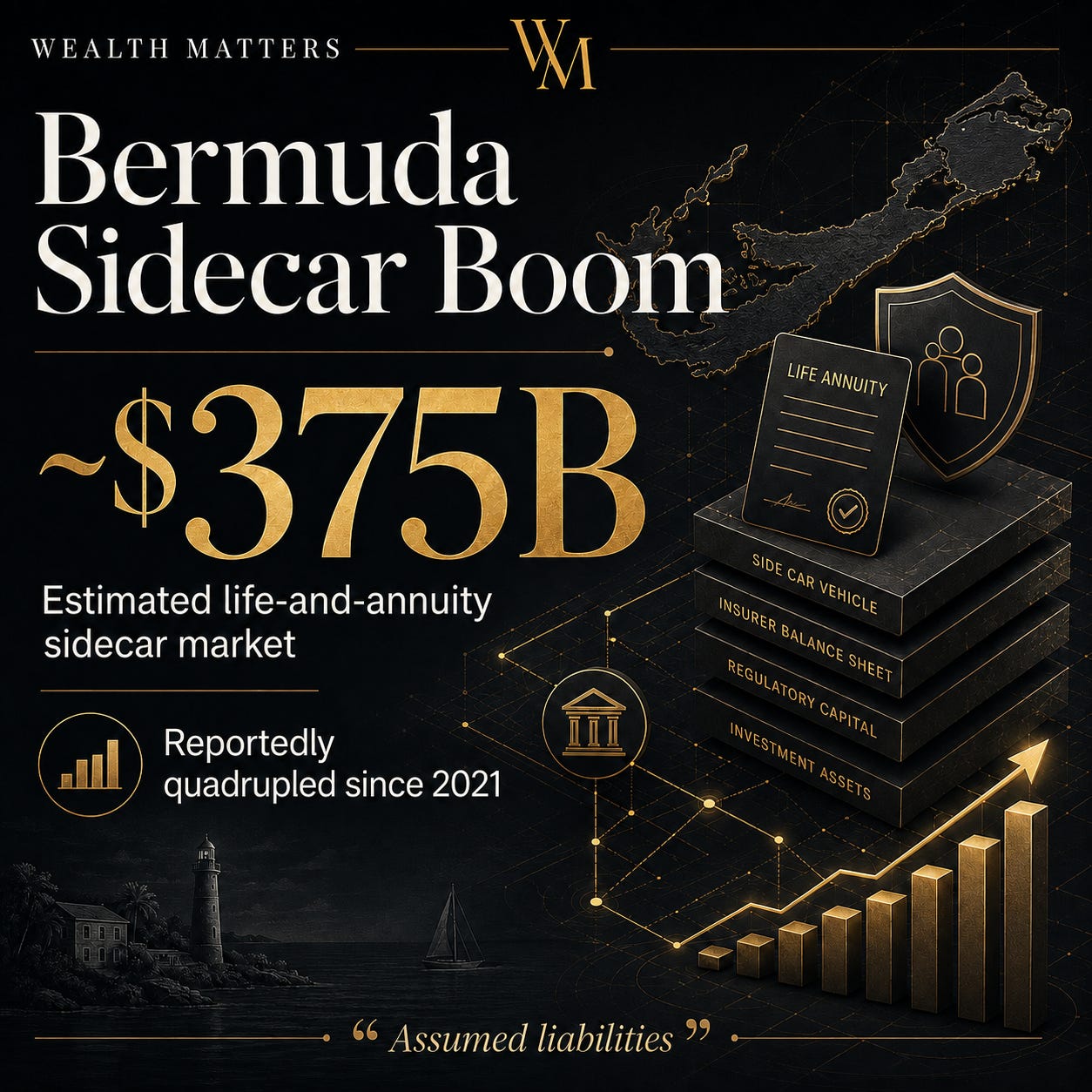
What bothered me most in the research was not the number. It was that many of these sidecars do not publicly disclose detailed investment allocations. Even the broker sitting between the carrier and the consumer may not have a transparent view into every asset supporting the reinsured block.
That’s where the Wealth Matters question to ask changes.
I don’t need my insurance professional to tell me Bermuda is safe or unsafe. I need someone to explain the chain of obligations.
If an insurer has transferred a meaningful portion of the obligations connected to my contract, I want to know:
Who is the reinsurer?
Is it affiliated with the original carrier or asset manager?
Where is it domiciled?
What is its financial-strength rating?
What assets and collateral support the arrangement?
What percentage of the relevant reserves have actually been ceded?
Those are adult ownership questions.
Rod Does Not Think You and I Should Become an Insurance Actuary
This was an important part of our conversation. At some point, macro risk becomes useless if the person listening cannot convert it into behavior.
People hear about private credit, AI bubbles, offshore structures, capital requirements, ratings arbitrage, and systemic risk, then eventually throw up their hands.
As I said to Rod, the reaction becomes something like:
Dude, what the hell does this mean to me? I have to trust something.
That paralysis is precisely why I think his next chapter as an independent journalist can be particularly valuable. Rod told me that part of the reason he created The People’s Economist was frustration with financial-literacy businesses whose economics depend on selling or referring the very products they rank. He wants a model that is more subscription-supported and less dependent on product-placement incentives.
That’s also where our missions overlap.
I don’t need every Wealth Matters reader to become a credit analyst. I want you to become a better owner and steward.
Owners know what they own.
Owners know who owes them money.
Owners know where the largest dependencies sit.
Owners know when they need somebody smarter than them in a particular domain.
Private Credit Is Not Automatically the Bad Guy
This point deserves more than a disclaimer. There is real evidence on both sides.
The supplemental research notes that AM Best has characterized insurer CLO exposure as manageable in part because CLO holdings remain a relatively limited percentage of total invested assets. It also cites a 2026 academic analysis finding that insurers with greater private-credit allocations actually showed lower estimated insolvency risk on average, with changes in those allocations not demonstrating a statistically detectable relationship with insolvency risk within the range studied.
That matters.
If you only read this article or listen to this episode to confirm that private equity is evil and every annuity is a ticking time bomb, you missed the article.
Other sources summarized in the research—including work from Moody’s, the Federal Reserve and the IMF—raise concerns about concentration, valuation, structural complexity, payment-in-kind exposure and potential differences in how illiquid credits behave under stress.
Both can be true.
Private credit can be a legitimate institutional asset class. And some insurers can still take too much of the wrong private-credit risk. That is why the correct question is not:
Does this insurer own private credit?
The better questions are about how much, what kind, how transparent, how rated, and how concentrated.
The “Reddit Run” May Look Nothing Like a Bank Run
Rod used a phrase during our conversation that I had not heard before: the Reddit run.
A traditional bank run involves depositors wanting their money immediately. Insurance is different. Liabilities are longer term. Policyholders don’t all show up at the same teller window at nine o’clock on Monday.
But information moves differently today.
Rod described monitoring online conversations surrounding insurers experiencing distress or liquidation. In one example, people were discussing multimillion-dollar life-insurance benefits and the uncomfortable realization that the contractual amount and the amount protected through a guaranty mechanism can be very different things.
His thesis is that a handful of visible insurance failures could create a consumer-confidence loop. Someone posts that their parent’s policy is trapped in an insolvency. Someone else checks their annuity carrier. A financial influencer posts a thread. A Reddit forum starts comparing companies. AI gives everybody a five-minute carrier dossier.
Suddenly the household that had never considered counterparty risk is calling an advisor asking whether to move money. That is not identical to a bank run. It can still change behavior.
“Guaranteed” Does Not Mean FDIC-Insured
This may be the most important practical distinction in the article.
Life-insurance and annuity customers benefit from state guaranty-association mechanisms when insurers fail. Those protections matter.
But they are not the same structure as federal deposit insurance.
The supplemental report says annuity coverage commonly ranges from approximately $250,000 to $300,000 in present value, with certain states providing higher limits—sometimes up to $500,000. The applicable protection is generally tied to the policyholder’s state of residence at the time of insolvency rather than simply the insurer’s headquarters or original point of sale.
Rod made the distinction bluntly in our discussion. FDIC-insured deposits, when properly within the applicable limits, carry a federal framework that is different from state insurance guaranty systems.
So suppose your household has an $800,000 annuity with one carrier. That does not mean $550,000 is doomed.
It means you need to understand what part of the exposure sits above the relevant guaranty limit and decide whether the concentration makes sense.
That’s a better way to think about it.
Risk is not the same as loss.
Risk is the possibility of loss that you have chosen to accept. The danger is accepting it without knowing it exists.
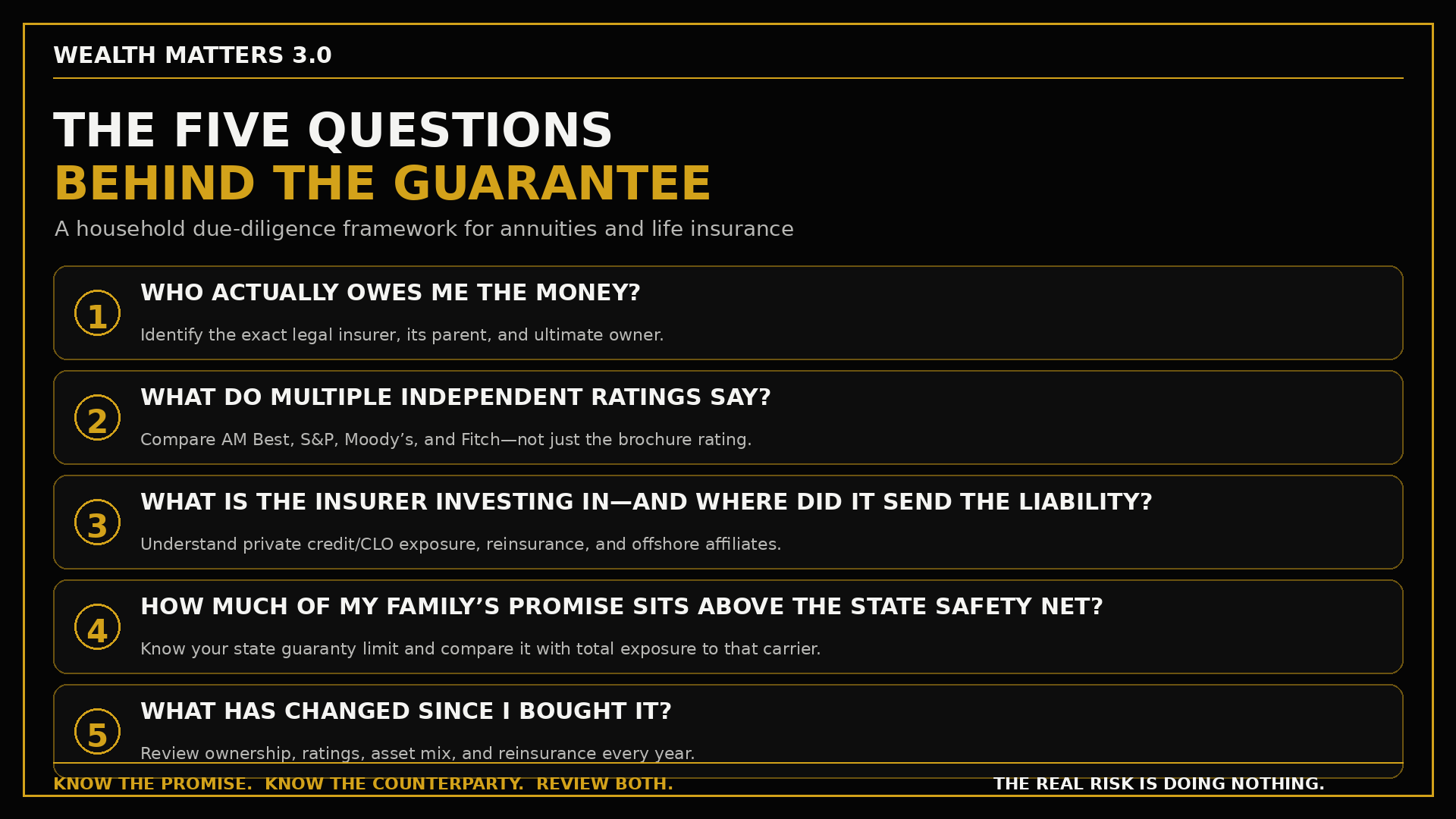
The Wealth Matters Five Questions Behind the Guarantee
This is the practical cheat sheet I want you to print off and hand to your advisor, and use in every meaningful annuity or permanent-life-insurance review.
Rather than burying it in another paragraph, I turned it into a standalone Wealth Matters graphic for the article:
The framework comes directly from the consumer due-diligence logic in the supplemental research:
Identify the actual legal insurer and owner,
Compare independent financial-strength ratings,
Investigate asset composition and reinsurance,
Understand state guaranty exposure, and
Keep monitoring after the purchase rather than treating due diligence as a one-time event.
The Legal Name on the Contract Matters More Than the Logo
One of the easiest mistakes is thinking you know the insurer because you know the brand.
Pull the actual contract.
Find the exact legal entity issuing the policy.
Then keep going.
Who owns that entity?
Is it mutual?
Public?
Privately held?
Owned by another financial-services organization?
Has the parent changed since you bought the policy?
Has part of the business been reinsured?
The research specifically recommends tracing the legal issuing carrier through its ultimate owner because product branding can obscure the entity that legally owes the obligation.
This is also where carrier diversification becomes more sophisticated than saying, “I have three annuities.”
Three annuities from one legal carrier are one counterparty.
Three different brand names can still potentially sit inside related corporate structures. Count promises by who owes them, not by how many pieces of paper you have.
Ratings Are a Starting Point, Not an Answer
The research recommends checking several major financial-strength agencies—AM Best, S&P, Moody’s and Fitch where ratings are available—and looking for consistency rather than relying on the single number presented in sales material.
This is a remarkably simple household practice.
If four sophisticated evaluators all land in roughly the same place, that tells you something.
If three are comfortable and one is deteriorating, that tells you something.
If a rating changes after years of stability, that tells you something.
None of those observations automatically tells you what to do.
It tells you what to investigate. Rod’s career is a reminder that ratings can lag. His response is not to ignore them. It is to question them intelligently.
If You Own a Large Annuity, Think in Terms of Carrier Concentration
Rod’s practical advice toward the end of our interview was straightforward.
Diversify.
Know the insurance company.
Read the news.
Question the ratings.
Use the information tools now available to you to put together a basic carrier dossier.
I would add one important implementation principle:
Do the math before you move the money.
If you discover that you have too much exposure to one carrier, the least intelligent response may be immediately surrendering a valuable contract.
You may have surrender charges. You may have guarantees you cannot replicate. There may be tax consequences. Interest-rate conditions may have changed. Your existing contract may still be economically attractive. The first move could simply be directing new money somewhere else. Diversification can be an allocation decision before it becomes an exit decision.
Life Insurance Requires Even More Patience
This is where counterparty fear can become actively dangerous.
Rod told me he personally canceled a Prudential policy after deciding he no longer needed the insurance and also deciding he was uncomfortable with the carrier exposure. He acknowledged that the decision cost him money.
That was Rod’s decision under Rod’s circumstances. You are not Rod.
If you bought life insurance when you were 42 and you are now 64, your health may have changed dramatically. You may not be able to replace the contract at the same economics. You may not be able to replace it at all. You may have cash value. You may have favorable guarantees. You may have estate-planning structures wrapped around it.
So if you become uncomfortable with the carrier, you do not start by canceling. You start by understanding.
Then, with qualified help, you evaluate what replacing or diversifying the risk would actually cost.
Never destroy an existing insurance bridge until you know the new bridge can hold your weight.
The AI Era Gives the Layperson a New Superpower
There is another reason I wanted to publish this guide now. Ten years ago, asking an ordinary household to investigate insurance-company statutory filings was almost comical.
Today, the information gap has collapsed.
Rod said during our conversation that someone sitting at home can use modern AI tools to build a basic dossier on an insurance company in a fraction of the time it would once have taken. Search the carrier. Ask about ownership. Find recent reporting. Ask what rating changes have occurred. Ask what regulators have said. Ask whether the business has been sold or reinsured.
That doesn’t mean AI becomes your insurance advisor. It becomes your research intern.
There is a difference.
AI can read the footnotes. AI can summarize ten filings. AI can identify the parent company. AI can compare ratings. AI can surface regulatory actions.
The part that still matters enormously is deciding what those facts mean in context. That’s where someone like Rod has an edge. He has lived through the incentives. He knows what it looks like when a financial structure behaves one way in the model and another way in the market.
That tacit knowledge is why I keep coming back to one of my biggest convictions:
Automate everything except trust.
Why Rod’s Story Is Really the Story
I could have written this article almost entirely from the insurance research. The statistics are fascinating.
$807 billion of private and illiquid credit.
$276.8 billion of CLO exposure.
43% of certain large alternative managers’ credit AUM now sourced from insurance capital.
Nearly 70% of offshore ceded reserves flowing to affiliated reinsurers.
A Bermuda reinsurance sidecar market estimated around $375 billion.
Those are important numbers. But they are not why I invited Rod onto ATOMIQ LEVEL. I invited him because numbers become more useful when you understand who is looking at them.
Rod’s worldview was not built in a newsletter. It was built on Black Monday. Then during the savings-and-loan crisis. Then inside Bank of America. Then inside Moody’s while securitization evolved. Then at Credit Suisse while the mortgage machine accelerated. Then while engaging policymakers during the Global Financial Crisis. Then at PIMCO helping governments and institutions deal with the aftermath. Then in a completely different world, working for a global development organization and seeing what finance, poverty, governance and institutional capacity look like outside Manhattan. And finally back at a computer, teaching himself enough coding to build financial tools while digging through thousands of pages of insurance-company filings that almost nobody else has the patience to read.
When someone with that path tells me the rating can be wrong, I listen.
When he says the legal structure matters, I listen.
When he tells me that a risk can appear years before the market decides it matters, I listen.
Not because he is guaranteed to be right. Because experience gives you pattern recognition. And pattern recognition is one of the few forms of intelligence that cannot be instantly commoditized.
Why You Should Press Play
If you only read this companion guide, you will understand the practical part.
The full conversation gives you the human with the unique experience to distill it and tell you what’s behind it.
Rod and I go through Black Monday, the savings-and-loan crisis, Moody’s, mortgage securitization, the characters around The Big Short, the rating agencies, private credit, private equity, the AI infrastructure boom, off-balance-sheet financing, the insurance system, regulatory architecture, the tension between the United States and China, and the increasingly important role of independent financial journalism.
We also spend time on something I think matters more than any specific prediction.
How do you distinguish being early from being wrong?
How do you keep analyzing a structure years before there is a catalyst?
How much weight should you place on rating agencies when you’ve personally watched ratings fail?
How do you investigate without becoming ideological?
And how do you take institutional financial complexity and make it useful to the person whose actual concern is whether the $3 million policy their family is depending on will still be there when it matters?
That is the bridge Rod is increasingly trying to build between his investigative journalism and The People’s Economist. I think that bridge is worth helping him build.
What I Would Do This Weekend
I am not giving you a recommendation about any particular insurer. I’m giving you homework.
Pull every meaningful annuity and life-insurance contract your family owns.
Build one page.
For each contract, capture the legal insurer, parent company, ownership structure, major financial-strength ratings, current exposure, applicable state guaranty limit and your last review date.
Then use the Five Questions graphic.
If everything looks boring, transparent and strong, congratulations. Boring is underrated.
If something makes you curious, investigate it.
If something makes you uncomfortable, take it to someone qualified who is not financially dependent on telling you that the product you already own is perfect.
And if the only answer you have for why you trust a carrier is “my advisor said they’re A-rated,” you don’t have enough information yet.
Final Thought
For most of my life, I thought of insurance as something that transferred risk. That is what it does. But the moment you transfer risk to someone else, you also create a new risk: The ability of the person or institution on the other side to perform.
That is counterparty risk.
And when the promise stretches twenty, thirty, or forty years into the future, counterparty quality matters.
None of this means annuities are bad.
None of this means life insurance is bad.
None of this proves an insurance crisis is imminent.
The supplemental research itself contains evidence suggesting that parts of the current private-credit exposure remain manageable.
That’s exactly why the takeaway should not be fear. It should be stewardship. The steward does not need to know when the next crisis arrives. The steward wants to know where the family is exposed before it arrives. The steward does not blindly trust the word guaranteed. The steward asks who made the guarantee. The steward understands the legal counterparty. The steward knows the concentration. The steward knows the protection limits. The steward reviews the structure periodically. And then the steward gets on with life.
That is the point of all this. Not to stare at the storm clouds. To know the roof is attached before the wind starts blowing.
Connect With Rod Dubitsky
Rod’s investigative work is increasingly focused on showing the receipts behind risks that are difficult to see from the surface. As he described during our conversation, his Substack currently leans toward deep-dive analysis while The People’s Economist contains more consumer-oriented financial tools and education. I think the opportunity sits in bringing those two worlds together.
The real risk is doing nothing.
~Chris J Snook
Thank you to everyone who tuned into my live video! Join me for my next live video in the app.