Why You Should Listen
I spend an unreasonable amount of time thinking about things most people understandably prefer not to think about.
What happens if I die unexpectedly? What happens if I am alive but incapacitated? What happens to the businesses? Where are the trusts? Who knows which entity owns what? Who understands why something was structured one way rather than another? Who calls the lawyer? Who talks to the CPA? Who knows which decisions require immediate action and which ones should absolutely not be made while everyone is grieving?
I have spent years architecting entities, investment structures, tax strategies, estate-planning tools, asset-protection mechanisms, and increasingly the technology that connects them. Yet during this week’s Shields & Succession conversation with estate-planning attorney Owen Hathaway, I had to acknowledge something uncomfortable.
The architecture may be sophisticated. But too much of the operating system still lives inside my head.
That distinction matters because I am not building these things primarily for myself. Like most people who spend their lives trying to build something, I am doing a substantial portion of it for the people I care about. In my case, that means my wife, my children, and whatever generations hopefully follow them.
During our conversation, I described what I have come to think of as the difference between “my way,” “your way,” and “our way.” After 23 years of marriage, there is no person on the planet whose judgment, loyalty, or contribution to our family I value more than my wife’s. Yet the very strengths that have allowed me to architect much of our financial world can create a weakness: when one spouse becomes the dominant designer, “my way” can quietly become “our way” without the family ever consciously designing it together.
That is not an estate-planning problem. It is a family operating-system problem, and I suspect far more successful families have it than they realize.
The Difference Between Having a Plan and Having a System
Most people with meaningful assets eventually accumulate documents.
A will. A revocable trust. Powers of attorney. LLC agreements. Insurance policies. Beneficiary designations. Operating agreements. Shareholder agreements. Investment accounts. Digital assets. Passwords. Tax returns. Maybe an irrevocable trust or asset-protection structure. Maybe several businesses across multiple states.
On paper, that can look like planning, but here is the question I think matters more:
If the person who architected everything disappeared tomorrow morning, could the people it was designed to protect actually operate it?
That question became particularly personal during our conversation. I admitted that despite the effort I have put into my own architecture, if something happened to me, there are areas where the rubber would not meet the road as smoothly as I would want. The reason is not that there is no plan. The problem is that I designed much of it, which means too much of its underlying logic still defaults to the way I think.
That realization changes what succession means. Succession is not simply deciding who receives the assets.
It is transferring the ability to understand, govern, protect, and adapt those assets after the person who created the system can no longer explain it.
Complexity Is the Tax Successful Families Eventually Pay
The problem usually gets worse as families become more successful.
A $2 million family may have a home, retirement accounts, insurance, a brokerage account, and a small business. A $20 million family may have multiple entities, real estate, private investments, trusts, operating companies, intellectual property, complicated tax planning, and several professional advisors. A $200 million family can begin to resemble a small institution.
The architecture becomes more sophisticated because the problems become more sophisticated. Asset protection matters. Tax coordination matters. Liability segregation matters. Business continuity matters. Privacy matters. Governance matters.
Complexity is the enemy of execution.
During the conversation, I framed this as one of the central problems of family governance:
How do we pass down not only resources, but the values, preferences, principles, traditions, and decision frameworks that created those resources in the first place? Families frequently have mechanisms for each of these things, but they rarely live together in one coherent system.
The legal documents live with the lawyer.
The tax logic lives with the CPA.
The investment philosophy lives with the wealth advisor.
The operating knowledge lives with the founder.
The passwords live somewhere else.
The family values live mostly in conversations.
And the person who understands how all those pieces fit together is often one human being. That is not redundancy. That is key-person risk.
The First 30 Days Test
Owen and I eventually brought this down to a brutally practical question.
What should the surviving spouse be able to find, understand, and access during the first 30 days after the other spouse dies?
That sounds like an estate-planning question, but it rapidly becomes much bigger. Owen pointed out that the answer starts remarkably close to the bottom of the hierarchy of needs. Does the surviving spouse know where usable cash is? Can the mortgage or bills be paid? What insurance exists? Where does income continue to come from? What happens to medical care? If the deceased spouse handled medications, logistics, or household administration, who knows those routines?
Then the complexity compounds.
If there is a family business, who has authority Monday morning?
If there is life insurance, who knows where the policy is and how to make a claim?
Where is the current trust?
Who is the successor trustee?
Who has access to the relevant bank accounts?
Who can talk to the CPA?
Who knows the attorney?
Which assets should not be sold?
Which obligations cannot wait?
Which decisions should be deliberately postponed until the emotional fog clears?
This is why I increasingly dislike the phrase “estate plan” when it is used to describe nothing more than a collection of documents.
The family does not need a binder or 400-page instruction manual. The family needs a centralized operating system with a simpler interface layer that can access the complexity while making it less visible.
Who Is the Family Quarterback?
One of the simplest ideas to emerge from the conversation may also be one of the most useful.
Every family needs to know its quarterback.
That does not mean one person must understand every technical detail. In fact, that becomes less realistic as the structure grows. Owen emphasized that almost every meaningful plan ultimately involves a roster of people: attorneys, accountants, advisors, bookkeepers, trustees, business partners, family members, insurance professionals, or others who understand specific pieces of the system.
The goal is therefore not to turn your spouse into a tax lawyer or force your children to memorize your entity chart.
The goal is to make sure they know where to start.
Imagine that your family had one page that answered:
Who is the quarterback?
Who is the estate attorney?
Who is the CPA?
Who understands the businesses?
Who controls cash management?
Who understands the investments?
Who handles insurance?
Who has authority if I am incapacitated?
Where are the controlling documents?
What should happen during the first 24 hours, first week, first month, and first year?
For many families, that single page would be more valuable during a crisis than another 70 pages of legal drafting nobody knows exists.
Your Spouse Does Not Need to Become You
There is another mistake I have made, and I suspect other dominant planners make it too.
We assume that getting our spouse “involved” means teaching them enough to think the way we think. Ugh, I have sucked in this regard.
My wife does some things dramatically better than I ever will. There are things she can execute with less time and fewer resources that I could not reproduce with ten times the budget. Likewise, there are financial, technological, and structural questions that fascinate me and that she has no desire to spend hours studying.
Neither of those facts means one of us cares more about the family. It means we have different capabilities. Different learning styles, and different definitions of “stability”.
The correct goal is not to make your spouse understand every complexity you created. It is to design the system so they do not have to.
Owen’s starting point was deceptively simple:
Who do you have, and what do you have?
If one spouse has historically driven the process, begin there, but then honestly identify the role and capacity of the other spouse. Some couples can design together immediately. Other situations involve years of illness, cognitive decline, disinterest, or simply different abilities and tolerances for complexity.
A good operating system accommodates those realities rather than pretending they do not exist.
“His Stuff, Her Stuff, and Our Stuff”
Things become even more interesting in blended families.
We tend to say “blended family” as though it describes one structure. It does not. Some remarried couples consider every child fully theirs. Others maintain distinct obligations to children from earlier relationships. Some have entered the marriage with dramatically different wealth. Others built most of their wealth together.
Owen described a deceptively useful framework he often uses in trust design:
His stuff. Her stuff. Our stuff.
From there, families can model outcomes instead of arguing from abstractions. If one spouse brings $2 million, another brings $3 million, and they accumulate $1.5 million together, what does a proposed distribution actually look like for the children? Rather than assuming a particular formula “sounds fair,” the family can see the numbers and ask a more human question: How does that outcome feel?
That is an important distinction. Good planning is not merely legal optimization. It is iterative design. Sometimes the first answer is technically elegant and emotionally terrible.
That is why the conversation matters before the documents are signed.
Do Not Overengineer the Family
There is an opposite danger, especially for people like me who enjoy architecture.
You can design too much.
We asked Owen how a family protects assets and continuity without spending a fortune creating layers of complexity it does not need. His answer began with cost discipline, but the larger point was operational. Every additional LLC, trust, holding company, bank account, tax return, jurisdiction, and reporting requirement creates another obligation the family will eventually have to manage.
This is particularly obvious in real estate. On a whiteboard, placing every property into its own LLC and rolling everything into holding companies can look beautiful. In reality, each circle on the diagram may produce a bank account, bookkeeping rules, registrations, tax filings, insurance coordination, and another set of instructions somebody eventually has to understand.
That does not mean the structure is wrong. It means complexity has a carrying cost.
The important insight from our discussion was that many families already live with substantial complexity. They simply manage it informally. Somebody knows where the rents go. Somebody pays the bills. Somebody communicates with the property manager. Somebody remembers which account funds which entity.
The problem is not always that complexity exists. The problem is that complexity is tacit rather than codified.
Owen used the example of a bookkeeper. The bookkeeper does not need to understand the entire tax strategy. The bookkeeper needs clear rules for where the cash goes. If the captain of the family team changes, that person can continue running the playbook.
That is what institutionalization looks like at the family level.
The $2 Million Family Is About to Get Family-Office Infrastructure
This is where artificial intelligence becomes genuinely interesting to me.
Not because AI should become the trustee.
Not because the bot should autonomously transfer money.
Not because I think families should upload their most sensitive financial documents into whichever consumer chatbot happens to be popular this month.
The opportunity with AI is much more practical.
Historically, a $20 million family could not operate like a $2 billion family office because the economics did not work. A large family office might employ millions of dollars of legal, tax, investment, administrative, risk-management, and operational talent. The $2 million to $30 million family simply cannot support that overhead.
AI changes the cost curve.
During the conversation, I described the potential for an agentic or virtual family office that makes sophisticated organizational infrastructure accessible to families that could never justify a traditional family-office payroll. The interface can become simpler even while the underlying system remains sophisticated.
This matters enormously for succession. The goal is not to make AI the family. The goal is to use software to preserve the knowledge the family would otherwise lose across the structured design.
My Family Office Is Starting to Look Like a Box
I showed Owen something during the episode that I had only recently assembled.
Sitting next to me was what I jokingly called the Snook Family Office.
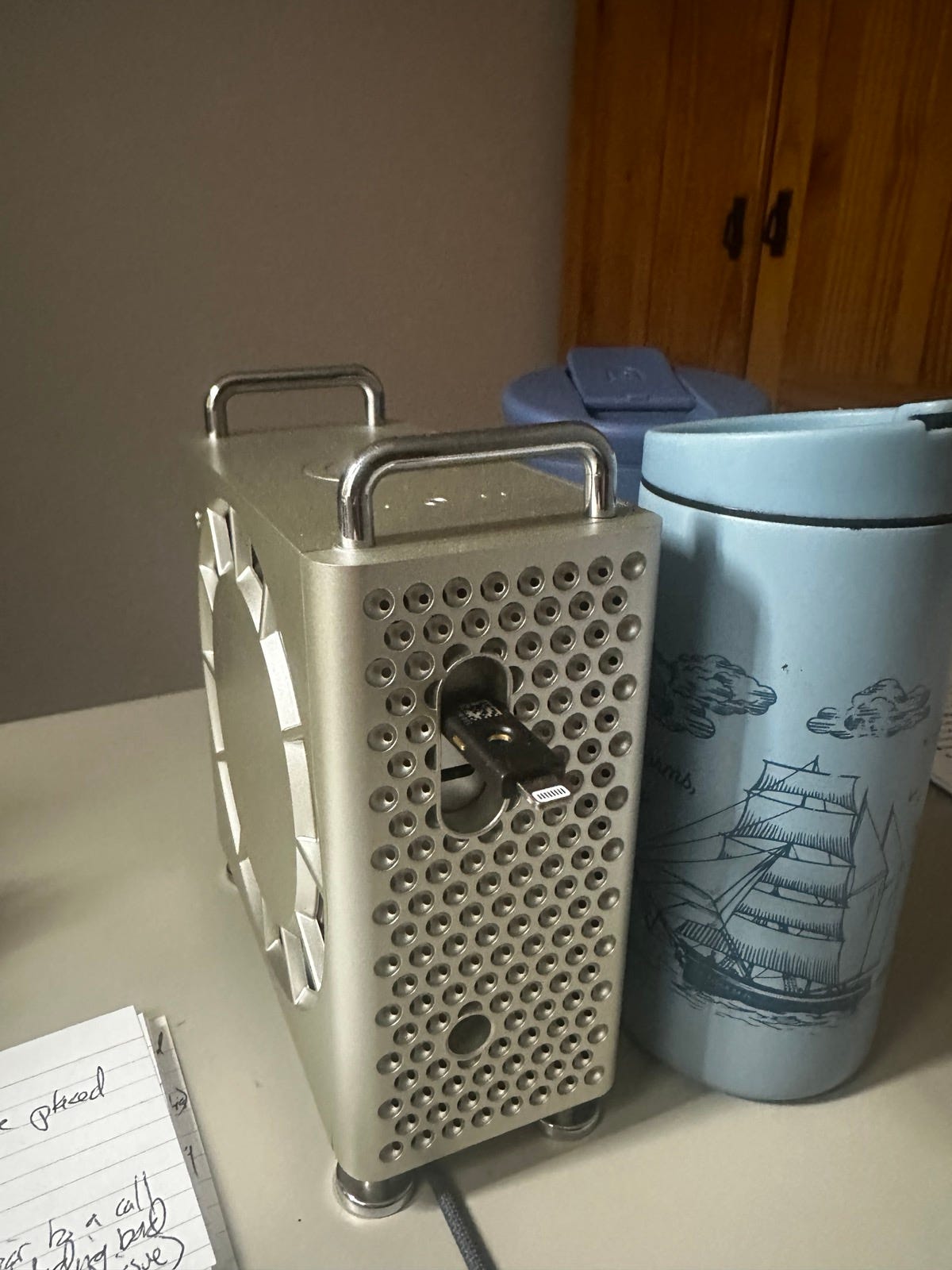
Source: The ATOMIQ AI Family Continuity Lockbox powered by LovarysOS #0001 on my desk
Physically, it is not impressive. It is basically a souped-up Mac Mini, storage, networking, and a custom software environment. But the important part is what I want the device eventually to represent.
I want the family’s important institutional knowledge to have a home we control.
The governance documents.
The entity maps.
The trust instructions.
The family rules.
The values.
The explanations behind why decisions were made.
The advisor roster.
The operating procedures.
The information someone would need if I suddenly could not answer a question.
During the conversation, I described the vision as an on-premises system that can use open-weight AI models, remain isolated when necessary, and ultimately walk the appropriate person through the family’s architecture in the correct order if I am no longer here.
That is not a substitute for an attorney.
It is not a substitute for a trustee.
It is not a substitute for judgment.
It is a continuity layer.
And I believe versions of this will become increasingly normal on the desks or in the family attorney’s custody of HNWI and UHWNI families.
AI Makes Human Judgment More Valuable, Not Less
Interestingly, Owen is already seeing the early stages of this shift from the attorney side.
He said clients increasingly arrive having done AI-assisted discovery before the first meeting. They know what irrevocable and revocable trusts are. They arrive with more specific questions. Sometimes they already have a rough sense of where they want assets to go, which allows the attorney to begin much deeper in the discussion than was previously possible.
That changes the advisor’s value proposition.
If information becomes abundant, information itself becomes less differentiated.
Judgment becomes more valuable.
Trust becomes more valuable.
Context becomes more valuable.
The attorney who merely knew something the client did not know had an information advantage. The attorney who understands the client, recognizes the tradeoffs, asks the right questions, applies judgment, and helps a family design something that fits their actual life has a relationship advantage.
AI is likely to compress the former. I suspect it will amplify the latter in parallel.
Owen put it nicely toward the end of our discussion: families are ultimately planning for real people. They are not creating documents in abstraction. There is something qualitatively different about knowing that a fiduciary understands you, cares about the family, and will still be there to help interpret the system when you no longer can.
That human layer matters. Perhaps it matters even more in a machine-rich world.
The Cement Is Still Wet
I have been thinking a lot about the next decade for the entirety of the last decade.
I described it during this show as a design window. I do not know whether it is two years, five years, or ten. I am not pretending to know exactly what AI, labor markets, capital markets, education, healthcare, or governance will look like in 2036.
That uncertainty is precisely the point.
I do not need to accurately predict the future to prepare my family for it. I need to create certainty around having optionality for whatever unfolds for my own family as well as my clients and audience.
The analogy I used was building a house. There is a period during construction when the architect can still move things relatively easily. Then the foundation is poured. Changes remain possible, but every subsequent choice is increasingly constrained by decisions already embedded in the structure.
Eventually, the cement dries.
Our financial system is changing. Our information system is changing. The way knowledge work is created is changing. The relationship between people and machines is changing. The kinds of risks our children will face will be different from the ones we faced.
I cannot write estate documents today that intelligently dictate every decision my children should make in 2055.
Nor should I try.
The better ambition is to give them principles, infrastructure, protected resources, institutional memory, trusted humans, and enough freedom to exercise judgment in circumstances I cannot foresee.
Stop Trying to Govern From the Grave
This may be the deepest lesson I took from the conversation.
The purpose of succession should not be to perfectly extend my preferences after I die.
It should be to create a family capable of making good decisions after my preferences are no longer enough.
There is a major difference between stewardship and control.
If I create a complicated structure nobody understands, attach a thousand restrictions to it, give nobody the context behind those restrictions, and then expect future generations to faithfully operate it for 50 years, I have not built resilience.
I have built a puzzle.
Eventually somebody will decide the easiest way to solve the puzzle is to dismantle it. A better system explains not only what the structure does but why it exists.
Why did we own this asset?
Why was this company separated from that company?
Why did we decide not to sell the land?
Why is this trust discretionary?
Why did Dad care about Bitcoin?
Why did Mom want a certain property preserved?
Why do we make certain charitable gifts?
Why should this business remain privately held—or why should it not?
A generation that understands the principles can intelligently change the tactics. A generation that inherits only the tactics or the assets eventually resents the rules and discards both.
From Estate Plan to Family Operating System
This is the evolution I am personally working through.
I still want excellent legal documents. I still want liability protection. I still care about tax efficiency. I still want appropriate trusts, entities, insurance, security, and professional advice. But increasingly I see those as components rather than the finished product.
The finished product is the family operating system.
It should tell us what we own. It should tell us who matters. It should identify our advisors. It should explain our governance. It should preserve institutional knowledge. It should simplify the first 30 days after disaster. It should evolve during our lifetime. It should give future generations enough structure to protect them without removing the judgment they will need to operate in a world we cannot predict.
Most importantly, it needs to belong to the family. Not just to me.
That is the uncomfortable realization. I had built a sophisticated version of my way. The real work now is turning it into our way.
Five things to do before you continue
1. Ask the 30-day question.
If you disappeared tonight, could your spouse or successor find the cash, trust documents, insurance policies, business instructions, passwords, and advisors they would need during the next 30 days?
Do not answer intellectually. Test it. Let me know in the comments what insights you had so that others can benefit too.
2. Identify the family quarterback.
Write down the first human being your spouse or children should call. Then identify the rest of the roster: attorney, CPA, financial advisor, business partner, trustee, insurance professional, bookkeeper, and anyone else who operates an important part of the system.
3. Make a “what we have” map.
Do not start with tax optimization. Start with an inventory of people, assets, entities, liabilities, accounts, businesses, trusts, insurance, digital property, and critical documents.
You cannot govern what the family cannot see.
4. Start documenting the why.
Entity diagrams tell people where things are.
They rarely tell people why things are.
Begin recording the reasoning behind the most important financial and family decisions you have made. Future generations will need your context far more than they need another spreadsheet.
5. Have the first 30-minute “our way” conversation.
Do not try to solve the entire estate plan over dinner.
Ask your spouse or partner a simpler question:
What do we most want everything we have built to accomplish for the people we love if one of us is no longer here to explain it?
Write the answers down. That is not the end of the planning process. It may finally be the beginning.
Please help the algorithm know this piece was worth seeing.
Hit the “heart emoji” and like this post,
Restack it, and
Share it with one person you know would value this in your network.
Leave a comment with a question for future office hours, and
Reach out via DM or the calendar link below if you want professional help from me or my network.
The real risk is doing nothing!
~Chris J Snook
P.S. Thank you to everyone who tuned into my live video! Join me for my next live video in the app.
I want to thank one of our Wealth Matters 3.0 ecosystem brand partners and Wealth CMDR PRO Subscribers: PEBL.
PEBL is a company I personally use across my own portfolio companies and personal strategy because hiring abroad or remotely should not require founders, operators, family offices, or distributed teams to spend months building employment infrastructure before they can bring great people into the business.
Hiring abroad or remotely can take months when you do it on your own, but with PEBL you can hire in over 185 countries in minutes and have your new hire onboarded by Monday.
PEBL is normally $399 a month per employee — already a no-brainer for what you get — but right now there’s a limited-time offer on their site that makes it even easier to get started.
Go to hipebl.ai.