


Real Answers for Navigating the K-Shaped Economy
If you own a business, manage a meaningful investment portfolio, hold commercial real estate, or are responsible for protecting a family’s wealth across generations, you are operating inside a financial system whose mechanics are fundamentally different from the ones most of us were taught to understand.
Money is no longer simply the medium through which savings become investment. Increasingly, it is the lubricant required to keep an enormous stock of existing debt from seizing up.
Government bonds are not merely instruments that pay interest. They are collateral that enables other institutions to borrow, lend, and manufacture additional financing capacity. And what we casually refer to as market liquidity is often inseparable from the leverage embedded in that machinery.
My returning guest on the ATOMIQ LEVEL, Michael Howell, has devoted much of his career to understanding precisely this system. He founded CrossBorder Capital, authored Capital Wars, and publishes a widely followed research newsletter of the same name. His work asks a deceptively simple question that the financial establishment too often overlooks:
Not just what is the price of money, but how much of it is available, where is it moving, and what collateral supports its circulation?
In our latest conversation, we explored why Howell believes the global liquidity cycle has begun to turn, why he expects the economy to slow rather than collapse, and why an investor could reasonably want government bonds over the next six months while questioning their role as a long-term store of purchasing power.
We also challenged his assumptions. Questions contributed by prior guests like Michael W. Green and Alexandra Damsker, Haretina and Henrik Zeberg helped push the discussion into passive investment flows, artificial intelligence capital spending, and the distinctions between financial and real-economy liquidity.
The result is a conversation about far more than a market forecast. It is about how the mechanics of money increasingly determine who can refinance, who must sell, who can afford to wait, and who gets to purchase the assets that others can no longer afford to hold.
The Question That Started Everything
I opened with a contradiction that has been bothering me.
What happens when the world has more nominal liquidity than ever, but the financial system’s ability to turn collateral into usable credit becomes constrained?
Howell resisted the premise. In his framework, liquidity abundance and collateral integrity are not independent conditions. Over the last two decades, collateral has become increasingly central to the creation of financing. When collateral deteriorates, the liquidity it supports contracts.
This is where the plumbing matters more than the headlines.
Consider a Treasury bond held by an institution seeking short-term funding. When that bond’s market price is relatively stable, another institution may accept it as security against a loan with a comparatively small haircut. When prices become volatile, the lender has to contemplate what that security might be worth tomorrow, next week, or next month. The amount it is willing to lend against the same security falls.
Nothing necessarily happened to the government’s promise to repay the bond. The borrower may remain creditworthy. Yet the financing capacity produced by that bond has declined.
Multiply that process across a global network of leveraged balance sheets, and the consequences can become enormous.
I then asked whether liquidity was actually abundant or simply highly leveraged.
Howell’s answer was that it was both. The abundance itself partly results from leverage. The distinction is important because it means a headline liquidity number cannot be interpreted without understanding how much financing capacity depends on asset valuations, collateral quality, and the willingness of lenders to extend credit.
This is one reason Howell pays such close attention to the volatility of the Treasury market and the collateral multiplier. The more volatile the underlying collateral, the more vulnerable the system may become to a contraction in available financing.
For investors, the risk is not confined to a decline in bond prices. It is the second-order effect of a decline in the amount of money that those bonds can support.
The Great Debt Echo of 2020
One of the most consequential sections of our conversation concerned a refinancing problem that is easy to underestimate when focusing exclusively on today’s interest rates.
During the pandemic, enormous amounts of debt were issued or refinanced at exceptionally low interest rates. Households, corporations, governments, and other borrowers took advantage of financing terms that were extraordinary by historical standards. Much of that debt was extended into future years.
Those future years have now arrived.
Howell identified 2026 through 2030 as a period in which that refinancing activity becomes increasingly significant. At the same time, governments continue borrowing, and new investment demands—particularly artificial intelligence infrastructure—are competing for capital.
The problem is not simply that borrowers owe money. It is that the system must continuously produce enough liquidity to refinance what already exists while also supporting new economic activity.
Howell’s framework places considerable importance on the relationship between the stock of debt and the liquidity available to service and refinance it. An inadequate supply of liquidity increases refinancing stress. An excessive supply can inflate financial assets beyond what underlying cash flows can justify.
This creates a dilemma for policymakers. They may wish to restrain inflation and speculative excess, but tightening liquidity too aggressively can destabilize the very refinancing system on which the economy depends.
It is not difficult to see how that dilemma can produce policies that appear contradictory. Central banks may maintain restrictive interest rates while fiscal authorities implement financing strategies intended to stabilize government debt markets. Financial conditions can remain tight for some borrowers even while monetary and fiscal mechanisms continue supporting other parts of the system.
Howell’s long-term conclusion is that debt growth makes further monetary expansion difficult to avoid. His near-term warning is that the liquidity cycle can still turn downward before those longer-term forces reassert themselves.
In other words, being correct about the long-term direction of monetary expansion provides no guarantee that an investor can survive an unfavorable short-term financing cycle.
The Apartment Building That Made the Macro Personal
I wanted to move this discussion away from charts and into a decision that private investors actually confront.
I described a 229-unit luxury multifamily property in West Plano, Texas, that had recently been presented to me as a potential investment. According to the offering details I relayed, the proposed acquisition represented a substantial discount to its prior transaction price, came in below estimated replacement cost, and included a fixed-rate financing arrangement.
On paper, those characteristics were interesting. But they did not answer the question that mattered most.
Was the property an attractive opportunity because the market had already repriced the collateral, or was it simply an early casualty of a larger liquidity contraction still unfolding?
Howell immediately shifted the discussion to time horizon.
A financially durable acquisition held for five to ten years is an entirely different proposition from an acquisition whose viability depends on refinancing, selling, or recapitalizing during a difficult liquidity window. Even a property purchased at a significant discount can become a bad investment if the capital structure cannot withstand the period between acquisition and eventual recovery.
That distinction matters especially to private investors who mistake an illiquidity discount for a margin of safety.
A property being offered at half its previous sale price does not establish that it is worth twice its current price. Replacement cost is relevant, but replacement cost does not pay interest, fund capital expenditures, or guarantee occupancy. The sponsor’s assumptions about rent growth, debt service, property taxes, capital expenditures, and exit capitalization rates remain critical.
The conversation crystallized a principle that applies far beyond multifamily real estate: the durability of your financing may matter as much as the attractiveness of your acquisition price.
There are times when having the ability to wait is itself the asset that creates the opportunity.
The Passive Investment Machine and the Disappearing Allocator
I brought a question from Michael Green into our discussion, asking Howell to explore the difference between persistent investment flows and flows that genuinely predict future market movements.
The issue is significant because a large proportion of investment capital enters markets through recurring institutional and retirement-plan mechanisms. Contributions are directed according to formulas, portfolio targets, and indexing methodologies that frequently operate with relatively little reference to the individual valuation of securities.
Howell’s response pointed toward something I believe deserves greater attention: the difference between money being allocated and investment judgment actually being exercised.
A retirement contribution automatically purchasing the same index each month represents a continuing source of demand. But it does not necessarily represent an investor independently evaluating whether the underlying businesses offer an attractive prospective return at their current prices.
This does not invalidate passive investing. It does, however, raise questions about the relationship between market prices, valuation discipline, and the mechanical flows that support existing portfolio structures.
For the business owner or family office, this creates a particularly uncomfortable problem. Their publicly traded securities may appreciate because of powerful and recurring financial flows while their operating business confronts worsening borrowing terms, higher wage costs, rising insurance premiums, and increased uncertainty.
One side of their balance sheet appears prosperous. The other side feels increasingly constrained.
That is a different version of the K-shaped economy from the one most often discussed in political or media narratives. It can exist inside the same household and even inside the same consolidated family balance sheet.
The more important question becomes whether the family’s liquidity, liability structure, and ownership mix are prepared for the moment those two experiences converge.
The AI Boom Could Be Consuming the Liquidity That Supports Asset Prices
Alexandra Damsker contributed another question that brought an essential distinction into focus.
If money is moving out of financial assets and into the real economy through artificial intelligence infrastructure, data centers, defense spending, and other capital-intensive projects, does that investment drain financial liquidity or sustain the economic cycle?
Howell’s answer was effectively both.
Capital expenditures can strengthen measured economic activity while simultaneously placing demands on corporate cash reserves, debt markets, and existing savings pools. The project receiving investment may experience a boom while financial investors face increasing competition for available capital.
That creates a potential paradox.
The AI infrastructure boom can support economic growth while contributing to tighter financial conditions. The resulting demand for financing may also affect businesses that have little direct involvement in artificial intelligence but still compete for capital from the same banks, institutions, and investors.
This is especially important when growth expectations are being capitalized into financial asset valuations before the promised cash flows have fully materialized.
To me, the implication is not that AI investment is inherently bad for markets. It is that economically productive investment and financial-market liquidity are not synonyms.
Howell tied this dynamic to what he calls Treasury QE: the use of short-term Treasury issuance and bank balance-sheet mechanisms to help finance public deficits while potentially expanding monetary liquidity.
This deserves scrutiny because Treasury-bill issuance is not automatically equivalent to central-bank money creation. The financing effect depends on who buys the debt, how purchases are funded, what happens to deposits and reserves, and whether bank balance sheets expand. Howell’s framework is a useful way to investigate those mechanisms, but the distinction between direct monetary creation and changes in the composition of private portfolios must remain clear.
Bitcoin, Gold, Stablecoins, and the Geography of Money
When we shifted to Bitcoin, I asked Howell what would convince him that it was becoming less of a speculative liquidity instrument and more of a monetary reserve asset.
He pointed to declining volatility.
His observation was straightforward: if an asset is becoming more institutionalized, a sustained reduction in its price volatility could be one indication that its ownership structure and market behavior are changing.
That does not establish that Bitcoin has completed a transition into reserve-asset status. But it gives investors something measurable to evaluate rather than requiring them to choose between ideological narratives.
We also discussed stablecoins, particularly their potential effect on demand for short-term U.S. government debt.
Howell sees an especially compelling use case outside the United States. For individuals and institutions operating in currencies with limited stability, high inflation, or less accessible financial infrastructure, dollar-denominated digital instruments may provide access to dollar liquidity and settlement mechanisms that domestic banking systems do not offer as efficiently.
The implications extend beyond digital-asset speculation. Stablecoins and tokenized Treasury instruments could become additional channels through which offshore demand interacts with U.S. government financing.
Gold occupied a different place in his argument.
Howell emphasized China’s role in global gold demand, domestic monetary expansion, capital controls, and the country’s struggle with debt deflation. His argument is that these dynamics may make Chinese investors and institutions increasingly important to the marginal price of gold.
He also highlighted the contrast between U.S. and Chinese bond yields, interpreting much of the difference through nominal economic growth rather than treating yields as a simple referendum on sovereign creditworthiness.
The conclusions are open to challenge. Bond yields incorporate inflation expectations, term premiums, monetary policy, currency conditions, and investor demand, not just nominal GDP growth. Yet the larger point remains valuable: understanding gold or Bitcoin exclusively through U.S. Federal Reserve policy may overlook increasingly important sources of demand and monetary change elsewhere in the world.
Do you hire remotely?
If you are looking into 2027 with new ways to consolidate compliance risk around remote and on-premises employees, reduce unnecessary filings with multiple domestic or international jurisdictions that impact tax nexus, etc., then I highly recommend you check out PEBL.
PEBL allows me to hire in more than 100 countries and every major state without having to change the nexus or jurisdiction of my operating companies, or expose myself to the risk of compliance failure related to an evolving HR landscape. For just $399 per month per employee, I can interview a talented contributor Friday and onboard them Monday without headache. If you have plans to update your payroll, benefits, and compliance in 2027, check them out today at
Https://hipebl.ai and this podcast will save you up to 25% off the standard fees. PEBL is a Pro Subscriber of this newsletter and a great vendor we use across the ATOMIQ ecosystem as our Employer-of-Record

Terms and conditions apply
The Most Important Distinction: Six Months Versus Six Years
Perhaps the most useful practical clarification came when Howell separated his short-term market outlook from his longer-term investment thesis.
He described a liquidity cycle that, in his framework, tends to unfold over approximately five to six years, with its effects often appearing sequentially across bond markets, equities, and real assets.
He believes the recent cycle has moved into a downswing. His forecast points toward economic slowing without necessarily requiring a full recession, with a potential liquidity-cycle low around the first quarter of 2027.
That view is not the same as predicting the end of an era of rising asset prices.
Over longer periods, Howell anticipates persistent government debt growth, monetary expansion, and continued pressure on the purchasing power of fiat currencies. In that environment, he sees a strategic role for assets whose values or cash flows can participate in monetary inflation, including selected equities, gold, resources, and prime real estate.
He also discussed the potential role of bonds as shorter-term protection during a tightening liquidity cycle.
There is no contradiction in believing that a government bond might offer attractive tactical protection during a slowdown while questioning its ability to preserve purchasing power across several decades of monetary expansion.
The relevant variables are time horizon, entry valuation, financing requirements, and the purpose of the capital.
That is a more sophisticated framework than simply classifying someone as bullish or bearish on bonds, Bitcoin, or real estate.
It also underscores the importance of separating an investment’s expected long-term economic characteristics from the owner’s actual ability to hold it through difficult financial conditions.
Introducing the Wealth Matters 3.0 Howell Liquidity Watch
Our conversation convinced me that readers should not have to choose between accepting a prominent macro strategist’s thesis without question and ignoring it because the underlying system appears too complicated.
So I am considering whether to launch a Wealth Matters 3.0 Howell Liquidity Watch widget for all subscribers as a weekly update, beginning with this replay. See today’s example here.
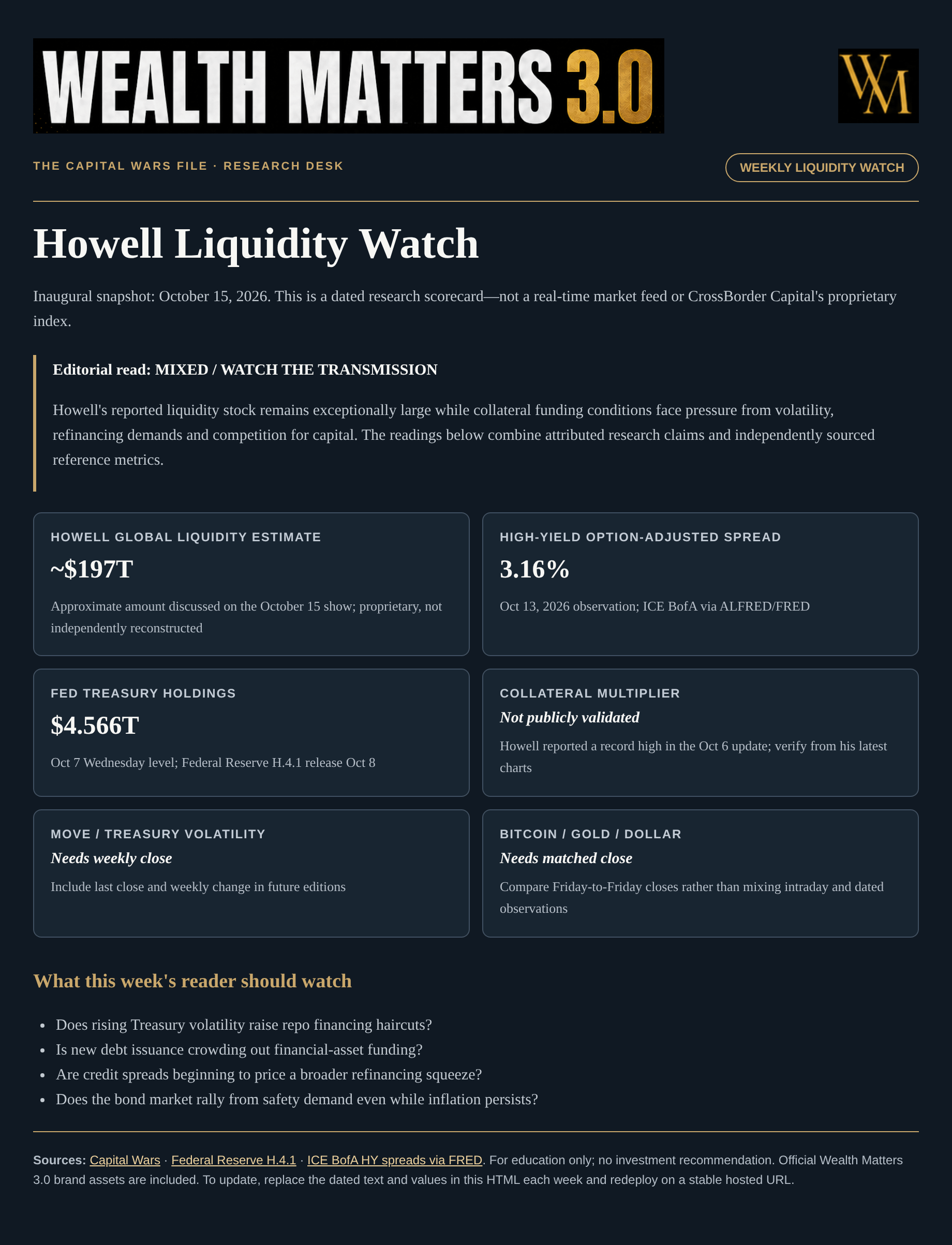
If you would like to see this as a dynamic ongoing tool to reference, answer the poll below or DM me.
The objective would not be to duplicate CrossBorder Capital’s proprietary research or pretend we can reconstruct every element of its methodology from publicly available information. It would be to create an independently useful framework and accessible widget that follows the evidence surrounding Howell’s thesis and identifies where the data confirms, complicates, or contradicts his outlook.
The monitor will track the direction of reported global liquidity, available information about collateral financing, Treasury-market volatility, funding conditions, high-yield credit spreads, relevant Federal Reserve balance-sheet measures, the dollar, and the behavior of Bitcoin and gold.
We will also pay attention to the financing demands coming from sovereign refinancing, AI investment, and private capital markets.
Each edition will distinguish actual observations from interpretations and forecasts. It will record what changed, whether the evidence is becoming more or less consistent with Howell’s outlook, and what developments would make the prevailing interpretation worth reconsidering.
The inaugural dashboard is dated October 15, 2026. Subsequent weekly editions will provide a consistent point of comparison rather than attempting to manufacture certainty from a single market reading.
For family offices, founders, and business owners, the value is in understanding whether the conditions affecting their capital availability are improving or deteriorating before those changes become obvious in a refinancing proposal, a transaction valuation, or an investment account statement.
The Question That Remains After the Conversation
I saved one question until near the end of our discussion because it captures the conflict at the heart of Howell’s work.
If the financial system requires ever-expanding liquidity to refinance its existing liabilities, and that liquidity expansion progressively undermines the purchasing power of the currencies in which those liabilities are denominated, have we solved the debt problem or simply transformed it?
Howell’s answer returned to the relationship between debt growth and monetary expansion. In his view, the financial system requires liquidity to expand at a rate sufficient to accommodate the growing debt burden, with gold potentially serving as an expression of that long-term monetary depreciation.
He also offered a useful distinction between the dollar’s value against other paper currencies and its value against gold. The dollar can remain comparatively strong against other national currencies while all of them lose purchasing power against a monetary asset.
That creates a very different investment problem from the one implied by a simple strong-dollar or weak-dollar forecast.
For me, the most important lesson from this discussion is that capital preservation cannot be reduced to owning assets expected to rise in nominal price.
Real preservation requires an understanding of what you own, how it is financed, what obligations it must support, and whether the family or business can maintain control when liquidity becomes scarce.
The great danger is not necessarily being wrong about the next decade. It is being financially forced out of the assets you intended to own for the next decade because you misjudged the next twelve months.
The liquidity cycle matters because financing conditions determine who retains the freedom to act and who loses it.
And ultimately, freedom to act is one of the most valuable things wealth can provide. Thanks again for reading/listening. Please don’t forget to like, restack, comment, share, and subscribe if you got value or insights from this post. My guests and I appreciate you telling the algorithmic overlords we earned it!
The real risk is doing nothing.
~Chris J Snook
Five Takeaways
Map your refinancing calendar. Identify every meaningful business, investment, and real estate obligation maturing between now and 2030. Understand your exposure to refinancing rates, covenants, loan-to-value requirements, and potential liquidity calls.
Separate permanent capital from temporary liquidity. Determine what must remain readily accessible to support operating expenses, family commitments, debt service, and unexpected opportunities.
Reexamine the financial structure of attractive investments. A low purchase price is only one part of the equation. Stress-test financing, cash flows, capital expenditures, and your ability to avoid a forced exit.
Follow monetary signals beyond the Fed funds rate. Watch Treasury volatility, repo financing conditions, credit spreads, reported global liquidity, and the direction of capital flows between financial markets and the real economy.
Participate in the discussion. Watch the full conversation with Michael Howell, subscribe to his research at Capital Wars, and tell me which part of the liquidity thesis you agree with, disagree with, or want us to investigate next.

Subscribe to Wealth Matters 3.0:

Thank you to everyone who tuned into my live video! Join me for my next live video in the app.


