




This episode was part of our Shields & Succession Office Hours programming on ATOMIQ LEVEL with Owen Hathaway, an estate planning attorney based in Colorado. We opened this conversation specifically for blended families that own closely held businesses, founders who have built a growing concern over years or decades, and heirs who may inherit the economic benefit of a business without inheriting the authority, desire, or skill to operate it.
Disclaimer: As always, this conversation is educational and informational. Owen is an attorney, but he is not automatically your attorney, and this piece should not be treated as individualized legal, tax, financial, investment, fiduciary, or estate-planning advice. The purpose is to help you ask better questions, understand the moving parts, and bring more powerful conversation starters to your own advisors, family, counsel, fiduciaries, partners, and beneficiaries.
Colorado residents can call 970-820-0090.
For advanced asset protection planning, Wyoming Asset Protection Trust planning, and exit architecture conversations across all 50 states and territories, call 307-463-3600.
A Word From An Ecosystem Brand Partner
Before we get into this topic further, I want to thank one of our Wealth Matters 3.0 ecosystem brand partners and Wealth CMDR PRO Subscribers: PEBL.
PEBL is a company I personally use across my own portfolio companies and personal strategy because hiring abroad or remote should not require founders, operators, family offices, or distributed teams to spend months building employment infrastructure before they can bring great people into the business.
Hiring abroad or remote can take months when you do it on your own, but with PEBL you can hire in over 185 countries in minutes and have your new hire onboarded by Monday.
PEBL is normally $399 a month per employee — already a no-brainer for what you get —, but right now there’s a limited-time offer on their site that makes it even easier to get started.
Go to hipebl.ai.

Terms and conditions apply.
The Fight Usually Starts Before the Funeral
There is a polite fiction inside a lot of estate planning conversations. The fiction is that succession is mostly about what happens after death. Death matters, of course. The will matters. The trust matters. The beneficiary designations matter. The estate tax matters. The buy-sell agreement matters. The liquidity matters. But the fiction becomes dangerous when families assume that the real problem begins only after the founder is gone.
For blended families that own closely held businesses, the greater risk often arrives earlier. It arrives while the founder is still alive, still technically the owner, still physically present, but no longer capable of making decisions with the clarity, stamina, judgment, or consistency that built the company in the first place.
That is the opening idea of the research framework we used for this episode: the greatest risk for a blended family that owns a closely held business is not necessarily what happens when the founder dies. It is what happens when the founder is still alive but no longer capable of making decisions, while the people who inherit economic value are not necessarily the same people legally entitled or qualified to control the company.
Picture the situation plainly. The founder has a current spouse, children from a prior marriage, perhaps children from the current marriage, a business partner, personal guarantees, debt, a trust, an LLC operating agreement, a buy-sell agreement, a bank relationship, vendors, software systems, insurance policies, employees, payroll, and maybe one adult child who has worked in the company for twelve years while three other children expect economic equality. Then the founder has a stroke.
In that moment, the estate plan is no longer a binder. It is a live grenade.
That was the center of this conversation with Owen Hathaway. We were not talking about blended families in a vague Hallmark sense. Owen is himself the product of a blended family, and he talked about this from both personal and professional experience. A blended family can mean divorce and remarriage, step-siblings, half-siblings, multiple children with spouses, second spouses, intergenerational conflict, and family members who may blend beautifully personally while still colliding economically once control, ownership, and liquidity enter the room.
The problem is that business succession does not wait for everyone to become emotionally mature. It activates whatever was already there.
The Three Legal Systems That Collide
The research framework framed the problem through three overlapping legal systems: incapacity law, business and corporate law, and trusts, estates, and family law.
Incapacity law asks who can make decisions when the owner cannot.
Business and corporate law asks who controls, operates, votes, sells, or transfers the company.
Trusts, estates, and family law ask who ultimately receives value and under what conditions.
A serious succession plan has to reconcile all three.
That sounds clinical until you translate it into the questions families actually face. These are not academic issues. They are payroll, control, family, banking, tax, and survival questions hiding inside legal language.
Who signs payroll?
Who talks to the bank?
Who can vote the shares?
Who gets the distribution?
Who decides whether the company borrows?
Who can remove the manager?
Who decides if the founder is actually incapacitated?
Who protects the current spouse?
Who protects children from the prior marriage?
Who protects the active child from passive siblings who want cash?
Who protects passive heirs from an active child who undervalues the company?
Who protects the business partner from suddenly being in business with someone they did not choose?
Who protects the enterprise from a distressed sale because the documents answered inheritance but not liquidity?
That is why I summarized the whole issue during the show in one sentence:
Who gets the income, who gets the ownership, and who gets control?
Most family fights begin because those three answers were never separated clearly enough. A surviving spouse may need income. A child may be the right operator. A trust may hold shares. A business partner may have veto rights. Passive children may expect equality. Creditors may still have claims. The IRS may have its own timetable. The bank may care about personal guarantees. The operating agreement may say one thing, while the trust implies another, and the family carries a completely different story in its collective head.
That is how technically documented plans still become emotionally and financially chaotic.
The Business Family Is Usually Blended Too
One of Owen’s earliest points was that founders often underestimate how many “families” exist around the business. There is the blood family, the marital family, the blended family, the ownership family, and the business family. The business family is usually blended even when the household family is not.
Very rarely is there not some kind of partner, minority partner, investor, lender, key employee, operating executive, advisor, or funding source involved in the lower middle market or small business enterprise space. That matters because the capital stack has opinions, even when it does not sit at Thanksgiving dinner.
Owen brought up a point from venture investing that applies far beyond venture. Investors often invest in the person more than the idea. That is obvious in Silicon Valley, but it is also true in a bank relationship, SBA loan, professional practice, contractor bond, distributor agreement, franchise relationship, or lender covenant. If the lender, investor, partner, or trade creditor underwrote the person, what happens when that person is suddenly removed from the equation?
This is where the blended-family succession conversation expands. The issue is not only whether the spouse and children agree. It is whether the company’s external stakeholders still have confidence when the founder is incapacitated, dead, divorced, remarried, sidelined, impaired, or simply no longer the person they underwrote.
A few practical questions follow immediately:
What happens to the personally guaranteed debt?
What happens to the bank line?
What happens to the insurance?
What happens to the customer relationship?
What happens to the vendor who was already nervous?
What happens to the partner who was comfortable with the founder but not comfortable with the founder’s spouse?
What happens to the partner who loves the spouse personally but does not want to be in business with the spouse?
That last question matters because it is brutally honest. I said it directly during the conversation: maybe I love the spouse. Maybe my spouse loves the spouse. Maybe we have dinner together. But that does not mean I want to be in business with that spouse if my partner becomes incapacitated.
That distinction is not cruel. It is responsible.
Personal affection is not business governance.
Incapacity Is Harder Than Death
Owen said something that should be printed at the top of every owner-operator succession checklist:
Incapacity is the tough one because you’re not dead.
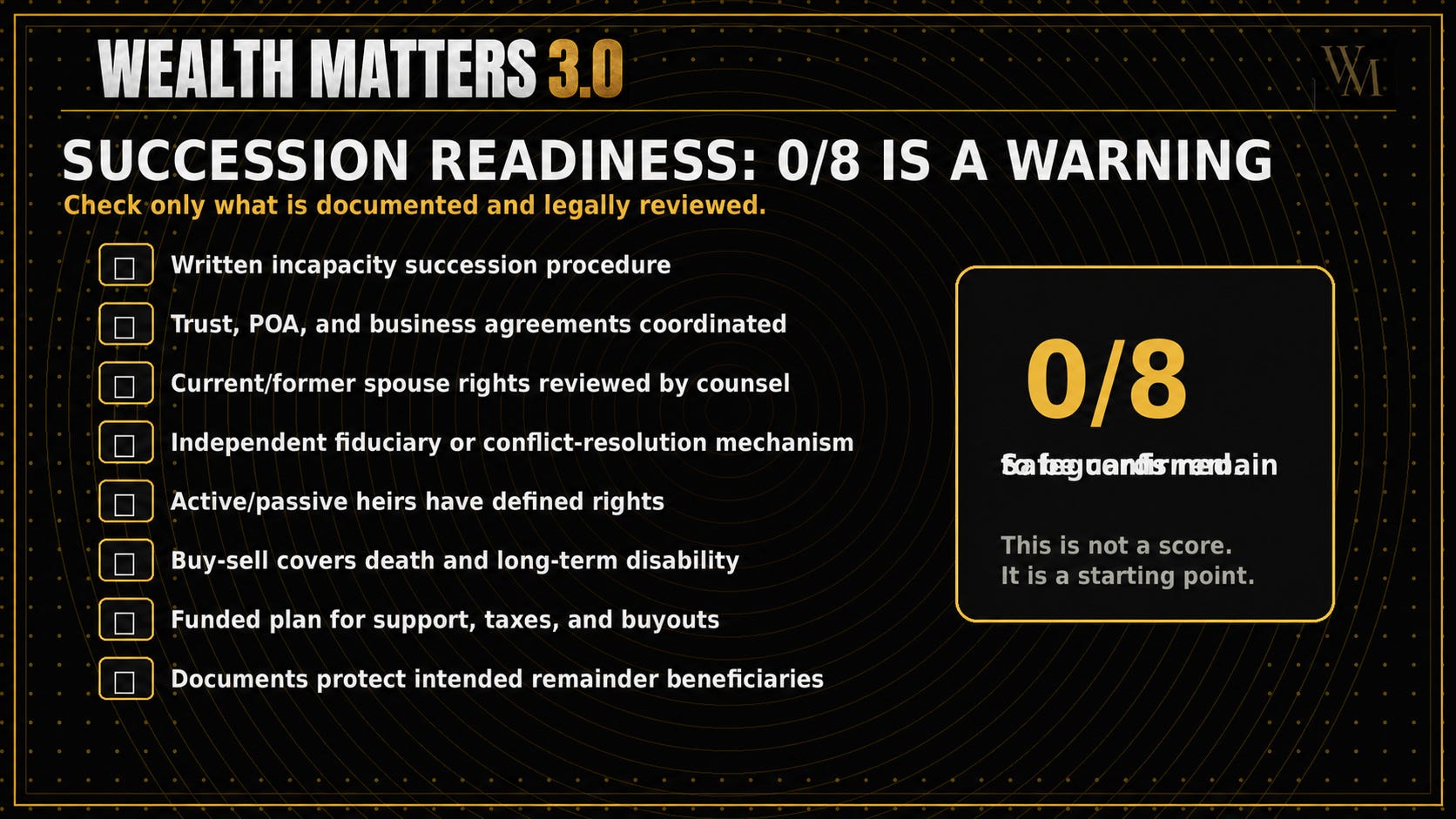
The Free Conversation Is the Gateway. The Playbook Lives Behind the Paywall.
The conversations on ATOMIQ LEVEL and LIVE office hours in the article follow-ups are ALWAYS free, because the insights and access to the discourse with the most brilliant minds in finance, business, and tech that I benefit from are my generous and strategic gateway drug.
The other side of the paywall is where you get the full playbooks, the office hours, and the archives distilled in a broader and more actionable context.
It is where, for $1 per day or less, you can go from conversation to planning and protecting your net worth and your net happiness.
So I will see you over there and welcome you to your journey of becoming a true Wealth CMDR.


