IMPORTANT: The official (and only) true Acid Capitalist site to connect with is https://www.hughhendry.com (No Posers). Other knockoff websites are not related to or endorsed by Hugh. Connect with him on Substack or his official website below
Your Halloween Treat Arrived Early
There are financial commentators who can explain what happened yesterday. There are fund managers who can tell you what their models say might happen tomorrow. And then there are people like Hugh Hendry, who seem constitutionally incapable of accepting the assumptions underpinning either conversation.
I have followed Hugh for years. I discovered him through Raoul Pal’s Real Vision and the financial thinkers who inhabit that world, and he quickly became one of the people I use to challenge my own assumptions. Not because I agree with him about everything, but because his mind moves differently. He does not simply construct an alternative forecast. He interrogates the premise that made the original forecast seem sensible.
Hugh is the former hedge fund manager behind Eclectica Asset Management and now operates publicly under the wonderfully provocative identity of the Acid Capitalist. He is as comfortable discussing sovereign debt, China, Bitcoin, the eurodollar system, and financial crises as he is describing the existential exhaustion of managing a boutique ultra-luxury hotel in St. Barts.
That combination makes this conversation especially valuable for business owners, investors, financial advisors, and families trying to navigate an economy that increasingly seems to reward the ownership of financial assets while punishing the people who build, manage, and operate things in the physical world.
We covered a remarkable amount of territory in nearly two and a half hours. Hugh explained why the financial industry’s obsession with caution can itself become dangerous, why he believes stablecoins could represent the next evolution of the dollar system, how he thinks about $1 million Bitcoin, why the market’s declaration that something is a bubble sometimes attracts rather than repels him, and why he sees particular opportunities in assets that have experienced significant drawdowns.
But the most valuable part of our conversation may have had nothing to do with a market forecast.
It came when Hugh, a man who has managed enormous amounts of institutional capital, described what it felt like when the cash stopped coming in from his hospitality business and his bank accounts went negative.
That moment changed the entire conversation. He, without any prompting, embodied the humanity I strive to reveal and amplify through this podcast platform, while we ground the smart money minds in the gritty and practical reality that all entrepreneurs, HNWIs, and their families navigate as wealth and experience accumulate.
This episode is about the person behind the market opinions, the machinery beneath modern money, and the uncomfortable distinction between having financial intelligence and having financial security.
It is a shining example of growing and protecting both your net worth and your net happiness.
The Man Who Refused to Keep Wearing the Tie
I had been trying to get Hugh onto ATOMIQ LEVEL for the better part of a year. When he finally joined me from St. Barts, I opened by referencing one of my favorite descriptions of his transformation: he had worn the tie and told the lie.
It is the kind of sentence that can mean several things depending on how you hear it. To me, it captures the tension between the institutional identity a person must adopt to function inside professional finance and the more authentic, sometimes unruly person who exists beneath the uniform.
Hugh did not offer the usual chronological autobiography. He described himself as a conundrum and then began dismantling the idea that his public persona should be interpreted literally.
The Acid Capitalist is provocative by design. Hugh uses vulgarity, humor, contradictions, cultural references, and an almost theatrical willingness to offend conventional sensibilities. He openly admires the spirit of Jesse Livermore and sees something of the artistic temperament in great speculation. He also invokes Hunter S. Thompson and Charles Bukowski, writers who refused to separate the narrator entirely from the spectacle.
What interested me was not the spectacle. It was the reason for it.
Hugh believes that seeing the future in markets is fundamentally different from processing yesterday’s information more efficiently. Conventional analysis often assumes that enough research, enough models, enough meetings, and enough professional seriousness will eventually produce superior foresight.
Hugh challenges that premise. He sees exceptional investing as requiring an unusual combination of disciplined observation, creativity, intuition, risk tolerance, and the ability to recognize something the dominant consensus has not yet incorporated into prices.
He calls himself an orthogonal investor.
That distinction matters. Contrarian investors often define themselves by disagreeing with the crowd. An orthogonal investor is trying to see the problem from a different angle entirely. Sometimes that produces a contrarian conclusion. Sometimes it produces an aggressively bullish conclusion when other people are frightened. The objective is not to be different for its own sake. It is to uncover an opportunity that conventional thinking has obscured.
My takeaway was that the most valuable intellectual asset Hugh developed during his institutional career was not a particular trade. It was his operating system for thinking.
And unlike the institutional identity he once wore, that operating system is something he still owns.
The Hedge Fund Manager Who Ran Out of Cash
The conversation took an unexpectedly personal turn when I asked Hugh about the hospitality property he owns in St. Barts.
Here is a man who built his reputation navigating some of the most difficult environments in modern finance. He has participated in markets where individual investment decisions involved enormous amounts of institutional capital. He understands leverage, credit, volatility, duration, liquidity, and financial distress at a level few commentators can claim.
Yet operating a luxury property has exposed him to an entirely different type of risk. The recent focus of my platform’s work is to help people define, design, and execute a plan to win in both the “financial economy” and the “real economy” (i.e., the K-Shape duality we all live within); this was the most authentically offered example yet in all my interviews of the battlefield.
Hugh described the seasonal economics of the business, including its dependence on extraordinarily valuable holiday bookings. He explained that a substantial portion of annual revenue can be concentrated into the final weeks of December. When expected bookings failed to materialize, the financial consequences became immediate.
He told me that nearly all his bank accounts had gone negative and that he had fallen behind on a mortgage payment.
There was no attempt to polish the admission into an inspirational business-school anecdote. He simply laid out what had happened.
I was struck by his candor because it illustrated the will, humility, and skill it takes to navigate successfully. After all, the financial economy and the real economy are not the same operating environment.
A successful portfolio manager can understand the financial consequences of uncertainty with exceptional clarity and still be exposed to the operational consequences of running a business.
A hotel cannot pay its mortgage with an excellent macroeconomic thesis. Payroll does not become optional because the long-term value of the real estate is attractive. A valuable property can be worth considerably more than its debt and still suffer a liquidity crisis when the timing of cash receipts and cash obligations diverges.
This is a distinction that anyone who has ever owned an operating business understands. I (like many operators) have faced these quiet struggles more times than I can count over the last 27 years, and to have Hugh Hendry open kimono so early in the discussion grounded us in an entrepreneurial brotherhood that brought out a treasure of insights over the remaining 2 hours.
In the financial economy, a position can look attractive because of its prospective return, liquidity profile, or relative valuation. In the real economy, an asset can remain fundamentally valuable while demanding cash from its owner every month.
Those obligations do not disappear simply because the market is temporarily uncooperative.
Hugh had encountered the brutal difference between being wealthy on a balance sheet and having enough accessible cash to keep operating.
The Loneliness of Fighting Trees
I shared a metaphor that has stayed with me through difficult periods of building companies and managing operating assets.
When you are in the middle of an operational crisis, you can become so focused on the next problem that you lose sight of the broader landscape. You are standing inside the forest fighting individual trees. Every payroll cycle, vendor payment, bank conversation, customer issue, regulatory obligation, and unexpected repair becomes another tree.
Occasionally, you manage to climb high enough to see the forest again. You remember that the business has value, that the broader cycle may eventually improve, and that other people are dealing with similar pressures.
Then you descend and return to fighting trees.
One of the strange comforts of speaking with other builders is discovering that people you admire are also fighting trees.
That realization produces two emotions simultaneously.
The first is anxiety: if someone with that much experience and apparent success is also struggling, how difficult must the environment really be?
The second is relief: perhaps the problems are not exclusively evidence of personal failure.
That is not an argument for ignoring bad decisions or avoiding accountability. It is an argument for understanding that operating businesses expose their owners to forces that are often outside their immediate control.
Hugh’s admission about his hotel made the rest of our discussion more meaningful because he was no longer speaking only as a former hedge fund manager interpreting the world from a screen. He was speaking as an entrepreneur experiencing the conditions he was analyzing, with his feet on the ground and his capital bet fully on the table.
There is a particular credibility that comes from having to live with the consequences of your decisions.
And there is an equally important lesson for anyone preparing to sell a business or transition from the real economy into the financial economy: the skills required to create wealth are not automatically the same skills required to preserve, allocate, and compound it.
Two Economies. Two Different Game Plans.
One of the core premises I brought into the discussion was that investors and business owners increasingly need to operate with two distinct, connected strategies.
The first applies to the real economy, where you create value through work, ownership, service, production, employment, and customer relationships.
The second applies to the financial economy, where accumulated capital is deployed through stocks, bonds, private investments, commodities, digital assets, and other financial instruments.
For decades, conventional retirement planning implied a relatively straightforward transition between the two. Work, save, contribute to a diversified portfolio, retire, and draw down the assets.
That model still contains useful principles, but it no longer adequately explains the complexity many entrepreneurs face.
An owner might have $12 million of estimated enterprise value but limited personal liquidity. A family might have several million dollars of residential and commercial real estate equity but face refinancing and tax obligations that require cash. A professional might have a substantial retirement portfolio while struggling with the cost of housing, education, insurance, and supporting aging parents.
Meanwhile, publicly traded financial assets can appreciate dramatically without generating an equivalent improvement in the operating conditions of small and mid-sized businesses.
Hugh observed that the extraordinary energy, creativity, and discipline people bring to making money in the real economy are often abandoned when they enter the financial economy. They willingly hand the accumulated proceeds to institutions whose brands imply competence, even when the process for generating attractive returns is poorly understood.
That criticism should be uncomfortable for both investors and advisors.
It does not mean professional management is worthless. It means the investor should demand the same clarity about value creation from a financial provider that they would demand from a business they owned.
If you built your company by managing risk, understanding customers, evaluating capital expenditures, and making difficult decisions under uncertainty, why would you stop applying those standards when investing the proceeds?
This is where I believe the next generation of wealth planning must evolve. We need to help owner-operators translate a lifetime of themselves being at work into generations of their capital being at work.
That requires more than an asset allocation questionnaire. It requires a different philosophy of ownership.
The Financial Brand Is Not the Financial Result
Hugh’s critique of conventional financial brands was particularly sharp.
He compared financial services with consumer brands. A familiar consumer product can create an immediate experience of value. The buyer knows what was promised and can evaluate whether the product delivered.
Financial services are more complicated because the results arrive over time, markets are uncertain, and separating manager skill from market exposure can be difficult.
But that complexity also creates room for a dangerous substitution: the appearance of expertise can become more marketable than its economic value.
Hugh believes this helps explain why so much institutional money management is driven by fear of professional consequences. The manager may become more concerned about looking defensible than about identifying asymmetric opportunities.
A decision that loses money while resembling the decisions of every competing institution may be safer for a career than a differentiated decision that is temporarily unpopular.
That is a serious criticism of incentives, not merely personalities. It also helps explain why Hugh is interested in becoming a larger public voice rather than returning to traditional fund management.
He is trying to commercialize something different: the distinctive way he thinks.
As he explained his ambitions, he made an unexpected reference to Jim Cramer. Not because he necessarily agrees with Cramer’s market judgments, but because he recognizes the economic value of turning financial commentary into a personality-led media franchise.
The broader point is worth considering. As AI makes financial summaries, spreadsheets, conventional research, and generic market commentary cheaper to produce, the premium on original judgment, personal context, entertainment, and trust may grow.
That is one of the ideas Hugh and I kept returning to.
The future is unlikely to reward generic expertise at the same premium as it once did. It may reward people who combine deep expertise with a differentiated perspective and the ability to communicate that perspective credibly.
In other words, the intelligence may become abundant while the trusted interpreter remains scarce.
When Financial Markets Become Live Sports
Our discussion moved naturally into professional sports.
Hugh has written about sports franchises as scarce assets, and we discussed the economics of live competition, intellectual property, global audiences, entertainment rights, and the unusually limited supply of established franchises.
The interesting part of the thesis is not simply that wealthy people want to own sports teams. It is that live sports offer something increasingly scarce in a world saturated with generated and reproducible content.
Uncertainty.
Nobody knows exactly what will happen when the game begins.
A match has a beginning, an end, and an outcome. But it also produces endless conversation before, during, and after the event. There are fans, commentators, fantasy leagues, licensed products, broadcasters, advertisers, and adjacent markets.
The event itself becomes the center of an enormous commercial ecosystem.
Hugh mentioned Manchester United as an example of a publicly traded expression of that scarcity thesis. His argument was that the enduring cultural relevance and global audience associated with certain franchises deserve to be analyzed differently from an ordinary operating company.
I challenged him with a question that had occurred to me during a previous conversation with sports owners. At what point does maximizing the value of a sports franchise begin to undermine the experience that made the franchise valuable?
If athletes become financial assets whose playing time must be constrained to protect an investment, is there a point at which the economics begin to compromise the spectacle?
It is a real tension. And it illustrates that scarce assets do not eliminate operational trade-offs.
The same lesson applies to financial markets.
Scarcity creates the possibility of pricing power. It does not guarantee attractive returns regardless of the price paid.
Hugh then extended the comparison into the market itself.
Financial markets have increasingly become an always-on spectator activity. There are constant price updates, personalities, predictions, rivalry, narratives, and public scoreboards. Crypto markets operate around the clock. Prediction markets expand the range of outcomes on which people can speculate. Social platforms turn trades into content.
That does not mean investing and gambling are identical. It means the commercial environment surrounding investing increasingly resembles entertainment.
An investor needs to distinguish the underlying asset from the spectacle surrounding it.
And a creator building a business in that environment needs to understand why people return.
The AI economy may make information easier to generate, but it will not automatically make attention, trust, original personality, or shared live experiences less valuable.
That is a powerful lens for identifying economic scarcity in a world moving toward abundant digital production.
China, the Dollar, and the Money We Think We Understand
Eventually, Hugh took us into the monetary system itself.
This is the part of the conversation that I particularly encourage investors, advisors, and owner-operators to listen to more than once. Understanding asset prices without understanding the monetary architecture behind them is like attempting to understand the weather by watching leaves move in the wind.
You can observe the result without understanding the forces producing it.
Hugh challenged the casual way people use the word liquidity. In financial commentary, liquidity can mean almost anything: central-bank reserves, bank deposits, money-market funds, market depth, credit availability, or merely the willingness of investors to accept more risk.
Those are not interchangeable concepts.
One of his examples involved the extraordinary scale of bank deposits in China relative to its economy. He contrasted the Chinese banking system with the United States and raised a fundamental question: what happens when a country accumulates an enormous stock of domestic monetary claims while maintaining restrictions on the ability of capital to leave?
His figures were presented conversationally and should be independently checked before being used for investment decisions. The conceptual question, however, is important.
Bank deposits are assets to depositors and liabilities to banks. The banking system must support those liabilities with assets, capital, and access to funding. Credit creation, asset values, capital controls, currency stability, and confidence are therefore intimately connected.
An apparent abundance of domestic money does not automatically mean households can purchase equivalent quantities of internationally valued assets without affecting exchange rates.
This is why Hugh resists interpreting monetary aggregates as a simple explanation for equity prices.
I find the distinction useful because investors can easily be drawn into the idea that more money in the system must automatically produce higher asset prices.
It may support risk-taking. It may affect funding costs. It may alter demand for particular assets. But the transmission mechanism matters.
Who owns the money? What can they purchase? What liabilities sit against it? Can it cross borders? Is it available to finance new credit, or is it being used to repair old balance sheets?
These are questions that separate a financial slogan from an investable thesis.
Stablecoins Could Become the Next Chapter of Dollar Dominance
The conversation about China eventually connected with Hugh’s most ambitious monetary argument. He believes stablecoins could represent an important new stage in the evolution of the global dollar system.
That claim is more interesting than the familiar debate over whether cryptocurrencies are good or bad.
Hugh traced the monetary system through different arrangements, from the historical gold standard to Bretton Woods and the enormous offshore dollar-credit network commonly described as the eurodollar system.
His argument is that the global dollar system has already evolved several times without the public necessarily appreciating how dramatically its underlying architecture had changed.
The next evolution, he believes, may come through digitally represented dollars circulating on new settlement infrastructure.
Consider how a dollar-backed stablecoin can work. A customer provides dollars to an issuer, receives corresponding digital tokens, and can transfer those tokens over an applicable blockchain or payments network. Depending on the issuer and regulatory framework, the reserves supporting those tokens may include cash and short-dated U.S. Treasury instruments.
That creates an important potential connection between digital-dollar adoption and sovereign debt demand.
If more individuals, businesses, financial institutions, and applications demand stablecoins, issuers may need to hold more eligible reserve assets. Treasury bills could benefit from that demand.
It is not a magical solution to federal deficits. The magnitude, maturity, reserve composition, and net-new nature of demand all matter. It is also possible for stablecoin adoption to shift deposits from banks rather than represent entirely new dollar savings.
Nevertheless, Hugh sees a strategic opportunity: a new global distribution channel for dollar-denominated monetary instruments at a time when the United States has reasons to cultivate additional demand for its sovereign debt.
That is a much bigger question than whether a particular token rises in price. It asks whether the United States can extend the reach of the dollar through digital networks while reinforcing demand for Treasury securities.
And that leads directly to Bitcoin.
Hugh Hendry’s $1 Million Bitcoin Thesis
One of the most provocative moments arrived when Hugh reiterated his belief that Bitcoin, or an economically comparable derivative of it, could eventually trade closer to $1 million per coin.
That is a forecast, not a fact.
But it deserves examination because Hugh did not present it simply as an extrapolation of previous bull markets. His argument connects Bitcoin’s relative market size with the possibility of broader institutional participation, digital-dollar infrastructure, and greater sovereign legitimacy.
He compared Bitcoin’s market capitalization with the much larger pool of global financial assets and the value investors attribute to gold.
His question, essentially, was whether Bitcoin could become a substantially larger component of the world’s monetary and collateral architecture.
If that happens, what valuation would be consistent with the new role?
This is the more useful way to analyze an extreme price target. Instead of asking whether the number sounds ridiculous, ask what conditions must exist for it to become plausible.
For Hugh, stablecoins and sovereign endorsement are central parts of that transition. He also pointed to declining volatility and what he interpreted as constructive price behavior.
His thesis has several demanding assumptions. It requires durable adoption, credible custody and settlement arrangements, manageable regulatory risk, continued confidence in Bitcoin’s underlying network, and an expanding set of market participants willing to treat it as an important financial asset.
It also requires the market to assign Bitcoin a significantly greater value than it does today. None of those outcomes is guaranteed.
I brought an additional consideration into the discussion: Bitcoin has a known issuance schedule, and the protocol constrains the ultimate supply of native bitcoin. That differentiates it from conventional sovereign money and many other digital tokens.
However, scarcity alone does not establish a market price. For an asset to increase dramatically in value, there must be corresponding demand.
This is where the intersection of monetary design, institutional adoption, and network confidence becomes important.
We also discussed potential vulnerabilities, including the concentration of mining activity through large pools. Bitcoin’s design is decentralized, but some operational layers can become concentrated. That creates governance and security questions that should be evaluated carefully rather than ignored because of enthusiasm for the underlying protocol.
For me, the practical portfolio question is not whether everyone should believe Bitcoin will reach $1 million.
It is whether an investor can rationally identify a place for an asymmetric asset whose possible upside is significant but whose downside, volatility, custody risk, and regulatory uncertainties are also meaningful.
An asset can have a persuasive long-term thesis and still be entirely inappropriate at the wrong position size.
A Lesson in Asymmetry, Not Certainty
Hugh’s investment philosophy becomes more useful when separated from his most dramatic price predictions.
The underlying principle is to search for opportunities where the distribution of possible outcomes is unusually favorable relative to the price and risk being accepted.
This is not the same as buying whatever has fallen the most.
A security can decline because it was overpriced. It can decline because its business model is deteriorating. It can decline because its capital structure is unsustainable. And it can decline because a temporary market environment is causing investors to demand an unusually high risk premium.
Those situations require very different responses.
Hugh’s experience encourages him to look for dislocations, especially where fear has become widespread, and investors are unwilling to consider outcomes that contradict the prevailing narrative.
But this philosophy includes a paradox.
Hugh is drawn to assets suffering from extreme pessimism, yet he also recognizes the importance of favorable price momentum. Markets can remain irrational, illiquid, or hostile to an investment thesis much longer than an investor expects.
Being intellectually early is not automatically economically profitable. That distinction is especially important for investors using leverage, options, or borrowed money.
The first objective is to remain solvent long enough for the thesis to matter. The second is to recognize when the evidence no longer supports it.
The Four-Quadrant Portfolio
Near the end of our discussion, Hugh offered one of the clearest and most practical frameworks of the episode.
He described a four-part portfolio structure:
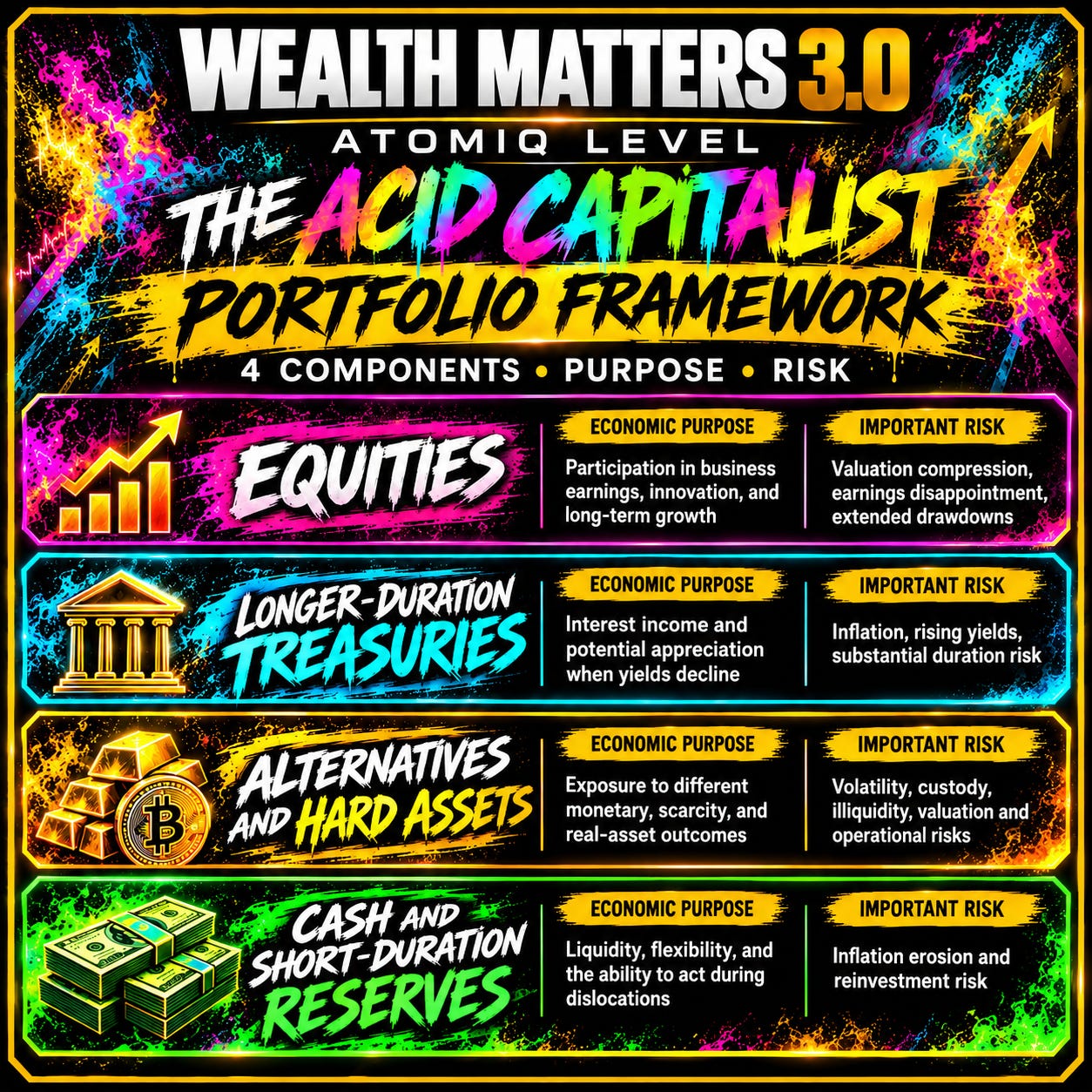
The framework resembles familiar permanent-portfolio thinking, but Hugh’s contribution is not merely the four categories. It is the discipline of looking for exceptional opportunities within them.
He described the importance of recognizing substantial bear markets in major asset classes and considering whether the resulting prices offer attractive prospective returns.
He made a distinction between individual stocks, where company-specific risks can permanently destroy value, and broader asset classes with different historical behaviors.
One anecdote stood out.
Hugh recalled traveling through China around the 2009 equity-market bottom after having navigated the financial crisis. Looking back, he believed he should have committed far more aggressively to depressed equities. He had already benefited from seeing the crisis differently, but he recognized that protecting capital through a collapse and taking advantage of the eventual recovery required two different decisions.
That is a profound lesson.
It is possible to be right about a crisis and still fail to capture the opportunity it creates.
The investor who avoids a major decline deserves credit. But the investor who is too frightened to redeploy capital after the decline may surrender much of the advantage.
For a business owner approaching a liquidity event, this is particularly relevant. The instinct to protect the proceeds of a lifetime’s work is understandable. Yet permanently avoiding risk may create another type of vulnerability: insufficient long-term compounding.
Protecting wealth requires a distinction between the capital that must remain available and the capital that can endure uncertainty in pursuit of growth.
The Treasury Market Nobody Wants to Own
Hugh was especially interested in the historically severe decline experienced by longer-duration U.S. Treasury securities during the rising-rate environment.
The decline illustrates an often misunderstood feature of fixed income. A Treasury bond can have very low nominal credit risk while remaining exposed to substantial price volatility.
When yields rise, the market value of existing fixed-rate bonds generally falls. Longer-duration securities typically experience greater sensitivity to yield changes.
That distinction matters because investors sometimes describe U.S. Treasuries as safe without defining what kind of safety they mean.
A short-dated Treasury held to maturity may serve a very different purpose from a long-duration bond purchased in anticipation of declining interest rates.
Hugh’s argument is that severe drawdowns can create future opportunities, particularly when investors have become conditioned to assume the recent trend will continue indefinitely.
But he also recognized that the market can keep moving against a thesis and that waiting for evidence of a turn may be sensible. The practical question is not whether Treasury bonds are good or bad. It is what role they are supposed to play.
Are they part of a liability-matching strategy?
A source of income? An emergency reserve?
A recession hedge? An interest-rate speculation?
Or a component of a long-term allocation?
The same asset can be appropriate for one purpose and unsuitable for another. That is why investment policy should precede investment enthusiasm.
The Midterm Market Pattern, the AI Trade, and the Danger of Calling a Bubble
Hugh also introduced a historical market pattern he believes is relevant to the period around U.S. midterm elections.
He argued that purchasing broad U.S. equities near midterm elections and holding for roughly a year has historically produced an unusually favorable record over the sample he follows.
That claim deserves independent examination. Historical results can depend heavily on the specific purchase date, index, holding period, inclusion of dividends, and start and end dates of the study. A historical pattern is not a guaranteed investment outcome.
But it is revealing that Hugh does not respond to widespread bubble warnings in the way many investors might expect.
He described how accusations of a bubble can actually attract his attention. Why? Because rapid increases in prices may accompany powerful changes in capital flows, technological expectations, and investor behavior.
Sometimes an asset is overpriced. Sometimes the market is anticipating a transformation that conventional valuation methods have not yet captured. And sometimes both things can be true.
He specifically mentioned companies such as Oracle and CoreWeave while discussing AI infrastructure and stressed credit markets.
This is where investors must be especially careful. A falling share price, widening credit spread, or distressed financing environment may create an opportunity, but it may also signal genuine financial weakness. Buying highly leveraged businesses during a credit scare can produce extraordinary returns or substantial permanent losses.
Hugh’s own discussion of credit-default swaps highlighted another important point: liquidity can be poor, financing instruments can be complex, and not every trade accessible to institutions belongs in an individual investor’s portfolio.
The valuable lesson is not to imitate a hedge fund manager’s most aggressive trade.
It is to understand what market stress might be signaling and distinguish between an opportunity in an underlying company and a sophisticated instrument that requires specialized execution and risk controls.
5 Questions Every Wealth Builder Should Take Away
After more than two hours of conversation, I came back to the audience that Wealth Matters 3.0 serves: people who have created or accumulated meaningful capital, business owners who may be preparing for a financial transition, and advisors responsible for helping families make sound decisions.
I would encourage every reader to consider five questions.
Are you confusing net worth with liquidity? A valuable company, property, or concentrated position can create substantial wealth while leaving you vulnerable to near-term cash obligations. What portion of your capital is available without depending on favorable markets or a forced sale?
Are you using an investment strategy designed for the capital you actually own? Operating-business equity, retirement assets, taxable investments, property, and emergency reserves have different constraints. Are they being managed as one undifferentiated pool?
Do you understand why your portfolio owns what it owns? Can you explain the purpose of equities, Treasuries, cash, Bitcoin, gold, and other exposures in terms of economic function rather than recent performance?
Are you prepared to act when an asset class becomes deeply unpopular? Do you have a written process for evaluating major drawdowns, changing fundamentals, and attractive prospective returns, or will emotional reactions determine your next allocation?
Are you paying for judgment or merely the appearance of expertise? What does each advisor, manager, research provider, or financial institution contribute that you could not replicate through an inexpensive index, sound policy, better data, or a carefully designed system of intelligence?
These are not rhetorical questions. They are the beginnings of an investment operating system. They help transform a collection of financial products into a coherent capital strategy.
Where Hugh and I Agree—and Where I Remain Cautious
There was a great deal in this conversation that aligned with my own thinking.
I agree that financial markets and the real economy demand different capabilities. I agree that investors should challenge professional incentives and conventional narratives. I agree that human judgment, trust, context, and taste are becoming increasingly valuable as generic analysis becomes cheaper to produce.
I also agree that the emergence of digitally native dollars deserves attention far beyond crypto trading circles.
And I still believe Bitcoin deserves serious analysis as a potential component of long-term capital allocation.
But agreement on the direction of a transformation is not the same as agreement on its timing, magnitude, or investment implications.
A stablecoin-driven demand for Treasury bills does not by itself resolve federal financing challenges. The possible monetary relevance of Bitcoin does not make a $1 million price inevitable. The historical behavior of equity markets around elections does not eliminate the possibility of an adverse market year. And the possibility of an AI-driven productivity boom does not ensure that every company financing data centers will generate attractive returns for shareholders.
Hugh understands uncertainty. His entire investment identity revolves around confronting it. Our audience needs to understand it too.
There is a difference between having a bold thesis and constructing a portfolio that can survive being wrong.
In my view, the latter is the true test of wealth management.
From Being at Work to Putting Your Money at Work
The lasting value of this episode connects directly to something I have been developing around the transition from operator wealth to family wealth.
For much of our adult lives, we build wealth through ourselves being at work.
We develop skills, create businesses, build customer relationships, employ people, acquire assets, take operating risks, and convert effort into cash flow and enterprise value.
At some point, we face a transition.
We want our accumulated capital to continue working even when we are not.
That sounds simple until we discover that financial capital operates under different rules. When we treat our money at work like the employee that it actually is, we must make sure we have the proper management controls and systems in place for it to succeed at compounding itself.
The business owner has spent decades understanding what creates value in a particular industry. Now that person must understand monetary policy, credit markets, financial intermediaries, portfolio construction, liquidity, duration, taxation, custody, and global capital flows.
The temptation is to delegate the entire problem to a financial brand. Hugh’s challenge is to remain intellectually engaged.
You do not need to become a hedge fund manager. You do not need to adopt his volatility tolerance, personality, or portfolio. You do need to understand the strategy governing the money your lifetime of work produced.
The objective is not perpetual speculation. The objective is to build an adaptable capital system capable of protecting today’s obligations while compounding tomorrow’s opportunities.
That is how a lifetime of you being at work can become generations of your money being at work.
Why You Should Press Play
This conversation is worth watching because the written article cannot fully reproduce Hugh’s personality, his sudden turns of thought, or the unexpected humanity behind his carefully cultivated Acid Capitalist identity.
You will hear an experienced macro investor describe what it feels like to face a real-business cash crunch. You will hear a challenge to the incentive structure of professional money management and a fascinating discussion about the economics of sports, financial commentary, and scarce human attention.
You will also hear an extended discussion about the banking system, China’s monetary structure, the evolution of the global dollar system, stablecoins, Bitcoin, long-duration Treasury bonds, and investment opportunities arising from market dislocations.
Most importantly, you will hear someone who is willing to expose how he thinks, including the uncertainty and mistakes that come with being a professional risk-taker.
Connect With Hugh Hendry
Hugh’s official website is HughHendry.com, which he identified during our conversation as the appropriate starting point for finding his authentic work and Substack.
That distinction matters. We also discussed the problem of impersonator accounts and deepfakes. In a market where commentary can be copied, synthetic identities can be created, and convincing videos can be fabricated, verifying that you are dealing with the real source is increasingly important.
Visit his official site and follow the links to his writing and other activities there.
The Thought I Cannot Shake
I went into this conversation expecting to explore one of the most unconventional minds in macro investing.
I came out of it thinking about the space between expertise and lived experience.
Here was Hugh Hendry, the former institutional money manager who had spent years operating under enormous pressure, who left that world to recover, live differently, and rediscover his own voice.
He now inhabits a beautiful island, builds a distinctive media identity, studies the future of money, and runs an operating business that can still produce the same anxiety familiar to anyone who has ever wondered how the next obligation would be met.
It would be easy to frame that as a contradiction. I think it is more revealing than that.
Hugh embodies the reality that financial intelligence does not exempt us from operational adversity and uncertainty. Professional success does not eliminate vulnerability. A sophisticated understanding of asset markets does not guarantee immediate liquidity. A valuable asset does not automatically make the owner feel financially secure.
And a person who made money wearing the institutional uniform does not necessarily find happiness by continuing to wear it. That last part deserves more attention than it usually receives in wealth management.
Because the ultimate objective is not to win a market argument. It is not to accumulate the most impressive collection of assets. It is not to build a reputation that requires you to maintain a personality you no longer want to inhabit.
The ultimate objective is to build enough economic independence, intellectual freedom, and personal agency to live a life you consider worth living.
Markets are one instrument in that process. Business ownership is another. Relationships, health, purpose, curiosity, and freedom are part of the balance sheet too, even if no custodian can place a market price on them.
Hugh Hendry is not a template for how anyone else must live or invest. He is an unusually transparent example of what happens when a person refuses to stop questioning the assumptions that shaped his success.
And that, more than any individual trade or forecast, is what I now respect most about him, and the lesson I hope readers carry forward.
The real risk is doing nothing.
— Chris J Snook
Five Favors Before You Go
Hit the ❤️. It tells the platform this is a conversation worth keeping visible and helps more readers discover it.
Restack 🔄. Someone in your network may be reconsidering how they invest, build, or protect capital. Introduce them to a perspective they might never otherwise encounter.
Share 📤. Send this to a business owner, financial advisor, family member, or investor who needs to think differently about the distinction between wealth and liquidity.
Join the conversation. What part of Hugh’s framework do you find most compelling—or most questionable? Is it the Bitcoin thesis, stablecoins, portfolio construction, monetary architecture, or the challenge to traditional wealth management? I want to hear your reasoning.
Subscribe to Wealth Matters 3.0. This newsletter and our Office Hours are 100% reader- and listener-supported. The free conversations create access and awareness. For our paid subscribers, the deeper playbooks, tools, research, and resources turn that awareness into informed, practical action. For $1 per day or less, join the Wealth CMDR community and build a stronger operating system for your net worth and your net happiness.
Editorial disclosure: This article is an interpretive feature based on my conversation with Hugh Hendry. Investment opinions, market forecasts, price targets, and personal accounts attributed to Hugh are his views expressed during the interview, not independently verified guarantees. Securities and strategies mentioned are not recommendations. Readers should consult their own qualified professionals before making consequential investment, legal, or tax decisions.
--
Thank you RaeAnn Engler, Robert A, J capocci, and many others for tuning into my live video with Hugh Hendry! Join me for my next live video in the app.