Before you read or listen to this absolute masterclass with Barry C Knapp, I encourage you to share, restack, and subscribe to Barry C. Knapp’s research through Ironsides Macro and follow his work on Substack for institutional-quality macro strategy made accessible to sophisticated individual investors, wealth advisors, RIAs, family offices, and allocators.
The worldview, his career arc, and the work.
Barry’s research translates macroeconomic history, monetary policy, sector positioning, credit markets, and long-term capital-spending cycles into practical portfolio guidance. His work includes specific sector allocations relative to the S&P 500, asset-allocation views across stocks and bonds, and longer-term secular frameworks designed to help investors distinguish between a tactical trade and a five-year investment thesis.
His current year-ahead outlook is available outside the paywall on the Ironsides Macro website, and his paid research is designed to bring the kind of analysis once reserved for institutional desks to a much broader investing audience.
This conversation is educational and should not be treated as personalized investment, legal, tax, or financial advice. Markets involve risk, forecasts can be wrong, and listeners should conduct their own diligence or consult qualified professionals before changing a portfolio.
The Soccer Player Who Became a Macro Strategist
Barry C. Knapp did not go to college planning to become one of the most recognizable macro strategists of his generation.
He thought he was going to play professional soccer.
That is where I wanted to begin our ATOMIQ LEVEL conversation, because before the frameworks, the television appearances, the institutional research, the derivative desks, the Lehman years, and Ironsides Macro, there was a young man whose first serious ambition had nothing to do with markets.
Barry grew up as the son of an electrical-engineering professor at the University of Connecticut. He was raised in a university town, surrounded by the children of academics, in an environment where ideas were constantly being proposed, tested, defended, and challenged.
That atmosphere gave him what he describes as a healthy skepticism toward ideas delivered with too much certainty.
He went to the University of Rhode Island because its soccer program was ranked sixth in the country. Ivy League coaches had written to him, but Rhode Island had beaten Connecticut, and Barry believed soccer was the path.
Then the North American Soccer League collapsed during his senior season.
No draft. No professional contract. No future in the direction he had been running.
Barry jokes that this may have been fortunate because he would have starved. But there is something important in the way a life changes when the first dream closes before the second one is visible.
A high-school guidance counselor had suggested economics. Barry took Macro 101. The lights went on.
He began reading The Wall Street Journal every day during one of the most intellectually and economically consequential periods of the modern era. Paul Volcker was driving policy rates toward 20%. Milton Friedman and Paul Samuelson were publicly debating competing economic worldviews. The country was wrestling with inflation, monetary credibility, the role of government, and whether markets or planners were better suited to allocate resources.
Barry sided with “Uncle Milty.”
He embraced classical economic liberalism and the belief that markets generally allocate capital more effectively than elite technocrats.
That belief has survived almost everything that followed.
The Paper That Explained the Man
One of my favorite moments in Barry’s story came from a college class on the history of economic thought.
The professor had earned his doctorate at Berkeley, described himself as a former Marxist, and had become a follower of Thorstein Veblen, whose work questioned conspicuous consumption and argued that government should play a role in determining which forms of production meaningfully benefit society.
Barry wrote his final paper in defense of the scientific method. He referred to Milton Friedman as “Uncle Milty.” He called Veblen a “normative stick in the mud.”
That was not exactly the safest route to an A. He received one of three A grades in a class of approximately sixty students.
Years later, after Barry’s father had died, his mother found the paper and sent it to him. The essay had become an artifact from an intellectual culture where a professor could reward a strong argument even when the argument attacked the professor’s own worldview.
That paper helps explain Barry better than a résumé. He is not contrarian merely to appear different. He is interested in the structure beneath the consensus.
He wants to know what assumptions are being smuggled into the conclusion, what historical analog is actually relevant, where the incentives sit, and which part of the prevailing framework is likely to fail when it touches reality.
That instinct would serve him well on Wall Street.
Arriving in New York Without a Map
Barry arrived in New York without connections.
He took a job as a financial advisor at Merrill Lynch in the Fifth Avenue Financial Complex. He looked around an office of roughly eighty brokers and asked himself a practical question:
Who do I want to become when I grow up?
His answer was none of them.
So he pursued an MBA at night. He was taking classes during the 1987 market crash while also running a small trading desk for Fidelity Investments in its first New York branch.
Imagine learning financial theory in the classroom while the market was teaching its own curriculum in real time.
That collision between formal economics and live market structure became part of Barry’s professional DNA. He eventually joined Lehman Brothers on the derivatives desk and spent approximately fifteen years in institutional equity derivatives, covering macro hedge funds and major quantitative managers.
He was early in the growth of indexation and quantitative investing, a period that now carries a degree of historical irony. Barry mentions the work of Michael Green and admits that he sometimes feels a little guilty about the distortions passive investing may have created because he participated in the industry’s earlier development.
But guilt is not the real takeaway. The experience gave him a front-row seat to how large pools of capital move. Not how they are described after the fact. How they actually move.
He became a managing director at Lehman in 2000, began trading the firm’s capital, and was repeatedly asked to move into research. In 2008, just before Lehman failed, he became the equity strategist.
That sentence alone contains an entire education.
The strategist who lived through Lehman
There are people who studied the financial crisis. Barry worked inside one of its central institutions.
After Lehman’s collapse, he continued in the strategy role at Barclays for six years. He later worked with Rick Rieder at BlackRock in an effective research-leadership capacity and reunited with former Lehman colleagues at Guggenheim Securities to develop a macro product.
Then, in 2019, he founded Ironsides Macro.
The professional arc runs through derivatives, portfolio management, proprietary trading, equity strategy, fixed income, credit, institutional research, television, and independent publishing. But the underlying worldview is remarkably consistent.
Barry believes markets are generally superior allocators of resources.
He distrusts policy frameworks that suppress price signals, distort capital allocation, and shift risk outside the area regulators believe they control.
He also believes investors need more than a reaction to the next headline. They need a framework. That is the gap Ironsides Macro was built to fill.
Making Institutional Research Approachable
Barry’s traditional audience had been institutional.
At Barclays and Guggenheim, his work was designed for sophisticated investment professionals, hedge funds, large asset managers, portfolio managers, and institutional clients. The material could be dense because the readers lived inside the language.
At the same time, Barry was a frequent guest on CNBC, Bloomberg, and Fox Business. Television taught him how to translate complicated subjects into something an intelligent viewer could understand without flattening the substance.
When he launched Ironsides, he wanted both. Institutional quality. Broader accessibility.
His research still serves institutional clients, but it is deliberately written for sophisticated individual investors, wealth advisors, RIAs, and family offices who want the underlying framework rather than a collection of stock tips.
Barry does not tell readers to buy Apple and sell Meta. He tells them where to be sector-by-sector.
He gives specific weightings relative to the S&P 500. Twenty-five percent technology instead of thirty-eight. A defined exposure to communication services. A view on financials, industrials, credit, Treasuries, mortgage-backed securities, and the appropriate part of the yield curve.
The strategy can be implemented using ETFs.
That is important because it makes the work actionable without forcing the reader to replicate an institutional trading desk.
Barry uses the same macro process with his own money. He does not buy individual stocks. The portfolio expression follows the framework.
The capital group lesson
During his years as Barclays’ equity strategist, Barry met an experienced Capital Group portfolio manager who offered him a piece of advice that changed the time horizon of his work.
The macro hedge funds Barry covered often cared about the next few months. They wanted to identify the trade, ride the move, and change direction when the setup changed.
The Capital Group manager wanted something else. Tell me which secular trends will persist for five years. That question stayed with Barry.
Today, his work separates the tactical from the strategic. A year-ahead outlook considers how the next twelve months may develop. His secular work asks what may persist over five or ten years.
That distinction matters for anyone investing generational wealth. A family office does not only need to know what the Fed may do at the next meeting.
It needs to know which structural forces may still matter after several policy cycles, elections, corrections, and market narratives have passed.
Barry’s answer increasingly centers on a long-running capital-spending cycle. A manufacturing renaissance. A broader U.S. CapEx revival that may extend far beyond the current AI boom.
Three favors before you keep reading
Hit the ❤️. The algorithm is a validation machine that needs your cheap dopamine to keep us at the top of your feed.
Hit the 🔄 restack. Somebody’s life will change passively today, and you can get the credit for bringing it to them from both of us.
Hit 📤 share. You know exactly one person in your email list or text stream who needs something on their playlist or reading wire today.
Drop a comment. I read every one, and I reply to the ones that make me laugh, make me think, or make me money. Preferably all three.
The manufacturing renaissance began before AI
The origins of Barry’s capital-spending thesis go back to 2012, when he was the equity strategist at Barclays and began studying the shale-energy revolution.
He met with analysts across every industry touched by energy, whether energy was an input, a product, or a source of competitive advantage.
The implications were larger than oil and gas.
A Boston Consulting Group report called “The Tipping Point” argued that China’s manufacturing advantage had been substantially arbitraged away across roughly $2 trillion of U.S. industrial production.
Chinese wages had risen rapidly after the country received permanent normal trade relations and joined the World Trade Organization. Transportation costs were increasing. China’s currency was no longer rigidly pegged. At the same time, U.S. energy costs were falling because of shale.
The American chemicals industry began to revive. Domestic manufacturing became more economically plausible. Then came the supply-chain shocks.
The 2011 Japanese earthquake and tsunami disrupted the auto industry for months. Flooding in Thailand later that year disrupted electronics and semiconductor supply chains. The first Trump trade war followed. Then COVID. Then the next trade war.
Each shock made efficiency look a little less efficient.
A supply chain optimized only for cost could become catastrophically expensive when it stopped moving. Risk management began to matter as much as labor arbitrage.
The underinvestment beneath the boom
Barry’s broader CapEx argument does not depend on AI spending continuing at its current pace forever.
That is one of the most important distinctions in the conversation.
The 2010s produced the second-weakest capital-spending business cycle since World War II. Structures investment as a percentage of GDP had historically run near 3% to 4% from the postwar era through the 1990s. Since then, it has generally occupied a lower 2% to 3% range.
America underinvested in its productive capital stock for decades.
Factories.
Energy systems.
Industrial facilities.
Transportation.
Housing.
Grid infrastructure.
Physical capacity.
That means the economy can experience an AI-specific slowdown without ending the broader CapEx cycle.
The AI boom may be the leading edge. It is not necessarily the entire wave.
Why the 1960s and 1990s matter as context
Barry compares the current environment with the two major postwar capital-spending decades: the 1960s and the 1990s.
The common ingredients were not merely technological excitement.
They included favorable supply-side tax policy, relatively stable prices, and bank-regulatory conditions that allowed credit to reach the private economy.
In the 1960s, John F. Kennedy changed depreciation schedules, and corporate tax reforms passed under Lyndon Johnson accelerated investment.
In the 1990s, regulatory changes after the savings-and-loan crisis helped banks increase private-sector lending.
Both eras featured price stability.
Barry does not define stability as a magical 2% inflation number. He focuses on the standard deviation of inflation—the degree to which prices remain predictable enough for companies to make long-term investment decisions.
A business can operate with 3% inflation if the environment is reasonably stable. It struggles when inflation jumps unpredictably from one regime to another.
This is why Barry believes the Federal Reserve’s 2% target is widely misunderstood. The target was formally adopted in 2012 to demonstrate resolve against deflation, not because 2% was discovered as the only economically valid inflation rate.
The target was designed for a different risk. Treating it as an eternal law may distort capital allocation.
Socialism with central-bank characteristics
Barry describes the Federal Reserve’s expanded role as “socialism with central-bank characteristics.”
The phrase is deliberately provocative.
His argument is that the central bank’s enormous balance sheet and suppression of term premiums distorted the price of capital. When the Fed holds trillions of dollars of long-duration securities, long-term yields do not fully reflect private-market demand and risk.
Capital then moves elsewhere.
Buybacks.
Financial engineering.
Private credit.
Leveraged structures.
Assets that benefit from the search for yield.
Barry’s preferred direction is for the Fed to shrink its footprint, reduce the balance sheet, and allow markets to allocate capital more naturally.
The larger thesis is not simply about interest rates. It is about who decides where money goes. Markets. Or technocrats.
Barry has been answering that question the same way since college.
The AI CapEx question
This is where our conversation became a genuine master class. The current AI investment cycle creates an unusual contradiction. The broad economy may be entering a durable capital-spending renaissance after decades of underinvestment.
At the same time, the leading AI hyperscalers may be approaching a dangerous rate of spending relative to their own cash flow.
Both can be true.
Barry uses CapEx as a percentage of cash flow as one of his primary warning indicators. In 2000, the telecom sector reached approximately 80%. The bubble broke.
In 2015, the energy sector reached approximately 80%. Oil subsequently fell roughly 77%.
The 80% level is not a law of physics, but it is a historically important stress point. It suggests companies are directing an extraordinary share of internally generated cash toward expansion in industries that may be approaching saturation.
The five major data-center spenders—Amazon, Google, Microsoft, Meta, and Oracle—are currently around 65% in aggregate. Oracle is the most aggressive spender relative to cash flow. Microsoft is the lowest.
Barry believes Meta may be the first to crack, and he points to indications that the company may consider renting out excess storage capacity as a possible sign that the spending trajectory is becoming harder to sustain.
The key phrase is rate of change. The AI CapEx cycle does not need to collapse. It needs to slow.
If it does not slow, the excess may become a systemic risk to the broader market.
The difference between a boom and a bust
The comparison with the late-1990s technology boom is useful precisely because the differences matter.
By 2000, the United States had experienced a decade-long capital-spending cycle. Non-residential fixed investment had compounded at close to a 10% annual rate for years, following already substantial investment during the 1970s and 1980s.
The economy entered the technology bust with broad overinvestment already in place. Barry does not believe that condition exists today. Outside the AI infrastructure complex, industrial America has not overinvested.
That provides an economic off-ramp.
The AI portion of the cycle can slow while investment continues in manufacturing, energy, transportation, housing, industrial automation, supply-chain resilience, and physical infrastructure.
The boom can rotate. It does not have to disappear.
Monetization is the harder question
CapEx is only one side of the AI equation. The other is monetization.
Can the companies spending hundreds of billions of dollars earn acceptable returns on that capital?
Barry believes this question is becoming more important as AI companies approach public-market scrutiny. IPO investors will ask questions private markets could postpone.
What are the revenues?
What are the margins?
How durable are the contracts?
How quickly does the hardware become obsolete?
Who ultimately pays?
What is the return on invested capital?
The answers are still developing. Barry’s recent work has focused on demand destruction. If a formerly cyclical memory-chip manufacturer raises prices fivefold and locks customers into multi-year contracts, the current economics may look extraordinary.
But prices that rise too far can reduce the demand they were meant to monetize. Every boom eventually discovers that the customer has a limit.
When the benefits move from producers to users
Barry believes the next stage of the AI cycle may transfer more value from the producers of the technology to the consumers.
The infrastructure providers, hyperscalers, semiconductor companies, and data-center builders captured the early wave.
The next wave may favor businesses that use the technology to improve productivity, margins, labor efficiency, products, logistics, and customer experience.
That view is reflected directly in his portfolio positioning. Technology represents roughly 38% of the S&P 500 benchmark. Communication services add approximately another 10%.
Barry’s allocations are closer to 25% technology and 5% communication services. That is an enormous relative underweight. He is not saying technology disappears.
He is saying the rate of earnings acceleration is approaching levels that may not be sustainable, and the investment cycle is moving toward a phase where the beneficiaries may broaden beyond the companies selling the picks and shovels.
Private Credit as the early-warning system
If Barry is right that AI CapEx is approaching a saturation point, where would the warning first appear?
Credit.
In the telecom bust and the energy collapse, credit spreads began widening before the full damage became visible elsewhere.
Today, public investment-grade spreads have remained remarkably calm despite record issuance. That calm might suggest the system is healthy.
But a different warning is appearing in private credit. Redemptions.
Barry points to major redemption requests from private-credit funds, including technology-focused vehicles associated with Blue Owl. He sees those withdrawals as evidence that investors may be reconsidering the liquidity tradeoff.
Private credit offered attractive yields in a world where the Fed suppressed returns in public fixed income. But the capital is locked up, valuations are less transparent, and investors cannot always exit when the thesis changes.
Public credit offers something increasingly valuable. A door.
If the deal deteriorates, the investor can sell the bond.
That does not mean the private-credit industry is broken. Barry is careful to distinguish between healthy direct lending and broader systemic collapse. But he sees the migration from private to public credit as a rational response to rising uncertainty around the technology-financing boom.
Dodd-Frank and the risk that moved outside the room
Barry tells a revealing story from 2010 or 2011, shortly after Dodd-Frank became law. He wrote in a Barclays strategy report that the regulation would cause an explosion in non-bank lending.
The New York Federal Reserve called him early on a Monday morning.
A conference call followed.
The response was essentially disbelief. That was not what the regulation was supposed to produce.
Barry’s answer was simple. “You did not eliminate the risk. You moved it outside the system you regulate.”
The banking sector became increasingly constrained. Loan-to-deposit ratios fell. Banks accumulated government securities. Private credit expanded to satisfy the demand for financing the banks no longer served.
That does not automatically make private credit dangerous. It makes it the location where the displaced risk went.
This is one of Barry’s recurring lessons: policy outcomes should be judged by incentives and behavior, not by the stated intention of the law.
The double-digit yield question
Barry remembers private-credit advertisements promising double-digit unlevered returns.
His reaction was not excitement. It was suspicion.
Who is paying that borrowing cost?
What kind of business can sustain SOFR plus 500 basis points when short-term rates are already above 5%?
A lender’s yield is a borrower’s expense.
That expense has to be supported by operating cash flow, asset appreciation, refinancing, or another investor willing to provide capital later. If the borrower’s economics cannot support the rate, the yield is not free.
It is a delayed credit risk.
Barry does not believe the economy is on the verge of another 2008-style collapse. Household leverage has fallen substantially since the financial crisis. Non-financial corporate debt relative to GDP is around 42%, well below levels associated with systemic instability. Private-credit vehicles generally carry nowhere near the leverage Lehman used.
Lehman operated with leverage measured in dozens of turns. Many private-credit structures operate closer to one-and-a-half.
The rhyme exists. The scale and transmission mechanism are different.
Why Barry thinks, “This is not 2008.”
I pressed Barry on the resemblance between collateralized private-credit structures and the alphabet soup of the pre-financial-crisis era.
CDOs.
Credit-default swaps.
Covenant-light loans.
Collateralized loan obligations.
Nine-figure minimum allocations.
The structures rhyme with the old world. Barry acknowledged the similarities but returned to the system-wide balance sheet. Households are not carrying the same leverage.
Banks are not carrying the same exposure.
Private-credit funds are not levered like investment banks were.
Non-financial corporate debt remains below historical danger thresholds.
The government is the sector whose leverage has moved beyond the line.
That means there can be losses, failed funds, frozen redemptions, bad loans, and ugly specific situations without the damage automatically becoming another global financial crisis.
Not every fire becomes a wildfire. The structure around it determines whether it spreads.
Lehman, Fannie, Freddie, and the policy error
Barry’s explanation of the financial crisis was one of the most valuable sections of the interview because he focused on the policy chain rather than the simplified morality play.
After the early-2000s refinancing boom, Fannie Mae made a major duration bet by declining to hedge prepayments. The market identified the exposure and forced the company out of the position. Congressional hearings followed. Regulators restricted Fannie and Freddie’s ability to take interest-rate risk.
So the government-sponsored entities moved toward credit risk instead.
They purchased super-senior tranches of subprime and structured-credit deals. The tranches appeared extremely safe because they would not lose money until housing losses reached extraordinary levels.
The yields were thin. The leverage was enormous.
Community-reinvestment and housing-policy objectives increased the pressure to participate. The policy designed to reduce one form of risk encouraged another. That does not absolve Wall Street. It explains why the system moved in the direction it did.
When policy restricts one outlet, capital finds another. That is Barry’s world in one sentence.
The public market becomes attractive again
As money leaves private credit, Barry expects a portion of it to move back toward public markets.
The attraction is transparency and liquidity.
Public bonds from high-quality issuers may offer less headline yield than private structures, but the investor can observe the price, assess the spread, and exit if the facts change.
Barry gives an example involving Goldman Sachs and Wells Fargo debt. A wealth-advisor friend called him because Goldman debt was trading at a tighter spread than Wells Fargo. Barry argued that the pricing reflected temporary regulatory distortions rather than the long-term risk.
The investor bought Goldman. The trade was not based on a narrative about investment banking. It was based on understanding the regulatory balance sheet. This is what Barry’s process does at its best. It translates policy into pricing.
The Fed’s real job
Barry’s 2026 framework centers on rebalancing monetary policy.
He wants the Fed to lower the policy rate at the front end while shrinking its long-duration balance sheet. That sounds contradictory only if all interest rates are treated as the same instrument.
Lower short-term rates can improve financing conditions for businesses, housing construction, and local-bank borrowers. A smaller Fed balance sheet can allow long-term rates and term premiums to reflect private-market demand rather than central-bank ownership.
One side supports productive credit creation. The other reduces financial repression. Barry believes this combination can help capital move away from financial engineering and toward productive investment.
Factories.
Housing.
Equipment.
Energy.
Infrastructure.
The things the economy underbuilt while cheap money inflated financial assets.
The housing multiplier
Barry connects front-end policy directly to housing. A large share of residential construction is carried out by smaller local builders. Those builders finance projects through local banks, and their borrowing costs are influenced by short-term policy rates.
A reduction in the policy rate can make projects economically viable again.
That matters because housing has a powerful economic multiplier. A new home requires land, labor, materials, appliances, financing, transportation, furnishings, and local services.
Housing is not just shelter. It is a network of economic activity.
Barry believes that rebalancing policy could help address supply constraints without recreating the excessively loose long-duration conditions that fueled earlier financial excesses.
From a K-Shaped economy toward a wonky “W”
Late in the conversation, we discussed the K-shaped economy.
Asset owners and high-income households have generally benefited.
Lower-income households, younger families, and people dependent on wages, credit, and housing affordability have faced a very different reality.
Barry believes part of the solution is monetary rebalancing, but he also points to several aggregate-demand shocks that are beginning to dissipate.
Government-spending growth slowed sharply in the final year of the Biden administration. Government layoffs and fiscal restraint reduced demand. A historic immigration surge changed labor and consumption dynamics.
Trade policy created uncertainty. Housing remained constrained.
These shocks produced a detox from an economy unusually dependent on government spending. Barry does not believe the slowdown automatically becomes a recession.
He believes the underlying private economy may begin to reaccelerate as the one-time shocks fade and productive investment strengthens.
The goal is not to restore the old dependency. It is to replace it with private-sector growth.
The analyst who still thinks in systems
What makes Barry compelling is not that he has an opinion on every market. It is that he sees the system.
AI CapEx connects to cash flow. Cash flow connects to credit. Credit connects to bank regulation. Bank regulation connects to private markets. Private markets connect to Fed policy. Fed policy connects to term premiums. Term premiums connect to asset allocation. Asset allocation connects to sector leadership. Sector leadership connects to the manufacturing and investment cycle.
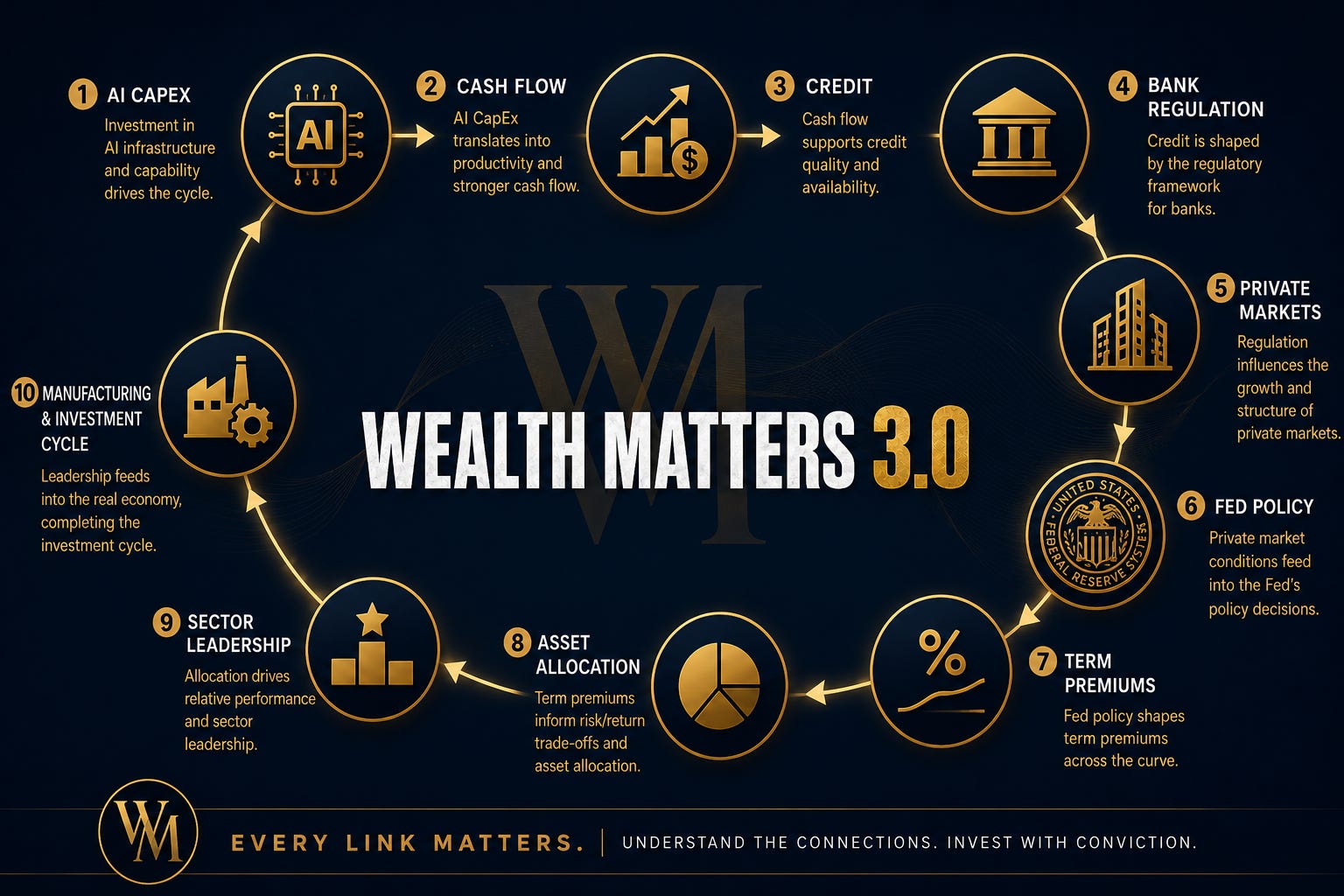
The headlines are separate only to people who do not see the plumbing. Barry sees the plumbing.
That is why a conversation with him can begin with soccer, move through Milton Friedman and Thorstein Veblen, pass through Lehman Brothers, Dodd-Frank, AI data centers, Blue Owl redemptions, inflation standard deviations, housing finance, and private credit—and still feel like one argument.
The argument is about capital allocation.
Who controls it.
What distorts it.
Where the risk moves.
And which prices are trying to tell us something before the consensus listens.
Why you should press play
This is not a short conversation. (just shy of 2 hours)…
Because it should not be.
Barry has nearly four decades of lived market history behind his views. He did not learn about the financial crisis from a documentary. He was inside Lehman. He did not discover derivatives after they became a political talking point. He spent fifteen years in the business. He did not build a macro framework by aggregating other people’s posts or using the latest AI frontier model. He developed it across trading desks, research departments, institutional meetings, policy cycles, television appearances, and his own capital.
Press play if you are trying to understand whether the AI infrastructure boom is a durable investment cycle or a bubble approaching its stress point.
Press play if you want to understand why private-credit redemptions may be a more important signal than public credit spreads.
Press play if you want a clearer distinction between a sector-specific bust and a system-wide financial crisis.
Press play if you are an advisor or allocator trying to position beyond the S&P 500’s extraordinary concentration in technology and communication services.
Press play if you are a long-term investor who wants to know which secular trends may still matter five years from now.
Press play if you believe the market has become too dependent on policy—and want to hear how it might begin standing on its own again.
This episode is a macro master class. But it is also a biography of how a worldview gets built.
The son of the professor
The thread running through Barry’s life begins with skepticism.
The son of an engineering professor grows up around ideas.
The soccer player loses the professional future he expected.
The economics student discovers Friedman during Volcker.
The young writer challenges a Veblenite professor and earns one of three “A’s” in the entire class.
The Merrill advisor looks around the room and decides he does not want that future.
The derivatives trader learns how large capital really behaves.
The Lehman strategist watches the institutional system break.
The researcher sees regulation move risk rather than eliminate it.
The independent analyst builds a product that gives sophisticated individuals access to institutional thinking.
The same instinct persists through every chapter. Do not accept the stated purpose as proof of the outcome.
Follow the incentive.
Follow the balance sheet.
Follow the credit.
Follow the cash flow.
Follow the capital.
Barry C. Knapp has spent most of his professional life studying the point where policy, credit, markets, and human behavior collide.
He does not sound like someone predicting an imminent collapse. He sounds like someone warning that the composition of the cycle is changing.
The AI spending boom is approaching a point where discipline matters. Private credit is beginning to reveal its liquidity cost. Public markets are becoming attractive again. The broader industrial economy remains underbuilt. The Fed may have an opportunity to reduce its footprint without ending growth.
The capital-spending cycle may rotate from the producers of AI toward the businesses and industries that use it. The next chapter may not look like 2000. It may not look like 2008.
It may look like a slower AI buildout inside a much broader manufacturing and private-investment renaissance. That is a harder story to reduce to a headline. It is also a more useful story for investors.
Subscribe to Barry’s work at Ironsides Macro, read the research, examine the sector tables, and listen to this full ATOMIQ LEVEL conversation.
You do not have to agree with every conclusion. You should understand the framework. Because in markets, the danger is rarely that nobody saw the pressure building. The danger is that the people who saw it were dismissed until the price finally agreed.
The real risk is doing nothing!
~Chris J Snook
Thank you to everyone who tuned into my live video! Join me for my next live video in the app.