


2 hours and 47 minutes lost (and found). We Actually Broke Substack Temporarily.
Charlie Garcia and I were supposed to drop this replay last Wednesday, July 29th. Instead, in a way that was theoretical, figurative, and apparently literal, we broke Substack.
What was intended to be a two-hour ATOMIQ LEVEL livestream became an almost three-hour conversation that ran so long, moved through so many layers, and apparently pushed so hard against the platform’s ability to process the replay that it could not be restored to my dashboard until 4:47 p.m. on Sunday so that you all could have it in your Monday playlist/reading list.
For several days, it existed like some lost pirate broadcast from the Wealth Matters and Mischief Maker motherships:
real to everyone who had been in the room,
missing to everyone who wanted to catch up,
and technically somewhere in the Substack pipes while the server gods decided whether Charlie and I had exceeded the acceptable dose of live-streamed intellectual mischief.
Thankfully, this Monday morning, you finally get the chance to read the summary and re-hear what we tried to give you last week.
And honestly, the delay almost makes the replay more appropriate because this was not a normal episode.
It was not a tidy interview. It was not a promotional stop. It was not a guest showing up with a canned story, three approved talking points, and a polite CTA before returning to the algorithmic fog. It was a deepening of two men whose respect and trust grew with each other over a public chat that was only missing the lit cigars and brown liquid poured neat.
This was me being my most probing and curious, and Charlie Garcia doing what Charlie Garcia does best:
opening the doors to a room full of dangerous minds,
implausible stories, contrarian instincts, sacred obligations, hard-won reading,
family grief, faith, markets, books, grandkids, purpose,
and the kind of trust that cannot be manufactured by content strategy alone.
The conversation wandered because real salons wander. It detoured because real intelligence detours. It went long because some people cannot be reduced to the runtime they were assigned.
That is why I am glad the replay survived. Because what Charlie has built on Substack is not merely a newsletter.
It is not merely Capital Mischief.
It is not merely a paid publication with some of the strongest engagement metrics on the platform.
It is the smartest money virtual salon on Substack. And this conversation is the best live demonstration I have seen of why that matters.
Charlie is the creator of Capital Mischief, the founder of the Mischief Makers community, a writer, investor, entrepreneur, veteran, former special operations operator, adviser to presidents, voracious reader, founder of R360, and one of the rare people on the internet who has built something that feels less like a newsletter and more like a living room full of high-agency people who came to argue, learn, challenge, laugh, and become sharper together.
You can also visit CharliePGarcia.com to learn more about Charlie’s broader body of work, books, speaking, faith, writing, and mission.
Disclaimer: This article and conversation are educational. Nothing here should be treated as individualized investment, financial, legal, tax, political, religious, business, publishing, or portfolio-construction advice.
A Word From Our Ecosystem
Before we get into this topic further, I want to thank one of our Wealth Matters 3.0 ecosystem brand partners and Wealth CMDR PRO Subscribers: PEBL.
PEBL is a company I personally use across my own portfolio companies and personal strategy because hiring abroad or remote should not require founders, operators, family offices, or distributed teams to spend months building employment infrastructure before they can bring great people into the business.
Hiring abroad or remotely can take months when you do it on your own, but with PEBL you can hire in over 185 countries in minutes and have your new hire onboarded by Monday.
PEBL is normally $399 per month per employee — already a no-brainer for what you get — but right now there’s a limited-time offer on their site that makes it even easier to get started.
Go to hipebl.ai.

Terms and conditions apply.
The Room Charlie Built
There are newsletters that publish. There are newsletters that perform. There are newsletters that sell. And then there are “rooms”.
Charlie Garcia has built a room. It all started a few months back with his M3 (Mishief Maker Manifesto) post.
That is the distinction I kept coming back to during our second ATOMIQ LEVEL conversation. Episode 18 gave people the origin story, the backstory, the man, the worldview, the arc, and the reasons he has lived more lives than most people manage to fit into one. Episode 53 was different. This one was current. This one was live. This one was unscripted in the best possible way.
This one was about the thing Charlie has built since then.
On the surface, it is a Substack. The category is finance. The title is Capital Mischief. The people are Mischief Makers. The pieces come frequently. The comment sections fill up. The ranking signals show momentum. The audience grows. The paid subscribers show up. The founding members stay close. The room gets louder without becoming cheap.
But calling it a Substack is almost too small.
IMHO, what Charlie has built is the smartest money virtual salon on Substack.
That phrase is not marketing garnish. It is the most accurate way I know to describe the thing. A salon is not merely a broadcast channel. A salon requires a host, a room, a standard, a shared curiosity, a little danger, a little elegance, and enough trust among the people inside it that disagreement does not automatically become social violence.
That is hard to build online.
Charlie has built it almost accidentally, which is probably why it works.
He did not show up with a sterile funnel, a lead magnet, a guru posture, or some mechanically optimized content machine. He came onto Substack frustrated by the limits of writing elsewhere. He wanted to do more than a weekly MarketWatch column allowed. So he started writing five days a week. The first 108 pieces were free. He did not want to go paid at first because he did not need the money and, as he joked, the minute someone pays for a year, now he has a job.
But the community kept forming anyway.
Charlie said he has about 23,000 subscribers, and sometimes the comment section is four times the length of a 10,000-word article. Personally, I have written comments in the 500-600 word range on his posts. He learns from the readers. They learn from him. Some are young. Some are in their late eighties. Some come to agree. Some come to fight. Some become founding members after first showing up as challengers.
That is the room. That is the thing most people cannot fake.
Trust, Context, Taste, and Coordination
Before we went too far, I framed the episode around a thesis I have been writing about inside Wealth Matters 3.0.
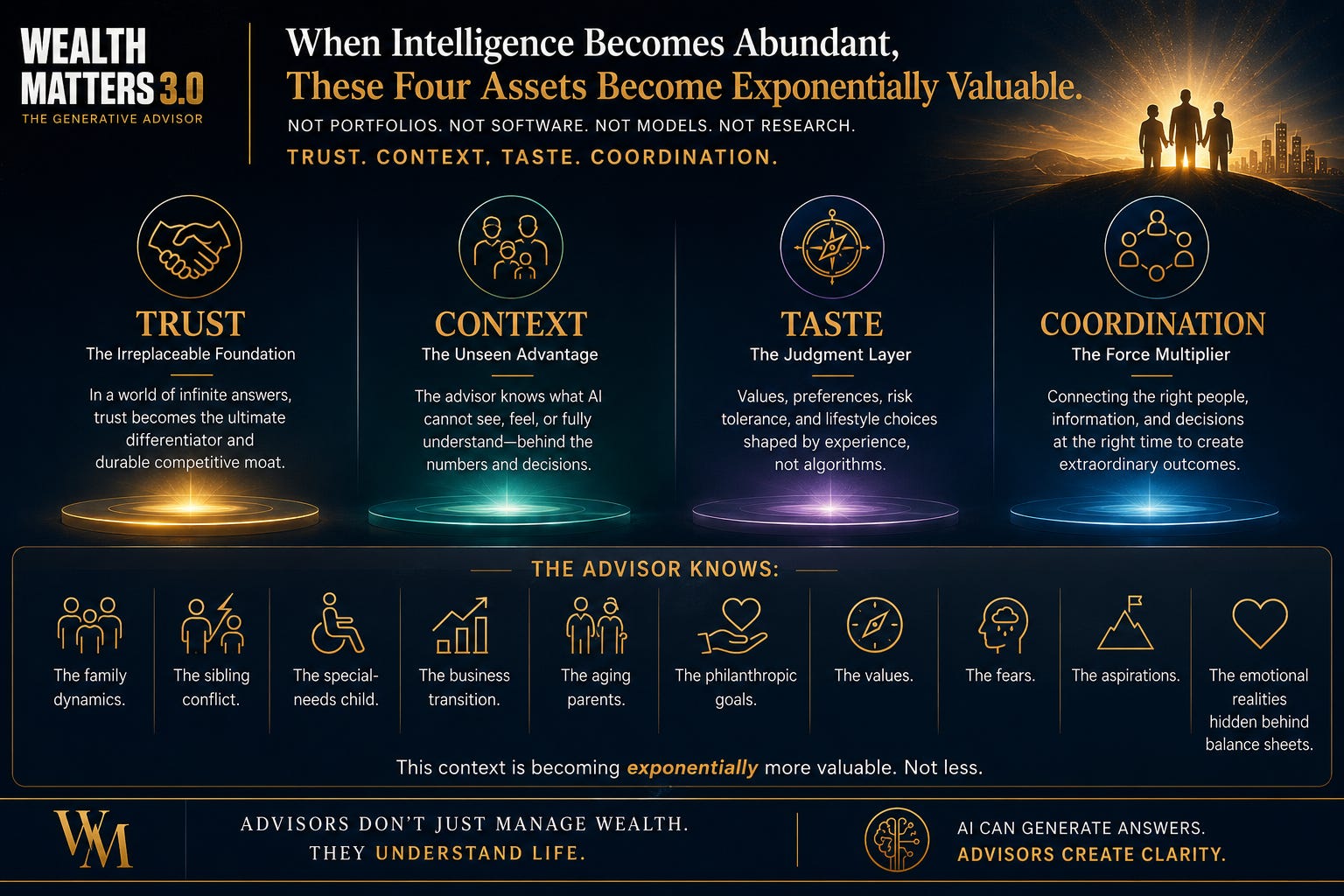
As artificial intelligence makes intelligence abundant, the things that become more valuable are the things that do not automate cleanly:
Trust.
Context.
Taste.
Coordination.
Charlie is one of the clearest use cases I have found for that framework.
Trust is the thing you cannot automate. It is built through attention on deposit. It compounds when a reader sees you show up, think clearly, say what you mean, correct yourself when wrong, defend the boundary when needed, and keep going when it would be easier to pander.
Charlie has trust because he does not write like a man trying to get permission from the room. He writes like someone who believes he has been given gifts and has an obligation to use them.
Context is what turns information into meaning. There are thousands of smart people publishing market thoughts, political takes, book notes, macro observations, and life reflections. Most of it disappears because it has no integrated frame. Charlie’s context comes from a life spent across military service, presidential advising, entrepreneurship, investing, writing, faith, reading, family, R360, and proximity to the kind of wealth most people only encounter as an abstraction.
Taste is the filter. It is the choice of what to elevate, what to ignore, what to challenge, what to read, what to share, and what to leave on the cutting room floor. Charlie’s Saturday book rhythm may be one of the clearest demonstrations of taste on the platform. He has spent a lifetime reading, and now he gives people a way to borrow the filter.
Coordination is where the value gets created. It is not enough to have ingredients. Flour, sugar, water, and heat do not automatically make a Michelin-star chef. Coordination is the repeated ability to turn those ingredients into a finished product people want to return to.
That is what Charlie does. He coordinates trust, context, and taste into a room.
The Man Who Stopped Avoiding It
Charlie wrote in “M3” that he did not start a Substack. He stopped avoiding it.
When I brought that line back to him, he did not turn it into a creator-economy strategy lesson. He went to Matthew 25 in the Bible.
That told me everything about why this thing works.
Charlie talked about the parable of the talents, the master who gives different amounts to different servants, and the servant who buries what he was given because he is afraid. For Charlie, the lesson is not abstract theology. It is operating instruction. There are billions of people on the planet, but each person has gifts, and each person has to find the courage to invest those gifts wisely.
His gift is reading, writing, synthesizing, and speaking with force.
He learned to type at the Air Force Academy. He learned to read at abnormal speed, with comprehension, and the sheer repetition over decades created a brain shaped by books. He said he reads 50 books a year, sometimes 100. He has written three books translated into 15 languages. He has dreamed of having a column since he was a kid.
That is the visible part. The invisible part is obligation.
Charlie does not talk about writing like a content asset. He talks about it like stewardship. A gift unused becomes a buried talent. A message delayed becomes a failure of courage. A platform avoided becomes a kind of disobedience to purpose. That may sound heavy.
It should.
Because the deeper this episode went, the clearer it became that Charlie is not writing because he needs a hobby. He is writing because life has reminded him that time is not theoretical.
Four favors before you continue.
Hit the ❤️. The algorithm is a validation machine that needs your cheap dopamine to keep us in the top of your feed.
Hit the 🔄 restack. Somebody’s life will change passively today, and you can get the credit for bringing it to them.
Hit 📤 share. You know exactly one person in your email list or text stream who needs something on their playlist or reading wire today.
Drop a comment. Tell me the story you loved best, or your favorite Charlie post to date, or mine. Ask the hardest unanswered question you have. I read every comment, and I reply to the ones that make me laugh (or cry), make me think, or make me money. Preferably all three.
The Brother, the Breakfast, and the Assignment
The most human part of the conversation came when Charlie talked about his brother.
In January, while returning from an R360 meeting, Charlie got the call. He had just seen his brother in Miami days earlier. His nephew came home from high school and found his father dead in the living room. His brother was 59. He did not drink. He worked out. He was preparing for trial. He had been on his phone, without glasses, tripped, fell backward, hit his head on a coffee table, snapped his neck, and died instantly.
There are moments where a conversation stops being content.
This was one of them.
A week later, still grieving, Charlie attended the National Prayer Breakfast in Washington, D.C. One of the organizers offered him a seat at the head table near the Nobel Peace Prize winner who had fed 120 million people during the pandemic. Then came the favor: Charlie was asked, 90 minutes before the closing dinner, to stand up in front of presidents, senators, members of Congress, foreign leaders, and dignitaries and speak for five minutes about his relationship to Jesus Christ.
His wife told him he was not going to do it. He did it anyway.
He had never cried in public, and the grief of his brother hit him in front of that room. But what came through was not performance. It was assignment. He felt the message clearly: you have a purpose, you know your purpose, and if you are not going to get to it, remember how quickly this can end.
Charlie’s father died at 61. His brother died at 59. Charlie is already older than both of them were. He has three grandchildren. He wants to be around for a while. He wakes, reads Genesis, meditates, prays, draws from a deck tied to the 72 Hebrew names of God, and dedicates the day.
Faith, in Charlie’s case, is not decorative. It is how he keeps the assignment in view.
And then, in the middle of all that, he holds up a walkie-talkie with a 5,000-mile range so his grandson Ezra can call him at bedtime. Ezra loves eagles, so Charlie is Eagle One, and Ezra is Eagle Two.
That is Charlie.
Nobel Peace Prize table. Dead brother. Matthew 25. Global family office network. Market research. Special operations intensity. Faith. Grandchildren. Walkie-talkies. Mischief.
It all lives in the same man.
Mischief Makers Are Not an Audience
The reason Charlie’s Substack has become so interesting is that his readers are not acting like passive consumers.
They are acting like participants.
I told him during the episode that I sometimes spend almost as much time writing a comment on one of his pieces as I do writing my own. I am not alone. His posts draw hundreds of hearts and dozens, sometimes hundreds, of comments. Some comments are long enough to become essays themselves. The back-and-forth is often sharper than the article comment sections most platforms pretend are “community.”
Charlie compared it to a kind of Dear Abbey. I called it a smart money salon.
The word matters because a salon is not a mob. It is not a fandom. It is not a Discord room full of anonymous chaos. It is a hosted intellectual environment where people are allowed to disagree because the host has set a tone that makes disagreement useful.
Charlie allows only paying subscribers to comment most of the time because otherwise the volume would become unmanageable. On Fridays and Saturdays, he publishes free pieces where anyone can comment. That is a boundary. It is not elitism. It is stewardship. He still tries to answer everybody, sometimes until two in the morning, with his wife coming in with the hook telling him to go to bed.
That is not scalable. That is exactly why it matters.
The irony of the creator economy is that the unscalable parts often create the most trust. Reading the comments. Answering the challengers. Correcting mistakes. Letting smart people push back. Refusing to pander. Refusing to ban dissent just because it is uncomfortable.
Charlie said he has banned only one person across hundreds of articles, and that person was making blatantly racist and inappropriate comments. That is a standard, not fragility. Everybody else gets a shot.
Some of the people who came at him hard became friends. That is what the internet forgot how to do.
The Art of Useful Disagreement
One of the reasons Charlie’s room works is that disagreement is not treated as disloyalty.
We talked about one exchange with a reader named Petra, a brilliant woman living in Italy who challenged Charlie on something he had written. Charlie did not collapse into defensiveness, but he also did not surrender the point just because someone disagreed. He fact-checked. He conceded where he believed he should concede. He pushed back where he had facts she did not. He argued.
That is the lost art.
Most online debate is theater. People posture for their side, dunk for applause, and confuse humiliation with persuasion. Charlie’s room is different because the exchange can become a relationship. He may not agree with you. You may not agree with him. But if the argument is serious, it can still add value.
That is not just an editorial point. It is an investment point.
A serious investor needs dissent. A serious advisor needs dissent. A serious family office needs dissent. A serious builder needs dissent. The person who only wants agreement is not building intelligence. They are building insulation.
Charlie’s Mischief Makers are valuable because the room does not merely consume his takes. It stress-tests them.
That is how a publication becomes a thinking network.
The Saturday Library and the Ghost of His Father
The Saturday format may be one of the most valuable parts of Charlie’s work. Not because book recommendations are rare. They are everywhere. Because Charlie’s book recommendations come through a lived filter.
He told a story about his father that made the Saturday library make sense. The first book Charlie remembers reading was A Message to Garcia. His father had an original copy tied to the author’s family. His father was a heart surgeon at Georgetown, read five newspapers a day, kept a large library, and quizzed the children at dinner on current events. Allowance was tied to reading. Charlie and his siblings were assigned books, and on Saturdays his father would quiz them. Based on their answers, they either got allowance or did not.
That is not merely a parenting anecdote. That is the origin of a reading machine.
Charlie reads nonfiction with a pen in his hand. He marks the margins. He reads biographies and history because they compress lived experience. He reads fast enough that he can absorb an extraordinary amount, but the deeper point is not speed. It is retention, discernment, and transfer.
The Saturday posts honor his father. That is what makes them different. They are not content. They are inheritance.
Charlie said he wishes his father were alive because his father would read the posts and tell him what he should write about next week based on what was happening in the world. That image hit me because it explains the texture of his work. It is current without being shallow. It is personal without being self-absorbed. It is opinionated but not unmoored from books, memory, tradition, faith, and lived experience.
For readers trying to grow and protect net worth and net happiness, that matters. There is too much data. Too much noise. Too many sources. Too many incentives. Too many headlines. Too many angles. A trusted reading filter is not a convenience.
It is leverage.
Contrarian Value, Yield, and the Fear of Hurting People
Charlie’s investing frame is also more interesting than the usual “here is what I bought” routine.
He described himself as a contrarian value investor focused on yield. That is 90% of what he does. The other 10% is asymmetric bets where he is willing to risk $1 to make $10. That alone tells you something. He is not anti-risk. He is not anti-speculation. He is not pretending that all returns come from one clean school of thought.
But he is careful.
He has run hedge funds. He once entered a stock trading competition where everyone started with $1 million, and he took it to $120 million in one year, with CNN covering it. He enjoys that kind of asymmetric thinking, but he is wary of bringing too much of it to Substack because younger or less experienced people might misuse it. What may be appropriate for 5% of liquid assets in one context could harm someone who treats it like a gospel trade.
That matters.
The internet rewards conviction. It rarely rewards suitability. Charlie worries about the responsibility attached to influence. He pays for serious institutional research. He reads Citrini and other sources. His family office spends a large amount each year on research. He wants to synthesize, filter, and share value, but he also understands attribution, caution, and the danger of people copying without context.
This is what separates a salon from a signal room.
A signal room gives people trades. A salon teaches people how to think.
Charlie keeps coming back to value. How can he give 10x value to a subscriber? How can he make the paid subscription feel absurdly underpriced relative to the intelligence, filters, community, and experience inside the room? He did not begin wanting 3,000 subscribers. He wanted 100 founding members because he wanted to attend to them. Then it grew.
That is usually how the best things scale. Not because the founder designs virality. Because the value leaks beyond the room.
The Future of Media May Be a Trusted Crowd
Toward the end of the conversation, we moved from Charlie’s Substack to the future of media itself.
This is where the conversation became less about one writer and more about the architecture of what may come next.
My view is that publishing and media are being disrupted because trusted crowds will continue to gather around people who provide context. Trust and context will drive power-law dynamics toward artists, analysts, writers, operators, and curators who can coordinate value.
Charlie agreed on the trust part, but immediately simplified the business model question back to value. He is right to do that. Whether the monetization layer is subscriptions, events, premium research, serialized books, audiobooks, community access, total value locked, or something we have not yet named, the enduring question is still:
Does the person or publication create more value than it captures?
Charlie is also thinking about the future of fiction and publishing. He has spent years working on a novel called Satoshi versus Goliath, and he is considering whether to serialize it on Substack instead of waiting 18 months for traditional publishing machinery to release it. He is bilingual and could potentially narrate it in English and Spanish. He has thought about Charles Dickens serializing A Tale of Two Cities in 1859, before the internet, before Substack, before the creator economy.
That is the right historical analogy.
Serialization is not new. The tools are new. The distribution is new. The payment rails are new. The feedback loop is new. The ability for a writer to gather readers, test chapters, build a community, earn income, preserve rights, and maybe disrupt the old publishing stack is newly powerful.
Charlie is not just building a finance Substack. He may be prototyping a different creator-owned institution. That is why this conversation matters beyond money.
The Wealth Lesson Hidden in the Salon
For Wealth Matters readers, the practical takeaway is not “start a Substack.”
That would be too shallow.
The real lesson is that in an age of abundant intelligence, scarce trust becomes wealth.
Charlie’s room is valuable because it sits at the intersection of intellectual capital, social capital, spiritual capital, reputational capital, and financial capital. He has not simply built an audience. He has built an arena where trust, context, taste, and coordination compound.
That is a wealth lesson.
If you are a founder, your future enterprise value may depend less on what you know and more on whether people trust your judgment.
If you are an advisor, your differentiation may depend less on model portfolios and more on your ability to curate context, build rooms, and help clients make sense of the flood.
If you are a family office, your edge may come from trusted networks where people share what they are seeing before it becomes consensus.
If you are a writer, your moat is not the post. It is the relationship with readers who believe your filter improves their life.
If you are a parent or grandparent, your real legacy may not be the assets you leave but the habits, reading, courage, faith, and standards you pass on.
Charlie’s father built a reader by requiring books before allowance. Charlie is now building a room by requiring seriousness before access. That is not a coincidence.
The “M”ischief in Mischief Makers
The word mischief can sound unserious.
In Charlie’s case, it is the opposite.
Mischief is the refusal to become domesticated by consensus. It is the willingness to ask the question polite rooms avoid. It is the courage to say what you think, then let smart people challenge it. It is rebellion without nihilism. It is argument without hatred. It is faith without performative softness. It is wealth without spiritual anesthesia.
The best part of Charlie’s mischief is that it is tethered. Tethered to reading. Tethered to family. Tethered to faith. Tethered to purpose. Tethered to generosity. Tethered to the belief that wealth should serve something beyond accumulation.
He talked about R360, where he is working with ultra-high-net-worth entrepreneurs, many with average net worths in the hundreds of millions, who want to touch billions of people positively for the benefit of humanity. Many of those entrepreneurs grew up poor. Many had awful things happen as children. The wound drove wealth creation. Now they want to focus on family and use wealth to benefit the world.
That is the full Wealth Matters 3.0 frame. Net worth without net happiness is not victory. It is just accounting.
Charlie understands that because he has seen money up close enough to know what it cannot fix. He has also seen purpose up close enough to know what it can demand.
Why You Should Press Play
Press play if you want to understand how Charlie Garcia built one of the most engaged, intellectually alive finance communities on Substack.
Press play if you want to hear why he believes gifts must be invested, not buried.
Press play if you want to understand why Capital Mischief feels less like a newsletter and more like a private salon full of high-agency people who read, argue, invest, challenge, and sharpen one another.
Press play if you want to understand the framework of trust, context, taste, and coordination in a real person’s operating system.
Press play if you want to hear the human story behind the writing: his brother’s sudden death, the National Prayer Breakfast, Matthew 25, his father’s library, his grandchildren, his faith, and the urgency that comes when purpose meets mortality.
Press play if you want to understand why Charlie is cautious about turning investment insight into easy signals, and why that caution may be one of the reasons his audience trusts him.
Press play if you are a writer, advisor, allocator, founder, family office member, investor, Substack reader, or high-agency mischief maker trying to understand how the next media business may be built around trusted rooms instead of generic content.
Press play if you believe the comment section can become more than noise.
Press play if you want to be reminded that disagreement can still become friendship when the room is serious enough.
Press play if you are tired of propaganda, shallow takes, anonymous cynicism, fake certainty, and financial content that treats readers like click-through units instead of human beings trying to protect their families, sharpen their minds, and make better decisions.
And press play if you are willing to ask the question Charlie keeps forcing back into view:
What gift am I still burying?
Charlie Garcia did not build the smartest money virtual salon on Substack by trying to engineer one. He built it by finally stopping the avoidance.
He wrote. He read. He answered. He argued. He conceded. He pushed back. He shared books. He honored his father. He grieved his brother. He talked about faith without sanding off the edges. He welcomed rebels. He protected the room. He gave people enough value that they did not just subscribe.
They participated. That is the difference.
A subscriber pays. A participant belongs.
That is what makes Capital Mischief interesting. It is not merely a source of information. It is a source of context. It is not merely a publication. It is a room. It is not merely Charlie’s take on the world. It is a living proof point that trust, taste, context, and coordination still matter when everything else becomes automated, accelerated, synthesized, or flattened by machines.
The machines can summarize. They cannot host the room. They cannot inherit the father’s library. They cannot feel the brother’s death. They cannot hear Eagle Two call Eagle One before bed. They cannot turn disagreement into friendship. They cannot make a group of strangers feel responsible for thinking better together.
Charlie Garcia can. That is why you should subscribe to him. That is why you should read Capital Mischief. That is why you should find the Mischief Makers. That is why you should visit CharliePGarcia.com. And that is why you should press play on the full ATOMIQ LEVEL conversation.
Because the real risk is not that the internet has too much information. The real risk is not finding the rooms where information becomes wisdom.
The real risk is doing nothing.
~Chris J Snook


