My ATOMIQ LEVEL conversation with Mark DiTondo on the seldom-known tax and retirement-planning opportunities available to profitable small-business owners, the five-year runway before an exit, and why building a pension before selling your company may change the financial future of your family.
Why You Should Listen
There is an uncomfortable possibility that every successful small-business owner approaching retirement should consider.
You could spend thirty years building a profitable company, employing people, investing in equipment, paying lenders, servicing customers, and sending increasingly large tax payments to the government, only to discover that the most important person in the business never received a properly designed retirement benefit.
You.
The company or practice might produce $750,000 or $1 million in annual pretax income. It might operate with remarkable consistency. Your employees may have a 401(k), your bank has collected interest for decades, and your local economy has benefited enormously from your work.
But what have you been building outside the company that will support your family when you are no longer operating it?
For this ATOMIQ LEVEL conversation, I sat down with my ATOMIQ Defined-Benefit-Plan expert Mark DiTondo, who recently retired from a 38-year corporate career in the insurance and financial-services industry, to explore an area of small-business retirement planning that many owners have never seriously evaluated: qualified defined-benefit pension arrangements, including cash balance plans and fully insured §412(e)(3) plans.
Our conversation went well beyond the mechanics of a pension.
We explored the difference between working in a business and making the business work for you:
The role of income security in retirement. T
The distinction between guaranteed contractual benefits and market-dependent assets.
And how qualified retirement planning can become part of a business owner’s pre-exit and succession strategy.
Mark brought examples involving dental practices, closely held family businesses, and a specialized cabinetry manufacturer whose owner wanted to transition the company to his son.
We also discussed how business owners can evaluate existing 401(k) arrangements, qualified pension contributions, retiree medical benefits, employee participation requirements, and the planning opportunities associated with the SECURE Act.
Some of the numbers were significant. Mark discussed hypothetical annual pension contributions of $400,000 or more and described scenarios in which qualified contributions materially reduced an owner’s current taxable income.
Those figures deserve attention, but they are not universal contribution allowances. The actual deductions and benefits depend on age, compensation, actuarial calculations, employee coverage, funding arrangements, business structure, and other legal requirements.
The important opportunity is not a single deduction.
It is the possibility that owners who are five to ten years from leaving their businesses could begin using the remaining operating years to build a separate, professionally designed retirement-income foundation.
You may be able to sell the business and still have a retirement asset you deliberately built before the sale.
That is a materially different outcome from expecting the business itself to provide everything, and it begins by asking questions while the company is still producing income.
Connect With Mark DiTondo
Mark DiTondo brings 38 years of experience in insurance, qualified retirement plans, and financial strategies for small-business owners. He spent his career helping business owners evaluate retirement-income solutions and is now continuing that educational mission through conversations, Office Hours, and the ATOMIQ ecosystem. Follow him on Substack, and if you want a complimentary mutual discovery call with us, find a time below on the calendar.
If you’re a profitable business owner considering a sale, succession, or retirement transition within the next five years, Mark and I invite you to begin with a personalized planning conversation. We’ll discuss your business, current retirement arrangements, expected exit timeline, income objectives, and potential planning opportunities that merit further professional evaluation.
Disclaimer: The appointment is an opportunity to evaluate potential strategies, not a representation that your sale or retirement distributions will be tax-free. Eligibility and any resulting tax benefits require individualized analysis.
The Young Entrepreneur Who Learned What It Means to Be Owned by Your Business
Mark’s story did not begin in an insurance office. It began with an ambition his employer couldn't accommodate.
After graduating from college in 1982, he joined a food-service company. During a performance review roughly two years into the job, he was asked about his long-term goals.
Mark told his supervisor that he wanted to be earning $100,000 annually by age thirty. The response was discouraging. Only a handful of people across the company’s national organization held positions that paid that kind of money.
For Mark, that was enough information. He went home and told his father that he needed a different career.
His uncle owned a dry-cleaning business, and his father helped finance the purchase. At approximately twenty-four years old, Mark became an entrepreneur. He eventually operated a cleaning plant and four locations.
The business became successful enough that a larger operator approached him about acquiring it. Five years after entering the industry, Mark sold the company.
By most conventional measures, he had accomplished exactly what ambitious young entrepreneurs set out to achieve. He owned a business. He expanded it. He built value. And somebody wanted to buy what he had created, but when I asked him what the experience taught him, his answer had very little to do with the sale price.
He told me the business had owned him.
Mark had spent seventy-five to eighty hours a week working. He carried mortgages, equipment obligations, and the relentless burden of servicing debt.
His freedom to make decisions was constrained by the necessity of keeping the operation functioning. That experience left him with a principle that would shape the next thirty-eight years of his professional life.
The business should work for the owner, rather than the owner spending a lifetime working for the business.
That distinction is easy to overlook when the company is growing. Revenue creates momentum. Customer demand provides validation. More employees and locations create the appearance of progress, but none of those things automatically produces financial independence.
A founder can operate an impressive company and still be dependent on remaining at the center of it. I have seen this repeatedly among entrepreneurs.
They build something valuable because they want autonomy, only to discover that their company has become a more demanding employer than the one they originally left.
Mark understood that contradiction from personal experience, and when he eventually entered financial services, he decided that helping other business owners avoid it would become his specialty.
The Most Important Bill He Paid Was Himself
Mark described another discipline he adopted when he was running his dry-cleaning business.
Every month, the company had bills. There were mortgage payments, equipment costs, operating expenses, and bank obligations.
But Mark put one more creditor on the list. Mark DiTondo.
He treated his own future financial security as an obligation that the business needed to fund. He began accumulating money at twenty-four years old, before selling the company and long before retirement was an immediate concern.
That may sound like familiar advice about paying yourself first, but Mark’s interpretation was more consequential than transferring a few dollars into a savings account.
He viewed retirement capital as a required component of the business owner’s financial structure.
I challenged him to consider how the meaning of saving has changed across different economic periods. In the early 1980s, interest rates were extraordinarily high by modern standards. A business owner could often obtain meaningful nominal yields on relatively conservative savings instruments. Over much of the subsequent period, owners experienced a very different environment, including years of extremely low interest rates and significant asset-price appreciation.
The discipline of setting money aside remained useful, but the vehicles used to preserve and compound that money required much more thought.
A savings account, a diversified investment portfolio, a qualified retirement plan, and an insurance contract are not interchangeable. They differ in liquidity, taxation, guarantees, opportunity cost, and investment risk.
The practical objective is not merely to save. It is to decide what each portion of the owner’s capital is supposed to accomplish.
Mark had been exposed to insurance and retirement planning through his father, who worked in the industry from 1954 to 1992.
After Mark sold his dry-cleaning company, he purchased a substantial permanent life insurance policy. He later used the policy’s available values in connection with family education expenses, automobiles, and a condominium deposit.
He also acquired real estate and participated in his father’s racehorse syndication, partly because he valued the opportunity to travel and spend time with him.
I found those details revealing. Mark was not simply accumulating financial products. He was using different assets to support different parts of his life.
His policy loans and withdrawals, like those available under many permanent life contracts, carried their own interest, tax, surrender, and benefit implications. They were not free money.
But the larger principle was valuable.
He had learned to separate the operating company from the assets intended to support his personal financial future.
Many entrepreneurs never make that separation. I know personally I made that mistake in my first two exits.
The Second Career That Grew Out of the First
After selling the dry-cleaning business, Mark’s father encouraged him to enter insurance and financial services. Mark joined a major insurance company in January 1989 and remained in the industry through September 2026.
His career included sales, managing-director responsibilities, general agency work, and extensive involvement in qualified retirement planning, but he never forgot where his professional understanding of entrepreneurship began.
Once he was licensed and knowledgeable about retirement plans, he returned to the industry he knew best. He visited the dry-cleaning owners and operators with whom he had built relationships.
He understood their debt obligations, payroll requirements, equipment costs, and unpredictable demands because he had managed those same problems himself.
Instead of approaching them exclusively as prospective insurance customers, he could speak to them as a former business owner. He helped them consider qualified retirement arrangements and insurance strategies appropriate to their circumstances. That background informed the way he evaluated small-business clients over the next several decades.
He knew that many owners have most of their wealth concentrated in one operating company. He knew that the owner may be the last person to receive a disciplined financial benefit from the company’s success. And he knew that retirement has an inconvenient habit of arriving whether the owner is financially prepared or not.
Mark’s father later demonstrated the value of employer-provided retirement income in a particularly personal way. When his father retired in 1992, he showed Mark a pension check of approximately $12,000 per month.
According to Mark, his father collected that income until he died in 2021. His mother then continued receiving a survivor benefit of approximately $6,000 monthly. The arrangement reflected the particular pension and survivor-benefit terms applicable to his father’s employment.
Those amounts are not representative of what all qualified pension plans can provide, but the experience profoundly shaped Mark’s understanding of retirement income.
He had seen a financial arrangement continue supporting a family long after the individual who earned the benefit stopped working. That was the outcome he wanted more business owners to consider.
The Pension Didn’t Disappear. The Owner Stopped Asking About It.
One of the most useful portions of our conversation involved the evolution of American retirement planning. For much of the twentieth century, many employees at established corporations participated in defined-benefit pension arrangements.
A defined-benefit plan establishes a formula for the benefit payable to an eligible participant, subject to plan provisions and applicable limits.
Over time, employers increasingly adopted defined-contribution arrangements, including 401(k) plans. Those plans helped shift more of the investment and accumulation responsibility toward individual employees.
A 401(k) generally begins with contributions rather than a specified future pension benefit. The eventual account value depends on contributions, investment results, fees, withdrawals, and other factors.
Both approaches can be useful, but they solve different problems. The 401(k) asks how much money is being contributed and invested.
The defined-benefit plan begins with the retirement benefit the plan is designed to provide and calculates required funding under applicable rules.
Mark believes many small-business owners have incorrectly concluded that traditional pensions are no longer available. That is an expensive assumption to make without asking an appropriate professional.
Defined-benefit plans remain available to qualifying businesses. Cash balance plans, which are a type of defined-benefit arrangement, have become particularly relevant in planning for some owners with stable, substantial business income.
Fully insured §412(e)(3) plans offer another distinct structure, with specific contract-funding requirements. These are not universally better than 401(k) plans.
They can involve more demanding funding obligations, administrative costs, actuarial work, employee benefits, and restrictions, but a profitable owner who has never evaluated them may be overlooking an important category of potential retirement planning.
Three Retirement Structures, Three Different Purposes
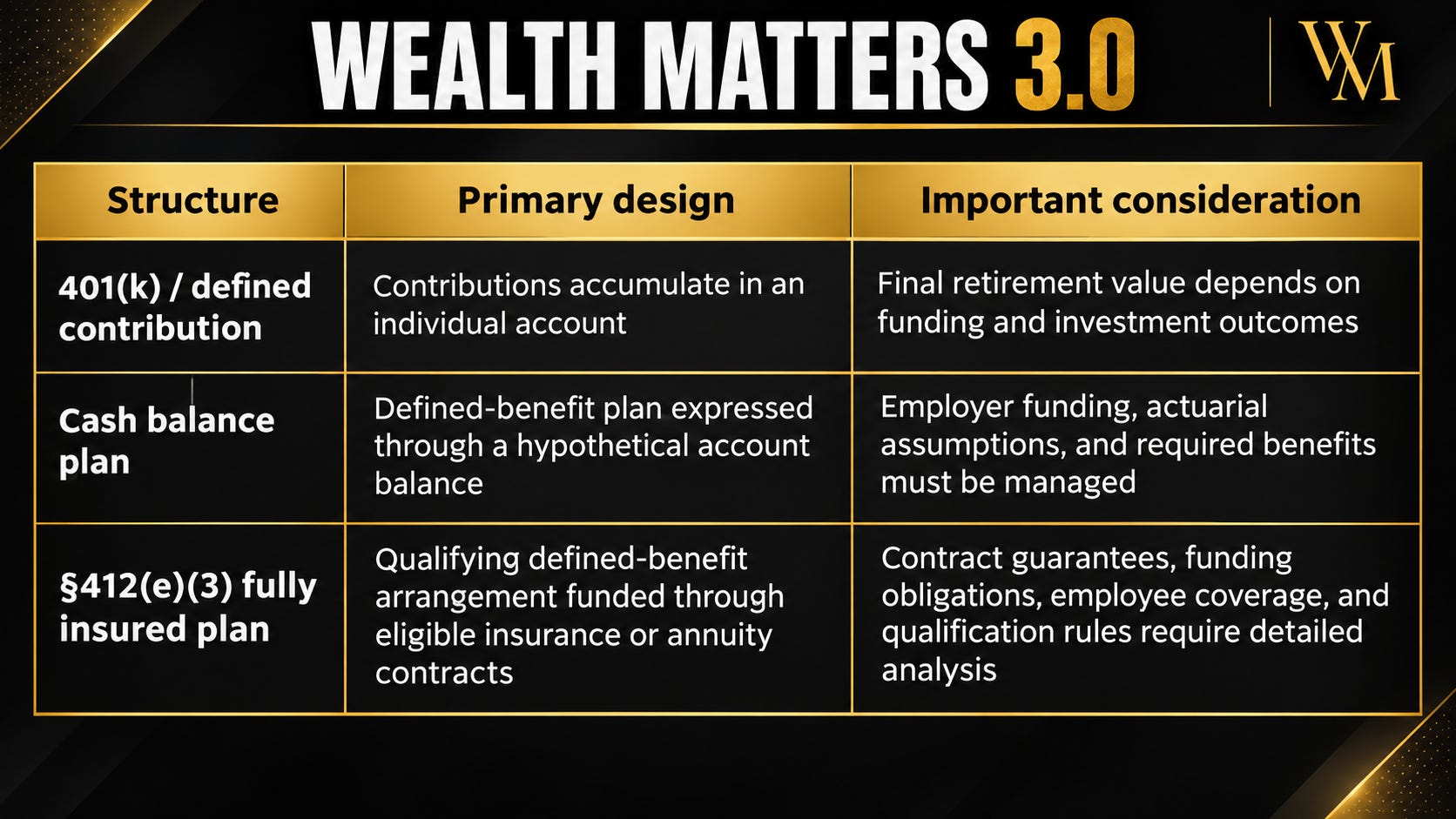
The goal is not to select the most complicated arrangement. It is to determine which combination best matches the business owner’s income, workforce, time horizon, and retirement objectives.
The Dentist Who Makes a Million Dollars but Has No Separate Retirement Strategy
To make the conversation practical, I asked Mark to consider a familiar type of closely held business.
Imagine a dental practice owned by a fifty-year-old professional and supported by a small team of hygienists and administrative employees.
The practice generates approximately $3 million in annual revenue and produces around $1 million in pretax income under our simplified assumptions.
The owner is successful. Appointments are booked months in advance. The practice has a predictable client base, and revenues have remained relatively stable.
Over time, the owner has purchased equipment, invested in facilities, and implemented conventional tax-planning strategies, but after operating expenses and available deductions, the practice still produces substantial taxable income.
What should the owner do?
Mark’s recommendation was to evaluate the existing retirement arrangements before assuming the business had exhausted its planning opportunities.
Does the owner have a 401(k)?
Are available employee and employer contributions being used appropriately?
Does the business offer profit sharing?
Would a cash balance or fully insured defined-benefit plan be suitable?
How would such a plan affect the employees?
And can the practice reasonably support the required funding over a multiyear period?
These are the questions that separate a genuine retirement-planning exercise from a simplistic tax-saving pitch.
Why a Large Pension Contribution Can Matter
During the conversation, Mark used a hypothetical contribution of $400,000 to illustrate how certain defined-benefit arrangements can create substantially greater contribution capacity than an ordinary employee 401(k) elective deferral.
For an owner facing a high marginal tax rate, a deductible employer pension contribution can potentially produce a significant current-year tax benefit while funding future retirement benefits, but the distinction between the contribution and the tax savings is essential.
A $400,000 deductible contribution does not create a $400,000 reduction in taxes. It potentially reduces taxable income by the allowed deductible amount.
The actual tax benefit depends on how that deduction interacts with the business owner’s tax circumstances and the applicable rules.
For illustration only, a fully deductible $400,000 contribution multiplied by an assumed 37% marginal tax rate would imply approximately $148,000 of tax reduction before considering other interactions or limitations.
That is meaningful.
It also means the business has actually contributed $400,000 to a retirement arrangement, with corresponding costs, restrictions, and funding consequences.
The purpose is not to make the deduction appear free.
It is to determine whether the owner can use operating profits to fund retirement more effectively while complying with the applicable requirements.
A Pension Is Not an Owner-Only Tax Shelter
I pushed Mark on an important complication: the employees. Our hypothetical dentist has hygienists, administrators, and other staff.
The owner may want to maximize retirement contributions, but qualified plans must satisfy employee participation, coverage, nondiscrimination, and other requirements.
That creates a meaningful difference between an owner-only professional practice and a company employing a substantial workforce.
Mark described how actuarial and administrative professionals can evaluate workforce characteristics, employee eligibility, and the interaction of different retirement plans.
He also discussed arrangements that combine an existing 401(k) with a new defined-benefit plan, but there is no universal percentage of employees that every owner can simply exclude, and there is no guarantee that a particular contribution formula will pass the necessary tests.
The caveat: Age, compensation, service, plan design, controlled-group relationships, employee benefits, and other factors matter.
One of the responsibilities of a qualified third-party administrator (TPA) and actuary is to model those issues before the employer commits to a plan.
I think this is an important reframing for founders.
Instead of asking only how much money the owner can accumulate, consider how the business can build a retirement system that is sustainable for the company and meaningful for eligible employees.
An owner who hopes to sell in five years may have long-serving employees who helped create the business’s value.
A thoughtfully designed benefit can become part of the legacy that owner leaves behind.
The employee costs are real. So is the potential value of retaining an experienced workforce and providing meaningful retirement benefits.
The goal is to evaluate both.
Why Predictability May Be More Valuable Than One Extraordinary Year
Mark repeatedly emphasized that stable cash flow is an important characteristic of a business suited to certain defined-benefit arrangements.
A company producing substantial income year after year may be better positioned to make ongoing funding commitments than a business whose earnings fluctuate dramatically.
That distinction matters.
A defined-benefit plan can create funding obligations that do not disappear simply because the owner has a disappointing year. Actuarial calculations, funded status, contract terms, and the governing documents affect what contributions are required or permitted.
A founder who had one extraordinary year should not assume that a large permanent pension commitment is automatically the right response. Similarly, a business owner planning to sell soon needs to consider what happens to the plan when ownership changes.
Will the buyer assume it?
Will the plan be terminated?
What happens to employee benefits?
How will existing insurance or annuity contracts be treated?
These questions are particularly important for owners in the final years before an exit. Mark’s point was not that every high-income entrepreneur should purchase a defined-benefit arrangement.
It was that successful owners with consistent income should understand what is available before deciding their existing retirement strategy is sufficient.
Why the §412(e)(3) Structure Deserves Its Own Conversation
Mark devoted considerable time to the distinctions between conventional cash balance arrangements and fully insured §412(e)(3) plans.
His preference in certain situations is to use contractual insurance and annuity arrangements to provide greater predictability in the funding and benefit structure.
He discussed the potential use of qualifying life insurance and annuity contracts, including the interaction between retirement accumulation, death benefits, and eventual distributions.
The contractual structure matters because the plan is intended to satisfy specific qualified pension requirements. There are also important restrictions that should not be overlooked.
Not every insurance or annuity contract qualifies for §412(e)(3) treatment. The plan must satisfy applicable statutory and regulatory requirements, including its funding design.
Life insurance inside a qualified plan can have tax consequences, including taxation of certain current insurance protection and potentially significant consequences when a policy is distributed to a participant.
The value of a transferred policy must be determined under applicable rules, and guarantees offered through insurance contracts ultimately depend on the terms of those contracts and the financial claims-paying ability of the issuing insurer.
A fully insured plan is not a blanket promise that every contribution will earn a particular return or that every participant will receive the maximum allowable pension.
Those details do not eliminate the potential appeal of the strategy.
They explain why it requires qualified specialists. For an owner looking for greater retirement-income predictability, the design may warrant consideration, but predictability should always be evaluated alongside cost, flexibility, liquidity, insurer exposure, and future obligations.
The Retirement Number That Can Be More Important Than the Sale Multiple
One of the striking details in Mark’s explanation was the statutory maximum annual defined-benefit amount. For 2026, the IRS limit under §415(b), before the impact of applicable age and other adjustments, is $290,000.
Mark used that figure to illustrate what a substantial qualified pension could mean to a retiring owner.
It is easy to understand the attraction.
A family capable of funding a significant lifetime retirement benefit may be less dependent on generating immediate income from the proceeds of a business sale.
That can change the owner’s negotiating position, but the figure is a limit, not an entitlement.
The actual benefit depends on plan provisions, participant circumstances, benefit elections, and applicable adjustments. More importantly, the distinction between an annual pension benefit and a business valuation is fundamental.
A founder may sell a company for an attractive multiple and still need to decide how to invest the net proceeds. Those investments may be subject to market volatility, inflation, taxes, and withdrawal risk. A separately established pension arrangement may provide a different source of retirement income.
The purpose is not to make the business sale irrelevant. It is to reduce the possibility that the entire retirement depends on a single transaction.
The Five-Year Runway: Create Retirement Wealth Before the Exit
This is where the conversation became especially relevant to my ATOMIQ EX!T thesis.
Suppose you are fifty-five or sixty years old and expect to sell your business in five years. The company has been profitable for decades. You have invested in employees, facilities, customer relationships, and equipment. You believe the business will be worth a meaningful amount when you sell.
Perhaps it will.
But what if the market changes?
What if interest rates make acquisitions more difficult?
What if a buyer demands seller financing?
What if a major customer leaves or a critical employee retires?
What if the company sells for less than you hoped?
The business may still be a wonderful enterprise, but it is not a guaranteed retirement plan. Having both is just prudent and wise, especially when you can potentially get your biggest tax deduction over the coming years in parallel.
Mark’s approach is to consider whether a portion of current operating income can be directed into qualified retirement funding during the years before the sale.
That potentially creates two distinct sources of future wealth.
The first is the value accumulated in the retirement plan.
The second is the value realized through the eventual business transaction.
Those sources may have different tax, liquidity, and distribution characteristics, and that distinction is valuable. It means the owner is not relying exclusively on the buyer to fund the next chapter of life.
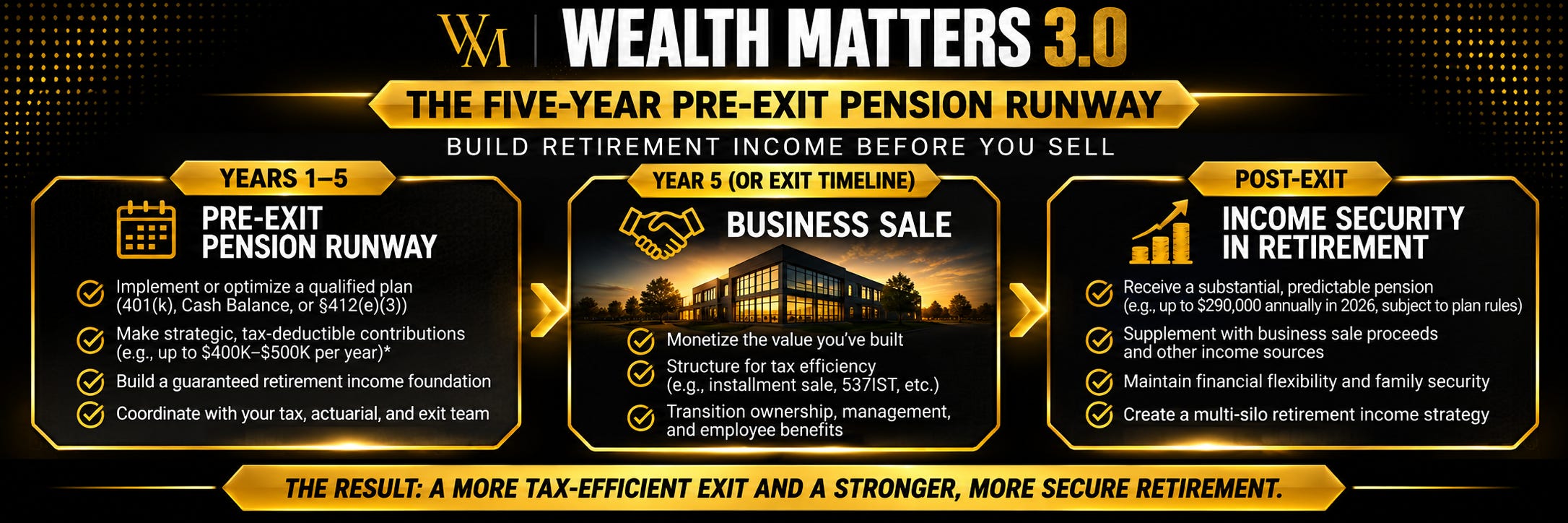
I also emphasized that the owner’s pre-exit planning must be coordinated with business valuation and transaction preparation.
Key Fact: Pension contributions are real expenses.
A buyer may evaluate them when assessing normalized earnings, working capital, retirement liabilities, and the treatment of employees after closing.
An owner should not assume that making substantial pension contributions leaves the company’s sale value completely unaffected.
This is why the tax advisor, pension specialist, business attorney, and exit advisor should be working together before the transaction. The objective is to maximize the overall outcome, not the size of one deduction.
The Retirement Income Silos That Protect You From a Single Bad Outcome
Mark used a term throughout the conversation that I found helpful.
Silos.
He believes retirement security should be built from multiple sources rather than relying on one asset to carry every financial obligation.
Those sources can include qualified pension benefits, defined-contribution accounts, taxable investments, insurance arrangements, income from real estate, Social Security, and proceeds from the sale of a business.
Not every owner needs every category, and each comes with different risks and restrictions, but the conceptual advantage is clear.
A business sale may occur at an unfavorable valuation. Equity markets may decline at the beginning of retirement. An income-producing property may require expensive repairs.
A surviving spouse may be unwilling to manage the assets the founder enjoyed operating. When the household has several appropriately designed sources of capital and income, it may have greater flexibility to respond.
That is a much better financial objective than simply accumulating as much nominal net worth as possible. A family can have a substantial balance sheet and still be fragile because nearly all its assets depend on one source of liquidity.
The purpose of multiple income and capital sources is to reduce that fragility.
The Cabinetmaker Who Wanted His Son to Own the Business
Near the latter portion of our conversation, Mark shared a story that brought the pension discussion into the world of family succession.
The client owned a company producing specialized high-end cabinetry for museums, churches, and other institutional customers.
The father was approximately fifty-seven years old. His son was around thirty-nine and wanted to acquire the business, but lacked the cash to purchase it outright.
The company had an appraised value of approximately $1.4 million.
Rather than simply requiring the son to find conventional acquisition financing, Mark described an arrangement that combined a staged ownership transfer with retirement-plan funding and life insurance.
The father would transition ownership over approximately seven years. Mark described a cash balance contribution of approximately $183,000 and a life insurance arrangement intended to address certain risks during the transition.
At the time of the interview, he indicated that the arrangement was approximately five years into the process.
The proposed outcome was for the father to retire after the transition with retirement assets accumulated during those years, while the son assumed ownership of the enterprise.
Those are Mark’s descriptions of a particular client arrangement. The legal, tax, actuarial, and funding details were not independently reviewed for this article, but the story captures something important.
A family business succession does not have to be framed exclusively as the choice between an immediate cash purchase and an outright gift.
There may be ways to coordinate legitimate compensation, retirement funding, financing, ownership transfers, and risk protection.
Each component must be evaluated independently and as part of the overall transaction.
The transfer must reflect genuine economic substance and appropriate valuation. Pension arrangements cannot simply be treated as an unrestricted substitute for purchase-price payments.
But the opportunity to coordinate these decisions can be meaningful. The father wants retirement security. The son wants ownership. The employees want the business to continue.
The family wants to preserve the relationships and value built over decades. A thoughtful succession process should consider all four.
The Employee’s Retirement Should Not Be Forgotten at Closing
I pushed Mark on what happens to employees when an owner sells a company. Business exits are often discussed almost entirely from the perspective of the seller and the buyer.
The purchase-price multiple receives enormous attention. Transaction taxes are modeled. Lawyers negotiate representations and warranties. Financing structures are evaluated, but the employees who helped create the business may have relatively little ownership.
For someone who has spent twenty or thirty years working for a closely held company, the sale can create uncertainty.
Will the buyer retain them?
Will benefits change?
Will the location remain open?
What happens to the retirement plan?
Mark explained that a properly maintained pension can provide participants with rights to accrued benefits under the applicable rules, even when the company changes ownership or the plan terminates.
Depending on the plan and transaction, participants may have options involving annuity benefits, eligible rollover distributions, or other treatment.
Those choices are not unlimited and must comply with the plan documents, vesting requirements, and applicable law. Still, the point is important. An exit should not be evaluated solely by what the founder receives.
It should also consider the continuity and financial security of the people who helped make the exit possible.
A company can be sold.
The owner’s responsibility to plan thoughtfully for that transition should begin much earlier.
Healthcare, Longevity, and the Retirement Expense Nobody Wants to Model
Later in our conversation, Mark introduced another specialized retirement-planning topic: retiree medical benefits under Internal Revenue Code §401(h).
This was a particularly relevant discussion because so many families underestimate the financial consequences of living longer.
I shared a personal example involving my grandmother. She experienced a stroke in her mid-eighties and required substantial in-home care during the remaining years of her life.
The cost was extraordinary.
Care of that intensity can consume significant household resources, even when the family has accumulated meaningful wealth.
Mark explained that qualified pension arrangements may, under certain conditions, include a separate account for retiree medical benefits.
That is an important distinction from an ordinary health savings account, or HSA.
A §401(h) arrangement has specialized qualification and contribution rules. Medical benefits must remain subordinate to retirement benefits, and the plan must comply with the applicable limits and separate-account requirements.
The commonly discussed 25% limitation involves a specific statutory contribution test and should not be interpreted as an unrestricted right to contribute another 25% of any pension amount.
Mark used hypothetical figures to illustrate the potential interaction between retirement funding and retiree healthcare needs.
I would encourage readers to treat those figures as a starting point for professional analysis rather than an immediately available planning formula, but the underlying question is essential.
How much capital will your family need if retirement lasts twenty-five or thirty years and includes a period of significant medical or caregiving expenses?
The business owner who has focused exclusively on maximizing the sale price may never have seriously modeled that possibility. That is precisely why a broader income-security strategy matters.
The Complexity of Owning Life Insurance Inside a Qualified Plan
We also spent time examining how life insurance contracts may be incorporated into certain pension arrangements.
Mark discussed alternative ways a plan might be funded using insurance and annuity contracts, subject to qualification and contract requirements.
I asked what happens when the owner retires, sells the business, or needs to terminate the plan.
Could the participant receive an annuity?
Could eligible plan assets be rolled into an IRA?
What happens to life insurance coverage?
Could the owner retain a policy personally?
Mark described several possible approaches, including policy surrender, qualified distributions, and arrangements under which the participant may seek to retain insurance coverage.
The important point is that each approach has different tax and economic consequences.
Life insurance coverage inside a qualified pension plan is not automatically available for personal use without tax consequences.
A policy distributed from a qualified plan may trigger taxable income based on its fair market value, and other rules may apply depending on the transaction.
A policy surrender can also affect the availability of death benefits and the amounts remaining to support retirement obligations.
The appropriate choice requires coordination among the actuary, plan administrator, insurer, and tax professionals, but what interested me was the broader lesson.
A plan should not be selected merely because its initial deduction looks attractive. The owner must understand how the arrangement works when contributions stop, retirement begins, and a business sale changes the employer’s circumstances.
The exit from the retirement plan deserves as much attention as the decision to establish it.
The Cash Out Clean Connection: Tax Strategy Before the Sale, Income Strategy Afterward
This discussion leads directly into our broader work around business exits.
Mark’s qualified retirement-planning expertise focuses primarily on how profitable business owners can use current operating income to build retirement benefits.
Our Cash Out Clean work addresses another set of decisions: how to structure a sale, evaluate tax treatment, model future cash flow, and preserve the financial flexibility created by a successful transaction.
Those are complementary objectives. They are not the same legal or tax strategy.
An eligible pension contribution during the years of business ownership may produce a current deduction and fund qualified retirement benefits.
An installment sale under §453 may, in appropriate circumstances, permit eligible gain to be recognized as payments are received.
A trust-based transaction marketed as a 537 Installment Sale Trust requires its own detailed analysis. IRS Publication 537 explains installment-sale rules but does not automatically approve every arrangement marketed under that name.
The owner also needs to understand the ordinary-income consequences of qualified retirement distributions.
Deferral is not the same as elimination.
A business owner who accumulates significant pension assets and later receives substantial business-sale proceeds must coordinate those sources carefully to understand future tax exposure.
That is why I believe the most important financial planning period for many owners is the final five years before the transaction.
The decisions made during that period can affect retirement income, sale negotiations, family succession, liquidity, and the options available after closing.
Free Personalized Exit Tax Strategy Playbook
CASH OUT CLEAN — Tax Strategy for Your Big Exit
Your exit deserves more than an estimated tax bill and a generic retirement projection.
Explore a personalized playbook built around your business, your potential transaction, your tax-planning questions, and your family’s post-exit priorities.
Whether you’re preparing to sell in the next twelve months or planning a succession several years away, this is an opportunity to begin modeling the decisions before they become irreversible.
You can interact with the Cash Out Clean book agent through spoken or typed answers, share details about your business and planning goals, and work through optional numerical questions.
In Chapter 9, the experience includes a confidential, customized 537IST revenue and tax estimator report intended to help frame a more informed discussion with qualified advisors.
The estimator is a modeling and educational resource, not a determination of tax eligibility, a legal opinion, or a guarantee of deferral.

The purpose is to help you understand the questions you need to ask before the transaction becomes difficult or impossible to change.
The 2026 Planning Window May Still Matter
Near the end of the conversation, Mark highlighted several provisions intended to encourage small employers to establish or improve retirement plans.
He discussed federal tax credits associated with eligible new retirement plans and qualifying employer contributions under the SECURE Act framework.
These credits can be particularly meaningful for small employers considering a new 401(k) arrangement.
The precise availability of those credits depends on factors including employer size, eligible employees, qualified startup expenses, contribution amounts, prior plan history, and applicable phaseouts.
Certain employers with fifty or fewer employees can qualify for a credit equal to 100% of eligible startup costs, subject to the applicable limitations.
Additional employer-contribution credits may be available, generally subject to a per-employee limit, eligible compensation rules, and a multiyear phaseout.
These are credits rather than ordinary deductions, which can make them especially valuable when the employer qualifies, but the incentive should not be confused with a universal reimbursement of all plan expenses or all employee contributions.
Mark also discussed how pension contributions can interact with the qualified business income deduction under §199A.
That interaction deserves careful modeling because the deduction’s availability and size depend on taxable income, the character of the business, wages, qualified property, and other factors.
A pension contribution may change the calculations, but it does not automatically make every owner eligible for an additional 20% deduction.
The practical message for owners approaching year-end is straightforward.
Do not assume your retirement-plan strategy is already optimized simply because your business has a 401(k).
Ask your CPA, retirement-plan specialist, and qualified actuary to evaluate what is available under your circumstances and whether appropriate action can still be taken for the relevant tax year.
Plan establishment deadlines, contribution deadlines, elections, and funding requirements can differ materially.
The sooner those questions are asked, the more room the owner may have to make an informed decision.
The Free Conversation Is the Gateway. The Full Playbooks Bring it to Life For Your Family.
The conversations on ATOMIQ LEVEL and the article follow-ups are ALWAYS free, because the insights and access to the discourse with the most brilliant minds on Finance, Business, and Tech that I benefit from are my generous (and strategic) gateway drug.
The other side of the paywall is where you get the full playbooks, the office hours, the archives distilled in a broader and more actionable context. It is where, for $1 per day or less, you can go from conversation to planning and protecting your net worth and your net happiness.
So I will see you over there and welcome you to your journey of becoming a true Wealth CMDR.
The Five-Year Retirement and Exit Planning Audit
If you own a consistently profitable business and expect to sell or transition ownership within the next five years, I would convert this conversation into a structured review with your professional team.
These are the questions I would ask before assuming that the company’s eventual sale will provide everything your family needs.
What is the actual retirement-income requirement? Determine the lifestyle, healthcare, family-support, and discretionary expenses that must be funded after the owner stops operating the business.
How much wealth exists outside the company? Separate business value from retirement accounts, personal investments, property, cash reserves, and insurance assets.
Are current qualified plans being used effectively? Review existing 401(k), profit-sharing, and employer contribution arrangements.
Would a defined-benefit or cash balance plan be appropriate? Ask qualified specialists to model contribution capacity, funding obligations, employee costs, actuarial assumptions, and potential tax treatment.
Could a §412(e)(3) arrangement make sense? Evaluate qualifying contract requirements, funding predictability, insurer risk, tax consequences, and distribution flexibility.
Is the business capable of supporting the commitments? Stress-test contributions against unfavorable operating years, declining revenue, a delayed exit, and changes in the workforce.
How will employees be treated during succession? Determine how existing retirement benefits, vesting, buy-sell terms, and company continuity will be managed.
What happens when the plan terminates or the owner retires? Model permissible distributions, rollovers, annuity elections, insurance-policy treatment, and possible tax consequences.
What is the realistic after-tax business-sale outcome? Compare transaction alternatives with the retirement assets already accumulated and the family income they are intended to produce.
Who is coordinating the complete strategy? Identify the actuary, pension administrator, CPA, insurance specialist, exit advisor, attorney, and financial advisor responsible for their respective parts of the plan.
The objective is not to construct the most elaborate system. It is to create a coordinated one.
The Most Important Insight From Mark’s Thirty-Eight Years
As our conversation approached its conclusion, I kept returning to the first business Mark had operated. He was twenty-four years old, ambitious, and frustrated by the income ceiling at his employer.
He became an entrepreneur because he wanted greater economic opportunity.
He expanded the business, learned to manage employees and equipment, and eventually sold it, but when I asked him what mattered most, he did not describe a revolutionary sales technique or a brilliant negotiation.
He described the cost of working seventy-five to eighty hours a week and carrying substantial debt.
Then he described how he learned to treat his future financial security as an obligation the business had to fund.
That is where his philosophy began.
Thirty-eight years of financial-services experience gave him access to sophisticated pension structures, actuarial calculations, insurance contracts, and qualified retirement strategies, but the motivation was simpler.
He did not want another owner to spend a lifetime building a company only to discover that they had failed to build anything independent of it.
I think that lesson matters far more than any individual retirement-plan design. The owner who understands it may begin setting aside capital earlier.
They may reconsider whether every available dollar should be reinvested in the next business expansion.
They may think more carefully about what the company is worth without their daily involvement.
They may ask whether a meaningful retirement-income foundation can be built before a sale.
And they may discover that the freedom they expect from the exit can begin taking shape years before the transaction occurs.
The dream is not necessarily to stop working.
Mark himself stepped away from a long corporate career and immediately continued pursuing opportunities to educate and serve business owners.
I see that as an important distinction.
Retirement is not always the end of productive work. It can be the point at which you gain greater freedom to choose the work you want to do.
Financial independence creates that choice. A successful exit may accelerate it, but a company sale alone does not guarantee it.
Why You Should Press Play
This episode is especially valuable for owners of consistently profitable companies who are generating substantial taxable income but have never seriously investigated defined-benefit or fully insured pension planning.
It is particularly relevant for professional practices, service companies, specialty manufacturers, family-owned businesses, and other enterprises where the founder expects to operate for another five to ten years before selling or transferring ownership.
Mark explains the differences among 401(k) plans, cash balance arrangements, and §412(e)(3) plans in practical terms.
He shares examples from decades of working with business owners and explores the role retirement benefits can play in succession, employee retention, and long-term financial security.
We examine the interaction between pension funding and business-sale planning, the potential complexity of insurance contracts inside qualified plans, and the need to anticipate future distribution and tax consequences.
Just as importantly, we discuss the responsibility owners have to their families and employees when transitioning away from a business.
The most useful insight is not that one specific pension should be adopted.
It is that qualified retirement planning deserves a place in the conversation before the owner signs a purchase agreement or hands over the keys.
Your Business Should Be the Beginning of Your Wealth, Not the Entirety of It.
A business can provide income, status, purpose, and the satisfaction of creating something meaningful.
It can employ people, serve customers, support a community, and eventually produce a significant liquidity event, but if the owner has made that business the sole source of financial security, the business may also become a source of vulnerability.
The value of the company depends on market conditions, buyer demand, management quality, operating performance, financing availability, and many other variables.
The owner cannot control all of them. That is why Mark’s story resonated with me. He had been an entrepreneur before he became an advisor to entrepreneurs.
He knew what it felt like to owe the bank money every month, to manage employees, and to work long hours while carrying the pressure of ownership.
He also knew what it felt like to sell the business and begin converting that experience into another form of opportunity.
The most important change was not his profession. It was his relationship with money.
He had begun separating the capital required to operate the business from the capital intended to support his life.
That is the same transition we are trying to help owners make through the ATOMIQ EX!T process.
You built your family fortune in one economy. Your children and grandchildren will inherit it in another.
The goal is to protect the income you need, transform the wealth you’ve built, and prepare the next generation to own and govern what comes next.
You do not accomplish that by assuming the business will sell for enough.
You accomplish it by defining the outcome, building the appropriate financial structures, understanding their obligations, and beginning before the final transaction.
The business you built should eventually be capable of supporting your independence.
It should not require you to sacrifice that independence indefinitely, and if you are already within five years of selling, there may still be meaningful planning questions worth asking today.
The real risk is doing nothing.
— Chris J Snook
Five Favors Before You Go
Hit the ❤️. The algorithm is a validation machine that needs your cheap dopamine to keep us at the top of your feed.
Hit the 🔄 restack. Somebody’s life will change passively today, and you can get the credit for bringing it to them from both of us.
Hit 📤 share. You know exactly one person in your email list or text stream who needs something on their playlist or reading wire today.
Drop a comment. Tell me your biggest insight, your greatest challenge, your counterargument or gap in the conversation, or a recent related triumph. I read every one, and I reply to the ones that make me laugh, make me think, or make me money. Preferably all three.
Subscribe. This newsletter and these Office Hours are 100% reader- and listener-supported. The free conversations provide access and awareness. Behind the paywall are the playbooks, resources, archives, and deeper subscriber discussions that help transform awareness into meaningful action for your net worth and your net happiness.
Technical References and Further Reading
Editorial disclosure: This article is based on my ATOMIQ LEVEL interview with Mark DiTondo, supplemented with explanatory information from IRS guidance and federal law. Mark’s client stories and financial illustrations are attributed to his account of the events and were not independently audited. Figures described in hypothetical examples do not establish actual contribution limits, available deductions, guaranteed returns, or tax outcomes for other business owners. Pension, insurance, trust, and installment-sale strategies should be evaluated with appropriately qualified professionals in light of the specific business, owner, participants, and proposed transaction. Thank you to everyone who tuned into my live video! Join me for my next live video in the app.