


In an era defined by escalating geopolitical tension, disrupted supply chains, and the ongoing Iran War, global trade dynamics are undergoing one of their most profound realignments in decades. The emerging multipolar order — where alliances shift and traditional trade corridors fragment — has exposed deep inefficiencies in how capital flows across borders. A widening $1.5 to $1.8 trillion trade finance gap now underscores the inability of traditional banking systems to keep pace with on-the-ground trade realities, particularly in emerging markets across Africa, Asia, and Latin America. As sanctions regimes, conflict, and currency instability strain conventional financing channels, demand is surging for alternative mechanisms that can de-risk and enable real-world trade amid uncertainty.
Trade finance — long the quiet backbone of global commerce — has resurfaced as a strategic asset class in this environment. Investors seeking uncorrelated, asset-backed returns are increasingly turning to firms like Consilient Capital, which are reengineering trade flows outside the boundaries of traditional banking compliance frameworks. Through a principal-based, title-controlled approach to commodities financing, firms in this space are filling the structural void left by banks since 2008. The conversation between Matthew Cape and Chris J Snook dives into how this evolution is unfolding — where AI, open-source intelligence, and agile capital are merging to restore certainty and liquidity to the arteries of global trade just as the world’s geopolitical landscape grows more volatile.
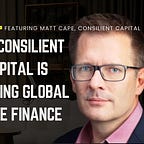
Against this backdrop, I sat down with Matt Cape of Consilient Capital — a veteran with more than 30 years in trade finance — to unpack how his firm is capitalizing on this market dislocation, delivering uncorrelated 9–11% returns while structurally de‑risking transactions for both buyers and sellers across the global trade network.
Connect with Matt Cape
Email: matt.cape@consilient.capital
Website: Consilient Capital
LinkedIn: https://www.linkedin.com/in/mattcape/
Watch the YouTube Video Version
Original recording Feb 26, 2026
Episode 017 Show Notes
Chris J Snook introduced Matt Cape of Consilient Capital to discuss achieving uncorrelated returns through a unique trade finance strategy that addresses a $1.5 to $1.8 trillion unfunded gap in global trade. Matt Cape detailed his background, the evolution of trade finance post-2008, and Consilient Capital’s low-risk model, which involves taking full title and control of non-perishable commodities during transit to secure an 8% to 12% risk-adjusted return for investors, while utilizing AI for advanced risk management and information tracking. The discussion concluded that the firm operates outside traditional bank regulation by acting as a principal in asset-backed transactions, positioning it to benefit from the growing trade needs in underserved regions like Africa and Latin America.
Introduction and Overview of the Discussion: Chris J Snook introduced Matt Cape of Consilient Capital to discuss methods for achieving uncorrelated returns in the market, particularly relevant in the context of AI. Matt Cape is based just outside London in Winter, which offers accessibility to both London and the airport. The conversation was set to explore Matt Cape’s background, the evolution of trade finance, and the unique strategy employed by Consilient Capital.
Matt Cape’s Early Career and Professional Background: Matt Cape began their career around 2000 as a shipping analyst, focusing on shipping markets and analyzing cargo flows to inform ship brokers. Around 1999/2000, they shifted into a niche area of the commodities market focused on marine fuel. This business involved gathering global pricing and supply information for heavy fuel oil used by ships and providing credit information to bunker suppliers, as ships typically bought fuel and paid 30 days later.
Evolution and Sale of the Shipping Fuel Business: The marine fuel information company, which grew to have 24-hour coverage with offices in London, Mumbai, Miami, Vancouver, and based out of Singapore, was sold in 2016 to Staten Pool’s division plants. Following the sale, Matt Cape and their business partner looked into new ventures, particularly trade finance, recognizing that customers buying their pricing/credit information primarily sought finance and payment assurance.
Genesis of the Trade Finance Strategy: The realization was that while most banking occurs in Europe and North America, most commodities originate in underserved regions like Africa, Asia, and Latin America. Traditional finance struggled to assess the creditworthiness of companies in these regions due to distance and difficulty verifying assets. Consilient Capital’s strategy was built on securing capital against real-world, liquid assets, such as 20,000 tons of coal or 5,000 tons of sugar, which have trackable market prices.
The Shift in Trade Financing Post-2008: After the 2008 financial crisis, new regulations made it uneconomic for large banks to finance small to medium-sized enterprise (SME) traders, which banks defined as companies with turnover under $500 million annually. This void was filled by large trading houses like Glencore and Cargill, who could raise cheap capital in first-world countries and then buy commodities at a discount from miners who lacked direct financing. These trading houses effectively financed the transactions by borrowing at low rates and taking an arbitrage profit.
The Market Void and Consilient Capital’s Approach: Matt Cape indicated that the unfunded element of global trade is estimated to be between $1.5 and $1.8 trillion US annually, representing transactions that cannot occur or are executed at high costs. Consilient Capital aims to address this gap by providing trade finance, generating a consistent risk-adjusted return of 8% to 12%. Their model focuses on financing trade with regions like Africa and Asia, which are experiencing high growth but are currently captive to the funding of European banks or large trading houses.
Consilient Capital’s Transactional Model: Consilient Capital enters existing, transparent transactions between a buyer and a supplier who have already agreed on terms. Consilient takes full title and control of the commodity, buying from the supplier at one price and selling to the buyer at another, with the spread serving as their margin (e.g., 1% on a 30-day term). They require the buyer to make a prepayment, potentially up to 30% of the cost, making the investment 110% to 130% covered by cash and title to the cargo.
Risk Mitigation and Security in the Model: The strategy is inherently low-risk because the funds are secured by the commodity, which is highly liquid and can be redirected if the buyer defaults. In the event of a buyer default, Consilient keeps the 10% to 30% prepayment, retains ownership of the cargo, and can redirect the vessel to sell the commodity for profit. Furthermore, all cargo is fully insured for loss or damage, and Consilient is the insured party.
Fund Structure and Growth Strategy: Consilient Capital has partnered with a regulated, established trade finance fund manager, Altea, to leverage their fund structure and 12 years of experience in African commodity trades. The fund is aiming for a $250,000 minimum investment. Consilient currently has $32 million deployed and another $15 million being onboarded, with a pipeline of over $100 million in qualifying transactions.
Target Returns and Liquidity: The strategy targets an annualized return in the range of 9% to 11% for investors. Transactions are self-liquidating, with terms varying from 30 to 180 days. Consilient aims for an average transaction period of 60 to 90 days, enabling them to offer redemption within a 90-day period.
Target Investor Profile and Payment Options: The fund is designed for high-net-worth individuals and self-directed IRA holders looking for a 6% to 9% net-of-fees return on cash. It is positioned as an asset-backed strategy for those with dry powder in cash or money markets who seek diversification and principal protection. Consilient also accepts stablecoin investments, offering returns without requiring redemption to US dollars.
Geographic and Commodity Diversification: Consilient’s primary focus is on transactions originating from Africa and Latin America, which are currently heavily underserviced by traditional finance. Their strategy mandates diversification, limiting exposure to any single commodity, counterparty, or geography to no more than 10%. The fund trades in non-perishable commodities, including grains, sugar, edible oils, petrochemicals, and various metals and metal ores.
Impact of Geopolitical Reordering: The current reordering of geopolitical trade agreements and alliances may benefit Consilient by creating more uncertainty, which encourages counterparties to trade directly through a neutral third party rather than relying on American or European banks. The existing market gap of $1.5 trillion is massive, regardless of geopolitical stability, suggesting continued growth potential for the fund.
Financing Mechanics and Control: Consilient finances transactions on a Cost, Insurance, and Freight (CIF) basis, meaning the price the buyer pays includes freight and insurance costs. The financing includes these elements, and Consilient is the client of the shipping company, ensuring they maintain full control and title over the commodity during transit.
Business Model and Risk Profile Summary: The discussion confirmed that the business operates in a vast market, which contributes to very stable returns and very low risk. The approach utilizes a model similar to historical methods of business, predating the complexity introduced by the financialization of trade by banks. The commitment to this model stems from the speaker’s belief that it is an “absolutely brilliant approach”.
Role of AI in Risk Management and Operations: The organization is actively collaborating with an AI business to develop a risk management platform. They are already capable of tracking every vessel globally, determining control points, inferring cargoes, and understanding the impact on local markets. The intent is to use AI to identify inconsistencies in paperwork, which is critical in the paper-heavy environment of commodity trading, to ensure consistency and prevent gaps in control or ownership.
Emergence of Open-Source Intelligence Tools: Chris J Snook highlighted the rapid development and open-sourcing of AI technologies, referencing a tool called “World Monitor” that provides intelligence rivaling state capabilities, tracking items like flights, protests, and ships. The availability of such open-source tools means that the intelligence required to track products and manage risk, which previously cost millions, is now freely accessible, enabling rapid infrastructure development for better information tracking.
Evolution of Information Availability in Trade: The conversation emphasized the dramatic shift in intelligence and information availability compared to the past, noting that 25 years ago, a boat captain might not have known their landing port until the final week, nor could they have determined the price of gas until arrival. Now, real-time intelligence feeds, accessible via a mobile phone or laptop, provide comprehensive visibility on global events, military vessels, and conflicts.
The Primary Role of the Firm and Investor Value: The firm creates certainty for buyers and sellers, ensuring transactions are fair and delivered, while assuming the risk during transit by owning the commodity. The business model involves making money on the spread and de-risking the transaction through deposits and a 1% average interest charge from the buyer while the commodity is in transit. For investors, the firm offers exposure to an underserved asset class in a growing region, tapping into an estimated $1.5 trillion of missed opportunity.
Distinction from Traditional Banking and Regulatory Status: Matt Cape identified the question they should have been asked: Why did banks abandon this profitable, low-risk business, which was a core of international trade? The banks relinquished this area due to the new costs associated with compliance. The firm is outside of certain regulatory environments because their approach is not a credit instrument; they are not lenders and do not finance with debt.
Clarification of the Financial Mechanism: The firm is not a lender but sits in as a neutral principal, owning commodities and selling them on within a 30-to-180-day self-liquidating period with a guaranteed margin. The capital is deployed only after the seller and buyer are confirmed, the spread is known, and the risk is insured, essentially funding the movement of the product and providing working capital to the transacting companies.
Conclusion and Next Steps: Chris J Snook commended Matt Cape for finding a “systematically global arbitrage opportunity”.


