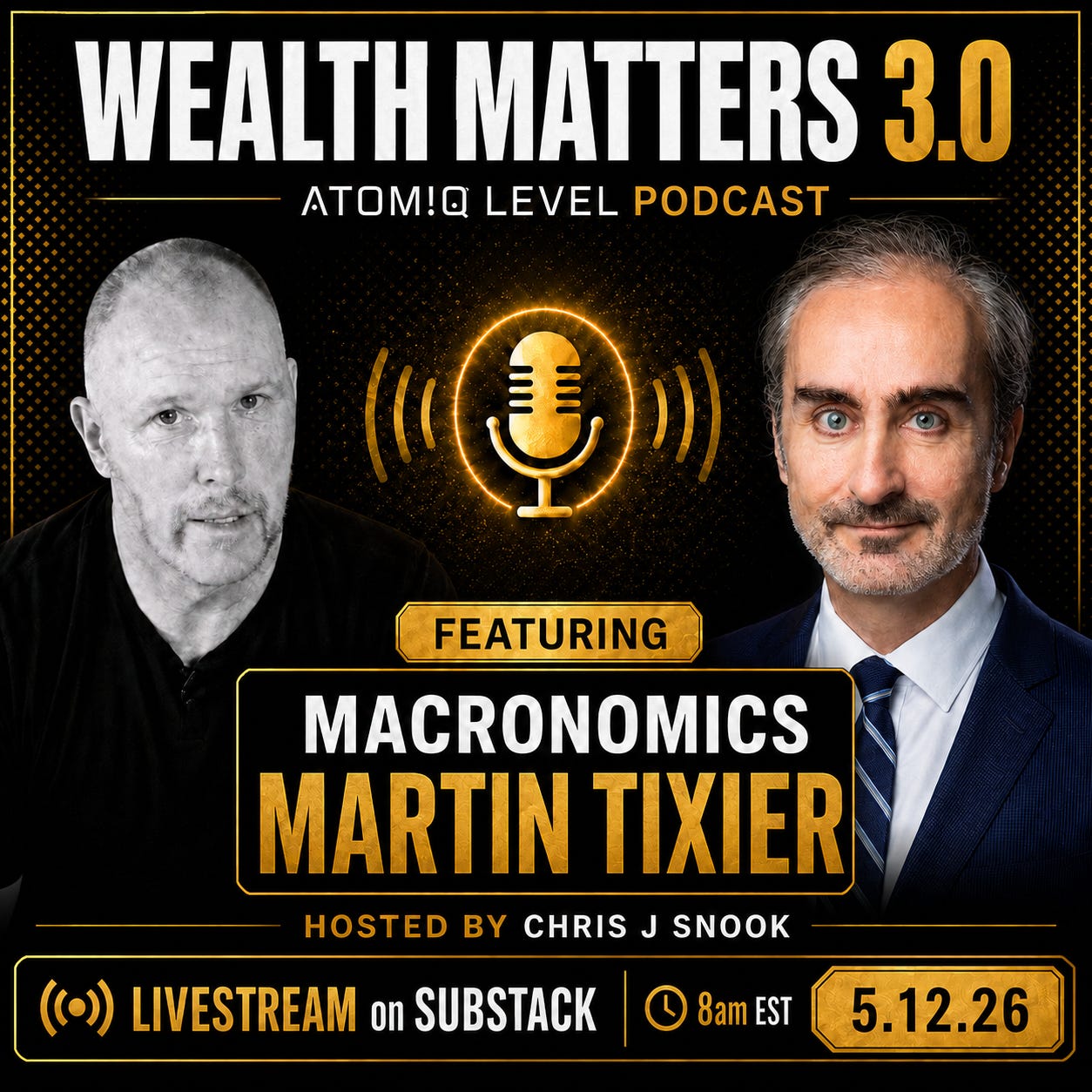
The Hidden Architecture Beneath Global Markets
Macronomics - Martin Tixier, known as Mr Tix, brings the kind of macro lens that is increasingly rare: credit-first, historically grounded, globally informed, and willing to look past the headline narrative to ask what the debt, collateral, energy, currency, and political incentives are actually saying.
His work sits at the intersection of macroeconomics, credit markets, geopolitics, gold, emerging markets, sovereign risk, and the uncomfortable reality that most investors still underestimate:
Without credit, there is no macro.
Subscribe to Macronomics-Mr Tix if you want a sharper view of the forces reshaping capital, currency, energy, Europe, China, and the next phase of global market risk.
TL:DR Key Takeaways
Martin Tixier’s worldview was shaped early by international exposure, bilingual education, and friendships across cultures, religions, and countries. That global lens later became central to how he interprets markets.
His father was not in finance, but helped shape Martin’s intellectual foundation by pointing him toward classical economic books. Jacques Rueff’s The Monetary Sin of the West, Angus Maddison’s work on world economic history, Gavekal Research, James Goldsmith’s The Trap and The Response, and Maurice Allais all helped frame his view of money, trade, globalization, and the cost of policy mistakes.
Martin’s career began in trading rooms and credit markets, including work at Bank of America in London, where Anthony Peters became a mentor. His experience selling investment-grade bonds, high-yield, asset-backed securities, and credit products to family offices, asset managers, hedge funds, and bank loan books taught him that credit is the real heartbeat of the economy.
One of the central ideas in this conversation is the “money illusion.” Martin argues that the U.S. equity market’s long-term rise since 2007 tracks closely with the growth of U.S. national debt. In plain English: a lot of what investors experience as market wealth may actually be debt-driven liquidity expansion.
Martin believes something broke in 2022, especially after the Russia-Ukraine war and the seizure of Russian central bank reserves. In his view, U.S. Treasuries lost part of their safe-haven aura because the world saw that reserves could become politically conditional.
Gold, in Martin’s framework, is not just an asset. It is a benchmark and a thermometer for the value of money. Investors should ask whether the assets they hold can outperform gold over meaningful time horizons.
Martin sees stagflationary pressure building because war is inflationary, sovereign yields are rising, and long-term interest rates are increasingly governed by fiscal discipline, not just central bank policy.
He argues that productive debt, such as Eisenhower’s interstate highway system, can strengthen a nation, while unproductive debt creates fragility. In today’s AI race, he sees energy infrastructure, grid capacity, gas turbines, copper, nuclear, and data center inputs as critical strategic bottlenecks.
On China, Martin does not believe real decoupling from the U.S. is possible. The U.S. needs Chinese supply chains for energy infrastructure and data centers. China needs the U.S. market. A grand bargain may be more likely than a clean break.
Europe, in his view, has scientific talent but is politically weakened by leadership failures, over-centralization, lack of democratic mandate, and delayed structural reform. Countries like Portugal, Spain, Ireland, and Greece took painful medicine. France, he argues, has postponed it.
On emerging markets, Martin is particularly interested in country-by-country opportunities, with Brazil standing out because of high real rates, cheap equity valuations, and potential currency and rate tailwinds.
The deeper message: investors need to stop looking only at equity prices and start understanding credit, fiscal discipline, energy, currency risk, geopolitics, and gold-relative returns.
Meet Macronomics - Martin Tixier -”Mr. Tix”
Before Martin Tixier became Mr Tix of Macronomics, before his Substack began rising among readers hungry for sharper macro insight, before he started translating credit markets, gold, fiscal discipline, geopolitics, China, Europe, and emerging markets into a framework investors could actually use, he was a boy in France being taught to see the world as larger than the country he was born into.
His parents put him in a bilingual school when he was five years old. That one decision mattered. It placed him early in a world of different languages, cultures, religions, nationalities, and assumptions. He grew up around people from everywhere, and those friendships became more than childhood memories. They became part of his operating system.
Martin did not learn macro first from a chart. He learned it from people. When you grow up around different cultures, you learn that no nation is the center of the story forever. You learn that money, trade, institutions, power, and trust are interpreted differently depending on where someone stands. You learn that history does not belong to one country, one market, or one currency. It moves across borders, and so does capital.
That early international exposure became the seed of a career spent reading the world through the lens of credit, history, and monetary architecture.
The Father Who Pointed Him Toward the Books
Martin’s father was not a finance professional. But he gave his son something more valuable than a job referral or a market tip. He pointed him toward books.
Classical economic books.Hard books.
Books that force the reader to think beyond headlines and quarterly market narratives.
One of the most important was Jacques Rueff’s The Monetary Sin of the West, a book that helped shape Martin’s understanding of monetary systems, credit pyramids, debt, and the illusion that nominal wealth always means real prosperity. He later discovered Gavekal Research around 2005 and 2006, through prop traders at Bank of America, and began reading deeply about asset allocation and macro. He read Angus Maddison’s sweeping work on the world economy from year zero to projections into 2030. He read Sir James Goldsmith’s The Trap and The Response, books from the early 1990s that warned against the naive globalization consensus before the consequences were obvious.
Those books mattered because they trained him to see today’s market conditions as part of a longer arc.
Goldsmith, in particular, warned that opening the world too aggressively without regard for local communities, industrial bases, and national cohesion would eventually destroy domestic resilience. At the time, that sounded unfashionable. Today, with reshoring, tariffs, supply chain anxiety, industrial policy, and strategic competition with China back at the center of the conversation, it sounds less like nostalgia and more like prophecy.
Martin’s intellectual foundation was built on a simple idea:
The warnings were there. Most people just ignored them until the bill came due.
The Credit Education
Martin’s professional career took him into trading rooms, credit desks, and the machinery of global finance. He studied at ESSEC BBA in France, pursued international exposure, and took an early internship in Geneva as an assistant trader focused on Japanese bonds issued in French francs. From there, he moved through internships in trading rooms and eventually to London, where he worked at Bank of America.
That is where he met Anthony Peters, who became a mentor. It was also where Martin’s credit-first worldview hardened.
He worked as a flow credit salesperson, selling investment-grade bonds, high-yield bonds, asset-backed securities, and other credit products to a wide range of clients: family offices, asset managers, hedge funds, and bank loan books. It was a front-row seat to how money really moves through the system, not as a theory, but as a daily negotiation between borrowers, lenders, risk managers, traders, portfolio managers, liquidity, and fear.
Equities may get the attention.
Credit tells you when the floor is cracking.
Martin is clear on this point: credit is the heart of the economy. Without credit, there is no macro. Equity markets are visible and emotionally seductive, but they are small relative to credit. If you want to understand the real picture, you have to understand debt, lending, spreads, refinancing, collateral, and the cost of capital.
He saw that lesson in real time during the financial crisis. He was at Bank of America as the credit markets began sending warning signals long before equities fully understood what was coming. The layoffs came in waves. Anthony Peters was part of the first wave. Martin was part of another. But the market lesson stayed with him.
Credit saw the crisis first. That is why credit people never look at markets quite the same way again.
The European Crisis and the Memory of 2011
After London, Martin spent years in Brussels, beginning in 2011, just as the European sovereign crisis was reaching a dangerous point. To casual observers, the Eurozone crisis may now feel like old news. To people who lived inside the system at the time, it was a near-death experience for the European banking sector.
Martin remembers how close Europe came to a collapse. He remembers the credit default swap spreads blowing out across financials. He remembers the stress in senior and subordinated bank debt. He remembers the ECB stepping in with long-term refinancing operations. He remembers the Fed helping the ECB through dollar swap lines.
These are not academic memories. They are part of the reason he watches sovereign yields, credit spreads, bank funding, and fiscal discipline with such intensity.
Because when credit breaks, the polite language disappears.
Suddenly, the question is not whether the market is expensive or cheap. The question is whether the system can fund itself tomorrow.
The Money/Wealth Illusion
One of the most important ideas Martin brings into this conversation is the “money illusion.” It comes through the influence of Jacques Rueff and Martin’s own credit-market lens.
He gives a simple example. If you start in January 2007 and look at the compounded annual growth rate of the S&P 500, it has been roughly around 8%. If you compare that with the compounded annual growth rate of U.S. national debt over the same period, he argues that the growth rates are remarkably similar.
The implication is uncomfortable.
What many investors experience as equity market wealth may be tied to the expansion of debt.
That does not mean companies are fake. It does not mean profits do not matter. It does not mean innovation does not matter. But it does mean nominal asset gains can be deeply entangled with the debt machine underneath the economy.
When liquidity is created, it has to go somewhere. It flows into scarce assets, productive assets, winner-take-all assets, real estate, equities, Bitcoin, gold, private markets, and whatever the system decides can absorb excess capital. If enough money piles into the same assets, prices rise, narratives harden, and people begin mistaking liquidity-driven gains for pure genius.
That is the money illusion.
It makes people feel wealthier, but the question is whether their wealth is rising faster than the debasement of the money they measure it in.
Gold as the Thermometer
For Martin, gold is not merely a commodity, a relic, or a fear trade. It is a benchmark. It is a thermometer for the value of money. It is a way to ask whether your portfolio is actually preserving purchasing power or simply rising in nominal terms alongside the debt machine.
He argues that investors should increasingly compare their equity performance against gold over one-year, three-year, and five-year periods. If an equity cannot outperform gold through a meaningful cycle, then the investor has to ask what they really own and why.
That is a different kind of benchmark than the one most advisors use. The standard investor compares a stock to an index, a portfolio to a 60/40 model, or a manager to a peer group. Martin’s lens asks a more primal question:
Did you actually outrun monetary debasement?
This becomes especially important if we are entering a more stagflationary world. War is inflationary. Energy constraints are inflationary. Supply chain fragmentation is inflationary. Rising sovereign yields increase the price of capital. Long-term rates become less about central bank wishes and more about fiscal discipline.
In that world, gold becomes a message. Ignore it at your own risk.
What Broke in 2022
Martin believes something changed in 2022. The Russia-Ukraine war was not just a geopolitical event. It marked a deeper shift in how the rest of the world perceived U.S. Treasuries, dollar reserves, and the safety of Western financial custody.
In his view, the United States made two major strategic mistakes. The first was weaponizing the dollar through sanctions and financial pressure. The second was pushing Russia closer to China. Russia is one of the world’s largest commodity players. China is the world’s largest industrial producer. Geographically, strategically, and economically, the match is powerful.
Then came the seizure of Russian central bank reserves. To Martin, that sent a chilling message to the rest of the world:
If you fall out of favor, your reserves may not be yours.
That realization accelerated the desire among central banks and sovereign actors to hold more gold. It changed the perception of Treasuries as a politically neutral safe-haven. It made reserve managers rethink what safety means in a world where finance is increasingly used as a geopolitical weapon.
For investors, this is not just a foreign policy debate. It is an asset allocation question. If the world begins reassessing the safety of dollar collateral, the effects ripple through gold, Treasuries, currencies, commodities, emerging markets, and every portfolio built on old assumptions.
Productive Debt Versus Destructive Debt
Martin is not anti-debt in some simplistic sense. He makes an important distinction between productive and unproductive debt.
Productive debt builds the future. Eisenhower’s interstate highway system is an example. It strengthened commerce, mobility, logistics, productivity, national defense, and the physical structure of the American economy. It was debt that created long-term capacity.
Unproductive debt props up consumption, political promises, misallocated spending, fraud, waste, and short-term power games. It can create the illusion of prosperity while weakening the foundation beneath it.
That distinction matters today because the United States, Europe, and China are all making enormous choices about infrastructure, energy, defense, AI, and industrial capacity. The question is not only how much debt a country issues. The question is what the debt builds.
Martin’s view is blunt: economic output is energy transformed.
That sentence brings the AI debate back to earth. Everyone talks about models, chips, data, and software. But AI at scale needs electricity, grids, gas turbines, copper, nuclear, renewables, transmission, substations, and data centers. China has spent massively on infrastructure, the electric grid, nuclear, solar, renewables, and industrial capacity. The U.S. still leads in frontier innovation, but it faces real bottlenecks in energy infrastructure.
The future of AI may not be decided only by who writes the best model. It may be decided by who can power it.
China, the U.S., and the Grand Bargain
One of the most important parts of this conversation is Martin’s refusal to accept simplistic U.S.-China decoupling narratives. The two countries are rivals, but they are also deeply entangled. The U.S. needs Chinese supply chains for data center inputs, gas turbines, copper components, and other industrial necessities. China needs the U.S. market and the broader global system.
There is no clean separation. There may need to be a grand bargain.
Martin frames the emerging world as a new Yalta-like moment, with the United States, China, and Russia as the major players. Europe, in his view, has become increasingly irrelevant in this power conversation, not because it lacks talent or science, but because its political leadership has weakened its strategic position.
China’s strengths are obvious: scale, infrastructure, industrial capacity, long-term planning, supply chain control, and a massive pool of engineers. But Martin also highlights its vulnerabilities, especially capital flight. He describes the Great Wall of China not only as facing outward, but inward. Capital controls help hold the system together because many Chinese citizens would otherwise prefer to move capital abroad.
China’s leadership understands this. It prizes harmony and balance above almost anything else because managing 1.3 billion people is not easy. Every five to ten years, it conducts corruption purges and mini-resets to keep excesses from destabilizing the system. Martin notes that you can even see traces of these cycles in luxury goods and high-end cognac sales when anti-corruption campaigns reduce conspicuous gifting and elite spending.
That is the kind of macro detail Martin watches. Not just GDP.
But Cognac sales!
Because sometimes the luxury cycle tells you what the political cycle is doing.
Europe’s Delayed Reckoning
Martin’s assessment of Europe is not sentimental. He believes Europe still has serious scientific and intellectual capability, but its political class has become a major obstacle. He is critical of the centralization of European power in institutions and leaders without a clear democratic mandate. He sees declining popularity, leadership turnover, and falling political credibility across the continent.
Some European countries have already taken painful medicine. Portugal, Spain, Ireland, and Greece went through difficult structural reforms after the crisis forced their hand. Portugal, in particular, now stands out in Martin’s mind because fiscal discipline has allowed it to borrow more cheaply than France on the long end of the curve.
That is a remarkable reversal.
The bond market is telling a story.
France, by contrast, has postponed structural reform. Martin argues that, eventually, France will have to go line by line through spending and decide what stays and what gets cut. There is no painless way around delayed discipline.
Fiscal discipline matters because long-term interest rates are not ultimately controlled by speeches from central bankers. Central banks can influence the short end of the curve. The long end answers to trust, debt, deficits, inflation expectations, and fiscal credibility.
Portugal has learned that lesson. France still has to face it.
The Emerging Market Lens
Martin does not treat emerging markets as one big basket. He looks country by country, structure by structure, and credit condition by credit condition.
Brazil stands out to him. His reasoning is credit-driven and simple. If rates are extremely high relative to inflation, and the real rate is strongly positive, then there may be a compelling opportunity if rates eventually come down. Add cheap equity valuations and a stronger currency trend, and the setup becomes interesting.
He does not claim emerging markets are universally attractive. He does not say to buy everything outside the U.S. But he does believe investors should look beyond the standard U.S.-centric allocation model, especially if the dollar weakens and country-specific opportunities emerge.
He also sees enormous long-term importance in India, Indonesia, Vietnam, Southeast Asia, and the broader eastward shift of economic gravity. Drawing on Angus Maddison’s historical work, he reminds listeners that China and India were once dominant forces in global trade and economic output. The world moving east is not an anomaly.
It may be a return.
Derivatives, Options, and the Casino Mood
Later in the conversation, Martin turns toward market structure and risk. He does not overstate the derivative danger in a simplistic way, acknowledging that reforms after the Great Financial Crisis, including trade compression, reduced some notional risks. But he is concerned about the explosion of very short-dated options activity, 0DTE-style trading, and the broader casino mood in markets.
He sees echoes of the Roaring Twenties: intense speculation, betting platforms, short-term options, crypto Ponzi behavior, record M&A, record debt issuance, and rising dispersion across equities and credit.
Those are not always immediate crash signals. But they are cycle signals.
The casino phase often arrives when liquidity, leverage, confidence, and speculation have already done their work. The question becomes not whether the party is loud, but whether the credit cycle is quietly turning underneath the noise.
Again, Martin comes back to credit. Because credit usually whispers before equities scream.
Why You Should Listen
This ATOMIQ LEVEL conversation with Martin Tixier is not just another macro interview. It is a guided walk through the architecture beneath global markets with someone who has spent his life reading across cultures, histories, balance sheets, credit markets, sovereign crises, central bank actions, and geopolitical fractures.
It is about a boy in France who learned English at five and grew up among international classmates before becoming a credit-market thinker shaped by classical economics, monetary history, Bank of America trading rooms, Anthony Peters, Gavekal, Jacques Rueff, Angus Maddison, James Goldsmith, European crisis, and the hard lesson that credit sees trouble before equities admit it.
It is about the money illusion hiding beneath the S&P 500, the idea that debt growth and equity growth may be more connected than most investors want to believe. It is about why gold may be a better benchmark for real wealth preservation than nominal index performance. It is about why 2022 changed how the world thinks about reserves, Treasuries, sanctions, and safety. It is about why productive debt builds infrastructure while unproductive debt builds fragility.
It is also about power. U.S. and China. Russia and commodities. Europe’s political weakness. Brazil’s real-rate opportunity. India’s potential. China’s inward-facing capital controls. Portugal’s fiscal discipline. France’s delayed reckoning. AI’s energy bottleneck. The coming importance of data centers, grids, gas turbines, copper, and nuclear power.
Most investors are still trained to watch equities first.
Martin Tixier is telling you to watch credit, gold, fiscal discipline, energy, and history.
That is why this conversation matters. It connects the dots between money, debt, geopolitics, infrastructure, and portfolio survival in a world that is no longer governed by the assumptions of the last 30 years.
Press play on this ATOMIQ LEVEL conversation with Martin Tixier, aka Mr Tix of Macronomics, and you will hear a macro thinker who does not just ask where markets are going next.
He asks what kind of world is being financed underneath them.
Because in the end, markets may rise, currencies may weaken, politicians may spend, central banks may intervene, and investors may chase whatever is working.
But credit remembers. Gold remembers. History remembers.
And the investors who learn to read all three may be the ones best prepared for what comes next.
The real risk is doing nothing!
~Chris J Snook
Thank you to everyone who tuned into my live stream and engaged today! Join me for my next live video in the app.