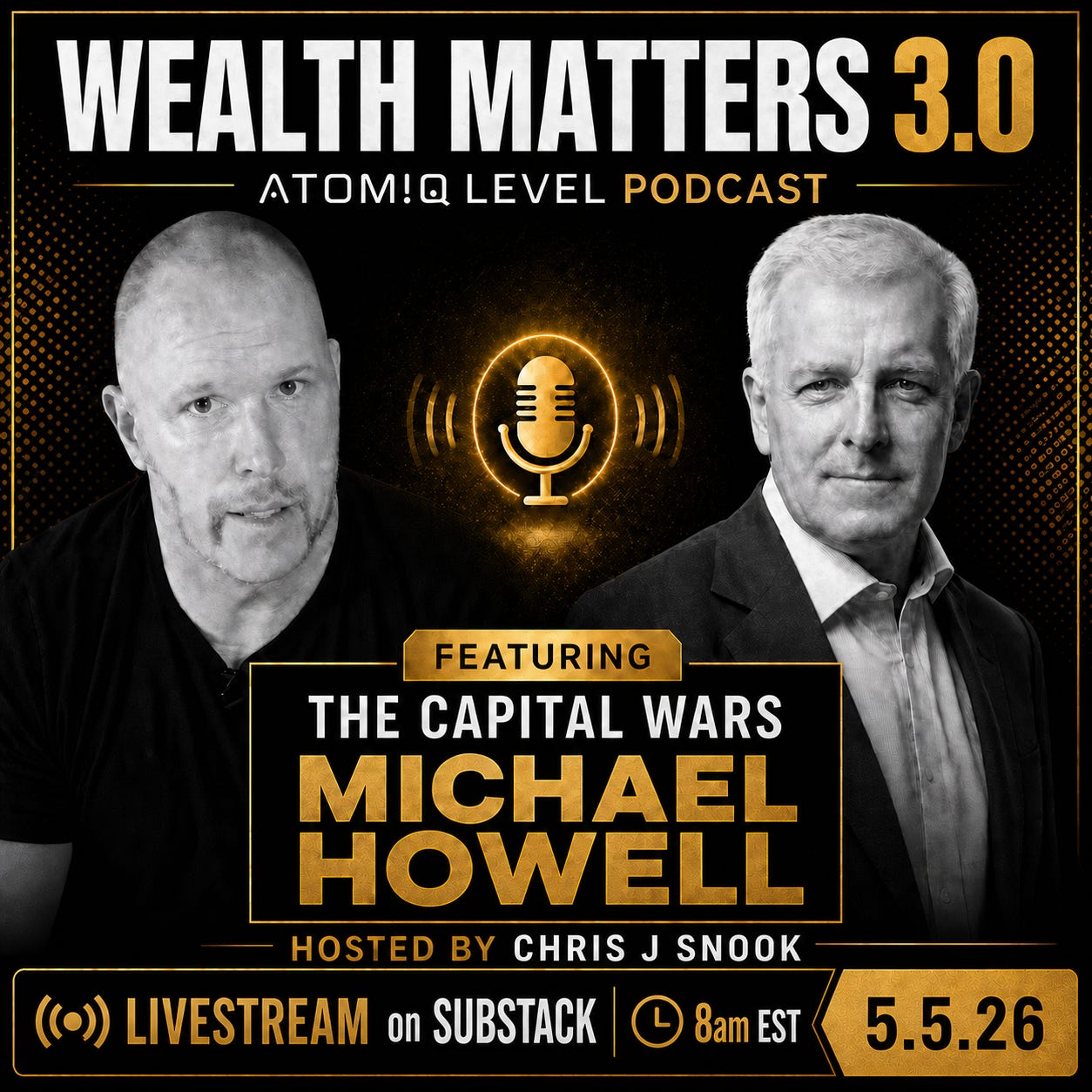
Before you read the show notes below, subscribe to Michael Howell’s Capital Wars on Substack. More than 60,000 readers already follow his work for a reason: he has spent a lifetime tracking the invisible forces that actually move markets, liquidity, collateral, currencies, central banks, and global capital flows.
If this conversation teaches one thing, it is that the world does not move because a textbook says it should.
It moves because money moves.
Subscribe to Michael Howell and follow Capital Wars if you want to understand where that money is moving next.
TL:DR Key Takeaways
Michael Howell’s core thesis is that markets are not primarily valuation machines. They are refinancing machines. Most financial activity is about rolling over debt, managing collateral, and keeping the global liquidity system functioning.
His career was shaped inside some of the most important financial institutions and crises of the modern era, from Salomon Brothers during the age of global bond market dominance to Barings during the explosion of emerging markets and the Nick Leeson scandal.
The real battlefield today is not just interest rates or stock valuations. It is the control of global mobile capital, collateral, liquidity, and monetary rails.
The U.S. dollar remains deeply entrenched because its network effects are enormous. Stablecoins may actually extend dollar hegemony by embedding U.S. Treasury-backed payment rails into the next generation of digital finance.
Gold’s rise is not only about Western debasement. Howell argues that China and the People’s Bank of China are a major marginal driver, as China attempts to manage internal monetary pressure while maintaining the appearance of currency stability.
The future belongs to investors who understand flows, not just fundamentals. Value still matters, but price is increasingly shaped by liquidity, collateral, refinancing needs, and the political economy of debt.
The Man Who Watches Money Move
Before Michael Howell became the voice behind Capital Wars, before tens of thousands of readers turned to him to understand global liquidity, collateral, central banks, Treasuries, gold, China, the dollar, and the invisible plumbing beneath modern markets, he was a young man in London trying to understand a world that was changing faster than most people could name.
He grew up in London, though he now lives in Oxford and keeps an office in the city where his financial life began. His entry into finance came in the early 1980s, after time in academia and management consulting. At first, his path seemed intellectual and conventional: economics with a mathematical slant, a stint in academia, then corporate planning for a British industrial business.
But academia did not fit him. The stakes were too low, the politics too bitter, the world too removed from the real battlefield of money and power. Howell jokes through the lens of the old Henry Kissinger line that academic politics are vicious because the stakes are so small. By the time he moved into finance, he was ready for a place where the stakes were real, the conflicts were direct, and theory had to survive contact with markets.
That place was Salomon Brothers.
And Salomon Brothers did not stab you in the back.
At Salomon Brothers, as Howell tells it, they came for you from the front with an axe.
For a man coming out of academia, that was almost refreshing.
The Salomon Brothers Education
To understand Michael Howell’s worldview, you have to understand what Salomon Brothers represented in its era. It was not merely a Wall Street firm. It was the bond market. It was one of the great engines of global finance, a place where the modern fixed income world was being invented, traded, structured, stress-tested, and exported.
Howell worked in London as a research director, focused on strategy and asset allocation. But the deeper education was not simply in reports, models, or forecasts. It was in the physical experience of watching capital move.
Salomon had enormous trading floors in financial centers around the world: New York, London, Tokyo. The desks represented different markets and products: U.S. Treasuries, British gilts, Japanese equities, warrants, currencies, bonds, credit. From above, Howell says, you could almost see money moving around the room. One desk would suddenly light up with activity, then another. The floor itself became a living map of flows.
That experience planted one of the ideas that would define the rest of his career.
There is no unrelated event in finance.
That was not a slogan to him. It was an operating system. A move in one market was connected to funding pressures in another. A change in one country’s flows could ripple through currencies, bonds, stocks, collateral, and credit. Markets were not isolated equations. They were plumbing. They were pressure systems. They were balance sheets reacting to balance sheets.
Textbooks taught that prices were formed by clean models of valuation, savings, investment, and interest rates. The trading floor taught something else.
Prices move when people press buttons.
Money flow, not academic elegance, was the force that made the screen change color.
From Salomon to Barings: Out of the Frying Pan
The next chapter in Howell’s career placed him near another historic institution at another historic moment. After the U.S. Treasury scandal hit Salomon in the early 1990s, Warren Buffett stepped in, the firm reeled, and the financial world around it continued to globalize. Howell saw where the opportunity was moving: emerging markets.
Latin America was opening. Structural reforms were unfolding. The IMF was encouraging deregulation and privatization. Capital was beginning to move across borders with a new intensity. Howell believed the future lay in emerging markets, but Salomon’s focus remained on preserving its dominant domestic fixed-income franchise.
So he moved to Barings.
Barings was a legendary British bank with a deep franchise in emerging markets, particularly Asia Pacific, Latin America, and Eastern Europe. Where Salomon had been the bond market, Barings had become one of the great portals into the frontier and emerging-market boom.
And then came Nick Leeson.
The Barings collapse became one of the most famous risk failures in modern financial history. For Howell, it was not merely a headline or a movie plot. It was another formative lesson in how institutions fail when they do not understand risk, capital, and control.
At Salomon, risk management was drilled into the culture. At Barings, Howell says, the British institution had no real grasp of it by comparison. The collapse did not simply happen because one trader lost money. It happened because systems, oversight, incentives, and institutional assumptions allowed capital to be pushed into places it never should have gone.
For Howell, this was another piece of the puzzle.
Finance is not a ladder you climb.
The ceiling always comes down to meet you.
Crisis is not an exception in finance. It is part of the architecture.
The Birth of the Flow Mindset
By the time Howell had lived through Salomon, Barings, emerging-market surges, bond market stress, deregulation, and the globalization of capital, his view of markets had hardened into something very different from the standard textbook framework.
He had learned that money does not sit politely inside borders. It moves. It overwhelms. It searches for collateral, yield, safety, leverage, and escape. Central banks matter, but not always in the way textbooks suggest. In many markets, especially emerging markets, central banks could be overpowered by cross-border flows. If foreign capital came in like a tidal wave, there were not enough buckets and mops to absorb it.
That is why Howell became obsessed with global liquidity.
Liquidity is fungible. It crosses markets. It enters one system, lifts collateral values, supports credit creation, inflates asset prices, and then, when the direction changes, it can reverse with brutal speed. The same flows that create prosperity on the way in can create a crisis on the way out.
This is the intellectual foundation of Capital Wars.
It is a way of looking at the world that asks not, “What should this asset be worth?” but, “Where is the money going, what collateral supports it, who must refinance, and which system is being forced to absorb the pressure?”
That shift changes everything.
Markets Are Not Valuation Machines
One of the most important ideas in the conversation is Howell’s view that markets are not primarily valuation machines. They are refinancing machines.
That sentence deserves to be sat with.
Most investors are trained to think in terms of valuation. Is this company cheap or expensive? Is this currency overvalued? Are equities priced correctly? Is real estate trading at the right cap rate? Is gold too high? Is Bitcoin too volatile? Is the market rational?
Howell’s point is that this framework misses the real engine underneath. In the textbook version, financial markets exist to raise new capital for new investment projects. In reality, he argues, the overwhelming majority of primary market activity is about refinancing existing debt.
Debt does not disappear.
It rolls.
A five-year bond matures, and the issuer does not usually pay it back from saved cash. It refinances. A government bill comes due, and the Treasury issues another. A corporation refinances a maturity wall. A bank matches liabilities with short-term instruments. A system built on debt must continuously roll that debt forward.
That means the health of markets depends less on whether assets are “worth” their quoted price and more on whether the refinancing machine keeps functioning.
When liquidity is abundant, refinancing is easier. Collateral values rise. Risk assets inflate. Debt issuance expands. Investors feel wealthier. Governments can fund deficits. Companies can roll obligations. The machine hums.
When liquidity tightens, the same machine becomes fragile. Collateral values fall. Risk assets reprice. Refinancing becomes harder. Debt that seemed manageable becomes a problem. Valuations fall not simply because the math changed, but because the funding environment did.
That is the hidden lesson.
Value may be philosophical.
Price is mechanical.
The Alligator Jaws of the U.S. Fiscal Problem
Howell’s analysis of the U.S. fiscal situation is not built around partisan talking points. It is built around flows, deficits, debt maturity, bank balance sheets, and the problem of rolling an enormous stock of obligations.
The U.S. government spends more than it receives. Tax revenue as a share of GDP has been relatively flat, while spending has trended higher, driven heavily by mandatory commitments such as Social Security, demographics, and interest expense on the debt. Howell describes the deficit visually as the jaws of an alligator: one jaw flat, the other opening wider.
That gap has to be funded.
There are only a few choices. Raise taxes, print money, or issue debt. Politically, raising taxes is difficult. Printing money is dangerous if it spills into consumer inflation. So the system issues debt, often increasingly toward the short end of the curve.
Short-term issuance has attractions. It can be cheaper than issuing long-term bonds, especially depending on the shape of the yield curve. It is also easier to place because banks like short-term government paper. If fiscal deficits cause deposits to build in the banking system, banks need short-term assets to match short-term liabilities. Treasury bills can fit that role.
But there is a catch.
When banks buy government debt, Howell reminds listeners through the lens of Milton Friedman, that it can become monetization by another route. It may not look like a central bank directly printing money, but it can still expand liquidity through the banking system.
And that creates the next dilemma: where does the new money go?
If it goes into Main Street, it may show up as consumer inflation, which destroys purchasing power and political confidence. If it goes into Wall Street, it inflates asset prices and makes investors feel wealthier. The same liquidity can be celebrated or condemned depending on where it lands.
That is why the public feels gaslit. The asset owner sees wealth. The wage earner sees inflation. The policymaker sees a funding mechanism. The investor sees liquidity. The citizen sees groceries, rent, insurance, and housing costs that no longer make sense.
It is all one machine.
But different people experience different parts of it.
Wall Street, Main Street, and the Hose of Liquidity
One of the most striking parts of the conversation is the discussion around how liquidity has soaked asset markets while leaving the real economy unevenly served. In the U.S., liquidity often finds its first home in stocks. In the U.K. and Australia, it may show up more immediately in housing. In other places, it can move through currencies, property, commodities, or sovereign debt.
But the underlying mechanism is similar. Liquidity goes somewhere.
If it does not feed productive real-economy activity, it feeds asset markets.
This creates a social problem that is not always obvious to investors watching indexes rise. Elevated house prices can reduce household formation. Reduced household formation can affect birth rates. Lower birth rates can affect labor force growth. Aging demographics then increase pressure on government spending, which widens deficits, which requires more financing, which feeds the machine again.
That is the kind of second- and third-order thinking Howell brings to the conversation. Liquidity is not only a market variable. It becomes a social variable, a demographic variable, and a political variable.
When money flows distort the cost of living, they eventually distort society.
The Capital Wars Battlefield: Control the Collateral
When asked how nations, sovereign wealth funds, central banks, corporations, and investors win in this new battlefield of global mobile capital, Howell’s answer is clear: they try to control capital by controlling collateral.
Collateral is the foundation of modern money and credit. The question is what the system trusts enough to lend against, settle against, store value in, or use as the basis for future claims.
Howell frames today’s great collateral contest around two poles: U.S. Treasuries and gold.
U.S. Treasuries sit at the center of the dollar-based financial system. They are the key collateral of the Western financial order, embedded in banking, repo markets, reserves, stablecoins, and institutional balance sheets. But they are also vulnerable because they depend on the fiscal integrity of the United States.
Gold, by contrast, has served as a monetary bedrock for millennia. It does not depend on the creditworthiness of a government. Howell sees China building more of its monetary strategy around gold, especially as it manages internal currency pressures and seeks alternatives to the U.S.-dominated system.
That is the core capital war: Treasury collateral versus gold collateral, dollar rails versus alternative reserves, network effects versus ancient monetary trust.
And yet Howell is not simply a dollar bear. In fact, he sees the dollar as likely to survive and remain powerful precisely because its network effects are so strong. The dollar is embedded everywhere. It settles everywhere. It is trusted in places where other currencies are not. It is hard to rip out of the global system because too much of the system has been built around it.
This is where stablecoins enter the story.
Stablecoins and the Extension of Dollar Hegemony
The conversation takes a fascinating turn into stablecoins and crypto rails. The idea is not that stablecoins necessarily replace the dollar. Treasury-backed dollar stablecoins may extend the dollar into the next generation of global digital commerce.
If future transactions increasingly occur across crypto networks, digital payment rails, AI agents, automated commerce, and 24/7 settlement layers, then the question becomes: what unit of account and collateral sits underneath those rails?
If the answer is U.S. Treasury-backed stablecoins, then the dollar’s network effects may not shrink. They may expand.
That is why China is so wary of crypto and stablecoins. Howell notes that China has doubled down on restrictions because crypto rails threaten the integrity of its monetary system. If Chinese citizens can access better money, they may prefer to leave their yuan exposure behind. Remove capital controls, and the yuan may not rise; it may fall, because the desire to get money out could overwhelm the desire to bring money in.
This leads to a reversal of the old Gresham’s Law idea. Instead of bad money driving out good, Howell suggests we may be entering a world where good money drives out bad. Dollars, gold, and perhaps Bitcoin or certain crypto rails become preferred settlement and store-of-value mechanisms where weaker monetary systems lose trust.
That does not mean de-dollarization is impossible. But it does mean it is far more complex than headlines suggest.
You cannot replace a global monetary network with a press release.
Japan, China, and the Myth of the Carry Trade as Everything
The conversation also moves into Japan and the famous yen carry trade. For years, global investors borrowed cheaply in yen and bought higher-yielding assets elsewhere. As Japan changes policy after decades of ultra-low rates, many market observers have worried about a giant reversal.
Howell’s view is more nuanced and probably more contrarian. He thinks the yen carry trade matters, but perhaps not as much as people assume. Japan was once a much larger force in global liquidity, especially in the 1980s and 1990s. Today, China’s role as a dollar investor is many times larger. Korea and Taiwan are also building surpluses that may be redirected into dollar assets.
In other words, the global liquidity story is bigger than Japan.
That does not mean Japan is irrelevant. It means investors need to be careful not to mistake the most talked-about flow for the most important flow. Howell’s work constantly returns to scale, direction, and collateral. Which flows are large enough to matter? Which are structural? Which are cyclical? Which are political? Which are forced? Which are optional?
That discipline is what separates flow analysis from financial storytelling.
Gold, China, and the Real Driver at the Margin
Toward the end of the conversation, Howell turns to gold. Many commentators argue that gold is rising because the West is debasing its currencies. Howell does not reject that, but he adds an important twist. At the margin, he believes one of the real drivers has been the People’s Bank of China and Chinese liquidity injections.
China, in his view, is trying to manage a difficult internal monetary problem. It wants to devalue the yuan internally while maintaining the external mystique of a stable yuan against the U.S. dollar. Gold becomes part of that adjustment mechanism. If China has to print much more money, and if it continues to manage currency pressure this way, then gold may need to move much higher to reflect that reality.
This is classic Howell. The surface story is “gold goes up because fiat is being debased.” His deeper version is more specific: watch China, watch the PBOC, watch internal versus external devaluation, watch collateral preference, and watch what the marginal buyer is doing.
The difference matters.
A slogan tells you what has already happened.
A flow tells you what may happen next.
Why Michael Howell Matters Now
Michael Howell’s value is not merely that he knows financial history. It is that he lived close enough to the machinery to see what most investors still miss. He saw the rise of global bond markets from inside Salomon Brothers. He saw emerging markets become the next frontier. He saw institutional risk failures at Barings. He watched money flow across borders before most people had a language for global liquidity. He learned that central banks are powerful, but not omnipotent. He learned that markets do not simply price value; they refinance debt. He learned that collateral is power.
And now he is applying that lifetime of pattern recognition to a world defined by fiscal stress, aging demographics, unstable politics, fragile currencies, gold accumulation, dollar stablecoins, crypto rails, China’s monetary dilemmas, and the enormous refinancing burden of modern debt.
This is why the conversation is worth listening to in full. It is not a headline tour. It is not another market pundit giving a directional call. It is a guided walk through the hidden plumbing of the world economy with someone who has spent decades watching the pipes burst, reroute, flood, and harden into new systems.
Howell does not ask you to stop caring about valuation. He asks you to understand why valuation is not enough.
He asks you to watch the flows.
He asks you to track the collateral.
He asks you to understand who must refinance, who must buy, who must sell, who controls the rails, and who is quietly losing control.
That is where the real story lives.
Why You Should Listen
This ATOMIQ LEVEL conversation with Michael Howell is not just about markets. It is about the architecture beneath markets. It is about why the world feels financially unstable even when asset prices rise. It is about why governments cannot easily escape their debt promises, why central banks do not control as much as people think, and why the private sector’s financial innovation often outruns the regulators trying to manage it.
It is also about the future of money itself. U.S. Treasuries, gold, stablecoins, Bitcoin, the yuan, the dollar, capital controls, and collateral are not separate stories. They are pieces of one global contest over trust, settlement, funding, and power.
Most investors are still watching prices.
Michael Howell is watching the machine that makes the prices.
That is why you should press play.
Because once you understand that markets are refinancing machines, not just valuation machines, the world starts to look different. The headlines become less confusing. The policy debates become more connected. The gold price, the dollar, the Treasury market, stablecoins, China, Japan, deficits, inflation, and Main Street frustration all begin to fit into one larger map.
And in a world where money moves faster than most people can think, having that map may be the difference between reacting to the next crisis and seeing the flow before it arrives.
Press play on this conversation with Michael Howell, subscribe to Capital Wars, and learn to watch the world the way liquidity sees it.
The real risk is doing nothing!
~Chris J Snook
SHOUT OUTS TO LIVE AUDIENCE
Thank you George Noble, Robert Jaffee, Complexity Trading, Garrett Baldwin Carol in Vermont, william mcleod, and many others for tuning in and commenting on my live video with Michael Howell! Join me for my next live video in the app.