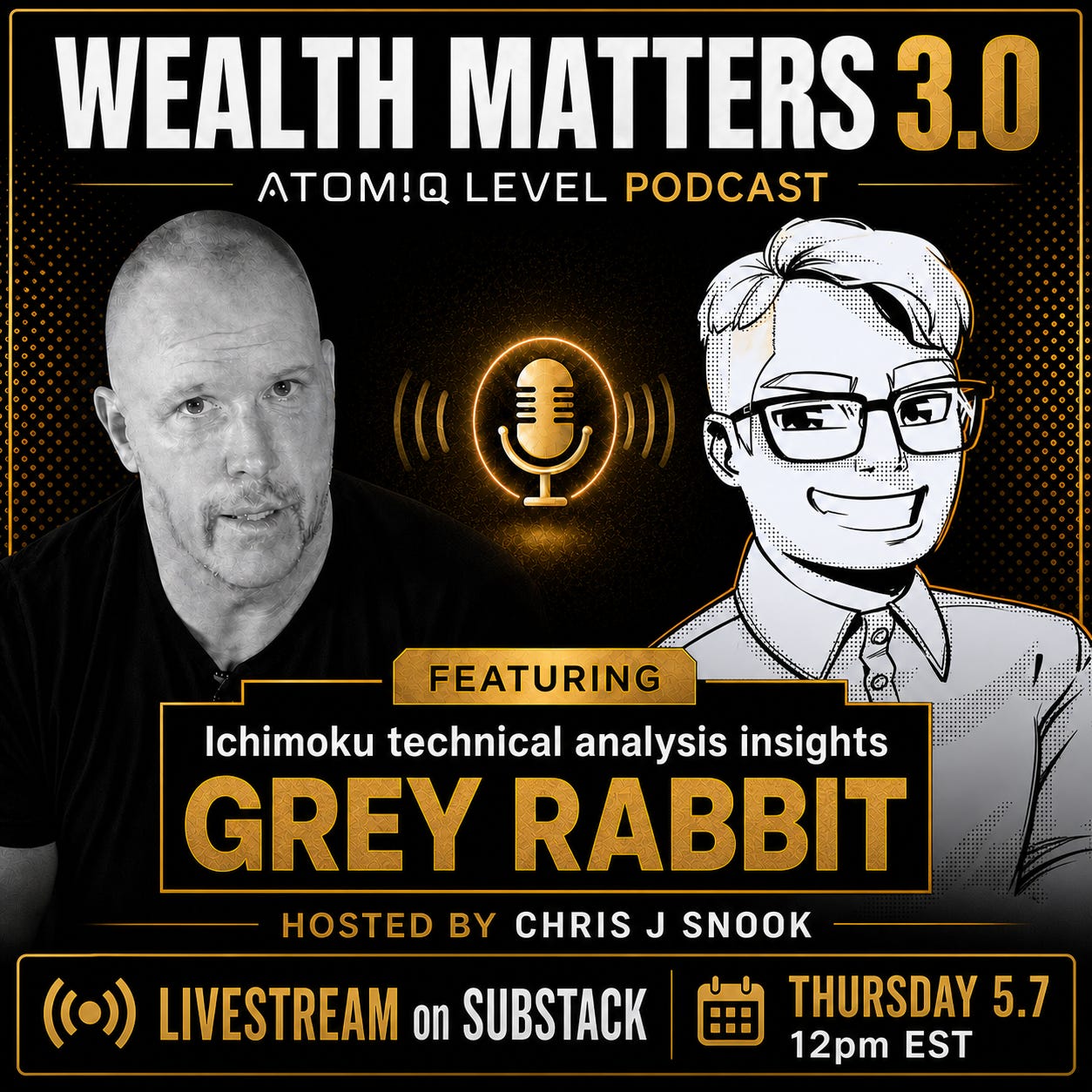
Before you read the show notes below, listen to or watch the interview. Please thank and subscribe to Grey Rabbit on Substack for spending 2 hours today with all of us.
Grey Rabbit brings a rare blend of technical market structure, trader psychology, personal transformation, and visual chart-based thinking to the world of finance. His work is not built around hype, hot takes, or simple “buy/sell” noise. It is built around the deeper question every investor eventually has to face:
Can you read the market clearly if you have not learned to read yourself first?
Follow and subscribe to Grey Rabbit for thoughtful market education, trading frameworks, Ichimoku analysis, Bitcoin insights, and the kind of psychological depth most financial commentary never touches.
TL:DW Key Takeaways
Grey Rabbit’s brand began almost accidentally, from a Russian gray cat that looked like a rabbit and kept sitting on his keyboard while he was trying to make educational content. Over time, the symbolism became deeper: rabbits as abundance, grey as the non-binary nature of markets, and the rabbit running uphill as a metaphor for resilience.
His path did not begin in finance. It began in Maryland, moved through architecture school, unpaid internships, 3D printing, rendering, long hours, and the growing realization that the life he was building did not match the freedom he wanted.
A friend introduced him to Bitcoin in 2014, around the $400 range, but the real story was not just Bitcoin. It was that Bitcoin became a proxy for a deeper desire: freedom, balance, and the possibility of designing life differently.
A one-way ticket to Munich became a major turning point. He moved to Germany to pursue a master’s degree, avoid massive debt, learn a new language, and test whether he could sacrifice short-term comfort for a future he actually wanted.
His experience with Bitcoin’s 2017 run-up and subsequent downturn became a psychological initiation. Selling Bitcoin to buy an engagement ring was not a life mistake, but it revealed a trading mistake: he had no strategy for greed, euphoria, loss, or decision-making under pressure.
Grey Rabbit’s framework starts with psychology before charts. His major influences include Trading in the Zone by Mark Douglas, Think and Grow Rich, and The Kybalion. He believes traders must first master their own subconscious patterns, victim mentality, emotional triggers, and balance before they can consistently master markets.
His trading style found its home in position trading, not frantic day trading. He believes everyone is a trader in some sense because everyone trades time, energy, attention, money, and opportunity every day.
His technical framework centers heavily on Ichimoku, which translates roughly to “one glance equilibrium chart.” As a former architect, he was drawn to its visual structure, its ability to reveal market equilibrium quickly, and its overlap with broader technical traditions like candlestick analysis, Wyckoff, Elliott Wave, and Japanese market theory.
The deeper message: markets are not black and white. They are gray. And if you want to succeed in them, you need more than indicators. You need self-awareness, humility, patience, and a framework that helps you see both the chart and the person reading it.
An Architect Becomes the Grey Rabbit of Finance
Before he became the Grey Rabbit of Finance, before the Substack, before the YouTube channel, before the trading frameworks, before the Ichimoku charts, before the market psychology, before the followers who began paying attention because his work felt different, he was a young man with a Russian gray cat sitting on his keyboard.
That is where the name began.
Not in a branding workshop. Not in a consultant’s mood board. Not in some elaborate attempt to manufacture mystique. Just a gray cat, a keyboard, and a creator trying to make educational content while learning about markets himself. The cat looked a little like a rabbit; the joke stuck, and eventually the symbol deepened.
Rabbits, he later learned, are symbols of abundance. They are also one of the few animals that can run faster uphill. The color gray became its own kind of market philosophy because markets are rarely black and white. They live in ambiguity, probability, emotion, imbalance, and movement. His early logo even featured a rabbit running up candlesticks.
That is the kind of origin story that cannot be faked. It begins as a joke, then reveals itself as destiny.
And destiny is a word Grey Rabbit does not use lightly. As he says early in the conversation, he did not grow up believing in destiny. He does now. Not because his life followed the plan he imagined, but because it did not. He never thought he would become a writer. He never imagined himself becoming a trader. He did not begin as a finance kid obsessing over markets or portfolios.
His first trade, he jokes, may have been Pokémon cards. But the real story begins long before the chart.
The Kid Who Did Not Yet Know What He Was Interested In
Grey Rabbit grew up in Maryland, between Washington, D.C., and Baltimore. In high school, he did not describe himself as a particularly great student, not because he lacked intelligence, but because he had not yet found the thing that pulled him forward. That is an important distinction. Many people mistake a lack of direction for a lack of ability. In his case, the signal had not yet found him.
There was a moment, though, when markets briefly appeared. A high school teacher, Mr. Zamuda, taught a class that involved journalism and writing about markets. Grey Rabbit remembers hearing him talk about trading oil and thinking it was one of the coolest things he had ever heard. The curiosity sparked. Stocks entered the picture. Trading entered the imagination.
Then someone older told him it was gambling.
So the spark faded.
That moment is easy to overlook, but it matters. A child shows curiosity. An adult dismisses it. A door closes quietly. Not forever, but long enough for destiny to take a different route. Grey Rabbit reflects on that with no bitterness, but with a lesson: when you see a young person show curiosity or skill, pay attention. Sometimes the smallest encouragement can alter the timeline.
His own timeline moved toward creativity. At first, he thought he might study film. When he arrived at Catholic University and found no film program, he entered business, then almost immediately pivoted to architecture. It was creative. It was structured. It was visual. It was demanding.
And architecture is not casual.
The first semester began with hand drafting. Line weights. Precision. Patience. Meticulous attention. Long hours. The kind of work that tests whether you are passionate, resilient, stubborn, or some combination of all three.
Grey Rabbit says he is both resilient and stubborn. That combination would later serve him well in markets.
The Architecture Years
Architecture gave him a way of seeing. It trained his eye for structure, balance, proportion, space, and systems. It also trained him in endurance. But after graduating in 2013, the path did not immediately become glamorous. His first post-school experience was an unpaid internship at the DuPont Underground in Washington, D.C., an abandoned trolley station beneath DuPont Circle.
The place had history. It had been a light rail trolley station, then a Cold War fallout shelter, then an attempted underground cafeteria called DuPont Down Under that failed because, as he notes, nobody working nearby wanted to go underground for lunch. It had its own haunted civic weirdness, even including tragedy. And there he was, surveying underground tunnels as an unpaid intern, inside a physical remnant of a city’s forgotten infrastructure.
There is something almost too perfect about that image.
Before he learned to read the hidden structure beneath markets, he was literally mapping the hidden structure beneath a city.
After that, he took temporary work installing computers in Maryland public schools. Eventually, he landed an architecture job at one of the top firms in Baltimore, helped by his specialization in 3D printing and rendering. He was not just drafting in the old world. He was working in the more innovative side of the field, using technology to visualize, model, and communicate space.
But even that did not fully fit.
After a couple of years, a realization started forming: architecture might not be the life he wanted. The work was real. The skill was real. But the picture of freedom was missing.
What’s the Picture You Call “Freedom”?
Grey Rabbit defines freedom in a way that feels different from the cliché. He does not reduce it to money. Money matters, but money alone can become another trap. More money can create more lifestyle, more obligations, more anchors, and more imbalance.
For him, freedom means balance.
He describes it like a video game, where different power bars represent different parts of life: money, family, hobbies, spiritual life, health, time, and meaning. Freedom is not just one bar maxed out while the others collapse. Freedom is trying to bring all of them into alignment.
That image is simple, but powerful. Everyone says they want freedom, but few people pause long enough to define what picture they are actually moving toward. Grey Rabbit had begun to see his picture. Then he began looking around at his life and realized the environment did not match it.
He was working long hours. He was playing social sports after work. Softball, kickball, bars, teams, nightlife. The purple team against the green team. Drinking after games. Fights are breaking out outside Patterson Park in Baltimore. The kind of life that can feel harmless in your twenties until one night you look up and see the older version of yourself sitting at the same bar, telling the same stories, still moving nowhere.
That was one of the moments. He saw the path. And he knew he had to leave it.
The One-Way Ticket to Munich
Grey Rabbit had always been drawn to Germany. He liked history. He had a pen pal from Germany. His family had discovered some ancestral connection. There was curiosity, but there was also pragmatism. If he wanted to pursue a master’s degree in architecture, doing it in the United States could mean taking on serious debt. Germany offered another path, but it required learning German and taking a leap.
So he started taking German classes after work at a local community college in October 2014. By July 2015, he had a one-way ticket to Munich.
Many people talk about reinvention.
Few buy the ticket.
Before he left, he spoke with his grandfather, a man who loved Baltimore history and knew how to tell a story. Grey Rabbit was still uncertain, still young, still deciding whether this was bold or foolish. His grandfather told him about the War of 1812, about fishermen spotting the British fleet in the Chesapeake Bay, about Washington, D.C. being burned, and about Baltimore becoming a final stand. He told him how merchants sank their own ships to defend the mouth of the harbor so the British could not push deeper into the city.
Years later, Grey Rabbit understood what the story had meant to him.
Sometimes you have to sacrifice present comfort to protect your future reality.
That lesson became part of the move. Germany was not just a place. It was a decision to sink the ships behind the version of himself he no longer wanted to be.
He arrived in Munich with roughly a year of money saved, enrolled in language school, ate Döner kebab like a student, learned German, got into university, secured a student visa, and began his master’s degree.
The new life had begun.
Bitcoin, Euphoria, and the First Real Market Lesson
Bitcoin entered his portfolio before Germany. A friend named Jamie introduced him to it in 2014, around the $400 range. He heard the pitch: Bitcoin was going to be the next big thing. At first, like many people, he watched, learned, bought some, and began seeing the price move.
By 2017, he was in Germany, standing in a Christmas market, drinking glühwein, watching Bitcoin reach around $18,000.
He felt brilliant.
That feeling is dangerous.
Anyone who has ever bought an asset before a major run knows the emotion. It feels like intelligence, but often it is a mix of timing, luck, narrative, and dopamine. The market is rising, your account is rising, your confidence is rising, and suddenly, you confuse being in the trade with understanding the trade.
Grey Rabbit later realized he had experienced the bandwagon effect in real time. He had been swept into euphoria. Then the bear market came. He moved back to the United States, was low on funds, wanted to put a ring on his future wife’s finger, and sold some Bitcoin around the depths of the downturn to buy the engagement ring.
In life, that was not a mistake.
Being with the right person is the best trade you can make.
But as a market lesson, it exposed something important. He had no strategy for euphoria. No plan for taking profits. No framework for buying dips. No process for managing greed, humility, regret, or loss. He had participated in the market, but he had not yet learned to manage himself inside the market.
That realization changed him.
The Market Finds Your Weak Point
Grey Rabbit’s next step was not to pile indicators onto a chart. It was not to chase the next coin, strategy, guru, or secret setup. He began studying psychology.
That is one of the most important parts of this conversation.
For Grey Rabbit, trading starts with the self. The market will find your weak point and exploit it until you fix it. If that weakness is greed, the market will expose greed. If it is fear, the market will expose fear. If it is revenge, impatience, ego, shame, attachment, envy, victim mentality, or the need to be right, the market will eventually bring that shadow to the surface.
He studied Trading in the Zone by Mark Douglas, a classic of trader psychology. He studied Think and Grow Rich. He read The Kybalion, which brought him to ideas like mentalism, correspondence, natural law, and the relationship between inner state and outer experience. He reflected on quantum concepts like observer theory, the idea that what is observed can be affected by the observer.
For him, these were not abstract ideas. They became trading principles. He began to understand that he could not approach the market as a victim. He had to understand himself as the observer. He had to raise his awareness, fix his psychology, and recognize that the charts were not merely external objects. They were also mirrors.
You cannot consistently read markets if you are emotionally unreadable to yourself.
That became the foundation.
Why Psychology Comes Before Indicators
Grey Rabbit is clear about the order in which people should learn markets. Do not start with Ichimoku. Do not start by loading charts with indicators. Do not start by trying to copy someone else’s system.
Start with psychology. Then learn candlesticks. Only after that should you begin layering systems onto the chart.
He points back to the Japanese rice trader Munehisa Homma, often associated with the origins of candlestick charting in the 1700s. Homma understood that markets were not just numbers. They were human behavior expressed through price. Patterns like the Three Mountains, which resemble what Western technical analysis later called the head-and-shoulders pattern, were recognized in Japan long before similar ideas became popular in the West.
This fascinated Grey Rabbit because the more he studied Japanese technical analysis, Western technical analysis, Elliott Wave, Wyckoff, candlesticks, and Ichimoku, the more he saw overlap. The systems were not identical, but they were pointing to similar truths.
Markets are governed by psychology. Psychology is governed by natural law. And price, no matter how far it stretches, eventually interacts with equilibrium.
The Ichimoku Revelation
Ichimoku appealed to Grey Rabbit because it matched how he sees.
The full name translates roughly as “one glance equilibrium chart.” That alone explains part of the attraction. As someone trained in architecture, he was drawn to structure. The cloud. The balance. The visual field. The ability to scan a chart quickly and see whether the market is in trend, congestion, imbalance, support, resistance, or transition.
Ichimoku gave him a way to speed-read markets.
It did not replace psychology. It did not replace candlesticks. It did not replace experience. But it gave him a visual framework that aligned with his mind. It allowed him to process market structure more quickly and see relationships that might otherwise be lost in noise.
He eventually found his natural trading rhythm in position trading, not frantic short-term trading. His time horizon became months to a year, long enough to let a thesis breathe, but active enough to engage with market structure.
This is where his background makes sense. He is not purely a trader in the stereotypical sense. He is part architect, part psychologist, part market historian, part visual analyst, part freedom seeker. His method reflects that blend.
The Market Is Gray
The name Grey Rabbit becomes more meaningful the deeper the conversation goes. Markets are not black and white. They are not simple. They are not purely rational. They are not purely emotional. They are not always wrong when they seem stretched, and they are not always right when they seem obvious.
They are gray.
This matters especially in moments like today, when investors look at the S&P 500, artificial intelligence, Bitcoin, inflation, reserve currency history, and monetary change and ask whether “this time is different.” Grey Rabbit’s framework does not dismiss that phrase outright. Sometimes the world really does change. Electricity changed buildings. The internet changed commerce. Bitcoin may change money. AI may change work.
But even when the future is different, gravity still exists.
Mean reversion is one of the laws he returns to. In nature, things are born, live, and return. In markets, price can stretch away from equilibrium, but eventually it must interact with it again. The hard part is timing, context, and knowing whether the stretch is a warning, an opportunity, or part of a larger structural shift.
That is why indicators alone are not enough.
You need psychology.
You need history.
You need a framework.
You need humility.
Everyone is a Trader
One of Grey Rabbit Finance’s most accessible insights is that everyone is a trader. Even people who do not buy or sell stocks trade every day. They trade time for money. They trade energy for status. They trade attention for entertainment. They trade health for ambition. They trade risk for comfort. They trade present pleasure for future possibility, or future possibility for present pleasure.
The only question is whether you are conscious of the trade.
That idea makes his work relevant far beyond active traders. His story is not simply about charts. It is about designing a life, recognizing when your environment no longer matches your vision, recovering from mistakes, studying your own mind, and building a framework that helps you make better decisions under uncertainty.
Finance becomes the arena. But the real subject is self-mastery.
Why You Should Listen
This ATOMIQ LEVEL conversation with Grey Rabbit is not just a market interview. It is a story about a young man who began in architecture, wandered through uncertainty, followed curiosity to Germany, learned through Bitcoin’s euphoria and pain, and eventually built a market framework rooted in psychology, visual structure, and the humility to admit that markets are never as black and white as we want them to be.
It is about the accidental origin of a brand that turned out to be more meaningful than planned. It is about a gray cat, a rabbit, a keyboard, and a creator who realized that the best symbols often choose us before we fully understand them. It is about a grandfather’s story of Baltimore merchants sinking their own ships to save the future, and how that became a lesson in sacrificing comfort for destiny. It is about the difference between making money and becoming free.
It is also about trading, but not in the shallow sense.
This episode gets into why psychology comes before indicators, why losses hurt more than wins feel good, why revenge trading exists, why euphoria can make us confuse luck with intelligence, why humility is a trading edge, and why systems like Ichimoku can help you see market structure only after you have begun to understand the structure inside yourself.
Most financial content tries to tell you what to buy.
Grey Rabbit is trying to help you understand how to see.
That is why this conversation matters. Whether you trade, invest, build, save, speculate, study Bitcoin, watch the S&P 500, or simply want to make better decisions with your time and money, this episode offers something more durable than a market call.
It offers a map for becoming the kind of person who can survive the market long enough to learn from it.
Press play on this conversation with Grey Rabbit, subscribe to his work, and read the full TL;DR above if you want the highlights.
But listen to the full episode if you want the story.
Because somewhere between a gray cat, a one-way ticket to Munich, a Bitcoin cycle, a trading mistake, and an Ichimoku cloud, there is a reminder every investor needs to hear:
The market is not just testing your strategy. It is testing you.
The real risk is doing nothing!
~Chris J Snook
Shoutout gratitude to our live stream audience!
Thank you BeerThirty, Cutting Through the Chaos, MarketStack, and many others for tuning into my live video with Grey Rabbit Finance! Join me for my next live video in the app.