This episode was part of our weekly Shields & Succession / Ask Matt Anything Office Hours with Matt Meuli on ATOMIQ LEVEL. Every Wednesday, we go live, office-hours-style, to talk through estate planning, asset protection, family business succession, trust design, and the practical issues families need to understand before the moment of crisis arrives.
DISCLAIMER: As always, this conversation is educational and informational. Matt is an attorney, but he may or may not yet be your attorney. Nothing here should be treated as individualized legal, tax, investment, financial, fiduciary, or estate-planning advice. The purpose is to help you ask better questions and understand the issues before you sit down with your own qualified professionals.
Colorado residents can call 970-820-0090.
For Wyoming Asset Protection Trust planning, asset-protection structures, and advanced planning conversations across all 50 states and territories, call 307-463-3600. A human being answers the phone during business hours, and if you call after hours, a human will call you back.
Matt Meuli and Owen Hathaway are also on Substack.
A Word From An Ecosystem Brand Partner
Before we get into this topic further, I want to thank one of our Wealth Matters 3.0 ecosystem brand partners and Wealth CMDR PRO Subscribers: PEBL.
PEBL is a company I personally use across my own portfolio companies and personal strategy because hiring abroad or remote should not require founders, operators, family offices, or distributed teams to spend months building employment infrastructure before they can bring great people into the business.
Hiring abroad or remote can take months when you do it on your own, but with PEBL you can hire in over 185 countries in minutes and have your new hire onboarded by Monday.
PEBL is normally $399 a month per employee — already a no-brainer for what you get — but right now there’s a limited-time offer on their site that makes it even easier to get started.

Go to hipebl.com.
Terms and conditions apply.
The Trust Can Be Legal and Still Create a War
The headline topic for this week’s Shields & Succession Office Hours was family enterprise succession.
Not the abstract version. The uncomfortable version.
What happens when a family business, family holding company, trust-owned asset, closely held operating company, or multigenerational fortune is technically transferred but practically misunderstood? What happens when everyone owns something, but only one person controls it? What happens when the founder assumed the heirs would be grateful, but one heir feels trapped? What happens when the surviving spouse inherits the lifestyle but not the operating capacity? What happens when the children inherit the shares but not the desire to be in business together?
That was the human question underneath the legal question.
At the top of the show, I referenced a few current-event triggers that made this conversation timely. One was a KPMG discussion around more families bringing in a management layer for family business succession. Another was the public dispute involving Hilltop Holdings and the family of President Gerald Ford, where I summarized the issue as an example of the cost of unclear control when a large family stake, voting rights, board influence, and ownership transfer meet litigation.
The point was not to litigate that specific case in the court of Substack.
The point was to ask what every family business owner should ask before their own family becomes an expensive case study:
Did we transfer the asset, or did we transfer a fight?
Matt’s first observation was the one every family should hear. A trust can be well-written as a legal document and still fail as a family operating system. In the Hilltop discussion, Matt’s point was that the fight sounded less like a failure to write a trust at all and more like a failure to build the exit planning, communication, and practical operating architecture around the trust. A lot of people can write a trust. Fewer show the family how that trust works in real life.
That distinction is everything.
A document can hold title.
A document can define distributions.
A document can appoint a trustee.
A document can allocate voting rights.
But a document cannot force adult children to want the same future. It cannot make a non-operator heir feel empowered. It cannot make a surviving spouse want to run the company. It cannot make minority shareholders happy being passengers forever. It cannot convert unspoken family assumptions into durable family agreement after the founder is gone.
The family has to do that work while the founder is still alive.
Ownership Without Control Can Feel Like a Financial Prison
One of the most useful phrases in the conversation was this:
A financial prison.
It sounds dramatic until you understand what it means.
Imagine being given ownership in a valuable family enterprise, but no meaningful control. You cannot sell. You cannot vote. You cannot influence operations. You cannot choose the manager. You cannot easily exit. You are technically wealthy, but practically stuck. You own something that may create tax consequences, relational friction, emotional resentment, and opportunity cost, but you do not have the autonomy to decide what to do with it.
That is not freedom. That is a gilded cage.
Matt framed it plainly: the person drafting the plan may assume every child will be delighted to own a piece of a valuable property, company, or family asset. But the child may not want to be forced into shared ownership with siblings. They may not want an older brother or younger sister controlling the company while they are “just along for the ride.” Without an exit plan, the court may become the place where the missing exit plan gets invented after the fact.
This is where founders make one of the most expensive emotional mistakes in succession planning.
They confuse value with desire.
Just because something is valuable does not mean every heir wants it. Just because the business funded the family’s lifestyle does not mean the children want to operate it. Just because the founder sacrificed for the enterprise does not mean the next generation experienced the enterprise as a blessing.
Some children see the business as Mom or Dad’s life work.
Others see it as the thing that stole Mom or Dad from dinner, weekends, vacations, birthdays, ball games, or the emotional availability they needed more than another distribution.
That does not make the child ungrateful. It makes the child honest. The worst time to discover that honesty is after the founder dies.
The Business May Have Taken Care of the Family While Also Taking From the Family
This was one of the more human turns in the episode.
A child’s view of the business may be very different from the founder’s view of the business.
The founder sees the friendships at work, the success of a completed project, the satisfaction of leading people, the pride of making payroll, the respect in the market, the identity of being the person customers trust, and the joy of building something that did not exist before.
The child may see missed vacations, late nights, parental stress, work calls during dinner, and the sense that the business always came first.
Matt said that children may initially evaluate the business by the time it took from the parent, not by the lifestyle it provided. But if families start talking, those opinions can shift. Children may begin to see the business not merely as what they lost, but as a lifestyle, legacy, operating system, community institution, or platform they might make their own.
That shift takes time.
It does not happen in a month. It does not happen because Dad says, “Here is the company.” It does not happen because the trust says everyone owns shares.
It happens through stewardship. It happens when the founder explains the philosophy behind the business, the investment, the service model, the customer relationships, the employees, and the way the family made decisions. Matt put it simply: we are trying to pass the values, not just the valuables.
That is the whole ballgame.
If you transfer a business without transferring the values, the heirs inherit complexity without context.
Five favors before you continue.
Hit the ❤️. The algorithm is a validation machine that needs your cheap dopamine to keep us at the top of your feed.
Hit the 🔄 restack. Somebody’s life will change passively today, and you can get the credit for bringing it to them from both of us.
Hit 📤 share. You know exactly one person in your email list or text stream who needs something on their playlist or reading wire today.
Drop a comment. Tell me your biggest insight, your greatest challenge, your counter-argument or gap in the conversation, or a recent related triumph. I read every one, and I reply to the ones that make me laugh, make me think, or make me money. Preferably all three.
Subscribe. This newsletter and these office hours are 100% reader and listener-supported. The free conversations create awareness. The other side of the paywall is where the playbooks, resources, archives, and office-hours context help turn that awareness into massive action for your net worth and your net happiness.
Ask the Kids Before You Yoke Them Together
One of Matt’s most practical examples came from work he has seen with family businesses where parents wanted to pass the business to the children.
On paper, that sounds beautiful. In reality, the children may have completely different goals.
Matt described families bringing in counselors to understand what the children actually wanted. One child might say, “I want to run this business. I have wanted to run it all my life.” Another might say, “I only want to be involved long enough to get enough money to retire and move somewhere else.” Yoking those people together without an exit plan is not stewardship. It is a future lawsuit with better manners at the beginning.
This is why the “equal shares to all children” reflex can be dangerous inside an operating business.
Equal is not always fair. Fair is not always equal.
And neither one matters if the structure forces people into an ownership relationship they never chose.
A family can love each other and still be terrible business partners. A sibling can respect the founder and still not want to work with the founder’s chosen CEO. A spouse can enjoy the lifestyle and still have no interest in operating the business. A minority partner can love the founder and still not want to wake up one day in business with the founder’s surviving spouse.
These are not insults. They are design realities.
Matt gave the divorce example because it is exactly the kind of thing people avoid thinking about while everyone is still friendly. If a husband and wife or two partners split up and a divorce decree gives one share to two people who now hate each other, minority owners may suddenly be working with people they did not choose. The time to design buyout rights, transfer restrictions, first rights of refusal, and dispute-resolution processes is while people still agree, not after incapacity, death, or divorce has turned the business into a hostage situation.
This is not pessimism. This is respect for future reality.
The Professional Manager May Save the Legacy
A major theme in the conversation was the rise of professional management inside family-owned businesses. This is the family enterprise version of a truth every founder eventually has to face:
The business may need to outgrow the founder’s daily presence before the family can safely inherit it.
The old idea of succession was often binary. Either the founder runs the company, or the child runs the company. But that is not always the right answer. Sometimes the better answer is a non-family CEO, a professional operator, a fractional CFO, a chief marketing advisor, a fractional COO, or some other management layer that lets the family retain ownership, board influence, and economic participation without pretending the heir wants or deserves the operating seat.
Matt talked about the rise of fractional C-suites: fractional CFOs, COOs, CEOs, marketing leaders, and other third-party professionals who can take one important hat off the founder’s head without forcing the company to hire a full-time executive it cannot afford. These roles can be very valuable because they focus on one function instead of trying to find a “mini-you” to wear every hat the founder has worn for years.
That line matters.
A lot of founders look for a successor and accidentally look for a clone.
But the business may not need another founder. It may need professionalization. It may need documented systems. It may need real books. It may need a CFO who can translate lifestyle income into transferable enterprise value. It may need a COO who can run the operating rhythm without the founder. It may need a sales leader who owns the customer relationships before the founder’s absence turns those relationships into smoke. It may need a marketing system, not the founder’s reputation. It may need an employee team that knows what decisions they can make without calling the owner. Professional management is not an insult to the founder. It is the bridge between founder dependence and transferable value.
Do You Own a Business, or Do You Own Your Job?
This question keeps coming up because it is the question small business owners most need to answer honestly.
Do you own a business?
Or do you own your job?
There is no shame in either answer, but the answers lead to very different succession plans.
A local business throwing off a good lifestyle may be a wonderful vehicle for the family while the founder is alive. It can pay the mortgage, employ people, build community, and create dignity. But that does not automatically make it an investable asset someone else wants to buy at a meaningful multiple.
I said it in the conversation this way: the sandwich shop, tire shop, dermatology practice, or local service business that throws off a few hundred thousand dollars a year may fund a very nice life, but it may not be worth much to an outside buyer if it depends almost entirely on the owner’s daily presence. In that case, exit planning may be less about selling a going concern and more about an organized wind-down, real estate strategy, asset sale, or family decision about whether anyone actually wants to continue operating it.
But a similar business with systems, management, customer concentration under control, transferable relationships, clean books, documented processes, and room to roll up adjacent markets might be a platform.
That is a different business. That is a different valuation. That is a different inheritance.
That is why professionalization before succession matters. A $2 million revenue business might be a lifestyle business in one family’s hands and a platform for consolidation in another owner’s hands. The difference may not be the customers. It may be the system.
Matt added a practical signal: if serious buyers or brokers are already reaching out, that tells the owner something about market perception. The business may have infrastructure, market position, philosophy, customer base, or regional relevance that someone else sees as valuable. That does not mean the founder should sell tomorrow. It means the founder should treat those inbound signals as data and bring the family into the conversation before the decision becomes urgent.
Sometimes an outside buyer sees the thing the family stopped seeing. Sometimes that buyer’s interest can even wake up the next generation.
An Outside Buyer Can Change the Family Conversation
One of my favorite turns in the episode came when we talked about the family’s emotional relationship to the business.
If a child has spent years seeing the business as the thing that took Dad away, the child may have no interest in it. But if a serious outside buyer shows up and explains the opportunity differently, the child may suddenly see something else.
Not the old box. A platform. A lifestyle. A growth vehicle. A way to put their own fingerprint on the family legacy.
That does not mean the child should be guilted into taking it over. It means the founder should not assume the child’s first reaction is the final answer. The conversation may change when the business is seen through fresh eyes.
Matt agreed that children often evaluate the business based on what it cost them emotionally. They may remember the missed time before they understand the value, identity, leadership, friendships, service, and purpose the founder experienced through the work. When families talk about those things, the child’s view can change.
This is why succession planning is not merely tax planning. It is translation. The founder has to translate the meaning of the business before asking anyone to inherit the mechanics of the business.
Key-Person Insurance Is Not a Strategy Unless the Instructions Are Clear
We also moved into key-person insurance, because insurance is one of those planning tools that can feel like a box has been checked when the real design question remains unanswered.
Buying a policy is not the same as designing a succession plan. The central question is not merely, “Is there money if something happens?”
The better question is:
What is the money supposed to do?
Is the policy meant to keep the business operating?
Buy out a spouse?
Fund a replacement CEO?
Protect the surviving family?
Buy out a partner?
Create liquidity so a beneficiary does not have to depend on the business?
Replace a key employee?
Support the company during transition?
Those are different intents. If the intent is not clear, money can arrive and still create conflict. I framed the issue around a simple example. Maybe the family thought the policy was there to take care of Mom. But did that mean Mom should be bought out of her shares? Or did it mean Mom remains the governing shareholder but now has enough personal liquidity that she does not depend on the next operator? Or was the money supposed to stay in the business to hire a COO or CEO? Same policy dollars. Completely different outcomes.
Matt’s answer was important. The structure matters. If policy proceeds flow into the business but the documents do not clearly show that the money is meant to buy out ownership, the money may be treated as a business asset. That can affect valuation and potentially create unintended tax consequences. He made the broader point that policy, operating agreement, trust, and buy-sell structure have to work together.
This is the planning lesson:
Insurance creates liquidity. Documents direct liquidity. Intent gives liquidity meaning.
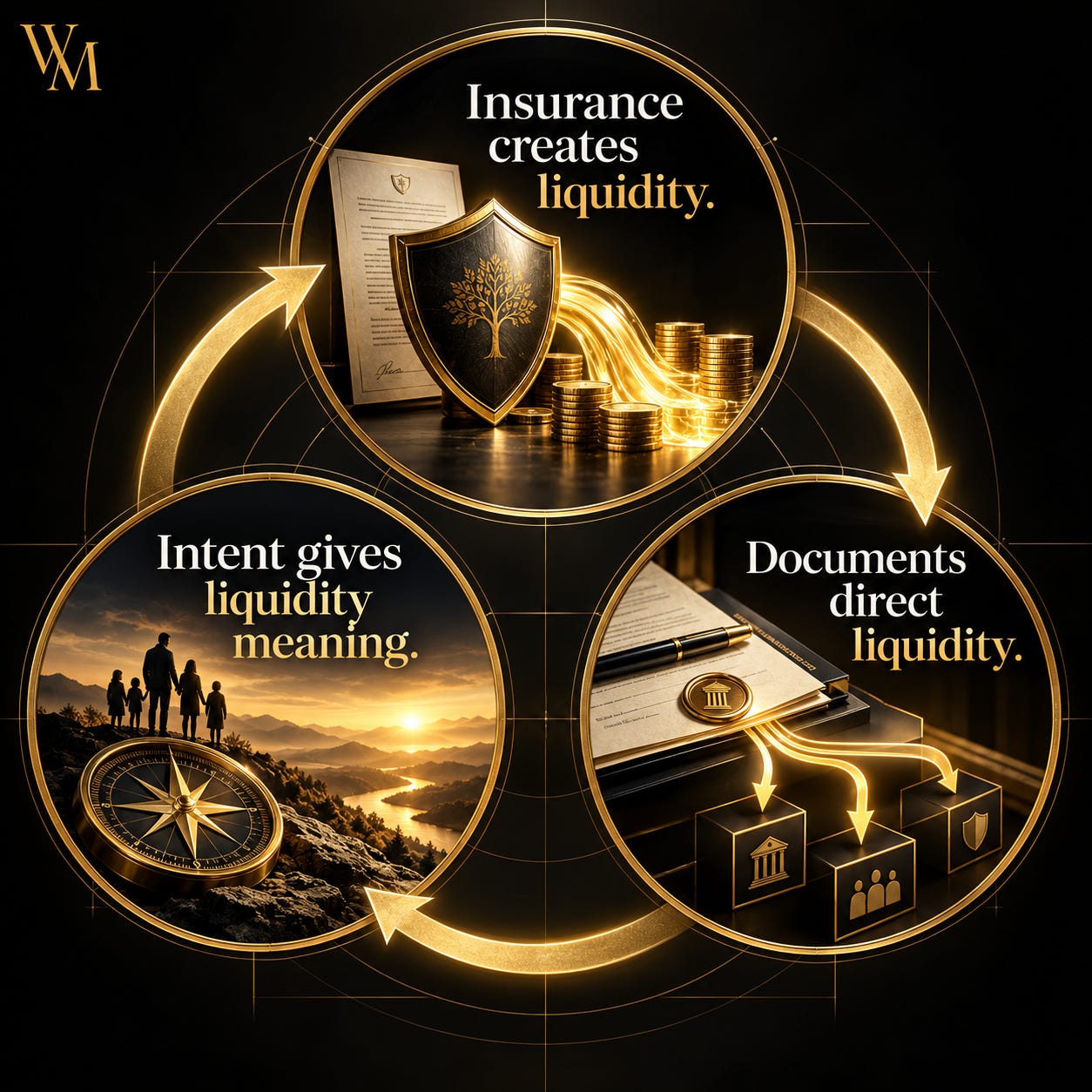
Without all three, the money may solve one problem while creating another.
The Free Conversation Is the Gateway. The Playbook Lives Behind the Paywall.
The conversations on ATOMIQ LEVEL and the article follow-ups are ALWAYS free, because the insights and access to the discourse with the most brilliant minds in finance, business, and tech that I benefit from are my generous and strategic gateway drug.
The other side of the paywall is where you get the full playbooks, the office hours, and the archives distilled in a broader and more actionable context.
It is where, for $1 per day or less, you can go from conversation to planning and protecting your net worth and your net happiness.
So I will see you over there and welcome you to your journey of becoming a true Wealth CMDR.
Guardrails Matter Because Heirs Will Look for Escape Hatches
The financial prison idea came back near the end in a different form.
What happens if an heir owns something but has no control?
What happens if the trust says they get access at certain ages?
What happens if they can borrow against future distributions?
What happens if they can sell a beneficial interest to a third party?
What happens if the family did not intend that outcome, but the document never clearly blocked it?
When a beneficiary feels trapped, they may look for ways to turn future value into current cash. They may borrow against distributions, pledge interests as collateral, sell something at a discount, or create leverage around a future inheritance. Sometimes that may be appropriate. Sometimes it may be destructive. But if the trust never contemplated it, the loophole can break the original purpose of the plan.
Matt explained that if a trust gives someone the right to take 50% at age 35, creditors may read that provision too. Even if the distribution is permissive, the door may be open enough for argument. Once assets are distributed out of a protected trust environment, the family may not be able to “unring the bell” and put the same protection back.
That phrase matters. Once the asset is out, it is out.
That does not mean every trust should be locked down forever. It means the family should design consciously.
Do we want beneficiary loans?
Promissory notes?
Family right of first refusal?
Internal buyback rights? Restrictions on pledging or assignment?
A family bank mechanism?
A trustee discretion standard?
Asset-protection guardrails? Exit rights?
A planned redemption formula?
These are not generic questions. They depend on the beneficiary.
Matt said it directly: Do you know your child? Is the child responsible? A creative spender? Someone who would pay off the Ferrari, or someone who would use the distribution as down payments on three more?
The goal is not to punish the child. The goal is to protect them from predictable risks, including themselves, while still giving them enough dignity and flexibility to live a meaningful life.
That is what good planning does. It does not control from the grave for sport. It protects purpose.
The New Middle-Class Millionaire Needs Access, Not Just Documents
The last section of the conversation moved into the business model of advice itself.
I used a Fort Collins example because it illustrates something happening all over the country. A family buys a large house in 2013 or 2014 for under $1 million at low rates. A decade later, that house may be worth two or three times that. The owner may not feel rich. They may still feel like a high-income family that made a good housing decision. But suddenly, the house alone may represent millions of dollars of net worth.
That family needs planning. But they may not think like a family office family. They may think like a consumer shopping for a trust package. What is the bill? A few thousand dollars? Fine. Let’s get the binder.
That is not enough anymore.
I argued that what this family really needs is ongoing access to the conversations that matter, when they matter, with someone who can help them understand the legal, financial, tax, insurance, privacy, and family governance implications before the crisis. Not every question should require the emotional friction of calling a lawyer and wondering whether the clock is running. Not every planning need is a one-time document project.
Matt agreed that this is the future. The ultra-wealthy have had stewardship meetings, private family office teams, and ongoing advisory coordination for a long time. The gap is for HENRYs and middle-class millionaire families who now have real complexity but not the traditional family office infrastructure. Matt described the need for something like a fractional stewardship officer: not a full-time payroll position, but recurring access to the guidance and conversations that help families use the plan.
This is where I think the market is going.
The old model was event-based.
Draft the trust. Sell the insurance. Manage the assets. Prepare the tax return.
The new model has to be stewardship-based.
Coordinate the plan. Maintain the architecture. Protect the confidentiality. Update the intent. Prepare the heirs. Review the insurance. Manage the exit options. Translate the trust. Discuss the business.
Help the family understand the difference between ownership, control, governance, liquidity, and legacy.
That is not merely legal work. That is wealth stewardship.
Privacy, AI, and the Attorney Quarterback
We also hit one of the most modern planning landmines: running private estate documents through public AI tools.
Matt warned that attorney-client privilege and work-product protection depend on how information is handled. Documents in the lawyer’s hands may have protections that can be weakened or destroyed if casually shared with CPAs, investment advisors, or public systems. He also made the point that if proprietary or confidential information is handled through counsel rather than pasted into a public database, the family has a better argument that the material was meant to remain confidential.
This matters.
A public AI tool may tell you what a generic trust usually says. It may flag provisions it has not seen before. It may suggest standard language. But it does not know the family philosophy, the asset-protection goal, the child’s creditor risk, the business succession problem, the marital history, the jurisdictional design, or why the attorney included a provision that seems odd in isolation.
That can create a bad loop. The client runs the document through AI. AI says, “This looks unusual.”
The client returns upset. The attorney now has to defend why the provision exists. The client gets billed to be educated about why a generic tool did not understand their specific plan.
Everyone is annoyed. Nobody is better served.
AI can be useful. It can help organize questions, summarize concepts, prepare families for meetings, and reveal where they do not understand something. But private estate documents, trust architecture, financial statements, insurance applications, succession disputes, and family governance problems should be handled with privacy discipline.
Matt made the point that who requests information and who provides information can matter. If an attorney requests certain materials from a CPA or advisor as part of legal work, there may be stronger confidentiality arguments than if the client casually sprays documents across the advisory ecosystem.
That is why the quarterback matters. Not because the attorney must always dominate the team.
Because someone must know how to coordinate the team without accidentally destroying the privacy, purpose, and protection the team is supposed to create.
What This Means for Net Worth and Net Happiness
For Wealth Matters readers, this conversation is not about rich-people drama. It is about the practical reality of family-owned wealth.
A closely held business can fund a beautiful life and still fail as an inheritance.
A trust can be well-drafted and still leave heirs feeling trapped.
A policy can pay out and still create conflict if nobody knows what the money was intended to do.
A child can love the founder and still not want the business. A spouse can deserve protection and still be the wrong operator.
A family can have millions in value and no system for exit, governance, liquidity, professional management, or next-generation readiness.
Your net worth depends on the structure.
Your net happiness depends on whether the people you love can live with the structure.
That is the distinction. Wealth is not merely what transfers. Wealth is what survives the transfer without destroying the people receiving it.
Why You Should Press Play
Press play if your family owns a business and the succession plan assumes the children want what the founder built.
Press play if you have a trust but have never had the family conversation about control, voting rights, exit rights, buyout rights, and dispute resolution.
Press play if you are leaving ownership to multiple heirs but only one person will actually control the asset.
Press play if your family business could become a financial prison for someone who technically owns a valuable interest but has no control, no liquidity, and no way out.
Press play if your business depends on the founder’s relationships, instincts, customer trust, daily decisions, or identity.
Press play if you have ever thought, “The kids will figure it out.”
Press play if you need to understand whether the business is a transferable enterprise or simply a lifestyle vehicle that should be wound down, sold, or professionally managed.
Press play if you are considering a fractional CFO, COO, CEO, or other management layer before the founder fully exits.
Press play if your buy-sell agreement, key-person insurance, operating agreement, trust, and succession plan have never been reviewed together.
Press play if you want to understand why insurance proceeds need instructions, not just beneficiaries.
Press play if your heirs may someday borrow against, pledge, sell, or try to monetize future trust interests because they feel trapped inside the structure.
Press play if your family is newly wealthy on paper because real estate, a business, retirement accounts, or investment assets appreciated faster than your planning architecture evolved.
Press play if you want to protect both your net worth and your net happiness by turning succession from a post-death fight into a living family stewardship conversation.
Closing Thought
The family business can become a financial prison when ownership arrives without voice, liquidity, purpose, or exit.
That is the warning.
The gift can become the handcuff. The trust can become the courtroom exhibit. The insurance policy can become the tax problem. The spouse can inherit a company they never wanted to operate.
The kids can inherit a business they associate more with absence than opportunity.
The professional manager can arrive too late.
The successor can discover too late that customers belonged to the founder, not the company. The family can discover too late that equal shares did not create equal desire.
But none of that has to be inevitable.
The founder can ask. The family can talk. The business can professionalize. The trust can include exit rights. The operating agreement can include buyout provisions. The policy can include instructions.
The family can test whether the next generation wants to steward, sell, operate, hold, or exit. The attorney, CPA, insurance professional, advisor, and operator can coordinate before the emergency.
The plan can become a living system instead of a static binder. That is what Shields & Succession is really about.
Not death.
Not documents.
Not fear.
Stewardship.
Because the real inheritance is not the company, the trust, the policy, the house, or the account.
The real inheritance is whether the people you love have the wisdom, authority, liquidity, privacy, and freedom to use those assets without destroying the family in the process.
Join us every Wednesday for Shields & Succession / Ask Matt Anything Office Hours on ATOMIQ LEVEL.
Colorado residents can call 970-820-0090.
For Wyoming Asset Protection Trust planning, advanced asset-protection architecture, and planning conversations across all 50 states and territories, call 307-463-3600.
The real risk is doing nothing.
~Chris J Snook
Thank you RaeAnn Engler, Owen Hathaway, and many others for tuning into my live video with Matt Meuli! Join me for my next live video in the app.