Recorded Feb 18, 2026
Connect with James Godfrey:
LinkedIn: https://www.linkedin.com/in/james-godfrey-9248754a/
Company: Secure Digital Markets
Investor Onboarding here:
https://onboard.sdm.co/ (mention this podcast for extra white-glove service!

Video version of our full interview is below:
Episode 007 Summary:
Chris J Snook and James Godfrey discussed James Godfrey’s extensive background in traditional finance and subsequent transition into digital assets and investment banking with SDM, emphasizing the evolution of the digital asset market driven by institutional adoption. They explored the macro context of generational shifts, the unique properties of Bitcoin as “unstoppable money” and an escape from financial tyranny, and the implications of Agentic AI on transactional activity and exponential wealth creation. James Godfrey detailed SDM’s white-glove services for high-net-worth clients, including OTC transactions, lending against Bitcoin collateral, and risk mitigation strategies using covered calls to offset loan interest, noting that trust and human advisory remain crucial in the changing financial landscape.
Details
Welcome and Introduction of Guest: Chris J Snook welcomed listeners to the ATOMIQ LEVEL podcast, highlighting the show’s focus on wealth and net happiness. Snook introduced James Godfrey, referencing the episode number (007) and Godfrey’s British nationality. Godfrey expressed enthusiasm for the discussion, acknowledging the need for their conversation to be insightful (00:00:00).
Background and Early Career in Finance: Snook prompted Godfrey to share their professional background before diving into the current state of digital assets and AI. Godfrey began their career on the stock exchange floor just before Big Bang in 1985, starting on their 19th birthday, and has consistently worked in trading and risk management (00:00:59).
Career Trajectory and Entry into Digital Assets: Godfrey detailed their significant roles, including head of global credit trading at Nomura, where they managed 32 traders across multiple continents through the global financial crisis. After a period of illness in 2014, Godfrey left traditional banking and, in 2016, encountered blockchain technology after hearing a World Economic Forum speaker predict it would change the world more than the internet (00:01:51). This led them down the “rabbit hole,” building exchanges and real-world asset platforms, eventually leading them to Canada to join SDM and build a crypto investment bank (00:02:54).
Affinity for James Bond and Book Collecting: Godfrey mentioned their fondness for James Bond, sharing that their microphone was sitting on a stack of James Bond first editions, including a paperback first edition of Dr. No. They noted the substantial price difference between the $50,000 hardbacks and the $200 paperbacks they collected, revealing their self-proclaimed “geek” status (00:04:01). Snook related to this passion, describing their own collection of various versions of books like The Art of War and Think and Grow Rich (00:04:56).
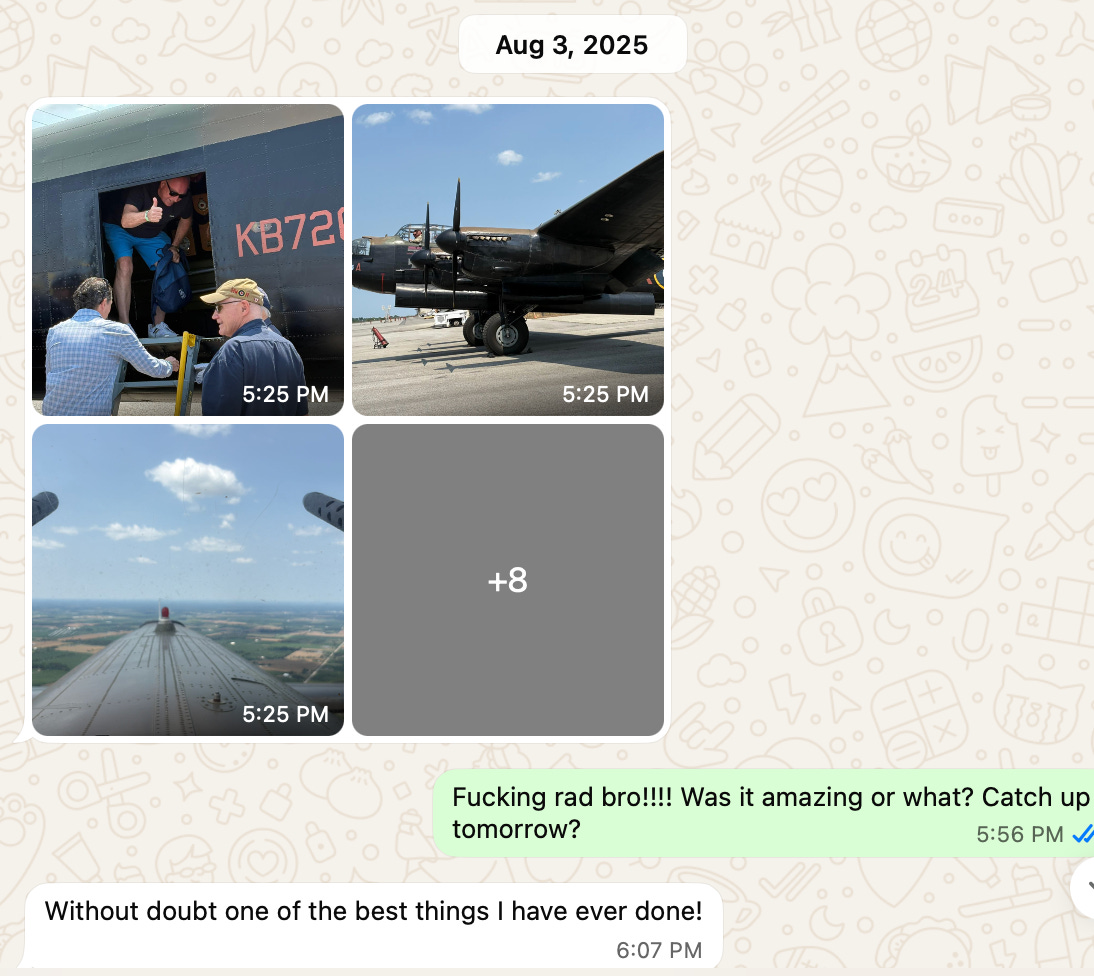
Passion for History and the Second World War: Godfrey revealed their passion for history, particularly the Second World War (00:05:44). They shared a surreal recent experience of securing a seat to fly in one of the only two flying Avro Lancaster bombers in the world, which is operated by the Canadian Warplane Heritage Museum. Godfrey described flying over Niagara and banking around the CN Tower, reflecting on the terrifying experience of the 1940s Royal Air Force bomber crew members (00:06:32).
Personal Story Archives: From Chris and James’ personal WhatsApp chat in August of 2025. Here is one of the 2 1940’s Avro Lancaster and James “Bond” Godfrey in action!


Macro Context and Generational Shifts: Snook drew parallels between the current macro environment and historical cycles, referencing the books The Fourth Turning and Rebecca Costa’s book on biological constraints. They explained that these books provide context for generational shifts and cycles of approximately 100 years that lead to a “reset,” which is currently evident in financial markets, geopolitical shifts, and populism (00:09:30). Godfrey agreed that nothing is new, noting that past events, such as the Reichstag fire in 1933, have been seen before (00:10:28).
Current Role and Market Observations: Godfrey confirmed they have spent seven to eight years fully immersed in digital asset investment banking with SDM, which handles bespoke strategies and over-the-counter (OTC) transactions for high-net-worth individuals and family offices (00:10:28). Reflecting on market volatility since 2016 (including the FTX and Celsius failures), Godfrey offered a primary life lesson: only engage in activities that one fully understands (00:11:30).
The Importance of Seeking Understanding: Snook challenged Godfrey’s “only do stuff you understand” advice, pointing out that Godfrey themself chose to learn about blockchain in 2016 after admitting they did not understand it. Godfrey agreed that the decision to “seek to understand” is critical for sustained wealth, noting that they regretted selling their Bitcoin purchase at $500, though they affirmed the principle that “nobody ever got shot taking a profit” (00:13:09).
Evolution of the Digital Asset Market: Godfrey shared advice from the global head of digital for HSBC: things take longer than expected but then happen faster than expected (00:13:56). They noted that the anticipated digital revolution is now occurring, driven by massive institutions like BlackRock, whose IBIT product inflows demonstrate that the current market is vastly different from that of four years ago (00:15:01).
Historical Parallels in Media Convergence: Snook drew a parallel to the early 2000s when digital production and media convergence were predicted to move online, but were delayed because necessary infrastructure (like bandwidth/dark fiber) was incomplete (00:16:26). The shift from physical media like CDs to digital consumption happened “slowly then suddenly” (00:17:45). Snook noted that the current environment is similar, with many smart people feeling overwhelmed by the convergence of AI, Bitcoin, and geopolitical shifts, leading to asset allocation paralysis or holding cash (00:19:05).
Institutional Resistance and Tipping Point: Godfrey highlighted that many established finance professionals, such as their intelligent friend who is an asset allocator for insurance companies, still struggle to adopt Bitcoin (00:21:01). They recounted a conversation with a large bank CEO who stated they would wait until the market “settles down” before buying what they need. Godfrey believes the market is approaching a tipping point where banks and large financial institutions will rapidly acquire smaller firms, accelerating mass adoption (00:22:03).
Trillion-Dollar Asset Status and Supply Elasticity: Snook recalled a 2020 conversation with a pension fund manager who stated they would only look at Bitcoin once it hit $55,000 (a trillion-dollar asset), but would not allocate until it reached $250,000 to $350,000 (00:23:50). Snook inferred that the manager did not fully grasp the fixed, inelastic supply of Bitcoin (21 million). They concluded that when institutions arrive at the $250,000 conclusion, the price will move quickly due to too much money pursuing too little supply (00:25:33).
Traditional Finance Servicing Crypto Wealth: Godfrey stated that traditional finance is recognizing the unprecedented wealth creation concentrated among private individuals in the crypto space. This realization will lead to the creation of products, such as covered call strategies and lending mechanisms, to generate yield on previously dormant Bitcoin holdings (00:27:50). They observed that 90% of the world’s Bitcoin is currently sitting inactive, a concept that is bizarre when compared to traditional bank accounts and investment accounts (00:29:11).
Gold as an Asset without an Issuer: Snook used gold as a historical reference, noting that 80% of the world’s supply is owned by G7 central banks, yet it remains a universally accepted store of value and hard money without counterparty risk (00:30:16). They contrasted the tradable security of Bitcoin ETFs (price exposure) with the direct ownership of the physical asset (Bitcoin itself) (00:31:01).
ETF Preference and Accessibility: Godfrey affirmed that for many, particularly new entrants, price exposure is what they want, not the technicalities of self-sovereignty or understanding fractional reserve banking (00:32:09). Godfrey admitted that if they were buying $1 million worth of Bitcoin today, they would likely buy the ETF because it is “so much easier,” insured, and removes the risk and hassle of wallet management (00:32:57).
Impact of Currency Debasement on Bitcoin Price: Godfrey emphasized the importance of perspective, noting that Bitcoin’s value is often viewed through the lens of the US dollar (00:37:32). They pointed out that if the US dollar weakens against other currencies (e.g., down 12% against Sterling), the effective price for Bitcoin rises for those with a dollar base. They advocated that the world needs to find a way to value Bitcoin against something other than the US dollar (00:38:24) (00:39:54).
Bitcoin as an Escape from Tyranny: Snook described the situation in Iran where, during a period of civil unrest and currency hyperinflation, people who held Bitcoin maintained price stability while the value of their local fiat currency plummeted (00:39:54). The lesson is that Bitcoin offers permissionless portability and transactional ability when regimes freeze bank assets, making it an essential asset for those seeking to escape political instability (00:41:08).
Global Indices and Currency Hedging: Godfrey explained that if the US dollar continues to devalue, it will make international travel and imports more expensive. They suggested hedging this risk by purchasing the FTSE 100, which they consider the only truly global stock exchange because its constituent companies derive their income from across the world (00:42:07).
Central Bank Digital Currencies (CBDCs) and Debt: Godfrey shared that a paper they wrote in 2018 for a central bank characterized CBDCs as “zero coupon perpetual debt”—an obligation the issuer never has to pay back or pay interest on (00:45:56). They explained that every country would like to issue this “free money,” but the potential for economies to collapse if they are outcompeted by other digital currencies (like the digital dollar or euro) prevents many smaller central banks from moving forward (00:47:04).
Bitcoin’s Unique Properties as Unstoppable Money: Snook summarized the unique case for Bitcoin: it is the only asset of its kind, featuring an immutable ledger and a proof-of-work system. It is an asset without an issuer, making it “permissionless unstoppable money” that can be traded globally and accepted anywhere in the world (00:49:51). Snook concluded that given the institutional and sovereign buy-in, Bitcoin has never been more “de-risked” than it is today (00:52:23).
The Potential for AI Agents to Drive Bitcoin Adoption: Snook introduced the final, novel point: whether human adoption of Bitcoin even matters, given the rapid emergence of Artificial General Intelligence (AGI) agents. They referenced the recent open-source release of software called OpenClaw, which immediately demonstrated network effects that dwarf prior technological viralities (00:53:12). Within weeks, AI agents opened Bitcoin and Lightning nodes and began autonomous micro-transactions (00:54:09). Snook posed that if AI agents become the ultimate consumer of Bitcoin infrastructure, human skepticism will cease to be a factor (00:55:04).
Exponential Growth and the Singularity: Godfrey agreed that AI will create a global playbook platform like OpenClaw that will use Bitcoin to solve problems, though they noted that the general public and traditional finance professionals are currently unaware of this rapid development (00:55:04). Snook used the analogy of compounding—a penny doubled for 30 days—to explain that the human brain struggles to comprehend exponential growth until it is too late (00:56:54). Snook concluded that the release of OpenClaw marked the “28th day of the singularity,” meaning that in under two years, humans will no longer be the smartest people on the planet and will not be conducting the majority of transactional market activity (00:57:40).
Monetary Systems and Bitcoin’s Infrastructure Footprint: The speakers discussed the inadequacy of using past human behavior—represented by the rearview mirror analogy—to predict the future of money, as complexity is causing a cognitive shutdown in people. They concluded that the only current monetary system with a sufficient infrastructure footprint and track record to be adopted at scale by the next economic agentic economy is the Bitcoin network (00:58:35). James Godfrey and Chris J Snook also noted the first million-dollar transaction was recently completed on Bitcoin Lightning in conjunction with Kraken, which was a significant, boundary-pushing event (00:59:37) (01:03:57).
Understanding the Bitcoin Lightning Network: The Lightning Network was explained as a secondary layer built over Bitcoin, similar to how fiat cash functions over gold, which allows for batching transactions. The utility of the Lightning Network is that it facilitates both much larger and much smaller transactions more cheaply, bringing Bitcoin into real-world use cases like buying coffee (01:00:20) (01:03:06). This secondary layer is necessary because traditional Bitcoin settlement takes 10 minutes, which is too slow for real-time purchases, whereas Lightning provides real-time transaction completion with the underlying security of the Bitcoin ledger (01:02:11).
The Evolution of Banking and Settlement Time: The conversation shifted to traditional banking, noting that companies like Starbucks and Apple are effectively becoming banks, partly because most transactions are no longer conducted using real-time settling cash. Traditional cash-like equivalents (debit/credit card swipes) take two to five days to settle, causing significant delays, whereas Bitcoin settles in 10 minutes, which the Lightning Network addresses (01:01:08). The speakers acknowledged that while the current banking system is perceived as broken, banks will not disappear but will instead evolve their business models in response to the changing financial landscape (01:30:39).
Impact of Agentic AI on Arbitrage and Wealth: Chris J Snook shared an anecdote about an agentic AI that generated over $300,000 in profit from a $50 investment in 36 hours on a prediction market, highlighting the power of agents to keep up with real-time information (01:03:57). This incident suggests that while arbitrage windows will shrink, the capability to execute high-speed, profitable trades will be accessible to individuals outside of large Wall Street firms. James Godfrey noted that they have “opened Pandora’s box” with these advancements, leading to uncertainty about future developments (01:05:00).
The Optimistic View of Disruption: The speakers discussed “hope” as the element at the bottom of Pandora’s box, viewing it as a spark of light amidst potential darkness or dystopia. They argued that current limitations in perspective prevent people from seeing the potential of what can be created, using the acquisition of Instagram and the creation of a single-person, open-source AI unicorn as examples of unanticipated value (01:05:48). The key question going forward is which payment rails and monetary infrastructure these new capabilities will adopt, with Bitcoin being the current early choice (01:07:46).
Rapid Wealth Creation via AI and Startup Equity: James Godfrey shared a story about a friend who received a life-changing amount of money by taking a 4% equity stake in a small AI company with only four employees in exchange for 50 hours of consultancy work. This example underscored the massive, rapid valuation shifts occurring in the AI startup space (01:08:31).
SDM’s Target Market and Transaction Profile: The discussion shifted to the services offered by SDM (Secure Digital Markets), a company focusing on high-net-worth and ultra-high-net-worth clients, rather than the institutional clients served by firms like BlackRock or Coinbase (01:09:23). SDM’s average transaction size is between $400,000 and $700,000, and the average loan size is $1 million. For one large multi-hundred-million-dollar transaction, SDM executed it across 3,500 transactions over a day and a half (01:10:08).
SDM’s Core Offerings and Infrastructure: SDM, identified as a large brokerage in Canada, operates an Over-The-Counter (OTC) desk, a lending desk, and a derivatives desk (01:11:02) (01:12:47). Their business model is a white-glove service with a minimum transaction size of $50,000, and they primarily deal in Bitcoin, which accounts for approximately 90% of their activity away from stablecoins (01:11:43). A key feature of SDM’s OTC desk is its lack of exposure to exchanges, instead executing orders into a massive liquidity pool sourced from 24 of the largest market makers (01:12:47).
Lending Strategies Against Bitcoin Collateral: James Godfrey detailed a strategy where clients borrow against their crypto—typically Bitcoin—at a cheap rate (e.g., 6.5–7% annually) for two years to buy an income-generating asset like property (01:13:46). A typical loan offers a 65% loan-to-value (LTV) ratio, and a significant benefit is that these are non-recourse loans, meaning the borrower retains the upside if Bitcoin appreciates, or they can walk away with the purchased property if Bitcoin crashes (01:14:45). This strategy serves as a method of de-risking a client’s crypto holdings (01:15:42).
Use of Covered Calls to Offset Loan Interest: SDM also utilizes a strategy involving covered calls to hedge risk and offset the interest payments on loans. In one example, a client borrowed against their Bitcoin, and the sale of out-of-the-money call options ($150,000 and $200,000 strike prices) covered the two years of interest on the loan (01:16:50). This strategy allows the client to obtain cash, purchase other assets, and effectively secure the cost of the debt service using the premium paid by option buyers (01:20:11).
Onboarding and Transaction Execution Timelines: The speakers outlined the timeline for a full strategy implementation, including onboarding, Bitcoin purchase, loan origination, and covered call execution. Onboarding, including Know Your Customer (KYC) compliance, typically takes 24 to 72 hours, although more complex entities may take longer (01:21:44). Once onboarded and funded, the Bitcoin purchase and execution are immediate, as SDM is “in the moving business, not in the storage business,” and they do not hold risk (01:22:37). A full end-to-end transaction, including loan documentation and derivatives execution, can be completed inside of a week (01:25:09).
Margin Calls and Client Behavior During Market Crashes: The conversation concluded with a discussion of client behavior during recent market volatility, noting James Godfrey had experienced more margin calls in the prior 10 days than in the last five years. This volatility was linked to loans taken out when Bitcoin was at $100,000. However, every single customer met their margin call, choosing to post more Bitcoin collateral or use existing holdings rather than paying down the loan with fiat (01:36:59).
The Human Element in Financial Advisory: The speakers emphasized the increasing importance of the human element in advisory services, even as AI agents become superior to humans in speed and execution (01:34:38). The core value of advisors lies in their trustworthiness, long-term relationship with clients, and ability to provide personal comfort and guidance during difficult or emotional financial situations (01:35:23). The example of using a self-driving car but being unwilling to board a fully autonomous airplane illustrated the public’s inherent need for human interaction in high-stakes situations (01:36:08).