

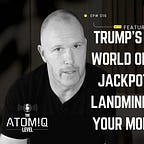

*Recorded March 31
Connect and Read Tanvi Ratna
Updated with links to all 6 parts of her report as of April 6, 2026

Episode 016 Intro Summary
Most investors sense the world is resetting, but few understand the playbook driving it. In this episode, Tanvi Ratna joins Chris J. Snook to decode Trump’s emerging world order strategy: why Washington believes the old liberal order failed America, why “free” US security and dollar privilege are being withdrawn, and how conflicts from Iran to Europe are being used as pressure points to redraw the map. Tanvi connects the dots between tariffs, energy chokepoints, BRICS dedollarization, and AI as the new arms race, showing how today’s chaos resembles a post‑war realignment happening in real time rather than in history books.foxbusiness+4
You should tune in if you manage capital, run a business, or simply don’t want to be surprised by the next decade. By listening, you’ll learn how the rise of sovereignty and a multi‑polar order will reorder supply chains, currencies, and AI infrastructure—and what that means for where risk and opportunity are actually migrating. You’ll walk away with a clearer lens for interpreting headlines, a framework for mapping “who must pick a side” by this summer, and a more grounded perspective on where to look for the next wave of wealth creation in the AI‑industrial age.
What does it all mean for portfolio positioning?
From a portfolio‑positioning lens, this episode argues that the “world order reset” is not random chaos but a deliberate restructuring that will change where capital can safely compound over the next decade. You’ll hear why the end of “free” US security and dollar privilege, BRICS dedollarization, and tariff shock therapy are pushing investors out of a one‑benchmark (US‑centric, dollar‑centric) worldview into a messier, multi‑polar map where supply chains, trade corridors, and alliances are being renegotiated like a post‑war settlement in real time.
Watch the Video Version on YouTube
Practically, the conversation gives you filters for tilting portfolios toward the winners of this shift: countries doubling down on sovereignty and re‑industrialization, regions plugged into new corridors like IMEC, and sectors levered to the AI‑industrial build‑out rather than the legacy, financialized dollar system. It also surfaces where to expect higher structural inflation, more volatile capital flows, and regime‑change risk—so you can rethink geographic exposure, duration risk, and real‑asset versus financial‑asset mix with a far clearer macro narrative than the headlines provide.
Episode Notes Summary
This discussion centered on geopolitical strategies for investment macro, examining Trump’s world order reset, with the US no longer providing security and the dollar as a free public goods.
US Liberal Order Failed
The current global reset is driven by the conviction that the liberal world order, particularly the US providing security and the dollar as public goods, has failed America. The post-Cold War model faltered as BRICS nations, including China, integrated economically without adopting democratic, open-market systems. This arrangement is deemed unfair to the US, leading to the current reordering playing out in capital markets and politics.
Geopolitical Reordering and Iran
The global reordering is forcing political alignments, accelerated by conflict in Iran, which serves as a nerve center transmitting effects into systems the US is reshaping. This conflict is driving realignments around energy supply chains and geographic choke points, fundamentally similar to changes that happen after a war. Trump’s strategy focuses on four objectives, including Middle East peace, new trade corridors, and a grand bargain with Russia.
Sovereignty and Economic Reset
The current global shift is framed as a rise in sovereignty, where nations function more independently, creating friction between the ‘one world order’ and a multi-polar order. The world map is expected to clarify by July as nations are forced to pick sides between the US, China, and Russia. This global reset is anticipated to usher in a new economic era characterized by AI, manufacturing pushes, and widespread deregulation.
Details
Welcome and Introduction of Tanvi Ratna: Chris J Snook introduced the show “The Atomic Level,” which focuses on decoding wealth matters to grow and protect net worth and happiness. Snook welcomed Tanvi Ratna, a columnist at Fox and Substack, noting that they had been following her work for the past year. Ratna expressed pleasure at being on the show (00:00:00).
Connecting Geopolitical Strategy to Investment Macro: Snook noted Ratna’s interesting lens and research capability on Substack, which covers macro investment matters and geopolitical strategies (00:00:00). The goal of the show is to examine the world as it is to enable practical and pragmatic decisions and help shape their impact (00:01:04).
Tanvi Ratna’s Career Path and Background: Ratna described their career path as unorthodox, starting as a systems engineer working in industrial engineering, supply chains, and manufacturing. They pursued graduate studies in foreign affairs and security studies at Georgetown after engineering work at Georgia Tech. Over ten years ago, Ratna pivoted to geopolitics, working on the Foreign Affairs Committee of Capitol Hill during the second Obama term’s “pivot to Asia” (00:01:55).
Transition to International Politics and Tech Regulation: When the US government entered a dysfunctional period, Ratna was curious about policy in other countries and went to India, eventually joining Prime Minister Modi’s first campaign team. This led to work on a major digital transformation in India (tech policy) and subsequently into the space of crypto regulation (00:03:06). Ratna worked on crypto regulation at Ernst and Young and with regulators in over ten countries, establishing a think tank on emerging tech regulation, focusing on crypto and AI related to national security (00:04:24).
Trump’s Strategy Centered on Geopolitical Components: Snook noted that Ratna’s background, covering manufacturing, supply chains, geopolitics, crypto, and AI, provides a holistic viewpoint that aligns with their writing (00:05:44). Ratna confirmed that these elements are central to the strategy being built by Trump, which they are currently analyzing. Ratna believes that making the assumption that there is a strategy allows for learning and understanding (00:04:24) (00:06:54).
Belief Driving the World Order Reset: Ratna asserted that the belief driving the current global reset is the fundamental conviction that the liberal world order has not worked for America. Furthermore, America providing security as a public good has not worked in the US’s favor and should not be a burden they bear (00:08:01). Snook agreed that the US has taken on a disproportionate share of the security apparatus established after World War II, creating economic and trade implications when unwinding it (00:09:23).
US Public Goods in the Liberal World Order: Ratna emphasized that the administration views the US as having provided two free public goods that it will no longer offer: the US military’s security and military umbrella and the dollar as a public good. They argue that both arrangements have backfired for the US and are unfair, so they will now only be offered to allies who share the burden (00:10:21). Snook questioned what the US was getting in return for providing these “public goods” (00:11:35).
Historical Context and Failure of the World Order Model: Ratna explained that the post-Cold War foreign policy, which aimed to remake the world in the US’s image (democratic free-market society), made sense at the time and largely worked as former Soviet-bloc countries integrated into the market (00:12:41). However, the model failed with China and some BRICS nations because they integrated economically but did not adopt open-market, democratic systems, instead pursuing industrial policies that some argue “gamed the system”. Ratna noted that China’s growth occurred within the secure global environment provided by the US military (00:13:52).
US Dollar Dominance and Economic Impacts: Snook detailed their thesis on the US dollar as the second public good, noting that after the gold standard ended in 1971, the dollar’s penetration via the IMF and World Bank created a network effect making it the default world reserve currency (00:15:42). Snook argued that this dependency allowed the US to export inflation and maintain stability despite large increases in national debt (00:16:57). China utilized this order through initiatives like the Belt and Road, increasing its global influence and creating reliance through global supply chains (00:18:05).
Tipping Point and Current Geopolitical Reordering: Ratna agreed that having China in the system created substantial wealth effects for the US, but they believe the problem exacerbated with the BRICS’ push for dedollarization and China’s increased concentration of supply chains over the last decade. Ratna sees the current global reordering, forced through political mechanisms like tariffs, as fundamentally similar to changes that happen after a war (00:20:19). This reordering is playing out in capital markets, for instance, with Japan’s moves in liquidity and increased defense spending (00:21:59).
Rise of Sovereignty as a Global Force: Chris J Snook and Tanvi Ratna discussed the rise of populism across the globe, citing examples in India (Modi), China (Xi), Turkey (Erdogan), and Italy (Meloni) (00:23:17). Ratna suggested framing this movement not as populism but as a force for sovereignty, which Snook agreed with (00:24:24). The current shift is a collision between those who favored a “one world order” and a growing desire for a “multi-polar order” where nations function more independently, creating significant friction (00:25:41).
Iran as the Climactic Geopolitical Theater: Ratna viewed the current conflict with Iran as the culmination of the process started by tariffs, which is forcing a final alignment of political and economic structures (00:27:45). Iran is seen as a “nerve center” or “pressure point” that transmits effects into every system the US is trying to reshape, including security architecture, trade, and power structures. The conflict is accelerating the shift into a new phase of US industrial policy, such as domestic re-industrialization and new AI export programs (00:28:51).
Specific Realignments Driven by the Iran Conflict: The Iran situation is driving two major realignments, one around energy supply chains and another around geographic choke points and trade routes, given Iran’s central location for major systems connecting Asia, Europe, and the US (00:30:32). The conflict is also forcing political alignment within the Middle East region. Israel’s change in military doctrine from defensive to offensive was a response to the October 7 attack and the realization that their previous security measures had failed (00:31:59).
The Sophisticated Nature of the Shia Axis: Ratna characterized the Shia axis as a sophisticated system, not just Iran as a single country, but a network of proxies, like Hezbollah, embedded within governments and civilian networks (00:33:46). This network is ideological and structural, functioning as a system that is “not a state actor but also not not a state actor” (00:36:49). The hardening of this system presented a challenge to the Sunni axis, creating fault lines between more progressive Gulf countries (Saudi, UAE) and Turkey/Qatar, which anchor the idea of an Islamist caliphate (00:38:01).
End Objectives for Trump’s Strategy: Ratna identified four main end objectives for Trump’s strategy, starting with achieving a lasting “border of peace” in the Middle East, requiring Saudi Arabia’s compromise with Israel (00:38:01) (00:42:05). The second objective is the establishment of new trade corridors, such as the IMAC (India Middle East Europe corridor), which cannot happen while Iran and its proxies remain a problem. The third objective is securing a “grand bargain” with Russia to break the “dragon bear alliance” with China, re-engaging Russia in the Western Hemisphere and financial system (00:43:07).
Europe and the Deep State Network as Key Frontiers: The fourth key objective is focused on Europe, which Ratna anticipates will be disproportionately hit by pain in the energy markets. Europe is expected to face pressure from the US regarding NATO and Greenland if they rely on US energy supplies. Ratna also introduced a fifth, “conspiratorial” frontier, suggesting that the “old system” (the “globalist network” or “deep state network”) is fighting back against the changes being implemented by Trump (00:45:44).
AI as the New Arms Race and Strategic Levers: Snook proposed a thesis that the current geopolitical situation is reframed by Artificial Intelligence as the new arms race, comparable to the previous nuclear armament (00:48:25). AI requires immense energy and water for cooling, which introduces natural resource constraints (00:49:45). Snook argued that the US and China are competing to define the future of society, with Iran being a crucial strategic lever due to the Strait of Hormuz controlling 20% of the global oil supply (00:50:43).
China’s Constraints and the Taiwan Choke Point: Snook posited that China’s reliance on Iranian oil is a constraint preventing them from invading Taiwan, which is the source of 90% of the world’s essential chip supply. An attack on Iran would dismantle a lever that could otherwise be traded in negotiation (00:52:39). Ratna agreed that Trump “thinks in terms of leverage” and is creating leverage for negotiations with China (00:53:41).
Alternative Solutions for AI and Taiwan’s Role: Ratna offered a different take on AI, believing that solutions for the US will come from “innovative out of the box technologies” such as nuclear energy innovation and space technology from entities like Elon Musk’s companies. Regarding Taiwan, Ratna acknowledged naval activity suggesting China may be preparing for a conflict, but also posited that Trump might seek a grand bargain with China (00:55:01) (00:57:39). Ratna highlighted that allies like Japan have indicated they will intervene against China if they attempt to take over Taiwan (00:56:20).
Dynamics of the European Union in the New Global Order: The state of the European Union (EU) is a major question, with potential divisions being discussed as part of a new alliance concept. SPEAKER_1 noted that it is difficult to imagine the EU remaining intact in ten years, and they questioned if the potential corridor could help keep it together or split it up. Tanvi Ratna described a dynamic where the East and South sides of Europe are becoming activated in a new alliance, specifically noting that Israel has initiated a hexagonal security strategy that involves activating Greece and Cyprus (00:58:48).
Eastern Europe’s Alignment and the IMAC Initiative: The activation of several Eastern European countries, including Italy, Croatia, Greece, and Hungary, is occurring due to issues like Islamist immigration, which encourages them to partner with Israel. These countries are also aligning with the idea of the India-Middle East-Europe Economic Corridor (IMAC), which extends through parts of Eastern Europe via the “Three C’s” initiative. Tanvi Ratna believes that much of Eastern Europe is betting heavily on the IMAC because it links them into high-growth corridor regions (00:59:57).
Europe as the Center of the Globalist Versus New Order Conflict: Tanvi Ratna views Europe as the center of the final confrontation between the “globalist” old order and the “new order,” stating that Europe is the original hegemon and is embedded in many global structures. All major debates surrounding Ukraine, NATO, and Greenland are expected to come to the forefront in Europe during this conflict. However, Tanvi Ratna admitted they are not the right person to provide investment advice for Europe as they are currently starting their own research into the region (01:01:32).
The Administration’s Push for Picking Sides and Hyperactive Leadership: Tanvi Ratna estimates that by July, which they believe is the administration’s deadline, the world map will be clearer because people will be forced to pick a side rather than hedging between the US, China, and Russia (01:02:40). Chris J Snook characterizes the current period as one of hyperactive leadership, where deals are being done and levers are being implemented, contrasting it with a prior period of passive leadership (01:04:06). They emphasize that dispassionately viewing the current moves reveals a level of strategic execution that is historic, marked by deadlines, resets, and settlements (01:05:13).
The Opportunity Presented by the World Order Reset: Both participants agree that they are living through history and watching a world order reset in real time, which is considered an inflection point (01:06:27). Tanvi Ratna believes that the ensuing period will lead to a very different economic era, including the start of the AI industrial age, a manufacturing push, re-industrialization, and a wave of reform and deregulation. The current trend, largely influenced by Trump’s administration, has encouraged governments globally to focus on sovereignty, security, and investment in their own economies (01:07:34).
Focusing on Emergence Over Destruction in the Financial Landscape: Chris J Snook agrees that when people are enlightened in their self-interest and see an opening, better quality leaders emerge who are passionate about their country. They describe the current chaos as “musical chairs” as every country tries to figure out its new position, but as an investor, they view it as a decentralization of economic leverage and interest (01:08:57). Tanvi Ratna concludes by noting that while the media often focuses on what is breaking, they are entirely focused on looking at what is emerging, which which they both find quite promising.
The ATOMIQ LEVEL podcast and Wealth Matters 3.0 are a reader-supported podcast and publication. To support my work, please become a free or paid subscriber today.


