


The Final Boss Is the Family Operating System
Subscribe to Shields & Succession inside Wealth Matters 3.0 to stay alerted for future Matt Chats office hours, replays, and practical conversations on estate planning, asset protection, long-term care, probate, family communication, digital access, and wealth succession.
If you want to speak with Matt Meuli’s firm directly for a one-on-one pre-consult, call:
Colorado Residents Only: 970-820-0090
Residents from All 50 States and Territories: 307-463-3600
A human answers during office hours, Monday through Friday, 9am–5pm MST.
Disclaimer: This conversation is educational and should not be treated as legal, tax, financial, estate planning, Medicaid, asset protection, or fiduciary advice for your specific situation. Matt is an attorney, but he is not your attorney unless and until you formally engage his firm.
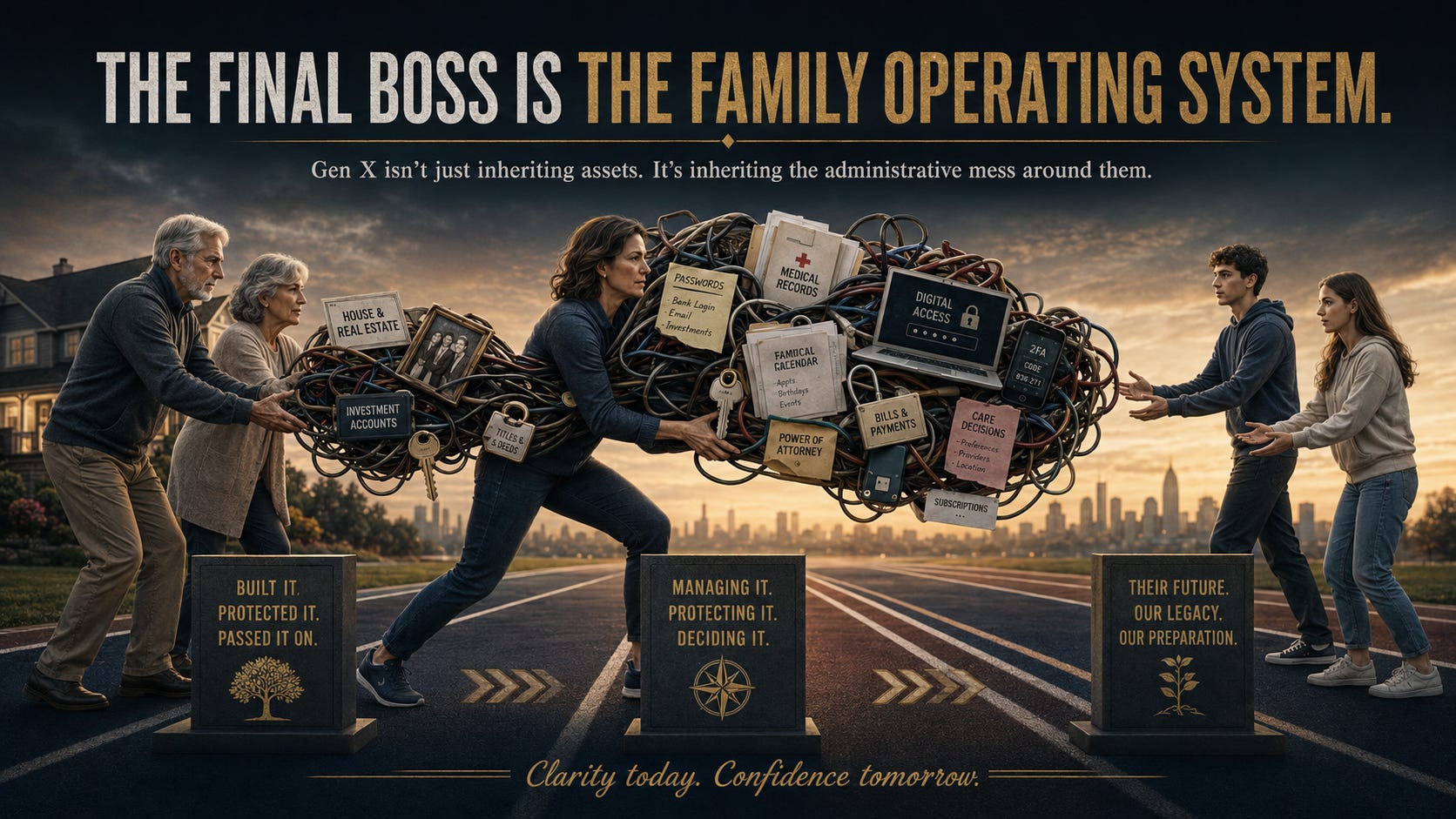
The Conversation Gen X Can’t Keep Avoiding
There is a strange anxiety sitting inside the Gen X household right now. It is not the old anxiety of inheritance. It is not simply the question of who gets what when Mom and Dad are gone.
It is more practical than that. More exhausting. More administratively brutal.
It is the quiet fear that one day soon, possibly without warning, someone will have to untangle the entire family operating system — and the person expected to do it may be the same Gen Xer already trying to raise kids, fund college, keep a business alive, keep a marriage steady, help aging parents, manage their own retirement math, and decode a world that keeps getting more expensive and more digital at the same time.
That is the emotional center of this week’s Matt Chats conversation between Chris Snook and Matt Meuli. On the surface, it is another Wednesday office-hours session inside the Shields & Succession column. But underneath the legal language, trust terminology, phone numbers, Medicaid questions, and asset protection structures is a much more human story.
It is the story of the generation that learned to adapt before anyone ever gave them credit for it.
Gen X drank from garden hoses.
Gen X came home when the streetlights turned on.
Gen X learned technology before their parents and before their kids.
Gen X survived analog childhood, digital adulthood, the dot-com bubble, 9/11, the housing crash, the Great Financial Crisis, endless platform shifts, a pandemic, and now the age of AI.
And now Gen X is being asked to adapt again. This time, the problem is not a new device, a new platform, a new market cycle, or a new operating system on a laptop.
It is the family operating system.
Who has authority?
Who knows where the documents are?
Who can access the bank accounts?
Who has the passwords?
Who knows what the care plan is?
Who knows what Mom and Dad own?
Who talks to the doctors?
Who pays the bills?
Who coordinates the siblings?
Who protects the assets?
Who prevents the avoidable mess from becoming the family’s next chapter?
That is why this episode matters. Because for a lot of Gen X families, the silent worry is not, “What will I inherit?” It is, “What disaster am I going to have to administer?”
Three favors as you listen
Hit the ❤️. The algorithm is a slot machine and hearts are quarters.
Hit the 🔄 restack. Somebody in your network is two weeks into the beach, watching stocks wiggle, wondering what they were created to do. Get them up.
Hit 📤 share. You know exactly one person who needs to start the daily phone call before it’s too late. Send them the Interlude.
Bonus Credit: Drop a comment. Tell me your bucket-of-apples moment, the lesson somebody pointed at you before you were ten. I read every one, and I reply to the ones that make me laugh, make me think, or make me money. Preferably all three.
The Bathroom Story That Explains Everything
Matt opens the conversation with a story that sounds almost too ordinary to be important.
That is exactly why it is important.
At one point in his own life, Matt had an older family member living in the house, teenage boys under the same roof, several adults trying to function, and not enough bathrooms. He woke up one morning and confronted the kind of problem that no estate planning diagram fully captures.
He needed a bathroom. Not eventually. Not conceptually. He needed it that morning.
So he went to a real estate app, searched for houses with four or more bathrooms, and within a month, bought one. It is funny because it is human. It is also not really about bathrooms. It is about what happens when caregiving stops being an idea and becomes a floor plan.
Families do not experience aging parents as a legal category. They experience them as someone who needs a room, a ride, a meal, a medication schedule, help with bills, a safe shower, a working phone, and someone who knows what to do when a facility costs $10,000 a month, and no one is sure what assets are available.
Estate planning sounds formal. Caregiving is physical. Asset protection sounds strategic. Aging parents need help getting through Tuesday.
That is the power of Matt’s story. It compresses the whole Gen X sandwich-generation problem into one scene: too many people, too few bathrooms, too many responsibilities, and not enough of a plan.
The story also gives the conversation credibility. Matt is not only speaking as an attorney who has seen clients navigate these problems. He is speaking as someone who has lived the squeeze himself. He knows what it feels like to be working full-time, raising children, helping older family members, and trying to make decisions when the information is incomplete.
That is what makes Matt Chats work. It is not theory wearing a suit. It is real experience translated into legal and practical questions that families can actually use.
The Difference Between Being Nosy and Being Prepared
One of the most important distinctions in the episode is the difference between being nosy and being prepared. This is the emotional choke point for adult children.
Most Gen Xers do not want to interrogate their parents. They do not want to sound entitled. They do not want to imply that Mom or Dad is incompetent. They do not want to ask about bank accounts, wills, trusts, passwords, insurance, care preferences, advisors, or power of attorney documents in a way that sounds like they are quietly counting the inheritance before anyone has died.
But politeness can become dangerous when it turns into avoidance.
If a parent falls, breaks a hip, develops cognitive decline, gets scammed, needs memory care, or can no longer manage bills, the adult child who was too polite to ask may suddenly be the adult child expected to solve everything. Matt’s framing is simple.
Lead with help. Not control. Not entitlement. Not inheritance.


