Subscribe, Share, Comment, or Book a Human Pre-Consult
Subscribe to Shields & Succession inside Wealth Matters 3.0 to stay alerted for future Matt Chats office hours, livestreams, subscriber replays, and practical conversations about wills, trusts, probate, long-term care, Medicaid planning, asset protection, business succession, family governance, and preserving what you worked a lifetime to build.
Matt Chats streams live ATOMIQ AMA Matt Chats Office Hours every Wednesday at 10am Pacific / 1pm Eastern on Substack
If you want to speak directly with Matt Meuli’s firm about a Life & Legacy plan, estate structure, or Wyoming Asset Protection Trust pre-consult, call:
Colorado residents: (970) 820-0090
Residents of all 50 states and territories: (307) 463-3600
A human answers during regular office hours, Monday through Friday, 9am–5pm Mountain Time.
DISCLAIMER: This article and the accompanying conversation are educational. They are not legal, tax, financial, Medicaid, investment, or asset-protection advice for your particular circumstances. Matt is an attorney, but he is not your attorney (yet), unless you formally engage his firm. The answer to almost every serious planning question depends on the state, the documents, the assets, the family, the timing, and the facts surrounding the situation.
Reader Questions Behind the $124 Trillion Wealth Transfer
Everyone wants to talk about the Great Wealth Transfer.
The headline number is enormous: approximately $124 trillion changing ownership over the next two decades. It works out to something like $5 trillion moving every year through inheritances, gifts, business transitions, property sales, charitable transfers, and the inevitable reallocation that follows death, incapacity, divorce, debt, and long-term care.
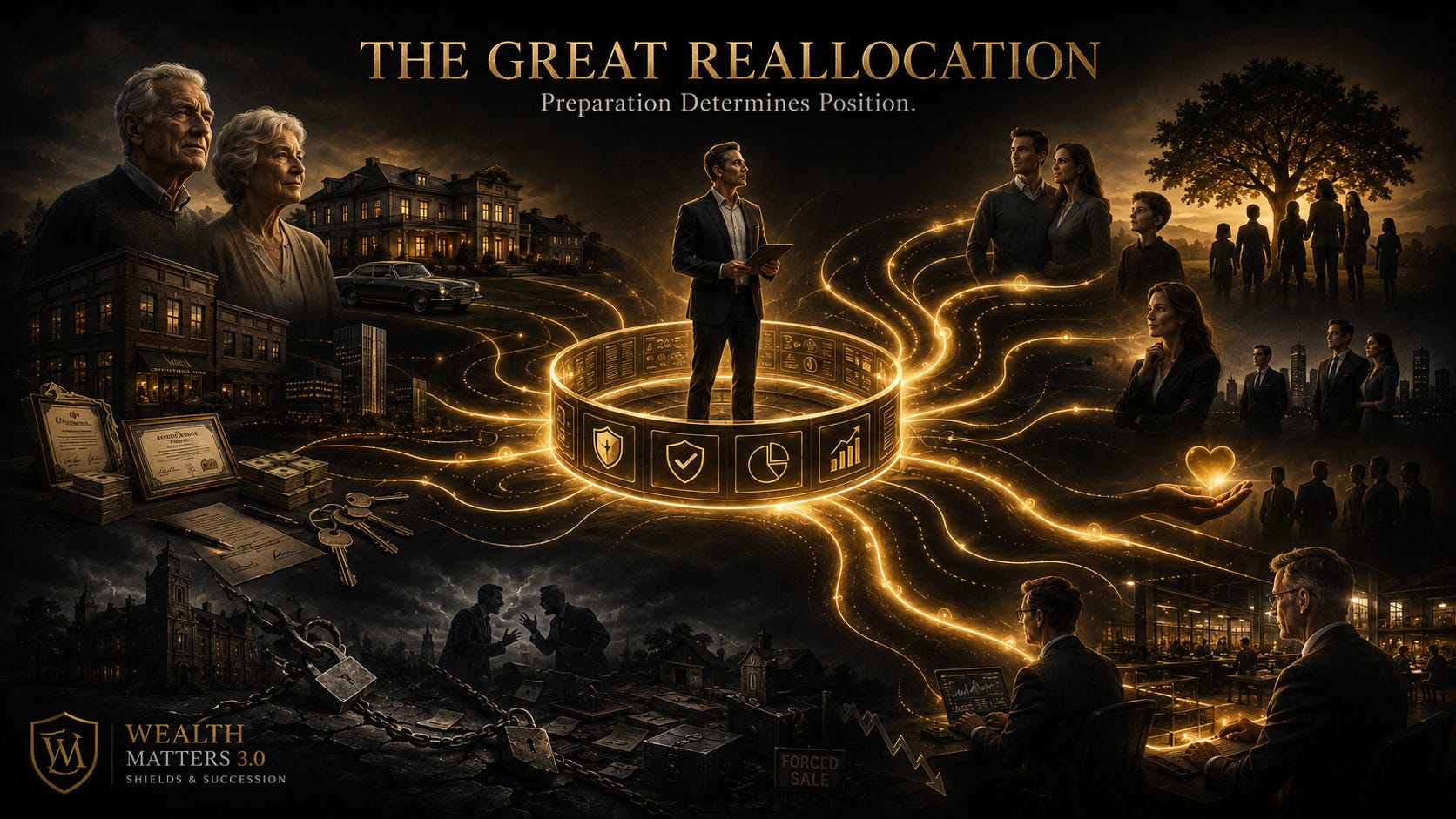
Most of the public conversation focuses on who will inherit those assets. I think the more consequential question is whether their estate plans are ready for the transfer.
That became the center of this week’s Matt Chats office hours with my counsel and friend, estate attorney Matt Meuli. The audience questions grew out of our recent Shields & Succession feature, The $124 Trillion Wealth Transfer Will Expose Every Weak Estate Plan.
That earlier article examined the macro reality behind the headline number. The Great Wealth Transfer will not be one clean movement of money from one generation’s account into another. It will be a decades-long migration of homes, operating companies, commercial properties, retirement accounts, private investments, mineral rights, insurance proceeds, debts, and family responsibilities.
The gross transfer may be approximately $124 trillion. The net legacy will be whatever survives the journey.
This Matt Chats conversation takes that thesis out of the abstract and brings it into live office hours. It asks whether the estate plan families already have will actually work when incapacity, long-term care, death, business disruption, or family conflict puts it under pressure.
Where will the money leak?
Most people instinctively answer taxes. Estate taxes. Capital-gains taxes. State inheritance taxes. Federal policy changes. The fear is understandable because taxes are visible, measurable, and politically easy to blame.
But after spending these Wednesdays with Matt, I have become convinced that taxes will not create the largest aggregate loss.
The larger leak will come from plans that look complete but do not work.
A trust that was never funded.
A will that requires probate to accomplish what the family assumed would happen privately.
A spouse who cannot access the accounts because the other spouse managed everything.
A power of attorney that activates too late.
A house exposed to Medicaid estate recovery.
A family business without sufficient liquidity to survive the founder’s death.
Three children forced into equal ownership of an asset only one of them wants.
A beneficiary designation that contradicts the carefully drafted trust.
An irrevocable structure filled with the wrong assets.
A family that waits until cognitive decline, hospitalization, or death to begin asking questions.
The transfer will happen either way. The issue is how much value survives the transition.
There is another side to this that investors, operators, and advisors should understand. Every leaked asset lands somewhere. A family unable to maintain a property sells it. A business without a succession plan gets liquidated. A sibling who needs immediate cash discounts an ownership interest. A trust dispute creates legal fees, forced sales, and opportunistic buyers.
The next great fire sale may not be caused primarily by recession. It may be caused by succession.
That means the Great Wealth Transfer is simultaneously a preservation challenge and an accumulation opportunity. Some families will protect what they built. Others will be unable to hold it. The assets will not vanish. Ownership will move toward the people, companies, investors, and institutions prepared to receive them.
That was the frame I brought into the room with Matt. Then we opened the office-hours questions.
Three favors before you go.
Hit the ❤️. The algorithm is a validation machine that needs your cheap dopamine to keep us in the top of your feed.
Hit the 🔄 restack. Somebody’s life will change passively today, and you can get the credit for bringing it to them from both of us.
Hit 📤 share. You know exactly one person in your email list or text stream who needs something on their playlist or reading wire today.
Drop a comment. Tell me your bucket-of-apples moment, the lesson somebody pointed at you before you were ten. I read every one, and I reply to the ones that make me laugh, make me think, or make me money. Preferably all three.
The Attorney Who Keeps Bringing the Conversation Back to Context
One of the things I have come to appreciate about Matt is his ability to insert caution without killing the conversation.
He has practiced law since 1988, although he jokes that he was only eleven years old and his mother drove him to court. That blend of legal experience, former-teacher clarity, and relentless dad humor makes him unusually good at translating complicated structures without pretending every family has the same answer.
Before responding to the first audience question, he offered the disclaimer I often forget to deliver because I dislike making a live conversation feel overly programmatic.
He reminded everyone that the answer depends.
Attorneys are mocked for saying that, but estate planning really is contextual. The answer changes based on ownership, titling, state law, beneficiaries, debt, capacity, family relationships, and the exact language inside the documents.
The same trust can work beautifully for one family and fail another. The same power of attorney can be useful in one state and frustrating in another.
The same property transfer can avoid probate but create tax, creditor, or Medicaid complications. The same equal inheritance can be generous to one child and destructive to another.
Matt does not use complexity to avoid answering. He uses it to teach the audience which facts they need before an answer becomes reliable.
That is the purpose of Matt Chats. Not to create amateur attorneys. To create better-prepared clients and families.
The Trust That Owns Nothing
The first audience question was one of the most important.
“My parents already have a will and a revocable living trust. How do we determine whether the trust is funded correctly and whether their assets will avoid probate?”
The question contains one of the most dangerous sentences in estate planning:
“We already have a trust.”
That sentence gives people enormous psychological comfort. They paid the attorney. They received the binder. They signed the documents. They placed the binder on a shelf and crossed estate planning off the list.
But a trust is a contract, and a contract generally governs only the assets connected to it.
Matt explained funding in the simplest terms. An individual transfers title from themselves personally to themselves in their capacity as trustee. The name on the ownership record changes. The person may still control and use the asset, but legally, the trust now owns it.
If the trust does not own the house, account, investment, property, or membership interest, the trust may have no authority over that asset.
The document can be valid and still accomplish almost nothing. That is the empty-bucket problem. The family paid for a bucket but never placed the assets inside it.
When the owner dies, property that does not otherwise have a beneficiary or co-owner may become part of the deceased person’s estate. That is where the will becomes relevant, and that is often where probate begins.
A properly funded trust can avoid probate for the assets it owns. An unfunded trust may simply become the destination after probate.
That is not the same result.
Why a Trust Plan Usually Still Includes a Will
An audience member had previously asked whether someone could have a trust without a will. Matt’s answer revealed why most trust-based plans still include one.
The accompanying document is often called a pour-over will. Its purpose is to catch property that was never transferred into the trust and direct it into the trust after death.
The name sounds efficient. Whatever was forgotten pours into the trust. The problem is the route it may have to take.
Probate.
The pour-over will is the backup plan, not the preferred transfer mechanism. It gives the personal representative the authority to locate forgotten assets, deal with institutions, obtain records, and move property where it was intended to go.
Matt described the will as the keys. The trust manages what is already inside it. The will may provide the legal keys needed to gather what remains outside.
This is also why the presence of both documents does not prove the plan is properly implemented. The family still needs to ask what is titled in the trust, what passes through beneficiary designation, what is jointly owned, and what would fall into the probate estate.
A trust does not avoid probate because it exists. It avoids probate because it owns or properly coordinates the assets.
The Financial Wizard and the Spouse Left Behind
The next question was painfully familiar.
What happens when one spouse has always managed the investments, properties, technology, professional relationships, and bills—and the other spouse knows almost nothing about the financial picture?
This is common enough to feel normal. One spouse manages the accounts. One spouse talks to the advisor. One spouse understands the business. One spouse knows where the deeds are. One spouse controls the email account. One spouse manages the passwords and two-factor authentication.
The other spouse knows the household is fine because the person they trust has always handled it. Then the financial wizard dies or becomes incapacitated.
Now grief and administration arrive on the same day.
The surviving spouse does not know whether bills are paid manually or automatically. They may not have access to the computer. Accounts may be held only in the deceased spouse’s name. Institutions may require a death certificate or formal authority before speaking with them. The professional relationships may have existed entirely through the spouse who is gone.
Matt described that moment accurately. It is a crisis event.
The solution is not necessarily forcing both spouses to become equally sophisticated investors. The solution is acknowledging the asymmetry before it becomes dangerous.
A well-designed trust can anticipate the order in which people may die. If the financially sophisticated spouse dies first, the surviving spouse may be authorized to appoint a co-trustee, trusted child, professional fiduciary, advisor, or other qualified person to help.
The surviving spouse can retain a voice and decision-making role without being forced to suddenly master every financial function alone.
A good trust can also authorize the trustee to hire accountants, attorneys, investment professionals, property managers, and other specialists.
But none of that can be designed around a problem nobody admits exists. We cannot plan for the vulnerability we refuse to name.
The Power of Attorney That Springs Too Late
The question of cognitive decline brought us into one of the most difficult transition zones in family life.
What happens when a parent is beginning to show signs of decline but has not been declared legally incapacitated? When can the person named in the power of attorney step in?
Matt explained that powers of attorney generally fall into two broad categories. A standing or immediate power of attorney becomes effective when signed.
A springing power of attorney becomes effective only after a defined event, usually a determination of incapacity.
The immediate version solves one problem but introduces another. The agent receives authority before incapacity. That can make it easier to step in gradually, pay bills, communicate with institutions, or act during a temporary emergency.
But the authority is real.
As Matt joked, spouses who later “split sheets” may discover that each has the legal ability to turn off the other’s utilities. The humor makes the risk memorable. Immediate authority should be granted only to someone trusted to act when appropriate rather than simply when possible.
The springing version sounds safer because the authority does not activate prematurely. But the family may have to obtain a physician’s letter, convene a disability panel, or satisfy whatever condition the document and state law require.
That takes time.
Meanwhile, the vulnerable parent may already be writing bad checks, giving away money, clicking fraudulent links, missing payments, or making decisions the family cannot reverse easily.
The family is running around trying to prove incapacity while the damage continues.
There is no universal right answer. There is a design choice.
Do you prioritize ease of intervention with a deeply trusted agent, or stronger restrictions that require proof before authority activates?
That choice should be made while the principal has capacity—not while the family is already debating whether it has been lost.
Medicaid Recovery and the House Everyone Assumed Was Safe
The question about long-term care exposed another source of wealth leakage.
Can Medicaid or another government program recover costs from a person’s estate or family home after death?
Yes.
The details vary by state because Medicaid is a federal-state program administered differently across jurisdictions. But in some cases, the state can seek reimbursement for benefits paid and place a claim or lien against estate property.
This surprises families because the home may not have counted against eligibility in the way they expected while the person was alive. They assume that means the home is permanently protected.
Then the owner dies. The property passes through probate. The state appears as a creditor. The house that the children assumed they would inherit becomes a recovery asset.
Matt emphasized the importance of understanding how the state treats the home, what transfer mechanisms are available, and whether planning was completed early enough to survive the applicable lookback period.
Depending on the state, that period may be three or five years. Giving away assets during the lookback does not necessarily remove them from the eligibility calculation. The government may continue treating the transfer as though the applicant retained the property.
That is why crisis planning has fewer options.
An irrevocable trust may sometimes be part of a lawful long-term-care strategy if established and funded far enough in advance. Once the assets are no longer treated as belonging to the applicant and the lookback period has passed, the result may be different.
But the timing is the plan. Creating the trust after the care need is obvious and the bill is imminent is not equivalent to planning years earlier.
Asset protection is not a fire extinguisher you purchase after the house is already burning.
The Debt That Follows the Asset Into the Trust
I used the Medicaid discussion to ask a more tactical question.
Suppose someone owns a house with debt on it. Or suppose the house is placed into an irrevocable trust, and the owner later wants to refinance it. What happens when the individual personally guarantees the loan, but the trust owns the property?
Matt’s answer clarified a principle that applies far beyond real estate. He generally does not like placing highly encumbered assets directly into an irrevocable asset-protection trust.
Why?
Because the debt is attached to the collateral. You may be inviting the creditor into the trust.
In some jurisdictions, transfers into an irrevocable trust require an affidavit of solvency. The person placing the property into the trust must attest that the transfer is not intended to defeat existing creditors and that they remain solvent.
An asset already burdened by substantial debt complicates the structure.
There is also a practical insight here. The lien itself provides a degree of asset protection because it reduces the equity available to a plaintiff.
Matt calls this asset stripping.
A contingency-fee lawyer considering a lawsuit may be less interested in forcing the sale of a property if the bank receives most of the proceeds. A house with 80% leverage presents a less attractive recovery target than a free-and-clear property with substantial accessible equity.
That does not make leverage a complete asset-protection plan. It changes the economics of the target.
Where Free-and-Clear Assets May Fit
I then tried to summarize the logic in plain language.
When a personal asset becomes free and clear, is not needed as future collateral, and is intended to be held long term, it may become a stronger candidate for an irrevocable asset-protection structure.
A home someone intends to keep. A portfolio of generational assets. Bitcoin someone intends never to sell or borrow against. Personal investments the family does not need for near-term living expenses.
The specific answer still depends on taxes, liquidity needs, jurisdiction, control, and future borrowing plans. But the broader principle is intuitive.
The asset with no creditor attached and no planned need for personal collateralization may fit more naturally inside the protected structure.
An asset the owner expects to refinance, pledge, trade, or use freely may fit better elsewhere.
Matt added an important nuance. A property inside an asset-protection trust can sometimes still be refinanced if the borrower provides a personal guarantee and the lender is willing. The structure may reduce flexibility, but it does not always eliminate access to capital.
It can, however, reduce privacy. Real estate ownership is public. Anyone who follows the owner home and searches the county records may discover the property is owned by a trust.
Privacy is never the same as invisibility.
The LLC Between the Business and the Trust
Business assets raise a different issue.
The operating business itself can create liabilities. Employees, tenants, customers, vendors, vehicles, contracts, products, and properties can all generate claims.
Placing the active operating asset directly into the same trust that holds protected personal wealth can introduce risk into the protected bucket.
The alternative is layering.
The business or rental property operates inside an LLC or other appropriate entity. The LLC handles its contracts, liabilities, income, debt, and operations. The trust owns the membership interest in the LLC.
The business risk remains at the operating-entity level, while the family’s ownership interest is held within the broader succession and asset-protection structure.
This is why sophisticated planning cannot be reduced to “get a trust.” The real question is the ownership stack.
Which entity owns the asset?
Which trust owns the entity?
Where does the liability originate?
Where does the income flow?
Who manages the operation?
Who receives distributions?
What happens after incapacity or death?
The document is only one layer. The architecture is the plan.
The Family Business With No Cash at the Moment It Needs It Most
Another audience question addressed families whose wealth is concentrated in real estate and a closely held business.
How can the estate pay expenses, taxes, debts, and inheritances without being forced to sell the productive assets?
This is where illiquid wealth becomes fragile.
A family may look wealthy on paper. It owns land, buildings, operating companies, equipment, or minority interests. But none of those assets automatically produces the immediate cash required after death.
The estate may need liquidity for administration, taxes, debt service, professional fees, buyouts, maintenance, and family distributions.
Without cash, the executor or trustee may be forced to sell the asset everyone hoped to preserve.
Life insurance is one common tool. A business can purchase key-person coverage. A family can use individual or second-to-die policies. The death benefit can provide liquidity at the exact moment the business or estate needs it.
That liquidity can fund expenses, equalize inheritances, redeem ownership interests, or create time for the family to make a thoughtful decision rather than accept the first available offer.
But insurance is not the only answer. The business itself should be prepared to survive without the founder.
Can it operate without them?
Are the customers under contract?
Are the procedures documented?
Is there management beneath the owner?
Are the financial statements reliable?
Could an internal employee or outside buyer acquire it?
Does the business have value independent of the founder’s labor and relationships?
A company that dies with its owner is not a transferable asset. It is a job that ended.
Exit planning and estate planning are inseparable for business owners because the most valuable estate asset may also be the one most vulnerable to the owner’s absence.
Equal Is Not Always Fair
One of the strongest questions concerned equality among children.
Is dividing every asset equally always fair?
That is ultimately a family decision, not a legal formula. But equal ownership can produce terrible outcomes when the assets, children, and life circumstances are not equal.
One child wants to operate the family business. Another wants cash. A third lives across the country. One child provided years of caregiving. Another is going through a divorce. One is financially sophisticated.
Another is, in Matt’s phrase, a “creative spender.” One wants to keep the vacation home for emotional reasons. Another sees only the maintenance bill. Putting all three into equal ownership may look fair on a spreadsheet and become unbearable in practice.
Now they are yoked together. Every major decision requires agreement. The child working in the business may feel that the others are extracting value without contributing labor.
The children outside the business may feel trapped in an illiquid asset controlled by their sibling. The vacation home becomes a source of resentment over schedules, repairs, taxes, and usage.
Equal shares can turn family members into unwilling business partners.
Matt used one of his classic analogies. If a squirrel, an elephant, and an alligator are in the room with a bag of peanuts, giving each the same portion is not necessarily fair or useful.
The squirrel would love the elephant’s share. The alligator may prefer to eat both of them. The point lands because it is true. People need different structures.
Separate Trusts for Separate Lives
Matt often recommends separate continuing trusts for each child rather than one undifferentiated family pot.
That allows each trust to reflect the beneficiary’s needs. One child may receive assets outright. Another may receive controlled annual distributions.
A child vulnerable to creditors, addiction, divorce, financial exploitation, or poor judgment may benefit from stronger trustee discretion and protection.
A responsible entrepreneur may receive greater control. A beneficiary with disabilities may require special planning.
If circumstances change, the family may need to amend or modify one child’s structure without rewriting the rules for everyone.
As Matt joked, the four responsible children should not have to submit two clean urine tests every month because the fifth child has a substance-abuse problem.
Humor aside, this is what customized succession looks like. The goal is not to punish or reward children based on parental preference. It is to give each beneficiary a hand up rather than a structure that makes their existing vulnerabilities worse.
The Child Who Receives the Business
Life insurance and other liquid assets can help equalize a family plan when one child receives the operating company. The child who wants and understands the business can inherit or acquire it.
The other children can receive insurance proceeds, investment accounts, property-sale proceeds, or other liquid assets.
That avoids forcing everyone into the company.
But even this solution requires communication because the future may distort the parents’ original idea of fairness.
Suppose the operating child takes the business, works for fifteen years, and triples its value. The other siblings may later conclude that Mom or Dad loved that child more because they received the largest asset.
They may forget that the growth came from the child’s labor, risk, and reinvestment.
Or the opposite may happen. The company may decline, while the siblings who received liquid assets invest successfully. The business heir may feel punished for accepting the responsibility.
No document can eliminate every future emotion. Communication can reduce the surprise.
The family should explain why the assets are being divided in a certain way, what assumptions informed the plan, and which child actually wants which responsibility.
Do not leave a child your business because you want them to want it.
Ask them first if they want it.
The Plan Cannot Be Static
Matt recommends reviewing plans periodically even when life appears unchanged—often around every three years to catch legal or regulatory developments.
But significant life changes should trigger an earlier review.
Marriage. Divorce. Birth. Death. Grandchildren. Relocation. A business sale. A diagnosis. Addiction. Estrangement. New property. A beneficiary’s lawsuit. A dramatic increase in wealth. A change in who wants to run the business. A change in the parents’ care needs.
A trust is not a monument. It is an operating document for a living family.
A plan written for the family that existed ten years ago may not serve the family that exists now.
This is where the largest wealth transfer becomes the largest complexity transfer. Families are not passing down only assets. They are transferring businesses, digital accounts, debts, medical decisions, property interests, tax obligations, sibling relationships, and unfinished administration.
The plan has to evolve with the thing it is designed to govern.
Grief and Headache Are Different—and They Compound
Near the end of the episode, Matt made a point that deserves more attention. Some clients say they do not care what happens because they will be dead.
But the mess becomes part of their legacy. Grief and administrative headache are not the same thing.
They compound.
A child can be devastated by losing a parent and simultaneously angry that the parent left no instructions. A surviving spouse can be emotionally shattered and still need to fight with a bank. Siblings can love one another and still fracture under ambiguity, unequal caregiving, illiquid property, and old resentments.
The family may eventually solve the paperwork. It may not recover from what the paperwork exposed. This is why estate planning is not fundamentally about death. It is about the experience of the people who survive you.
What will they have to carry while they are grieving?
That is the true measure of whether the plan worked.
What I Learned From This Office-Hours Session
The questions in this episode moved from basic trust funding into some of the hardest issues families face: incapacity, Medicaid recovery, debt, illiquid estates, business continuity, unequal beneficiaries, and the emotional difference between equality and fairness.
But the same answer kept appearing beneath the technical differences.
Structure matters.
Timing matters.
Communication matters.
A will without implementation may create probate.
A trust without assets may be an empty bucket.
A power of attorney that activates too late may not prevent the damage.
An asset-protection trust filled with the wrong property may invite the creditor inside.
An estate rich in assets but poor in liquidity may be forced to sell.
Equal ownership may create conflict instead of fairness.
A static plan may preserve the intentions of a family that no longer exists.
The Great Wealth Transfer will expose all of it. Every weak document. Every unspoken assumption. Every stale beneficiary designation. Every unfunded trust. Every business unit that is dependent on one person.
Every sibling relationship held together by the pure hope that money will not make things weird.
The money will move. The quality of the plan will determine how.
Why You Should Press Play
This Matt Chats episode is not a theoretical seminar about what ultra-wealthy families do. It is an office-hours conversation built from the questions ordinary and affluent families are already asking.
How do we know whether the trust is actually funded?
Do we need both a will and a trust?
What happens when one spouse knows everything and the other knows nothing?
When can a power of attorney step in?
Can Medicaid recover costs from the family home?
What belongs inside an irrevocable trust?
How do we preserve a business without forcing a sale?
Is equal really fair?
Those are not edge cases.
They are the questions sitting beneath millions of family plans right now. Press play because Matt explains them in plain English without pretending the answer is simple.
Press play because the details will help you identify what you need to ask your own attorney, advisor, spouse, parent, or adult child.
Press play because a one-hour conversation today may reveal the weak link before a court, creditor, government agency, bank, or sibling discovers it for you.
The winners will not necessarily be the people who begin with the most money. They will be the people with the clearest structures, strongest communication, sufficient liquidity, and the ability to act before a crisis removes their options.
Succession will create opportunity and loss on a scale most investors still associate only with recession. The difference is that this transfer is not hypothetical. The demographics have already scheduled it.
The real risk is not asking the basic question. The real risk is believing the binder answered it. The real risk is doing nothing!
~Chris J Snook with Matt Meuli
Sources and Further Reading
Primary source
ATOMIQ LEVEL AMA: Matt Chats Office Hours interview with Matt Meuli, June 24, 2026. This transcript is the primary source for Matt’s explanations of trust funding, pour-over wills, powers of attorney, Medicaid estate recovery, irrevocable trusts, asset stripping, business liquidity, beneficiary planning, and periodic estate-plan reviews.
Related Wealth Matters 3.0 analysis
The $124 Trillion Wealth Transfer Will Expose Every Weak Estate Plan — The macro companion to this article, examining how taxes, probate, long-term care, debt, family conflict, stale planning, and forced asset sales could determine how much of the projected wealth transfer families actually preserve.
Disclaimer: Important sourcing note
Legal standards involving probate, Medicaid eligibility and recovery, lookback periods, powers of attorney, trusts, creditor protection, and property transfers vary by jurisdiction and may change over time. The interview and article provide educational context, not state-specific legal conclusions. Readers should verify the applicable rules with qualified legal, tax, and financial professionals before acting.
Related posts referenced in this AMA Matt Chats:
The $124 Trillion Wealth Transfer Will Create Winners, Losers, and Forced Sellers at Scale

Cerulli Associates estimates that approximately $124 trillion will transfer through 2048.
Thank you to everyone who tuned into my live video! Join me for my next live video in the app.