


A business can make two million dollars a year and still be a hobby.
That sentence sounds ridiculous until you spend time around founders, creators, doctors, attorneys, financial advisors, consultants, and other highly skilled people who have built profitable machines almost entirely around themselves.
They have revenue. They have customers. They have employees. They may have a recognizable name, a healthy bank account, and tax returns thick enough to stop a door.
What they do not necessarily have is a transferable business.
That was the tension Owen Hathaway and I found ourselves pulling apart during this edition of our ATOMIQ LEVEL office hours. Matt was in Denver speaking with hundreds of attorneys about Wyoming Asset Protection Trusts, so the usual Ask Matt Anything became Ask Owen Anything.
Owen is an attorney and law partner with the Meuli Law Office who practices in Colorado, but he most likely is not your attorney. So before we dive in, please see the disclaimer below. I have also provided contact information if you wish to consult with him or his team on your own matters.
For Colorado residents interested in speaking with Owen, call 970-820-0090.
For information about Wyoming asset protection strategies, including Wyoming Asset Protection Trusts, residents of all 50 states can call 307-463-3600. A human answers during business hours, and the team will return missed calls.
Important disclaimer: This article and the accompanying conversation are provided for educational and informational purposes only. Owen is not your attorney unless you have signed an engagement agreement with him. Nothing here should be construed as legal, tax, financial, or investment advice. Take these ideas to your qualified advisors and apply them to your specific circumstances.
A Word From July’s Ecosystem Brand Partner
Before we get into this topic further, I want to thank one of our Wealth Matters 3.0 ecosystem brand partners and Wealth CMDR PRO Subscribers: PEBL.
PEBL is a company I personally use across my own portfolio companies and personal strategy because hiring abroad or remotely should not require founders, operators, family offices, or distributed teams to spend months building employment infrastructure before they can bring great people into the business.
Hiring abroad or remotely can take months when you do it on your own, but with PEBL you can hire in over 185 countries in minutes and have your new hire onboarded by Monday.
PEBL is normally $399 per month per employee — already a no-brainer for what you get — but right now there’s a limited-time offer on their site that makes it even easier to get started.
Go to hipebl.ai.

Terms and conditions apply.
Summary of what we discussed at length
Owen and I started this ATOMIQ office hours with a question about hobby businesses this week. Then the conversation widened into personal brands, name-image-and-likeness rights, professional practices, digital assets, artificial intelligence, succession, control, ownership, and the architecture required to prevent a lifetime of value from disappearing with the person who created it.
Owen made the distinction early.
A company may look and smell like a business to its customers. It may generate high income. But when the owner has never examined the entity structure, documented the processes, separated the assets, planned for continuity, or asked what happens after incapacity or death, the owner may still be treating it like a hobby.
Not an IRS hobby. A behavioral hobby.
Something we keep doing because it is fun, familiar, and profitable, without ever pausing long enough to design what it is becoming.
That phrase stayed with me.
Revenue Is Not the Same as Transferable Value
Sometimes a hobby becomes a business before the owner realizes it.
A person starts writing because they love to write. They build an audience. That audience becomes a publication. The publication begins producing meaningful income. Suddenly, what started as a passion project is also a media property, a lead-generation engine, a recurring revenue stream, and a reputation asset attached to everything else the person owns.
The business arrived before the architecture did.
This happens to creators on Substack, YouTube, podcasts, and social platforms. It happens to consultants whose expertise becomes a course, methodology, or software tool. It happens to advisors whose weekly newsletter becomes a separate audience asset supporting the regulated practice. It happens to physicians who own a building, employ a clinical team, produce content, license intellectual property, and operate multiple revenue streams through one entity because that was easier at the beginning.
Easy at the beginning can become expensive at the end.
The owner sees one career.
The balance sheet may contain five different assets.
The law may see several different exposures.
A buyer may see a personality-dependent job wearing the clothing of a company.
Revenue tells me that something works today. Transferable value tells me whether it can work for somebody else tomorrow.
Those are not the same measurement.
The Default Rules Are Probably Not Your Rules
Owen offered one of the sharpest observations in the conversation:
“Anytime you start doing something for money, rules start attaching.”
Those rules can involve taxes, employment, intellectual property, contracts, creditors, platform agreements, licensing, regulatory obligations, succession, and liability.
The dangerous part is not that rules exist.
The dangerous part is assuming the defaults were designed around your intentions.
They were not.
Owen pointed out that the people running businesses are usually too busy running businesses to sit in the rooms where creditor laws and collection rules are written. The defaults tend to serve the institutions that know the rules, monitor the rules, and enforce the rules.
If you do nothing, you are still making a decision. You are choosing the default.
That default may determine who controls an account after your death, whether your family needs a judge’s permission to access a digital asset, where a lawsuit lands, how a business interest transfers, whether a platform account can be reassigned, and which part of your operation becomes responsible for a claim.
Asset protection, succession, and continuity do not begin when you purchase a trust or sign an operating agreement. They begin when you decide not to let these things happen by accident.
Your Name Is Property
Most of us experience our identity from the inside.
I do not wake up naturally thinking of “Chris J Snook” as an asset. I wake up thinking of Chris as “me”, which implies “mine”.
That creates a strange blind spot.
My name, image, likeness (NIL), voice, archives, writing, recordings, audience relationships, trademarks, domains, account identities, and body of work can have commercial value separate from my physical presence and my soul’s existence.
Some of those assets may belong to me. Some may belong to an entity. Some may be licensed. Some may exist on platforms where my control is temporary, conditional, and governed by an agreement I accepted without reading.
That is the ownership illusion of the digital economy. I can say, “I have 100,000 followers.”
Where are they? On a platform.
Who owns the platform? Not me.
Who controls the identity those people are following?
That answer may be more complicated than I want it to be.
I may own the master recording sitting on a hard drive in my house. I do not own the Apple Podcast infrastructure distributing a copy. I may own my manuscript. I do not automatically control every account, identifier, channel, comment, derivative, or audience connection created around it.
The practical issue is not whether platforms are good or bad. Platforms are useful. They provide distribution, discovery, infrastructure, and reach.
The issue is confusing access with ownership. Ownership also comes with liability, so who carries the liability and who is shielded from some of it are also important questions to ask and structure properly with intent.
A tenant can build a successful company inside a building without owning the building. That does not make the lease irrelevant.
Your digital presence deserves the same clarity.
The Four Questions Every Owner Needs to Answer
The most useful framework from this conversation can fit on one index card.
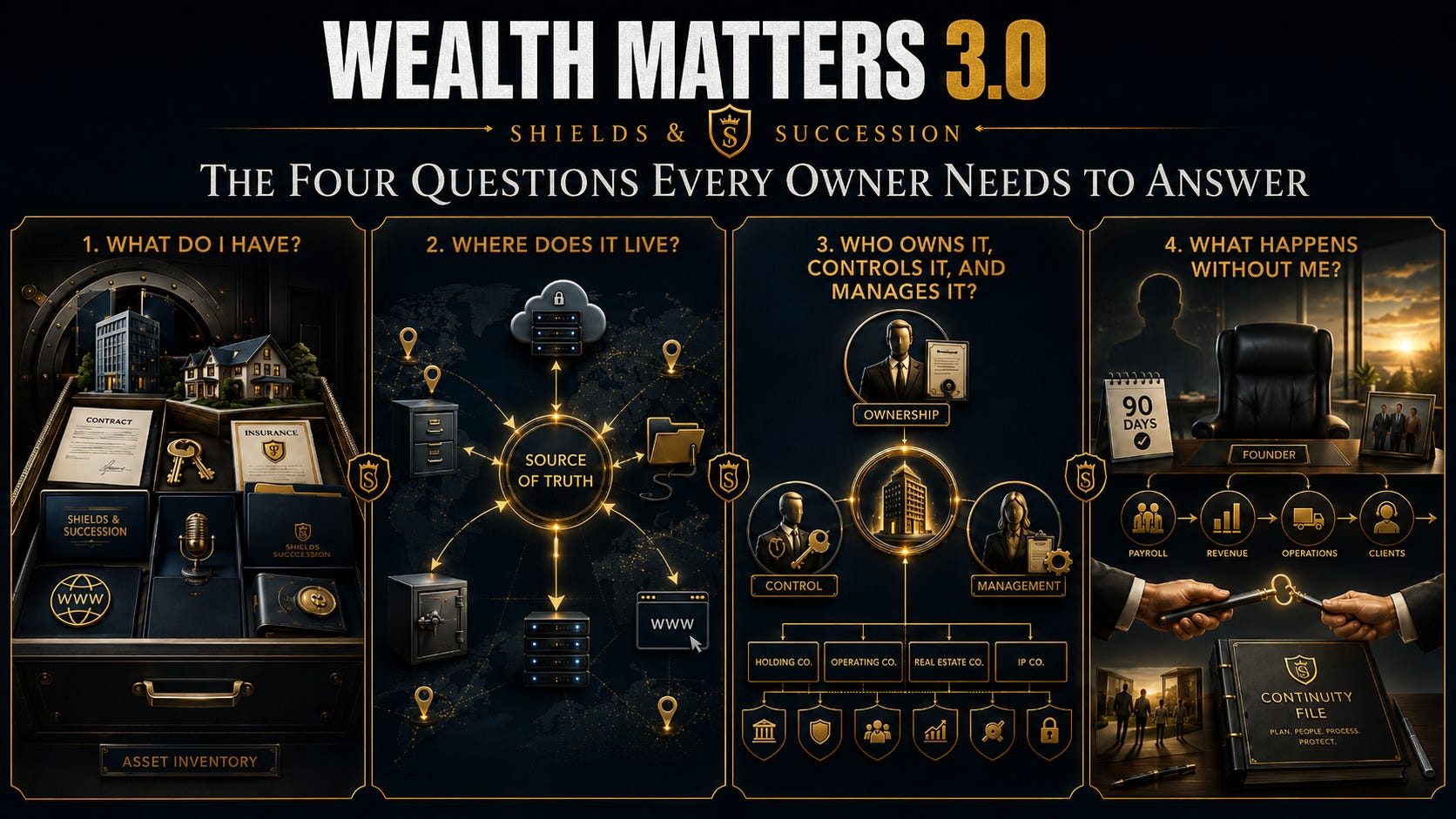
1. What do I have?
Start with an honest inventory.
List the obvious things: companies, real estate, investment accounts, insurance policies, vehicles, equipment, trademarks, and contracts.
Then list the things owners routinely overlook:
Domain names and websites
Email lists and subscriber databases
Podcast, video, and audio archives
Social accounts and platform identities
Courses, templates, methodologies, and software
Licensing agreements
Customer relationships and referral channels
Name, image, likeness, and voice rights
Proprietary processes stored only in someone’s head
Digital wallets and digital assets
Accounts receivable and recurring subscriptions
Key-person relationships
Access credentials and administrative permissions
You cannot protect, transfer, value, or intentionally terminate an asset that nobody has identified.
2. Where does it live?
This question came from a phrase one of my mentors, Mickey McManus, has used with me:
“Where it is is what it is.”
Where does the master file live?
Where does the customer data live?
Where is the contract?
Where is the source code?
Where are the keys?
Where is the account registered?
Where is the entity domiciled?
Where does the revenue land?
Where is the person who knows how everything works?
An asset may appear in several places, but the source of truth usually lives somewhere specific. That location influences access, jurisdiction, control, security, and transferability.
3. Who owns it, controls it, and manages it?
Ownership, control, and management are three different things.
They are often concentrated in one founder during the early years because concentration is efficient. The founder owns the shares, manages the operation, controls the accounts, maintains the relationships, approves the spending, and possesses the passwords.
That works until it does not.
A mature structure may separate those roles. The owner of an asset does not necessarily have to be the person managing the operating company. The person controlling certain decisions does not necessarily have to personally own everything being controlled.
The right separation depends on the asset, the family, the regulatory environment, the tax considerations, the business model, and the desired outcome. There is no universal diagram.
But there is a universal question:
Do the entities and agreements you have today properly serve the things you actually own today?
4. What happens without me?
This is the question owners avoid because it feels morbid.
It is not morbid.
It is operational.
Take yourself out of the picture for 90 days.
Do payroll and billing continue?
Can somebody access the bank account?
Can clients be served?
Can content be published?
Can contracts be signed?
Can a spouse or partner identify what exists?
Can a successor find the passwords, files, policies, operating procedures, and advisors?
Does the business survive?
Now take yourself out permanently.
Does the asset transfer by contract, by beneficiary designation, through an entity, through a trust, through probate, through a platform’s internal process, or not at all?
If nobody knows, you have discovered the actual state of the plan.
Owen’s Most Important Question Was Personal
It is easy to let an estate-planning conversation become a diagram.
Boxes. Arrows. Entities. Trustees. Managers. Beneficiaries. Shareholders. Tax treatments. Jurisdictions.
Then Owen brought the conversation back to the reason the diagram exists. He asked:
“What does my wife’s life look like without me?”
Listen to this episode with a 7-day free trial
Subscribe to Wealth Matters 3.0 to listen to this post and get 7 days of free access to the full post archives.


