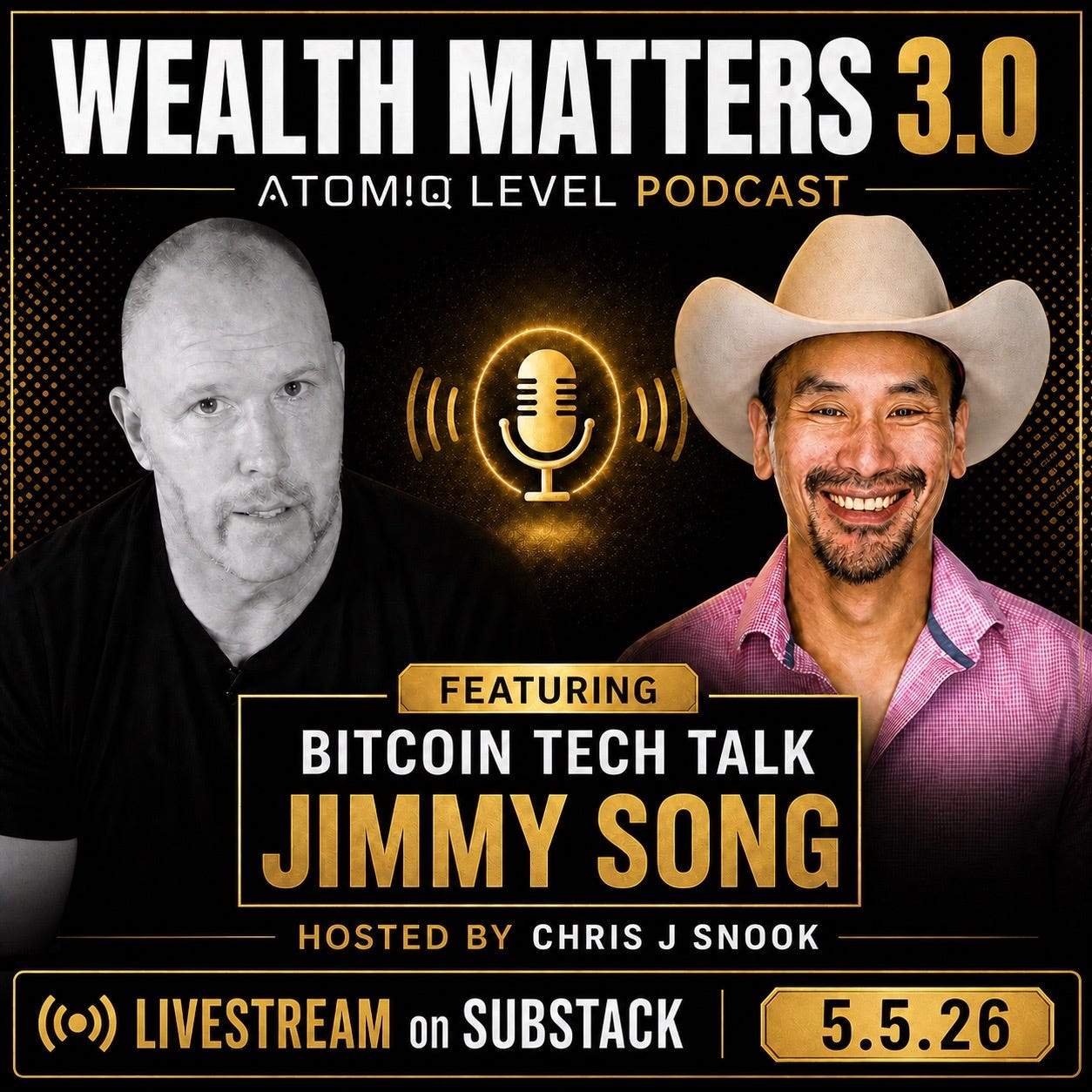
Before you read the show notes below, subscribe to Jimmy Song’s Bitcoin Tech Talk on Substack. Jimmy is one of Bitcoin’s most respected educators, developers, and long-time voices because he can explain both sides of the Bitcoin story: the monetary revolution and the technical reality underneath it.
Also visit www.productionready.org, the home of Production Ready, Jimmy’s work on alternative Bitcoin node software designed to strengthen client diversity, user sovereignty, and Bitcoin’s long-term resilience.
TL;DR Key Takeaways
Jimmy Song’s Bitcoin journey began in 2011, when there was almost nothing to read beyond the white paper, BitcoinTalk forums, scattered links, faucets, and early web wallets. What gave him an edge was the rare combination of coding experience, math background, cryptography awareness, and Austrian economics.
His conviction did not come from “number go up.” It came from understanding Bitcoin as permissionless money, then experiencing it directly when he was paid in Bitcoin by a developer in Ukraine while sitting in Austin, Texas.
Jimmy argues that holding Bitcoin requires more than luck. Many early holders lost their position by trading, speculating on altcoins, misunderstanding the network, or failing to develop true conviction. Bitcoin teaches low time preference.
The conversation explores why Bitcoin is still early if you believe it can become the world's reserve money. But getting there requires understanding the endgame, not just watching the price.
Jimmy’s current focus is Production Ready, an alternative Bitcoin node client. His concern is not merely technical. It is about governance, client diversity, user consensus, and making sure Bitcoin does not become overdependent on one software implementation or one developer culture.
The deeper message: Bitcoin is not just an asset. It is a test of patience, sovereignty, incentives, governance, and whether people are willing to think for themselves in a world built on permissioned systems.
Jimmy Song, Bitcoin Tech Talk, and the Long Road from Curiosity to Conviction
Before Jimmy Song became one of Bitcoin’s most recognizable educators, before he wrote and taught about Bitcoin with the clarity of someone who had lived inside the code and the culture, before he became a voice people turned to when the noise around crypto got too loud, he was a programmer.
A coder by trade.
A math major.
A startup veteran.
A man who had spent years building software long before most of the world had heard the word Bitcoin, let alone understood why it might matter.
Jimmy had been programming since he was nine years old. By the time he left college in the late 1990s, he was already deep in the world of startups, codebases, incentives, equity packages, long hours, technical problem solving, and the familiar promises of the venture-backed economy. He knew what it meant to work on something that might become valuable someday. He knew what it meant to hold startup equity that looked exciting on paper but could remain theoretical for years. He knew what it meant to build inside systems where the reward was always out there, somewhere in the future, behind an IPO, an acquisition, a board decision, a liquidity event, or a story someone else controlled.
Then, in 2011, he discovered Bitcoin.
At the time, Bitcoin was not yet a household name, an institutional asset, an ETF, a political talking point, or a treasury reserve strategy. It was a strange internet object. A white paper. A forum. A handful of links. A few people giving away coins through faucets and obscure web wallets. A small group of technologists, libertarians, monetary thinkers, and curious misfits trying to understand whether this thing could actually work.
Most people saw a scam. Jimmy saw a system.
The Rare Confluence
What made Jimmy’s early encounter with Bitcoin different was not that he was merely technical. Plenty of coders missed it. It was not that he was merely interested in money. Plenty of gold bugs and libertarians missed it, too. His advantage was the rare overlap.
He understood code. He understood enough cryptography to appreciate the technical design. He had a math background. And he had already spent time studying Austrian economics, monetary supply, and the problems of fiat money.
Bitcoin landed at the intersection of things he already cared about.
That matters because, as Jimmy explains in the conversation, many people assume Bitcoin is the hardest to understand technically. They think the barrier is cryptography, mining, hashes, private keys, blocks, nodes, and code. Those things matter, but Jimmy makes a different point: for many people, the economic side is actually harder.
The technical part can be studied.
The monetary part requires unlearning.
It requires questioning what money is, where it comes from, why scarcity matters, why central banking changes incentives, why permissionless settlement is radical, and why a decentralized monetary network with a fixed supply might be more than just a speculative asset.
That is why so many Austrian economics-minded people and libertarians recognized Bitcoin early, sometimes before Silicon Valley did. They were already asking the kind of questions Bitcoin answered.
The Early Wild West
In 2011, there was no polished onboarding path. No sleek exchange app. No institution is telling you it was safe. No mainstream media guide. No elegant hardware wallet in a box. If you searched for Bitcoin, you found a few scattered resources, the white paper, BitcoinTalk forum posts, random wallets, and people experimenting in public.
Faucets were giving away five Bitcoin at a time when that was worth almost nothing. Web wallets were offering tiny amounts of Bitcoin just for signing up. There were early exchanges that required patience, trust, and a tolerance for absurd friction. To buy Bitcoin, Jimmy remembers the process of trying to get dollars to Mt. Gox in Japan through a money transmission service. Opening accounts, linking accounts, waiting days, then waiting more days. The process was clunky enough that he abandoned it halfway through the first time.
That decision became one of those memories every early Bitcoiner carries: the road not taken, the cheap coins not bought, the laptop lost, the wallet forgotten, the opportunity that was obvious only in hindsight.
But Jimmy did not walk away forever. He came back.
By the summer of 2011, Bitcoin had gone from roughly a dollar to around thirty dollars before crashing. Later, after the fall, he finished the process and began accumulating. At first, like many early users, he left coins on Mt. Gox. Self-custody was not yet intuitive. The tools were immature. Hardware wallets did not yet exist in the way people know them today. Even for a coder, the early experience was rough.
But the roughness was part of the education.
The system was not easy.
It was real.
When Theory Became Experience
The moment that seems to have changed everything for Jimmy came in 2013. Until then, he had been curious, interested, and involved as a holder. But 2013 forced him deeper.
Bitcoin had moved through another violent cycle. It had risen, crashed, risen again, and attracted more attention. Jimmy wanted to earn more of it. He went looking for work that would pay in Bitcoin and found a post seeking a Python programmer for an open-source Bitcoin-related project.
The person offering the work was in Ukraine.
Jimmy was in Austin, Texas.
He completed the task in a few hours, sent it back, provided a Bitcoin address, and got paid almost immediately.
That was the moment.
Not because it was abstractly clever. Not because it proved a thesis on a whiteboard. But because he felt it. A developer in Ukraine paid a developer in Texas without a bank, without a wire, without a currency conversion desk, without permission, without a week of waiting, without anyone deciding whether the transaction was allowed.
The money moved.
That experience hit differently than theory. It showed him that Bitcoin was not merely a price chart or a message board debate. It was a working monetary network that could settle value across borders between two people who had never met.
Permissionless money was no longer a concept.
It was a lived experience.
That month, Jimmy worked forty hours a week at his normal job and another forty hours at home earning Bitcoin. He learned the technology by coding it. He earned the asset by building with it. He felt the incentive structure in real time. Compared with startup equity, Bitcoin was immediate, liquid, scarce, and deeply motivating.
That experience changed his career.
The Startup World, Repriced in Bitcoin
Jimmy had already been through the startup world. He had worked on companies, held equity, seen exits, and understood the promise and frustration of startup compensation. The standard startup bargain was simple: work hard now for a theoretical future reward. Maybe the company exits. Maybe the options are worth something. Maybe the dilution is not too severe. Maybe the timing works. Maybe the liquidity event comes before the culture burns out.
Bitcoin felt different.
The feedback loop was immediate. The monetary incentive was not buried behind a corporate cap table. When Jimmy did work, he could be paid in Bitcoin. When Bitcoin appreciated, the reward was not theoretical. It was sitting in his wallet, or at least it should have been if he had the right.
That contrast pulled him further in. By 2014, he moved into Bitcoin startups full-time. He worked across several companies, including early wallet infrastructure like Armory and later at what became Paxos. He attended Bitcoin meetups in Austin, went to early conferences, met the builders, and lived through the messy process of a movement becoming an industry.
That era was not clean. It was full of brilliance, scams, naïveté, ideological conflict, technical discovery, and financial temptation. People who got in early often thought they were geniuses. Some were lucky. Some were thoughtful. Some were both. Many did not survive the next cycle with their Bitcoin intact.
That is one of Jimmy’s most important warnings.
Getting in early was hard.
Holding was harder.
The Discipline to Hold
Bitcoin has a way of punishing short-term horizons. Jimmy watched people buy early, brag early, diversify into altcoins, trade away conviction, chase the next thing, leverage themselves, lose keys, lose coins, or abandon Bitcoin during bear markets because they never understood what they owned.
Some had cost bases that now sound mythological. Five-dollar Bitcoin. Ten-dollar Bitcoin. Coins from faucets. Coins earned from small jobs. Coins that could have become life-changing if held. But many of those early participants were gone by the next cycle.
They had not developed conviction.
They had developed exposure.
There is a difference.
Conviction requires understanding why Bitcoin matters beyond price. It requires seeing the endgame. It requires believing, as Jimmy does, that Bitcoin could become the world's reserve money. That does not mean there is no risk. It does not mean the path is smooth. It does not mean volatility disappears. It means the investment thesis is grounded in something deeper than “number go up.”
Jimmy is clear that it took him years to fully get there. Even after discovering Bitcoin in 2011, he did not describe himself as fully all-in until around 2015 or 2016. Saifedean Ammous’s The Bitcoin Standard, which Jimmy saw in manuscript form before publication, helped crystallize the economic conviction for him.
That is a critical lesson for new Bitcoiners.
You do not borrow conviction.
You build it.
Why Being Early Still Requires an Endgame
One of the more useful parts of the conversation is the discussion around whether people are still “early.” Many people look at Bitcoin’s price today compared with 2011, 2013, or 2017 and assume the opportunity has passed. Jimmy reframes the question.
The right question is not whether you are early compared with the past.
The right question is whether you understand the endgame.
If Bitcoin is merely a trade, then maybe it always feels late after a big move. But if Bitcoin is competing to become global reserve money, pristine collateral, or a monetary base for a radically different financial system, then the addressable market is not the current market cap. It is the total market for money, savings, settlement, store of value, collateral, and trust.
That requires imagination, but not fantasy. It requires estimating what the world looks like if Bitcoin continues to win trust over decades. It requires thinking in twenty-year terms instead of twenty-day terms. It requires low time preference.
Most people want an impossible asset: zero risk, no need for conviction, and guaranteed upside. Jimmy does not indulge that fantasy. Wealth does not work that way. Life does not work that way. If you want the reward of being right before the crowd, you have to accept the burden of being early, misunderstood, and tested.
That is where the money is made. When you are right, and the rest of society is wrong.
Permissionless Money and the Meaning of Ownership
The conversation also touches on the deeper emotional and philosophical power of Bitcoin: permissionlessness.
For many people, Bitcoin becomes real when they experience a transaction that traditional rails would have slowed, blocked, questioned, taxed with friction, or made unnecessarily difficult. Chris shares his own examples: receiving a sponsorship payment in Bitcoin almost instantly, trying to pay for software with multiple bank cards that failed, then clicking “pay with Bitcoin” and settling the transaction in seconds.
Those are small stories, but they reveal the larger point.
The current financial system is permissioned by default. Banks, cards, processors, governments, platforms, compliance systems, and intermediaries sit between people who want to transact. Sometimes that system works. Often, it works well enough that people forget the permission layer exists. But when it fails, freezes, delays, flags, censors, or extracts too much friction, the illusion breaks.
Bitcoin offers another path: two people, one network, final settlement, no one in the middle deciding whether the transaction deserves to exist.
That is not merely a convenience feature.
It is a civilizational feature.
Because if every asset can be sanctioned, frozen, intermediated, or trapped inside someone else’s permission structure, then ownership becomes conditional. Bitcoin restores the possibility of ownership that travels with the individual.
That is why the conversation moves beyond price. Bitcoin is not just about return. It is about sovereignty.
From Bitcoin Educator to Bitcoin Infrastructure
Today, Jimmy is focused on Production Ready, an alternative implementation of Bitcoin node software. For casual listeners, that may sound technical and obscure. In reality, it goes directly to the heart of Bitcoin’s governance.
A Bitcoin node allows a user to verify the ledger for themselves. It is how users enforce the rules they choose to run. It is part of what makes Bitcoin decentralized. You do not have to trust a bank, a company, a government, or even a developer. You can run the software, verify the chain back to the Genesis block, and participate in the network as a sovereign user.
For most of Bitcoin’s history, Bitcoin Core has dominated node software. Jimmy’s concern is not that Bitcoin Core is bad. It is that overdependence on one implementation creates structural risk. If one software culture, one developer group, or one set of defaults becomes too dominant, users can begin to feel as if they have fewer meaningful choices.
The issue came to a head for Jimmy around a controversial change related to OP_RETURN and data limits. He does not frame the technical issue itself as the main problem. The deeper concern was the process: Bitcoin Core developers merged a change despite significant community blowback, then effectively told users they did not have to run the software if they disagreed.
In theory, that is true.
In practice, if there are no strong alternatives, the choice can feel hollow.
When users began switching to Bitcoin Knots as a form of protest, some of the same voices criticized that option as insecure or unsuitable. To Jimmy, that dynamic exposed a deeper governance tension. Bitcoin is a consensus system, and users are part of that consensus. Developers matter, but they are not rulers. In a system built to resist centralized control, users need real software choice.
That is why Production Ready matters.
It is not just a technical project.
It is a sovereignty project.
Bitcoin’s Governance Is Messy Because Freedom Is Messy
One of the most valuable parts of this episode is that it does not romanticize Bitcoin governance. It acknowledges that Bitcoin is full of disagreements, religious wars, forks, defaults, spam debates, developer tensions, and community conflict.
But that is not necessarily a weakness.
It may be the proof that the system is alive.
In traditional monetary systems, users do not vote on money printing. They do not get a direct say in central bank balance sheets. They do not choose the rules of fiat. They are born into a system and told to use it. Bitcoin is different because users can run software, reject changes, fork if necessary, and coordinate around rules they believe preserve the network.
That does not make the process clean. It makes it real.
The block size war was one major example. The current debates over node software, OP_RETURN, inscriptions, spam, quantum concerns, and client diversity are another. These debates can look chaotic to outsiders, but they are part of what makes Bitcoin resistant to capture.
Bitcoin governance is not based on politeness.
It is based on the ability to say no.
Why You Should Listen
This ATOMIQ LEVEL conversation with Jimmy Song is not just another Bitcoin interview. It is a first-person walk through the evolution of Bitcoin from obscure internet money to global monetary contender, told by someone who was technical enough to understand the code, economically grounded enough to understand the monetary revolution, and honest enough to admit that conviction took years to fully form.
It is about a kid who started programming at nine, became a coder, studied math, worked in startups, discovered Bitcoin when almost no one understood it, tried to buy it through painfully clunky early infrastructure, earned it from a developer in Ukraine, and eventually realized that the future of money might not come from a central bank, a startup exit, or a Silicon Valley platform.
It might come from a network no one had permission to control.
It is about the difference between buying Bitcoin and understanding Bitcoin. It is about why so many early adopters still lost. It is about why holding requires humility, patience, and a thesis bigger than price. It is about why permissionless money matters in a world where almost every other asset can be intermediated. It is about why node software, client diversity, and user consensus are not nerd topics but survival topics for anyone who believes Bitcoin’s decentralization must remain real.
Most of all, this is a conversation about sovereignty.
Financial sovereignty.
Technical sovereignty.
User sovereignty.
The sovereignty to hold your own keys.
The sovereignty to verify your own ledger.
The sovereignty to transact without asking permission.
The sovereignty to think on a longer time horizon than the crowd.
Press play on this ATOMIQ LEVEL conversation with Jimmy Song, subscribe to Bitcoin Tech Talk, and visit www.productionready.org to learn more about the Bitcoin node software work he is building now.
Because Bitcoin is not just something to own. It is something to understand. BUT OWN SOME FIRST, according to Jimmy :)
The real risk is doing nothing!
~Chris J Snook
Thank you to everyone who tuned into my live video! Join me for my next live video in the app.